
When SAP introduced RISE with SAP in 2021, its primary objective was to simplify one of the largest IT transformations many organizations would undertake: migrating from SAP ERP on premise to SAP S/4HANA Cloud. Instead of treating infrastructure, technical operations, licensing and business transformation as separate projects, RISE with SAP brought them together into a single commercial and operational model offered by SAP. However, the migration itself remained the responsibility of the client and its implementation partners.
For many organizations, this represented a shift from managing their own SAP infrastructure to using SAP through a managed cloud model, while retaining the flexibility required for complex enterprise landscapes.
Since then, the scope of RISE with SAP has expanded significantly.
SAP now positions RISE with SAP as a transformation journey to SAP ERP Cloud and toward the Autonomous Enterprise. This vision extends beyond ERP modernization: AI agents collaborate across business processes, SAP Joule provides the interface between users and SAP applications, and SAP Business AI becomes embedded throughout SAP Cloud ERP.
This development expands the role of RISE with SAP.
Organizations are no longer only moving to existing ERP systems to the cloud. They are establishing a modern ERP environment in which business processes can become increasingly autonomous while remaining governed, secure, and compliant.
Cloud migration therefore becomes the milestone, but not a final destination, of enterprise transformation.
The Autonomous Enterprise represents SAP's vision of digital transformation. It combines SAP Cloud ERP, trusted business data, embedded AI, and autonomous software agents to support and automate increasingly complex business processes.
Unlike traditional rule-based automation, AI agents can interpret business context, analyze real-time information, recommend actions, and execute defined tasks within governed workflows. SAP Joule, SAP Business AI, Business Data Cloud and AI agents work together to support processes across finance, procurement, supply chain, HR, and manufacturing.
These capabilities require a modern ERP foundation.
Standardized processes, trusted business data, a clean core, integrated applications, and a modern cloud architecture are essential for deploying AI effectively and at scale.
This is why RISE with SAP is strategically important. It provides existing SAP customers with a structured transformation journey to adopt SAP cloud ERP Private, including transformations tools lifecycle services, and support for establishing a cloud operating model. This enables organizations to introduce SAP Business AI progressively across all business processes rather than through disconnected pilots.
Organizations that modernize their ERP landscapes today are better prepared adopt new AI capabilities as they become available- RISE with SAP supports this transformation journey, while SAP Cloud ERP Private, business data, security, AI governance, and operations together provide the foundation of the Autonomous Enterprise.
As organizations adopt cloud ERP and embed AI into business processes, questions of data location and infrastructure control become increasingly important. Organizations must understand which AI services can access their enterprise data, how those interactions are governed, who operates the underlying systems, and which legal jurisdictions apply.
SAP's vision of the Autonomous Enterprise includes AI agents that analyze operational data, recommend actions, and perform defined tasks within business processes. As the level of automation increases, so does the importance of data governance, security, access control, auditability, and regulatory compliance.
For European organizations, particularly those in regulated industries, digital sovereignty is therefore no longer solely an infrastructure consideration. It is a business requirement and can be essential for meeting legal, regulatory and contractual obligations.
However, digital sovereignty does not require every SAP workload to operate in the same sovereign cloud environment. Organizations should access each workload according to its data sensitivity, business criticality, operational requirements, and applicable regulations. Highly sensitive workloads may require strong sovereign controls, while other workloads can benefit from the scalability and innovation offered by hyperscalers.
T-Systems describes this workload-specific approach as balanced sovereignty. It combines appropriate levels of data protection, operational control, legal certainty, flexibility and cloud innovation instead of applying the highest sovereignty requirements to every workload.
Balanced sovereignty is T-Systems’ approach to applying the appropriate level of control and protection to each SAP workload. It recognizes that SAP workloads have different business, technical, and regulatory requirements.
For example, a development environment used to test new applications may require different controls from a production finance system. Similarly, a marketing analytics platform may have different compliance requirements from an HR system processing personal data or a manufacturing system supporting critical infrastructure.
Instead of applying a single cloud and infrastructure model across the enterprise, organizations assess each workloads according to criteria such as:
Based on this assessment, organizations can select an appropriate deployment environment.
May be suitable for workloads that prioritize scalability, flexibility, and access to cloud innovation, provided that their security and compliance requirements permit it.
Examples can include:
May be suitable for business critical or sensitive workloads that require greater infrastructure control, isolation, or customization.
Examples include:
May be required when workloads are subject to specific requirements concerning data residency, operational control, provider access, or legal jurisdiction.
Examples can include:
Hybrid and multi-cloud models combine different deployment environments within an integrated SAP landscape. They can support:
This workload-specific approach helps organizations to balance costs, scalability, innovation, security, and regulatory compliance. For RISE with SAP customers, balanced sovereignty provides a practical framework for adopting SAP Business AI and agentic processes while maintaining appropriate governance and operational control.
SAP positions RISE with SAP as a transformation journey designed primarily for existing SAP customers that want to move from on-premises SAP ERP to SAP Cloud ERP Private. It is particularly relevant for the following organizations:
SAP ECC customers
Organizations planning to migrate from SAP ECC to SAP Cloud ERP Private and modernize their business processes, data, integrations, and operational model.
SAP S/4HANA customers operating on-premises
Organizations that already use SAP S/4HANA but want to adopt a managed cloud operating model and gain access to cloud-based SAP innovations.
Organizations in regulated industries
Companies and public-sector organizations that must meet specific requirements for governance, security, data residency, operational resilience, and regulatory compliance Relevant sectors include in financial services, healthcare, life sciences, manufacturing, energy, critical infrastructure and the public sector.
Organizations preparing for SAP Business AI
Businesses that want to adopt SAP Business AI, SAP Joule and agentic business processes based on standardized processes, trusted data, a clean core, and a modern cloud ERP.
Organizations modernizing their SAP operating model
Businesses seeking to simplify SAP operations while retaining the flexibility required for customized processes, hybrid architectures, and workload-specific cloud deployments.
RISE with SAP can support organizations of different sizes. It is especially relevant when ERP modernization, complex business requirements, cloud transformation, and preparation for AI must be addressed as part of an integrated transformation journey.
RISE with SAP combines ERP modernization, cloud infrastructure, technical operations, transformation tools, and lifecycle services within a structured transformation journey.
Its advantages include:
Structured ERP modernization
RISE with SAP provides a guided and increasingly AI-supported path from SAP ECC to SAP Cloud ERP Private.
Continuous access to innovation
Organizations can adopt SAP Business AI, SAP Joule, and other cloud-based capabilities through the release and update cycles of SAP cloud ERP Private, subject to the relevant licenses and services scope.
Simplified technical operations
SAP assumes responsibility for cloud infrastructure, lifecycle management, and technical operations, consolidating these components into a single operating model.
Greater business agility
A modern ERP landscape can help organizations introduce new capabilities, adapt business processes, and respond more quickly to changing requirements.
AI readiness
The RISE with SAP journey supports the development of standardized processes, trusted data, a clean core, an integrated applications. These are important prerequisites for adopting SAP Business AI and agentic business processes at scale.
Flexible deployment
Depending on the selected deployment model and provider, SAP Cloud ERP Private can operate on different cloud infrastructures. Hybrid and multi-cloud architectures allow organizations to connect SAP with private, public, hybrid and sovereign environments.
Operational resilience
Cloud infrastructure, managed technical operations, and lifecycle management can improve availability, disaster recovery, and operational continuity when configured according to the organization’s requirements.

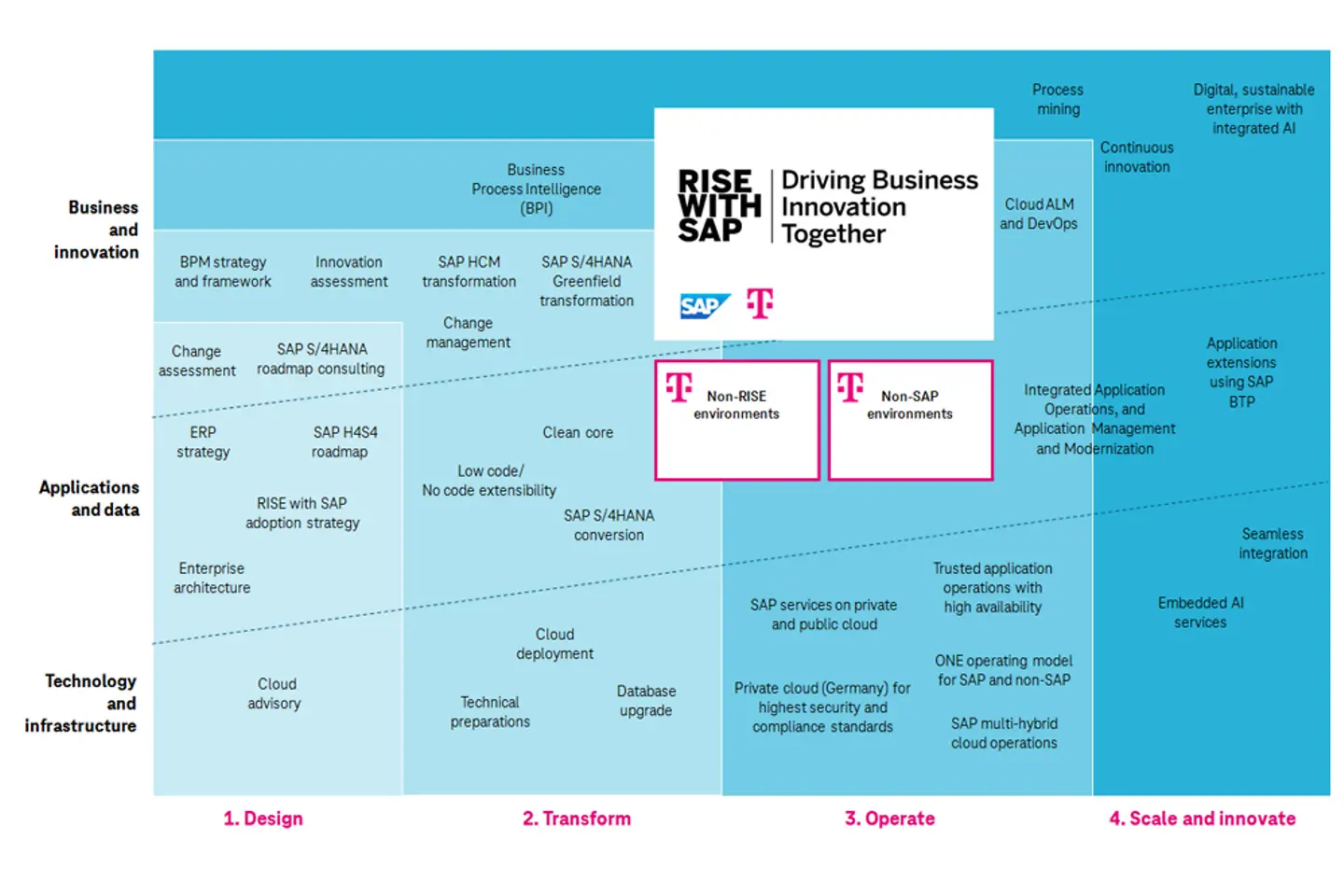
Enterprise transformation rarely takes place within a single project. RISE with SAP provides a structured journey that allows organizations to modernize at their ERP landscape and business processes progressively. The individual phases can overlap and be adapted to the organization’s requirements:
Step 1 – Assess the current ERP landscape
Analyze existing SAP systems, business processes, integrations, custom codes, data quality and regulatory requirements.
Step 2 – Define the transformation approach
Determine the target architecture, cloud operating model, business objectives, and migration approach, such as Greenfield, Brownfield, or selective data transition.
Step 3 – Modernize the digital core
Move to SAP Cloud ERP Private, reducing technical debt and unnecessary customizations, and establishing a clean core. This helps keep the ERP landscape upgradeable and prepared for future SAP innovations.
Step 4 – Optimize business processes
Standardize and redesign processes across finance, procurement, human resources, manufacturing, supply chain, and other business functions using SAP best practices where appropriate.
Step 5 – Extend and integrate SAP applications
Use SAP Business Technology Platform (SAP BTP) to build extensions, automate workflows, connect third-party applications, and integrate data without modifying the ERP core.
Step 6 – Introduce and scale enterprise AI
Implement SAP Business AI, SAP Joule, and AI agents across suitable business processes. Governance, security, human oversight, and operational control remain essential as the level of automation increases.
This phased approach allows organizations to modernize according to at their priorities while adopting cloud and AI capabilities.
Moving to SAP Cloud ERP is only part of a successful transformation. Organizations must determine how custom code, integrations, data, and business-specific functionality will be managed before, during and after migration.
Many enterprises have accumulated extensive custom code, modifications, and point-to-point integrations over time. Although these developments often support important business requirements, they can also create technical debt, complicate upgrades, increase operating costs, and slow the adoption of new SAP capabilities.
SAP's clean core strategy addresses this challenge. Organizations keep the ERP core as close as possible to SAP standard and implement business-specific functionality through clean core-compliant extension mechanisms, released APIs, and SAP Business Technology Platform (SAP BTP).
A clean core can provide several long-term advantages:
Clean core does not mean eliminating all customizations. Organizations can continue to develop differentiating processes and applications. The objective is to implement them without creatin unnecessary dependencies within the ERP core.
Clean core should therefore not be treated as a one-time technical exercise. It requires continuous governance to assess new requirements, select suitable extension methods, and prevent new technical debt throughout the RISE with SAP journey.
As a RISE with SAP Premium Supplier, T-Systems supports customers across ERP transformation, cloud operations, application management, and continuous modernization.
T-Systems helps organizations assess existing custom code, integrations, and technical debt, define a clean core roadmap, and select a suitable migration and transformation approach. Where business-specific functionality is required, T-Systems supports the development of extensions and integrations using SAP BTP, released APIs, and other clean core-compliant technologies.
After migration, T-Systems combines SAP application management with ongoing clean core governance.
This helps organizations manage new requirements, maintain an upgradeable ERP landscape, and adopt SAP Business AI and SAP Joule progressively.
By combining SAP transformation expertise, managed operations, multi-cloud capabilities, and certified private-cloud infrastructure, T-Systems helps customers establish a secure and future-ready foundation for continuous innovation with RISE with SAP.
Although both offerings support the transition to SAP Cloud ERP, they address different business situations.
RISE with SAP is designed primarily for existing SAP customers running complex ERP landscapes. It provides a structured path from SAP ECC or earlier SAP environments to SAP Cloud ERP Private while helping organizations analyze, optimize and preserve critical business processes, industry-specific functionality, and integration with existing enterprise systems. RISE with SAP supports Greenfield, Brownfield, and selective data transition approaches.
SAP GROW, previously known as GROW with SAP, addresses a different audience. It targets organizations that want to implement SAP Cloud ERP using a Greenfield approach. SAP Cloud ERP follows a more standardized model, offering less flexibility for customization but potentially enabling faster deployment than SAP Cloud ERP Private when the organization is prepared to adopt standardized processes. The distinction becomes increasingly important as organizations prepare for AI-driven operations.
Organizations with complex ERP landscapes often require greater flexibility to support their unique business processes, industry-specific compliance requirements, multi-cloud strategies, and controlled migration approaches. RISE with SAP is particularly suitable for these requirements and support organizations on their journey toward the Autonomous Enterprise.
RISE with SAP combines software, cloud infrastructure, technical services, transformation tools, and lifecycle management into a single offering. Instead of organizations sourcing and managing these components separately, SAP delivers an integrated operating model. Depending on the deployment model, certified premium suppliers such as T-Systems provide infrastructure and technical operations and can also deliver transformation and application management services.
A typical RISE with SAP journey follows six stages.
1. Assess the current landscape
Organizations evaluate their existing SAP environment, business processes, custom developments, integrations, and future business objectives.
2. Plan the transformation
A migration strategy is defined, including:
Organizations also determine the appropriate cloud operating model based on performance, security, compliance, and business requirements.
3. Modernize ERP
SAP ECC is migrated to SAP Cloud ERP Private while reducing technical debt and standardizing core business processes where appropriate.
4. Operate in the cloud
Infrastructure, lifecycle management, updates, and technical operations become part of a managed cloud operating model.
5. Extend the platform
SAP Business Technology Platform supports AI services, new applications, integrations, automation, and analytics without unnecessary modifications to the ERP core.
6. Innovate continuously
Organizations progressively adopt SAP Business AI, SAP Joule and AI agents while optimizing processes and moving toward the Autonomous Enterprise.
Instead of treating ERP modernization as a one-time migration project, RISE with SAP establishes a journey for continuous innovation.
Standardized public cloud ERP does not meet every organization’s business, technical or regulatory requirements. This is particularly true for enterprises with complex SAP landscapes, industry-specific processes, extensive integrations, sensitive data, and mission-critical operations.
SAP Cloud ERP Private combines a managed cloud operating model with the flexibility required to transform complex transformto transformments. Organizations retain greater control over customization, release planning, and business-critical processes while gaining access to continuous SAP innovation.
SAP Cloud ERP Private combines a managed cloud operating model with the flexibility required to transform complex enterprise landscapes. Organizations retain greater control over customization, release planning, and business-critical processes while gaining access to continuous SAP innovation.
SAP Cloud ERP Private also provides the digital foundation for SAP Business AI, SAP Joule, and AI agents. A clean core, trusted business data, and integrated processes enable organizations to introduce these capabilities progressively without repeatedly redesigning their ERP landscape.
This combination of flexibility, operational resilience, governance, and innovation is particularly relevant for regulated industries, including manufacturing, financial services, healthcare, energy and the public sector.
As a RISE with SAP Premium Supplier, T-Systems provides certified private cloud infrastructure hosted in Germany and managed SAP operations for SAP Cloud ERP Private. T-Systems also supports hyperscalers, hybrid, and multi-cloud environments, giving organizations greater flexibility to balance innovation, performance, regulatory requirements, and digital sovereignty.
SAP Cloud ERP Private is therefore more than a migration destination. It provides a flexible and secure digital core for continuous transformation and AI-enabled business processes
AI has become a core capability of modern ERP systems rather than a standalone technology. SAP Business AI embeds AI directly into business applications, while SAP Joule provides a conversational interface that connects users with enterprise data, applications, and workflows.
Beyond prompt-based AI assistants, SAP's strategy is evolving toward AI agents capable of executing multi-step tasks within governed business processes. Users interact with SAP Joule using natural language, while AI agents retrieve business context, analyze data, recommend actions, and increasingly automate routine tasks.
Examples include:
This shift changes AI from a productivity tool into an operational capability embedded throughout the enterprise.
However, intelligent agents are only as effective as the business data and process context they can access. Clean master data, governed business processes, and integrated applications remain essential prerequisites. RISE with SAP supports organizations in establishing this foundation by modernizing their ERP landscapes and preparing them for enterprise-wide AI.
AI agents, SAP Joule, and SAP Business AI are central to SAP's vision of Autonomous Enterprise, in which business processes become increasingly autonomous while remaining subject to human oversight and governance.
SAP Business AI Platform brings together business data, AI, and Technology capabilities to connect applications, data, automation, and AI across the enterprise.
The integration, application development, automation, and extension capabilities associated with SAP Business Technology Platform (SAP BTP) are now part of SAP Business AI platform. These capabilities enable organizations to extend SAP applications, integrate third-party systems, automate workflows, and build AI-powered business services without disrupting the ERP core.
They also support the clean core approach. Rather than embedding custom developments within SAP Cloud ERP, organizations build side-by-side applications, integrations, and automations using SAP BTP capabilities. This preserves the integrity of the ERP core while allowing continuous innovation and future SAP upgrades.
As organizations move toward autonomous business operations, SAP Business AI platform becomes the orchestration layer that connects:
The platform also provides governance capabilities that become increasingly important as AI assumes greater responsibility for business processes. Identity management, authorization, auditability, API management, and data integration help ensure that AI systems operate within clearly defined business rules.
For organizations operating in regulated industries, governance is as important as innovation.
A technology platform alone does not provide full digital sovereignty. Sovereign AI also requires trusted infrastructure, clearly defined governance, and operational controls. T-Systems combines SAP BTP with its Industrial AI Cloud and T Cloud Private, enabling organizations to build and operate AI services while maintaining operational and regulatory control.
You can display all external content on the website at this point.
I agree that personal data may be transmitted to third-party platforms. Read more about this in our privacy policy.
T-Systems’ SAP expert Uwe Birkenhauer explains what RISE with SAP really is, how it differs from SAP GROW, and why SAP now positions it as a transformation framework rather than a product. Learn how RISE with SAP fits into SAP’s cloud strategy, the Autonomous Enterprise and what it means for your business.
Enterprise IT no longer operates in a single infrastructure environment.
Organizations increasingly combine private cloud, hyperscalers, edge environments and sovereign cloud platforms to balance performance, resilience, innovation, control, and compliance. The same applies to SAP.
Development systems may benefit from hyperscale cloud elasticity, while production finance systems require stricter operational controls. AI training workloads demand GPU scalability, whereas HR applications require enhanced protection for personal data.
Rather than forcing every workload into one environment, organizations are adopting multi-cloud strategies that place each workload where it delivers the greatest business value.
This enables enterprises to
For AI-driven enterprises, multi-cloud also provides flexibility to deploy new services without compromising governance. Hybrid and multi-cloud is the practical approach for combining hyperscaler innovation with sovereign infrastructure for critical SAP workloads.
Moving to SAP Cloud ERP is one milestone within a broader business transformation. Organizations must assess their existing SAP landscape, define a migration strategy, modernize applications and processes, establish a clean core, integrate AI capabilities and establish governance that supports continuous innovation.
As a RISE with SAP Premium Supplier, T-Systems supports customer across the complete transformation lifecycle. T-Systems combines SAP transformation expertise, RISE-certified private cloud infrastructure, multi-cloud capabilities, application management, and sovereign operations.
Our approach combines:
Advisory and transformation
Cloud transformation
Managed SAP operations
AI readiness
Sovereign operations
T-Systems’ value as a RISE with SAP Premium Supplier lies in combining transformation, infrastructure, and operations. Customers can work with. T-Systems from the initial assessment and migration through applications management, multi-cloud operations, clean core adoption, and sovereign AI integration. This integrated approach helps organizations to operate SAP Cloud ERP Private securely while continuing to modernize their business processes and adopt new SAP innovations.
RISE with SAP has evolved from a cloud migration offering into the strategic transformation journey towards the Autonomous Enterprise. What began as a program to simplify the move from on-premises ERP to the cloud now helps organizations modernize SAP Cloud ERP Private, establish clean core, and adopt SAP Business AI, SAP Joule, SAP Business AI Platform, and intelligent automation.
The future of enterprise transformation is no longer only defined by moving ERP to the cloud. Organizations are building intelligent, AI-enabled enterprises where trusted business data, standardized processes and cloud-native operations allow AI agents to assist employees, automate routine decisions and continuously optimize business processes.
This transformation will take place progressively. Organizations will first modernize their ERP landscape, establish a clean core and trusted business data, use the integration and extend capabilities of SAP BTP, embed AI into suitable business processes. Over time, they can orchestrate increasingly autonomous business operations across the enterprise.
As AI becomes more deeply integrated into core business functions, enterprise governance, security and digital sovereignty become equally important. Intelligent systems rely on continuous access to highest quality enterprise data, making trusted infrastructure, compliance and operational control essential for responsible AI adoption.
For most organizations, the Autonomous Enterprise will not replace human expertise. Instead, it will augment decision-making by allowing employees to focus on innovation, customer value and strategic growth while AI manages repetitive operational work and supports faster, more informed decisions.
For organizations planning the next stage of digital transformation, the journey is no longer simply about adopting cloud ERP. It is about building an enterprise that can continuously adapt, innovate and scale AI with confidence. As a RISE with SAP Premium Supplier, T-Systems supports this journey from strategy and migration to clean core adoption, RISE-Certified private cloud infrastructure, managed SAP operations, sovereign cloud operations and AI readiness. By combining these capabilities, T-Systems helps organizations establish secure and future-ready foundation for the Autonomous Enterprise.
RISE with SAP is SAP's business transformation journey that helps organizations modernize their ERP landscape by moving from SAP ECC or earlier SAP environments to SAP Cloud ERP Private. It combines cloud infrastructure, software, technical services, and lifecycle management into one offering. Today, RISE with SAP also serves as the foundation for SAP Business AI and the Autonomous Enterprise.
Originally introduced to simplify cloud migration and SAP S/4HANA adoption, RISE with SAP has evolved into the methodology of adopting and supporting SAP's vision of the Autonomous Enterprise. It now integrates Cloud ERP Private, SAP Business AI, SAP Joule, SAP Business AI Platform, and AI-driven business processes to help organizations move beyond ERP modernization toward intelligent enterprise operations.
RISE with SAP is designed for existing SAP customers migrating complex ERP landscapes to SAP Cloud ERP Private in Greenfield or Brownfield approach. It supports customized business processes, hybrid environments, and regulated industries. SAP GROW (previously called GROW with SAP) targets organizations implementing SAP Cloud ERP in a Greenfield approach with standardized processes, making it more suitable for entirely new implementations and smaller organizations.
The Autonomous Enterprise relies on trusted business data, cloud-native ERP, AI services, and intelligent process automation. RISE with SAP provides the methods and the tools to support organizations to adopt SAP Business AI, SAP Joule and AI agents while maintaining governance, security, and operational control.
SAP Cloud ERP Private is the digital foundation designed for organizations that require greater flexibility, customization, and operational control than the more standardized SAP Cloud ERP environment. It is particularly suited for enterprises with complex SAP landscapes, industry-specific processes, or strict compliance requirements.
SAP Joule is SAP's AI copilot that enables users to interact with enterprise applications using natural language, written or spoken. It helps employees retrieve business insights, automate routine tasks, summarize information, and collaborate with AI-powered business processes across SAP applications.
SAP Business AI embeds artificial intelligence directly into SAP applications to improve decision-making and automate business processes. It supports use cases across finance, procurement, HR, manufacturing, supply chain, and customer service while using business context from SAP systems.
SAP Business AI Platform connects applications, data, automation, and AI services across the enterprise. It provides integration, extensive application development, process automation, analytics, and governance capabilities that help organizations build and operate intelligent business applications while keeping the ERP core clean.
SAP Clean Core is an architectural approach that keeps SAP Cloud ERP as close as possible to the standard solution while implementing custom functionality through SAP Business Technology Platform, APIs, and extension services. This reduces technical debt, simplifies upgrades, and enables organizations to adopt new SAP innovations more quickly.
RISE with SAP is designed for continuous innovation rather than one-time migration. Organizations with a clean core can consume regular SAP updates, adopt SAP Business AI, and SAP Joule faster, reduce maintenance effort and avoid repeatedly modifying custom code during upgrades.
No. Clean core does not eliminate customization; it changes the way how customization is implemented. Organizations continue to differentiate their business processes using SAP BTP, side-by-side extensions, and APIs instead of adding individual tables or modifying the ERP core. This preserves flexibility while maintaining an upgradeable SAP landscape.
AI depends on standardized business processes, trusted data, and modern cloud architecture. A clean core simplifies the integration of SAP Business AI, SAP Joule, and future AI agents by reducing technical complexity and ensuring organizations can continuously adopt new intelligent capabilities as SAP releases them.
As AI systems gain access to increasing amounts of enterprise data, organizations need greater transparency and control over where their data is processed, who can access it and under which legal framework it is governed. Digital sovereignty helps organizations meet regulatory requirements while securely adopting AI and cloud technologies.
Balanced sovereignty is an approach that matches the level of protection to the sensitivity of each workload rather than applying one cloud model across the entire SAP landscape. Less critical workloads can benefit from hyperscale cloud innovation, while business-critical systems operate within sovereign or private cloud environments.
Multi-cloud strategies allow organizations to combine the strengths of private cloud, sovereign cloud and hyperscalers. This improves flexibility, resilience and scalability while enabling businesses to place each SAP workload in the environment that best balances performance, compliance, cost, and innovation.
Yes. RISE with SAP provides the cloud-native ERP foundation required for SAP Business AI, SAP Joule, and future AI agents. These capabilities help organizations automate business processes, improve decision-making, and move toward SAP's Autonomous Enterprise vision.
RISE with SAP is particularly valuable for enterprises operating complex SAP environments, organizations migrating from SAP ECC, companies in regulated industries and businesses looking to modernize ERP while preparing for AI-driven transformation.
As a RISE with SAP Premium Supplier, T-Systems supports organizations throughout the entire transformation journey, from advisory and migration to managed operations and AI readiness. With expertise across private, public, and sovereign cloud environments, T-Systems helps customers balance innovation, compliance and operational resilience while preparing for the Autonomous Enterprise.
The first step is assessing your existing SAP landscape, business objectives, and regulatory requirements. A structured transformation roadmap helps organizations determine the appropriate migration approach, cloud operating model and AI readiness strategy while identifying which workloads require sovereign, hybrid or hyperscale cloud deployment.
The Autonomous Enterprise is SAP's vision for organizations where AI agents, SAP Business AI and SAP Joule automate business processes, provide real-time recommendations and support employees with intelligent decision-making. Human oversight remains essential for governance and strategic decisions.
No. While cloud migration remains a critical component, RISE with SAP now encompasses business transformation, AI readiness, cloud operations, SAP Business AI, SAP BTP, and the technological foundation required for autonomous business processes.
RISE with SAP modernizes ERP systems, standardizes business processes, and establishes trusted business data, all prerequisites for adopting SAP Business AI, SAP Joule, and future AI agents. By creating a cloud-native digital core, organizations can integrate AI more effectively across finance, supply chain, HR, and other business functions.