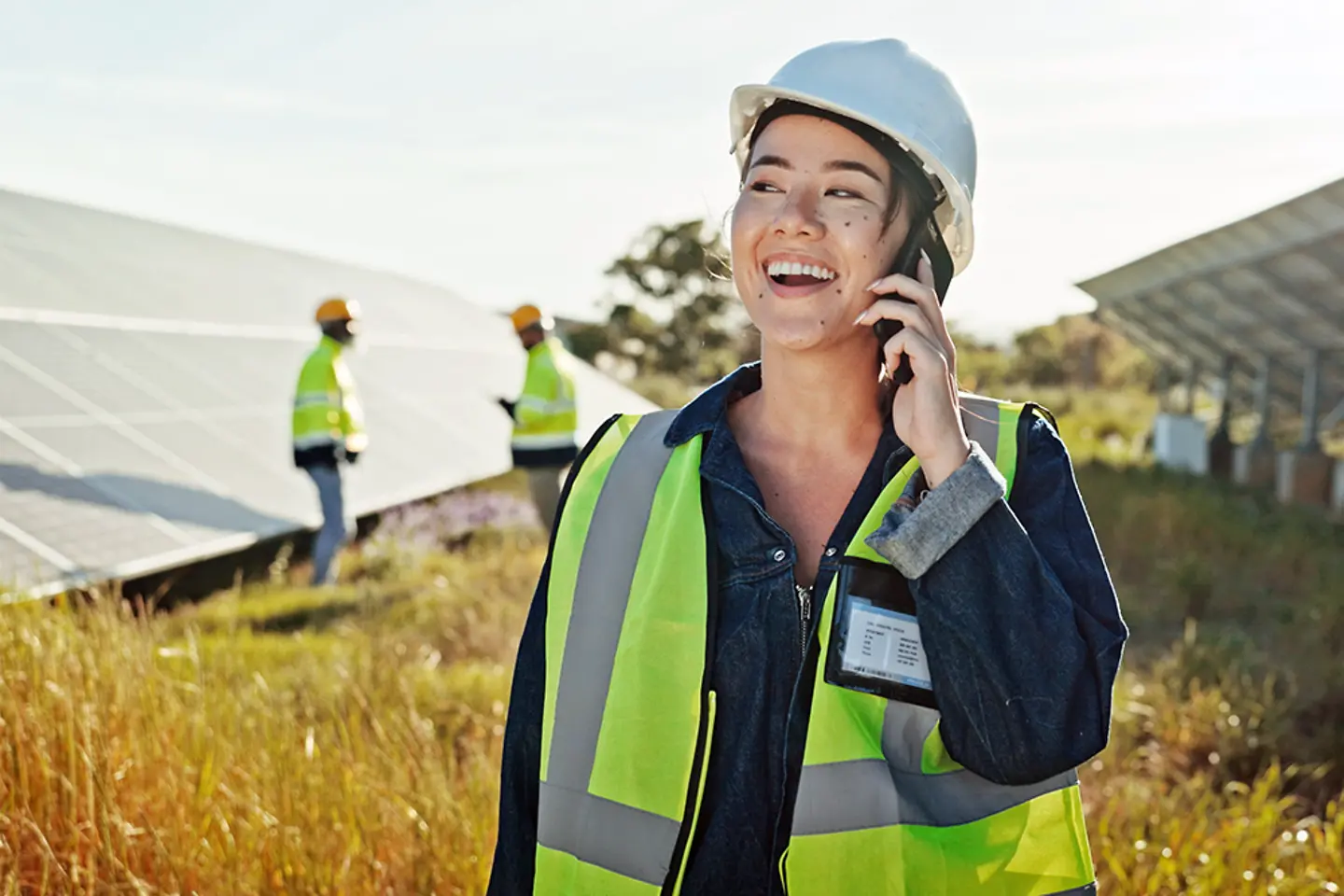
Sustainability and digitalization are inextricably linked. As one of the leading ICT service providers, we combine responsible action with digital technologies that support companies in achieving their sustainability goals.
We are consistently working to reduce emissions along the entire value chain, increase the energy efficiency of our data centers, make AI sustainable, and use resources more efficiently. At the same time, we set high standards for human rights, responsible supply chains, and corporate governance. In this way, we create measurable value for our customers, society, and the environment.
Our ambition is clear: we want to be a leading sustainable ICT company. That is why we combine transparent ESG strategies with digital innovations that make companies more resilient, efficient, and future-ready.
For Scope 1 and 2, we have been climate-neutral since 2025. We have reduced emissions from our own operations worldwide by more than 94% compared to 2017. We neutralize the remaining emissions through high-quality projects that bind CO2. By 2030, we aim to reduce our greenhouse gas emissions by 55 percent. By 2040, we want to achieve net zero along the entire value chain.5
We increase energy efficiency, use electricity exclusively from renewable energies, electrify our vehicle fleet, and consistently design procurement, supply chains, and logistics to be low on emissions.
Longer product life cycles, efficient use of resources, and material cycles that are as closed as possible help to permanently reduce emissions.
We consider the entire lifecycle of our IT solutions and hardware: from design and procurement through use and reuse to recycling.
Along the waste hierarchy, we avoid waste and extend product lifecycles through reuse and refurbishment. At the end of their useful life, we consistently return materials to the cycle. Our electronic waste has already been fully recycled for years.
With the Telco Circularity Score, we manage our circularity performance across the entire Group. By 2030, we aim to increase the share of recycled materials in our IT hardware to 30 percent and to use fully sustainable hardware packaging.4
Our cloud and AI infrastructures combine high performance with the lowest possible resource consumption. Since 2021, we have been operating our data centers entirely with electricity from renewable energies. We continuously optimize architecture, management, and hardware utilization.
A PUE value of around 1.3 makes our data center in Biere particularly energy-efficient. In the Industrial AI Cloud, we also rely on innovative cooling concepts and plan to use waste heat for the local district heating network.3
AI, IoT, and real-time analytics make the energy consumption and savings potential transparent. With our Green AI Principles and targeted training, we embed energy efficiency into the development and operation of our technologies.
We also use these experiences to support customers in the sustainable design of their digital infrastructures.
We design the development, training, and operation of AI to be energy-efficient, secure, and transparent. Clear governance, responsible handling of data, and continuous monitoring build trust and support compliance with regulatory requirements.
Sustainable AI can reduce energy and operating costs while also strengthening resilience, ESG performance, and trust.
AI can help reduce emissions, improve energy efficiency, optimize supply chains, and conserve resources. This creates measurable added value for companies and the environment.
Social responsibility is an important part of our sustainability commitment at T-Systems. Together with the Group Corporate Responsibility (GCR), we work to further develop the Social Engagement Strategy at the Group level and to firmly embed social responsibility and sustainability in our activities and processes. Together with our employees, partners, and social initiatives, we demonstrate that sustainable action goes far beyond ecological aspects. Whether through inclusion, education, civic engagement, or the promotion of diversity and human rights, we take responsibility and make our contribution to a more sustainable and equitable future.
Furthermore, we support various initiatives that make a positive contribution to society, the environment, and inclusion. With our annual World Earth Day CleanUp on April 22, we mobilize employees at numerous locations worldwide to collect litter together and make a statement for environmental protection. This also includes our regular involvement with the Ronald McDonald House in Sankt Augustin, which supports families of seriously ill children. Another important long-standing partner is AfB social & green IT. Through this collaboration, we promote the reuse of IT hardware while simultaneously supporting the professional participation of people with disabilities.
Respecting human rights is a central component of sustainable corporate governance at T-Systems. Worldwide, we are committed to upholding and promoting international human rights standards along our entire value chain—both within our own business areas and among suppliers and partners. The basis of our actions is internationally recognized standards such as the Universal Declaration of Human Rights, the ILO core labor standards, the OECD Guidelines, and the UN Guiding Principles on Business and Human Rights. The Policy Statement on Human Rights and the Code of Human Rights of Deutsche Telekom provide the binding framework for all T-Systems companies worldwide. We also promote diversity, equal opportunity, and inclusion, and create a working environment in which all employees can contribute their strengths and unlock their potential.
T-Systems focuses on climate protection, circular economy, energy-efficient digital infrastructures, sustainable AI, as well as social responsibility and good corporate governance.
Since 2021, all T-Systems' data centers have been powered by electricity from renewable energy sources. In addition, T-Systems continuously optimizes cooling, hardware utilization, and data center architecture.3
For T-Systems, sustainable AI means designing AI to be energy- and resource-efficient, transparent, and responsible across its entire lifecycle, while also deploying AI in a targeted manner to scale sustainability solutions and increase their impact.
Digital solutions create transparency around energy, emissions, and resources. They help companies identify savings potential, manage measures, and make progress measurable.
T-Systems' climate targets are SBTi certified. We aim to reduce our emissions (Scope 1–3) by 55% by 2030 and achieve net zero along our entire value chain by 2040.5
T-Systems considers the entire lifecycle of IT hardware: sustainable design and sustainable use of materials, extended use, refurbishment, and recycling. The Telco Circularity Score makes progress along this circular economy measurable.
2 Deutsche Telekom - CR Report 2025, System Solutions - KPI "Share of renewable electricity"
3 Deutsche Telekom - CR Report 2025, Energy: optimizing consumption and increasing efficiency
4 Deutsche Telekom - CR Report 2025, Circular economy: holistic approach along the entire value chain
5 Deutsche Telekom - CR Report 2025, Climate protection: our path to achieving net zero by 2040