The Industrial AI Cloud, developed by Deutsche Telekom, T-Systems, and NVIDIA, is a high-performance, sovereign platform for enterprises and public sector organizations. It integrates Information Technology (IT) and Operational Technology (OT) data, enables real-time analytics, and scales AI from edge to cloud. Built in Germany for Europe, it is fully GDPR-compliant, aligned with the EU AI Act, and ensures secure, efficient, and compliant AI operations.

Björn is responsible for sales of the Industrial AI Cloud as Senior Vice President. He brings over two decades of leadership experience across key commercial roles in B2B, consumer, and wholesale units of Deutsche Telekom Group.
You can display all external content on the website at this point.
I agree that personal data may be transmitted to third-party platforms. Read more about this in our privacy policy.
Powered by NVIDIA. Secured by European sovereignty.
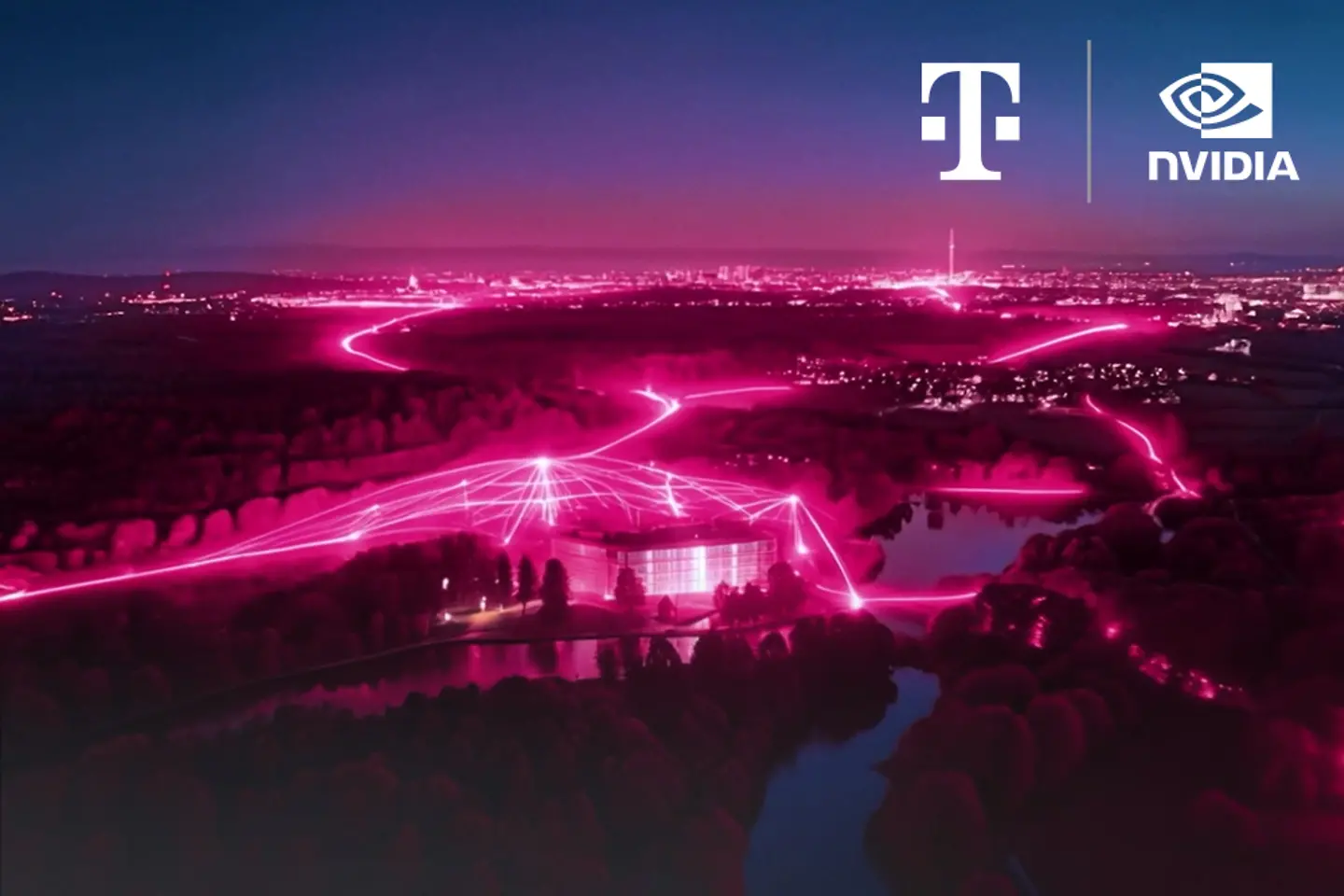
The Industrial AI Cloud is Germany’s first industrial AI data center and is available to customers since February 2026. With its launch, Germany’s available AI computing capacity increased by 50 percent almost overnight. The Industrial AI Cloud is a key building block in ensuring that Europe remains competitive in industrial AI and can continue to develop its own sovereign AI offerings. To this end, 10,000 state-of-the-art NVIDIA AI chips (GPUs) have been installed in a Deutsche Telekom data center in Munich. Unlike conventional CPUs, which process tasks sequentially, GPUs can handle many operations in parallel, making them particularly well suited for graphics and AI workloads. They deliver computing power far beyond the capabilities of traditional IT infrastructures. This enables the development and operation of large language models, image and video AI, simulations, and robotics applications. The GPUs powering the Industrial AI Cloud deliver computing performance equivalent to 2.3 million standard desktop computers. Customers do not need to build and operate their own supercomputing environments – instead, they can directly leverage Telekom’s AI computing power.
The Industrial AI Cloud is primarily aimed at industrial companies, small and medium-sized enterprises, start-ups, as well as public authorities and research institutions.
Typical use cases include quality assurance in manufacturing, predictive maintenance of machinery, digital twins and 3D simulations, automated logistics, and industry-specific AI assistants. Customers can flexibly consume the required computing power as a cloud service—depending on the project, data volumes, and the complexity of the application.
Data is processed in a data center in Germany, in accordance with German and European law. Partners such as SAP and Siemens integrate their platforms and applications, making it easier to embed AI solutions into existing business processes. This creates a “Germany stack” for industrial AI, with high standards for data protection, security, and compliance.
We don't just offer Hardware-as-a-service—we actually offer AI-as-a-Service. To this end, we offer a complete AI stack – the Germany stack – from connectivity to the base plate, including Platform-as-a-Service (PaaS) and Software-as-a-Service (SaaS).
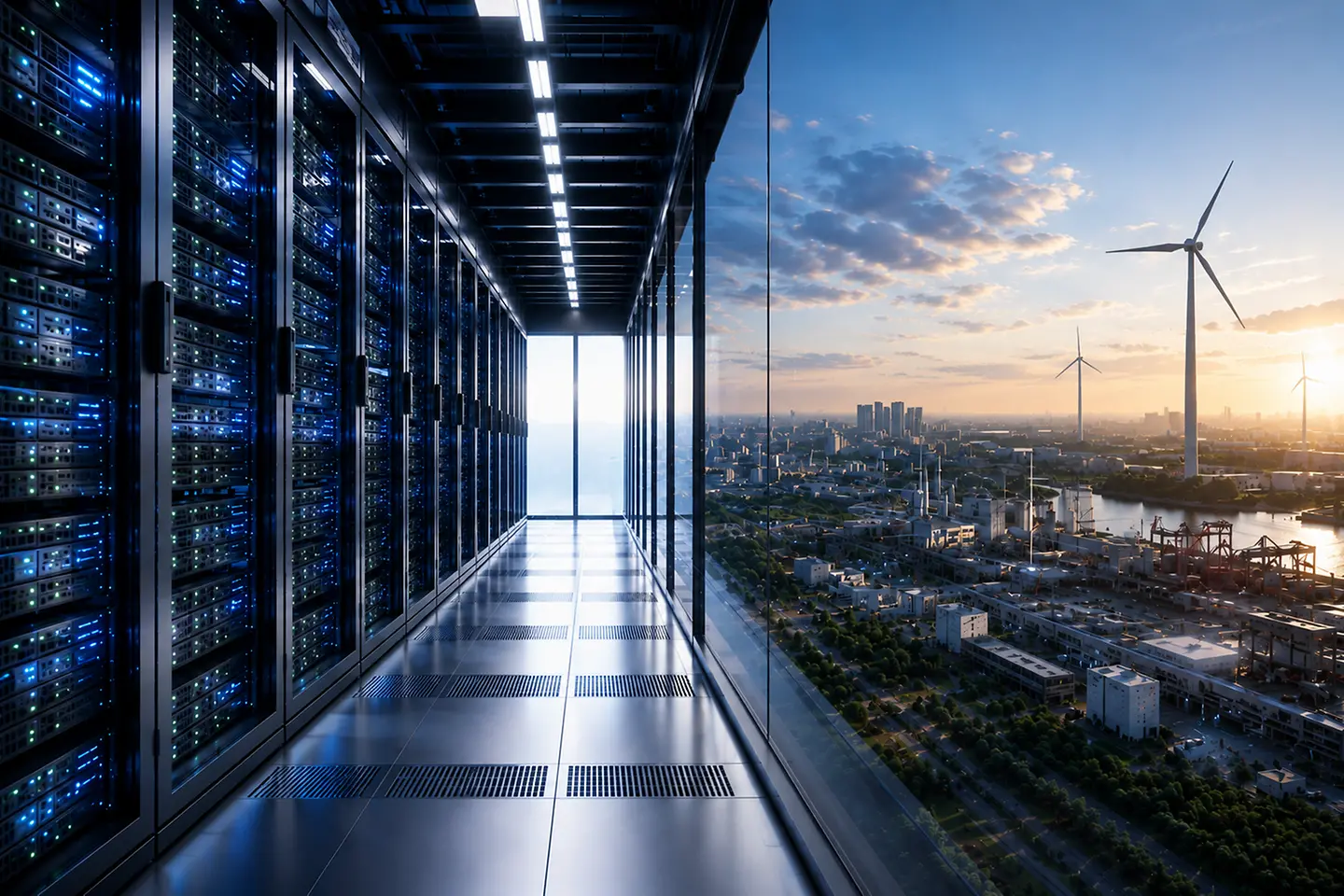
The data center is powered entirely by renewable energy. It is designed for maximum energy efficiency. In the future, the waste heat will supply the entire Tucherpark district with heat as a source. A modern cooling concept relies on cooling of the data center with water from the nearby Eisbach. The Industrial AI Cloud thus fits into Deutsche Telekom's sustainability strategy.
The Industrial AI Cloud is delivered by Deutsche Telekom and T-Systems in collaboration with leading technology partners such as NVIDIA. NVIDIA provides advanced GPU infrastructure and AI capabilities, while Deutsche Telekom and T-Systems ensure secure, sovereign, and compliant cloud operations in Europe. The Industrial AI Cloud grows through a strong and expanding partner ecosystem. Each new partner contributes capabilities, expertise, and innovation that accelerate the joint evolution of industrial AI.