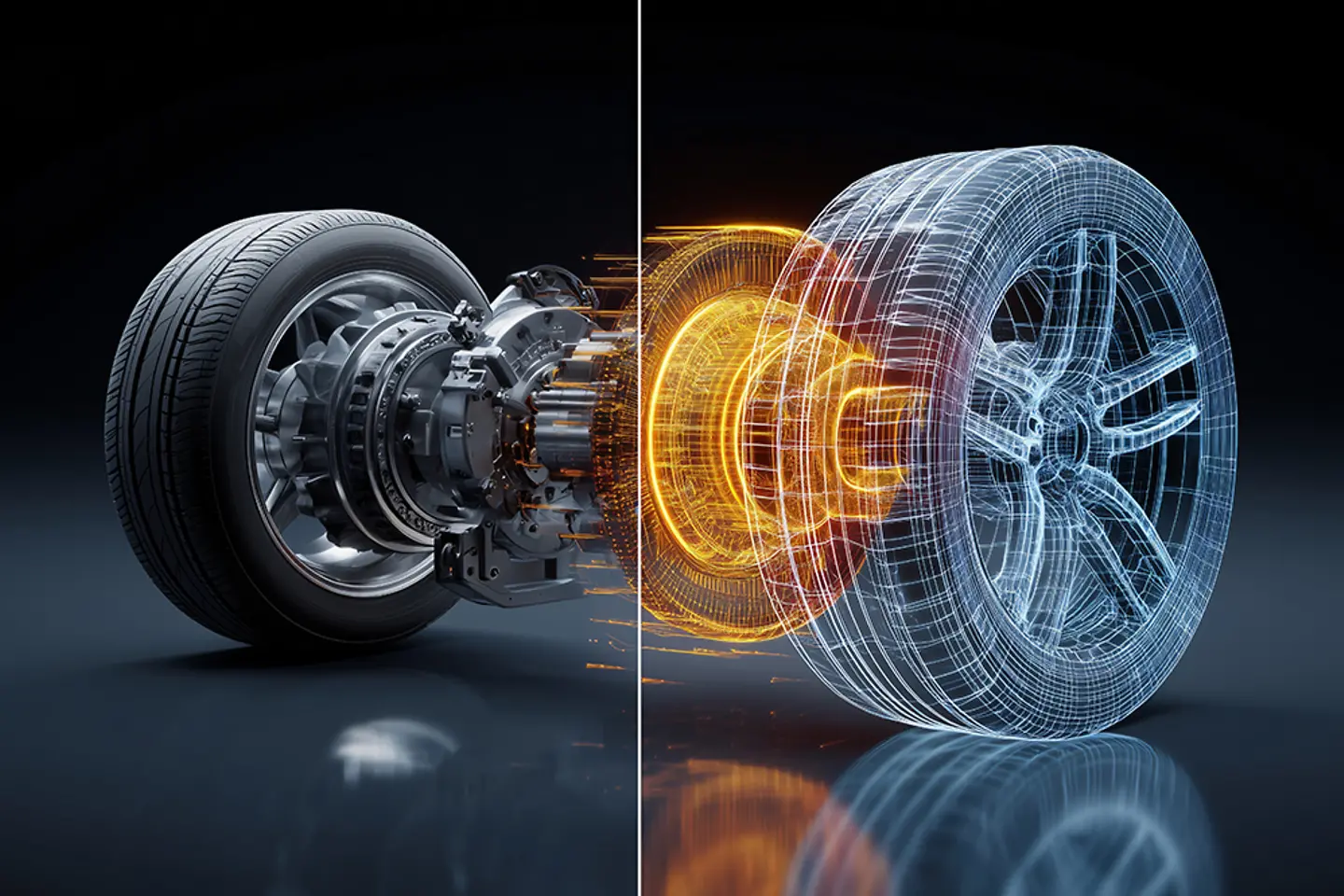
Fragmented data across systems increases costs and limits lifecycle visibility. To ensure traceability and compliance with regulations such as the Digital Product Passport (DPP), companies need consistent, integrated data. Without early simulation and structured digital twin management, risks and inefficiencies grow. A unified digital twin connects data, improves transparency, and enables informed decisions from design to service.
A digital twin is the digital representation of a physical asset, such as a vehicle or a component like a battery. It may represent a serialized product in operation or a design at the type level.
The “digital master” defines the asset’s structured master data, including all variants and configurations. The “digital shadow” captures real-time and lifecycle data generated during use. The digital twin combines the digital master with its specific digital shadow to reflect the asset’s actual state and behavior.
Building a digital twin requires extracting data from the various systems that describe an asset and consolidating them into a consistent context. This depends on establishing a digital thread across enterprise systems and semantically linking information models into a unified data model. Together, these elements create a structured foundation for an accurate and scalable digital twin.
Our holistic approach combines standards from multiple domains. The Asset Administration Shell provides a structured foundation for describing assets and supports defined use cases such as the digital nameplate. In addition, we incorporate domain-specific standards, including STEP (Standard for the Exchange of Product model data, ISO 10303) for engineering data exchange, to ensure interoperability, consistency, and long-term scalability across systems.
The technology stack depends on the specific use case and business objectives. We use knowledge graphs to connect distributed data and make it structured, searchable, and context-aware. For advanced visualization and virtualization of digital twin, we leverage strategic partnerships, including NVIDIA Omniverse, to enable immersive simulation and real-time collaboration environments.
We begin by defining a clear vision for what the digital twin should achieve. Together with our consulting partner Detecon, we support strategy development and use case definition. Once objectives and constraints are defined, we conduct a technical assessment, identify requirements, and design the target architecture. We evaluate existing capabilities, identify gaps, and develop a structured proof of concept to validate the approach.
Digital twins are central to data-driven Product Lifecycle Management in the Catena-X ecosystem. The Digital Twin Registry enables the scalable creation of digital representations for millions of assets, enriched with standardized semantic descriptions. This allows companies to share trusted data across the value chain, gain real-time visibility, strengthen collaboration with supply chain partners, and optimize products and production processes throughout the entire lifecycle.