 Image generated with AI
The debate on AI sovereignty often revolves around chips, data, cloud platforms, and regulation. But as AI expands rapidly, another question is moving to the forefront: what physical infrastructure will support this growth? Because computing power requires more than just processors. It needs a reliable energy supply, cooling, suitable locations, and high-performance networks. Sustainability is therefore shifting from a secondary consideration to a prerequisite for sovereign AI.
Those who talk about sovereign AI usually talk about control: Where is the data stored? Who operates the cloud? Which technology and which laws apply?
These questions remain central. Yet they describe only part of the infrastructure on which AI is based. The current white paper from the World Economic Forum (WEF)1 distinguishes three fundamental building blocks: computing power, connectivity, and data storage. Operating these at scale also requires fundamental physical resources—from energy and cooling to suitable space and available hardware.
These physical requirements are increasingly becoming bottlenecks. The WEF notes that physical constraints are increasingly determining what can actually be realized at any given location. Power supply, cooling, and available space are therefore no longer merely technical details at the end of a data center planning process. They are becoming strategic factors in the development of AI capacities.
This also changes our understanding of digital sovereignty. In the long run, sovereignty does not belong to those who merely have access to powerful chips. Sovereignty ultimately rests with those who can operate and advance the underlying infrastructure reliably, economically, and in a resource-efficient manner.
This is particularly evident in the case of electricity. AI infrastructure requires large amounts of continuously available power—while electricity grids, generation capacities, and the expansion of renewable energy cannot proceed at an arbitrary pace. The WEF therefore identifies energy supply as one of the central technical prerequisites for large-scale AI infrastructure. The same applies to cooling and site availability.
What is crucial here is not to view these factors in isolation. A suitable AI location does not simply need enough square meters. It needs powerful electricity and data networks. An efficient cooling concept influences how water and energy are managed. And the question of what happens to the waste heat generated helps determine whether energy is merely consumed or integrated into a local supply system.
Sustainable AI infrastructure is therefore above all a systemic question. It is about planning computing power, energy, cooling, buildings, networks, and local infrastructure together from the outset. This goes beyond conventional CO₂ optimization. It is infrastructure design under conditions of scarce resources.

In the long run, sovereignty does not belong to those who merely have access to powerful chips. Sovereignty belongs to those who can reliably, economically, and in a resource-efficient manner operate and further develop the infrastructure behind them.
Nils Muthmann, Program Lead Sustainability/ESG, T-Systems
Our AI factory in Munich, the Industrial AI Cloud, makes this approach tangible: it was not built from scratch on a greenfield site. As part of the revitalization of Munich's Tucherpark, an existing data center covering around 10,000 square meters was gutted and comprehensively modernized. Today, approximately 10,000 NVIDIA Blackwell GPUs with a computing power of up to 0.5 ExaFLOPS are available there.
As Telekom/T-Systems, we combine high computing capacity with efficient use of existing infrastructure and space. The high compute density enables substantial computing capacity to be provided at an existing site. The data center itself is designed for high energy efficiency and is operated entirely with electricity from renewable energy.
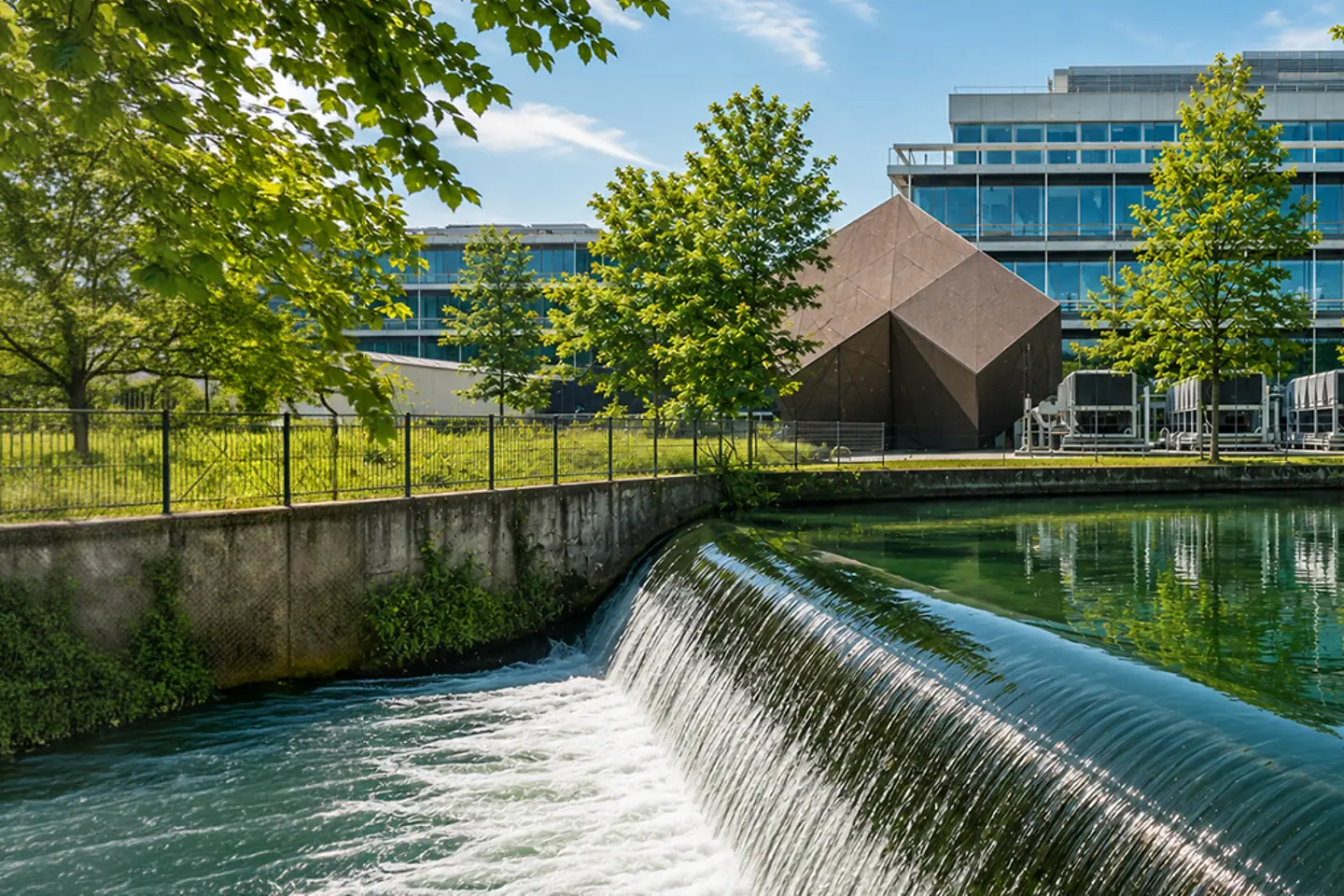
The local infrastructure is also incorporated into the cooling system: the concept uses water from the nearby Eisbach stream to cool the data center. At the same time, the waste heat generated is expected to contribute to the heat supply of the entire Tucherpark district in the future. In this way, a by-product of data center operations becomes a usable resource for the surrounding area.
Connectivity is also part of this picture. AI computing power is only truly usable when large volumes of data can be transported quickly and reliably. Four fiber-optic connections, each with 400 Gbit/s, ensure a high-performance connectivity for our Munich AI factory.
Yet physical infrastructure alone does not create access to AI. What is crucial is that companies can flexibly use and interconnect computing power, cloud services, and data infrastructure. This is precisely where T Cloud comes into play: it forms the central gateway to the AI factory and connects the Industrial AI Cloud with Telekom/T-Systems' sovereign cloud ecosystem.
This transforms a highly specialized data center into a usable infrastructure for companies—and individual building blocks into an integrated system. Because sustainable AI infrastructure is not created by a single "green" technology. What matters is the interplay between the existing building infrastructure, efficient use of space, renewable energy, smart cooling and heat recovery, high-performance networks, and a cloud platform through which these resources can be used on demand.
The World Economic Forum draws an important conclusion from this: energy, water, and land must be treated as fundamental design conditions from the outset when building AI infrastructure—alongside grids, site planning, and long-term resilience.
This is of particular importance for Europe. We will not win in the global AI competition by ignoring resource scarcity. On the contrary: precisely because energy, suitable locations, and infrastructure capacities are limited, their intelligent and resource-efficient use can become a competitive factor.
This is why we should not reduce the debate on sustainable AI to the question of how much electricity a model or a data center consumes. The more strategic question is: how much economically viable computing power can we provide on sustainably and resiliently with the available resources?
This gives AI sovereignty an additional dimension. It does not mean building as much computing infrastructure as possible at any cost. It means having the capabilities, networks, and resources to independently shape and operate critical digital infrastructure over the long term. Sustainability is therefore not an add-on to AI sovereignty—it is one of its prerequisites.
¹ AI Infrastructure in the Age of Sovereignty: Requirements, Strategies and a Trusted Framework for Digital Embassies, World Economic Forum in collaboration with Bain & Company, 2026, www.weforum.org