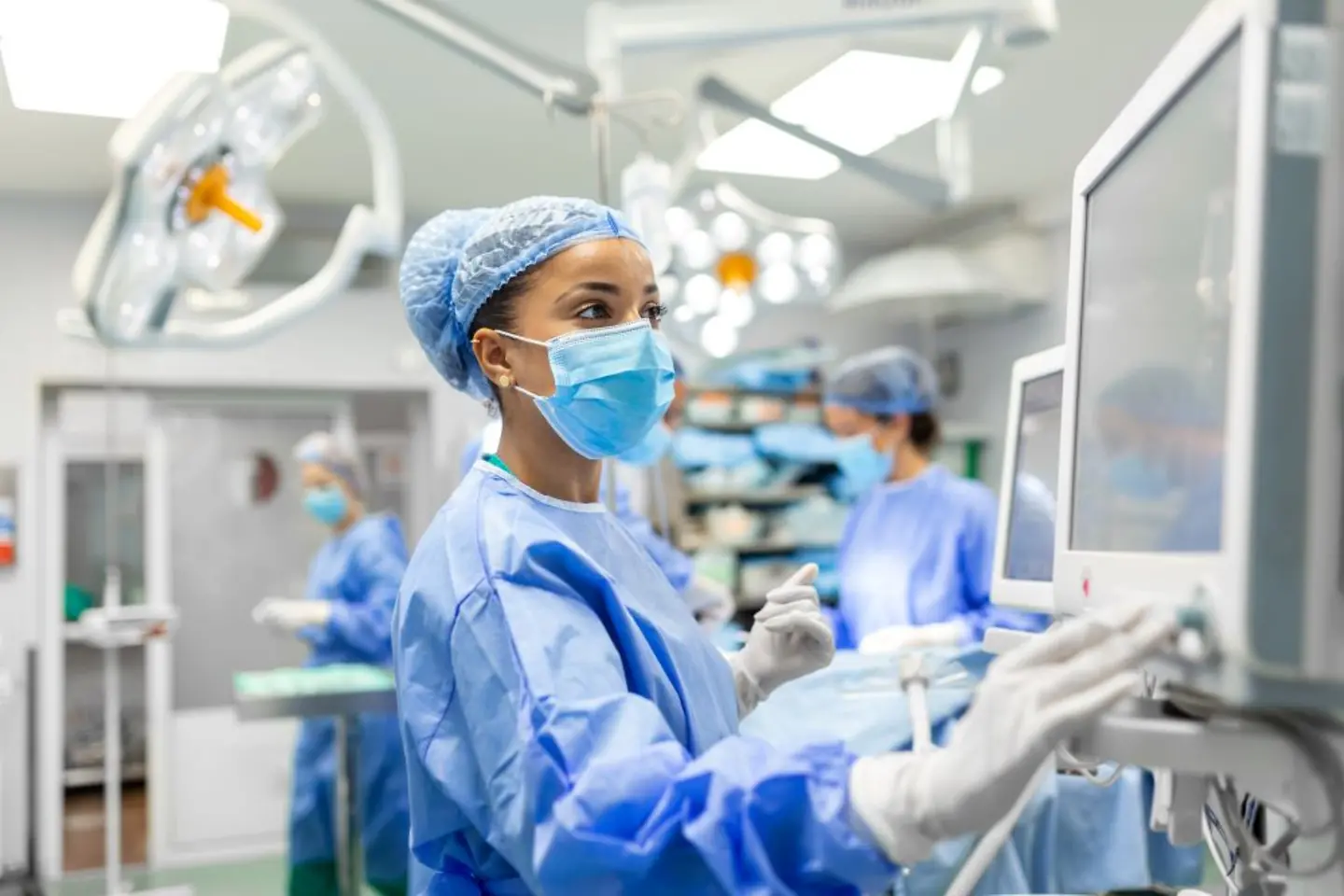
In the emergency room of hospitals, the so-called trauma room, up to ten doctors and nursing staff work together to provide rapid and life-saving care for critically injured patients. Deutsche Telekom/T-Systems, the Fraunhofer Institute for Intelligent Analysis and Information Systems (IAIS), and Merheim Hospital, part of Kliniken der Stadt Köln, are currently developing an AI-powered real-time display system based on trauma room simulations. The AI listens to and tracks the conversations of the medical team in the trauma room. Based on this input, an AI agent categorizes the extracted information according to medical priorities. This list is continuously updated, while the data is simultaneously recorded for treatment documentation purposes. The goal is to ease the workload for trauma teams, minimize errors, and ultimately – save lives.
The AI application can be operated within the so-called cloud-edge continuum, either directly on dedicated servers at the hospital without requiring an internet connection or through the cloud. The data is thus securely protected and stored exclusively within Europe, in compliance with European data protection standards. The one-year project to develop a prototype using trauma room simulations began in September. At its core, the project relies on a modular software toolkit designed for AI solutions.
The medical team in the trauma room operates under immense pressure: As patients are transferred from the emergency services to the trauma room team, throughout the treatment process in the trauma room, and when transitioning patients to the intensive care unit or operating room, all medically relevant information is verbally communicated. These critical details need to be captured, exchanged, and processed instantly, all while diagnostics and treatment progress simultaneously. The solution under development leverages artificial intelligence to automatically record conversations, analyze them in real-time, enrich the information, and present it in a structured, graphical format. The AI agent currently being developed is designed to assist with this process.
Treatment in the trauma room follows the so-called ABCDE protocol, prioritizing life-threatening conditions: Airways, Breathing, Circulation, Disability (neurological status), and Exposure (additional information). Are the airways clear? Are there major external or internal hemorrhages? Is the metabolism destabilized? Additionally, does the patient take anticoagulants, putting them at increased risk of severe bleeding? The goal of the AI system is: it identifies which findings, actions, and decisions are mentioned. For example, if a doctor observes a "coarse bubbling sound" in a patient’s breathing, the AI agent will search for the respective category and generate a live status display in a traffic-light format aligned with the ABCDE protocol. Beyond this, the AI agent automatically transfers the data into forms used for documentation and quality assurance purposes.
This solution is being developed as part of the European funding program IPCEI-CIS. The goal is to create a standardized and transferable infrastructure within the cloud-edge continuum. The system is designed with substantial resilience to infrastructure failures, as it can operate both locally and offline using NVIDIA's DGX Spark super-minicomputer, as well as through AI Foundation Services in the Open Telekom Cloud (OTC). The OTC – an integral component of Deutsche Telekom's T Cloud offering – fully complies with European data protection standards. Key components of the system, such as the modular software toolkit for AI solutions, the edge agent framework, lightweight AI models, and automated workflows for data processing and training, can be "reused" to develop other AI-agent-based cloud-edge infrastructures.
“With the development of a versatile multi-agent framework and its adaptation to the demanding requirements of emergency medicine, we are laying the foundation for relieving medical teams during the treatment of critically injured patients. Key elements include a well-designed system architecture, the integration of trusted components for speech processing and data management, and edge capabilities that enable on-site operation,” says Stefan Rüping, head of department at the Fraunhofer IAIS.
“By integrating medical expertise and realistic trauma room simulations, we are bridging the gap between research and practice, contributing to the potential for AI agents to bring tangible advancements to emergency care in the trauma room,” adds Jerome Defosse, MD, Emergency Medicine, Anesthesia and Intensive Care, Kliniken der Stadt Köln.
“AI is already saving lives today. Our AI agent for emergency medicine serves as a model for other industries as well. With this practical solution, we demonstrate the value of sovereign digital infrastructure for both the economy and the greater good,” says Ferri Abolhassan, Member of the Board of Management of Deutsche Telekom and CEO of T-Systems.
The Bundeswehr Hospital in Berlin of the German Armed Forces and the Florence Nightingale Hospital in Düsseldorf are supporting the project in an advisory capacity. A fully operational prototype, capable of functioning offline within the hospital environment, is expected to be ready for deployment by the summer of 2026.
Thorsten Tjardes, Director of the Department of Trauma Surgery and Orthopedics, Septic and Reconstructive Surgery at the Bundeswehr Hospital in Berlin, emphasizes: “For us, the resilience of the AI assistance system is the top priority – it must function with absolute reliability and security, both in the cloud and locally offline, to meet the rigorous demands of emergency medicine.”
Martin Pin, Head Physician of the Department of Emergency and Acute Medicine at Florence Nightingale Krankenhaus in Düsseldorf, adds: “As an advisory partner, we contribute our expertise to ensure that this innovative AI technology is designed with practical applicability in mind, achieving the optimal balance between technical excellence and usability in clinical operations.”
The current initiative builds on the "TraumAInterfaces" project, funded by the German Federal Ministry of Health. To further develop the insights gained from that project and make them available to the healthcare sector, additional funding was provided through the European support program IPCEI-CIS.
The AI Foundation Services serve as a central platform for secure AI applications. Companies can access a wide range of open-source and commercial AI models. The open-source models are operated by T-Systems in its own data centers, adhering to the highest security standards.
The IPCEI-CIS program of the European Union aims to establish a "multi-provider cloud-edge continuum": a connected, sovereign digital infrastructure for Europe, built in Europe. Edge-cloud computing enables high-performance computing capabilities at the network's edge with minimal latency. Today, twelve EU member states and approximately 150 partners – including industry leaders such as SAP, Siemens, Bosch, Telefónica, Orange, and Airbus—are already collaborating on this open European operating system.
With locations in 26 countries and over 26,000 employees, as well as annual revenues of over EUR 4.0 billion, T-Systems is one of the leading service providers for ICT and digitalization solutions in Europe.
The Fraunhofer Institute for Intelligent Analysis and Information Systems IAIS, headquartered in Sankt Augustin near Bonn and with locations in Dresden and Heilbronn, is one of the leading institutions for applied research in the fields of artificial intelligence (AI), machine learning, and generative AI in Germany and Europe. With approximately 350 employees, the institute develops strategies, technologies, and solutions for businesses, government agencies, and organizations along the entire value chain.
Kliniken der Stadt Köln gGmbH is one of the largest municipal healthcare providers and serves as the university hospital for the private University of Witten/Herdecke. Each year, approximately 159,500 patients receive outpatient care, and 48,500 patients are treated as inpatients. The hospital network operates 1,400 planned beds and employs around 5,000 staff members across its three locations: Cologne Merheim, Cologne Holweide, and the children's Hospital on Amsterdamer Straße, Cologne. In the future, the three sites will be consolidated into a single healthcare campus at the Merheim location.
The Cologne Merheim Hospital is certified as a supra-regional trauma center by the German Society for Trauma Surgery. Each year, 600 patients are treated in the hospital's trauma rooms. Within the framework of the project, Kliniken der Stadt Köln serves as a subcontractor to the Fraunhofer IAIS.