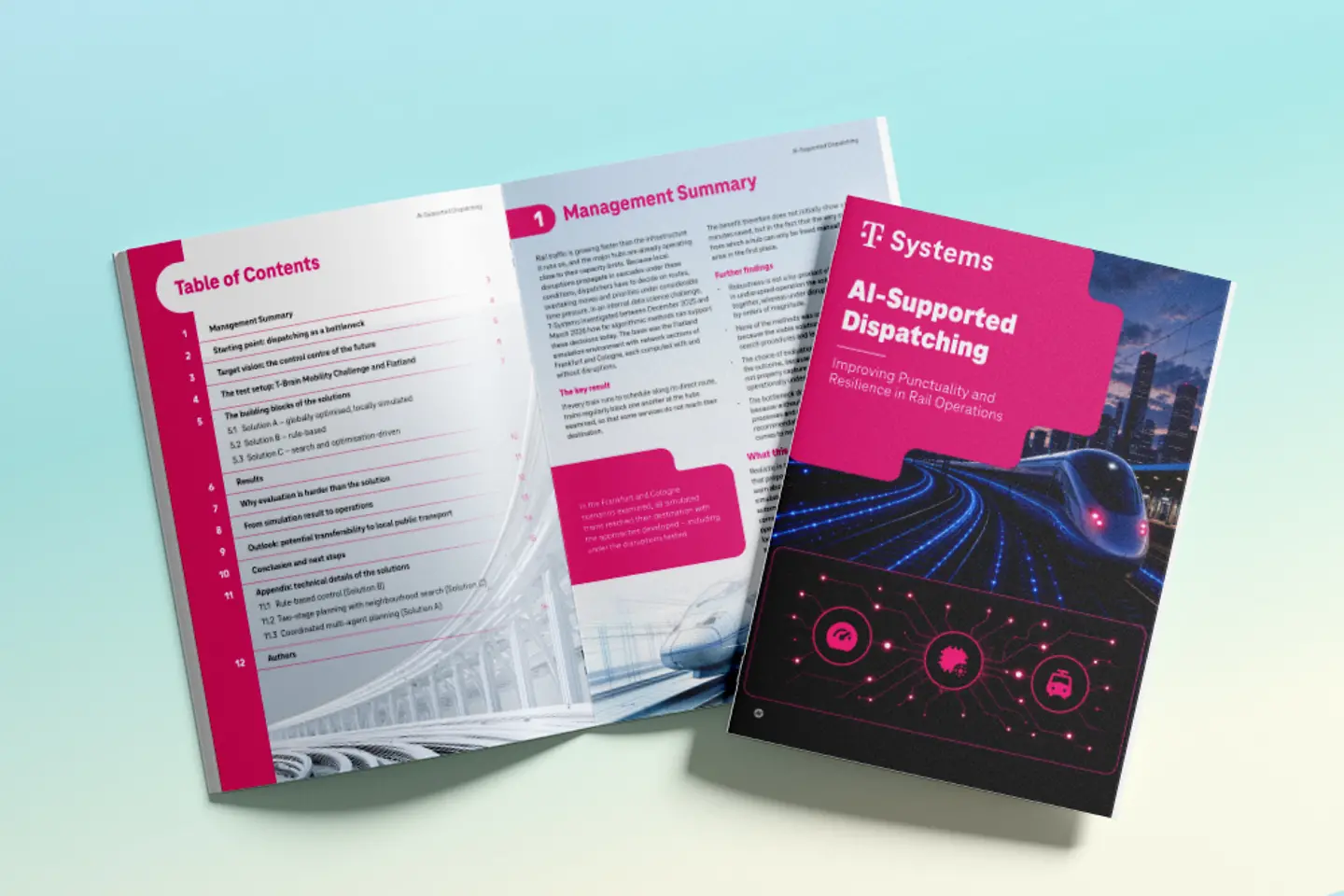
The white paper leverages three approaches from the T-Brain Mobility Challenge in the Flatland simulation environment for Frankfurt and Cologne rail networks: two-stage planning with neighbourhood search, rule-based control, and coordinated multi-agent planning. It examines their recurring building blocks, performance under disruptions, evaluation metrics and the prerequisites for moving from simulation to human-in-the-loop rail operations. The findings demonstrate how AI-supported dispatching can prevent network blockages, with all simulated trains reaching their destinations in the scenarios tested, and also provide a foundation for further validation using real-world rail data, operational constraints, and robust evaluation criteria.