 Image generated with AI
Machine learning is a field of artificial intelligence in which statistical models learn patterns from data and use those patterns to make predictions, classifications, recommendations, or other decisions on new data. The system is not given a separate rule for every possible situation; it iteratively improves a defined performance measure through training, evaluation, and feedback. 1,3
A model connects inputs to outputs using patterns learned from real-world examples. For example, a fraud-detection model may learn from previous transactions and their outcomes, then estimate whether a new transaction is unusual. The model does not “understand” fraud like a person. It calculates a result from patterns represented in its data and parameters.
Machine learning is most useful when the task is repeatable, relevant data exists, success can be measured, and a probabilistic result is operationally acceptable. Human judgment remains important for setting objectives, validating outcomes, handling exceptions, and deciding how predictions should be used.
Traditional software follows logic explicitly written by developers: if a defined condition occurs, the program performs a defined action. This works well when rules are stable and can be described clearly.
Machine learning is useful when the relationships are too numerous, variable, or subtle to express as a complete rule set. Instead of programming every decision, teams provide examples and a learning objective. The resulting model estimates an output for new cases.
The two approaches often work together. Business rules can enforce mandatory controls, while a machine learning model ranks cases, predicts demand, detects anomalies, or recommends an action.
During training, an algorithm iteratively adjusts model parameters to improve performance on selected data. A separate validation or test set checks whether the model can generalize beyond the examples it has already seen. After deployment, inference is the process of using the trained model to produce an output for new data. 1, 2
The lifecycle continues after launch. Teams monitor model quality, latency, fairness, security, data changes, and business outcomes. New data and verified outcomes can be used to retrain or replace the model when performance no longer meets requirements.
Traditional analytics often explains what happened through reports, dashboards, descriptive statistics, and predefined queries. Machine learning focuses on learning relationships that can be applied to new data, such as estimating what may happen next or selecting the most likely category.
The boundary is not absolute. Statistical methods support both analytics and machine learning, and many enterprise solutions combine reporting, forecasting, optimization, and human decision-making. The right method is the simplest one that meets the business, risk, and performance requirements.
Machine learning is a set of methods for building models that generalize from data. Data science is the broader discipline that combines data engineering, statistics, visualization, domain expertise, and machine learning to answer questions and support decisions. Data mining overlaps with machine learning but focuses more on discovering previously unknown patterns in existing data, whereas machine learning is usually evaluated by how well a model predicts or acts on new data.1
Depending on the business objective, machine learning can support descriptive analysis (what happened), predictive analysis (what is likely to happen), and prescriptive decision support (what action should be considered). These modes can work together: a system may detect a pattern, forecast an outcome, and recommend a response, while a person or governed workflow retains final control.2
Machine learning can support decisions and processes across the enterprise, but it does not create value simply by producing an accurate model. Benefits emerge when predictions are relevant, trusted, integrated into workflows, and measured against business outcomes. The strongest cases usually combine a repeatable decision, sufficient data, and a clear action that follows the model output.
Models can evaluate many data points and variables in a repeatable way and provide scores, classifications, or recommendations within seconds. This is useful for high-volume tasks such as prioritizing service requests, reviewing transactions, forecasting inventory, or identifying records that require specialist attention.
Automation should be proportional to risk. Low-risk decisions may be automated, while consequential outcomes may require approval, explanation, or an escalation path.
Machine learning can automate analytical steps that are difficult to manage with fixed rules, including image classification, natural language processing (NLP), anomaly detection, and recommendation. NLP applies machine learning to text and speech tasks such as classification, information extraction, search, translation, summarization, and chatbot interactions. This can reduce repetitive work and help specialists to focus on exceptions and higher-value decisions.
A useful model must be connected to applications, APIs, data pipelines, and operational workflows. Without this integration, a prediction remains an experiment rather than a business capability.
Forecasting models combine historical patterns with relevant drivers such as seasonality, promotions, prices, weather, capacity, or economic indicators. They can support demand planning, workload management, energy forecasting, and cash-flow planning.
Forecast quality depends on data coverage and changing conditions. Teams should compare the model with transparent baselines, measure errors by business segment, and plan how to respond when unusual events reduce accuracy.
Machine learning can identify transactions, equipment signals, network events, or process behavior that differs from expected patterns. The output may be a risk score or a prioritized alert rather than a final decision.
Effective anomaly detection balances missed events against false alarms. Thresholds, review capacity, feedback from specialists, and the consequences of error must be considered together.
Recommendation and propensity models can help organizations to select relevant products, content, actions, or service options for different customers. A customer-service chatbot can also use machine learning to classify intent, retrieve relevant information, or rank response options. Segmentation models can reveal groups with similar behavior without relying only on predefined categories.
Personalization should be transparent, privacy-conscious, and aligned with the customer relationship. Sensitive attributes, inappropriate inferences, and feedback loops that narrow customer choice require careful governance.
A technically impressive model may have limited business impact if the decision occurs rarely, the prediction arrives too late, or no practical action follows. Conversely, a relatively simple model can create significant value when it improves a frequent, costly, or time-sensitive process.
Before development, define the decision to improve, the user of the result, the acceptable error rate, the operating constraints, and the metrics that will show whether the solution is working.
Machine learning begins with a business question and ends with an operational feedback loop. Teams translate the question into a measurable task, prepare representative data, select an approach, train and evaluate a model, deploy it into a real-world process, and monitor whether it continues to perform as intended. 1, 2, 3
Training is only one part of the lifecycle. Data pipelines, application integration, security, monitoring, documentation, and human oversight often determine whether a model can be used reliably in production.
Start with the decision or process that needs improvement. Determine whether the desired output is a category, value, ranking, recommendation, anomaly score, or sequence of actions.
Define success in both model and business terms. Accuracy alone may be insufficient; precision, recall, calibration, latency, fairness, cost per decision, user adoption, or financial impact may be more relevant.
Identify the data needed to represent the problem and the outcome. Relevant data points may come from transactions, sensor readings, images, documents, process logs, customer interactions, maintenance records, or external context.
Raw data must be converted into a stable, governed pipeline that supports development and ongoing operation. This includes cleaning and transformation, feature creation, model selection, evaluation, deployment, and monitoring. The choices should reflect the business objective, explainability needs, data sensitivity, latency, scale, and cost.
Data preparation can be time-consuming and may include removing duplicates, handling missing values, standardizing formats, joining sources, balancing classes, and transforming text, images, or time-series signals into model-ready representations.
Supervised learning requires reliable labels. Creating and reviewing those labels can be time-consuming, so definitions should be documented and checked for consistency. Where outcomes are delayed or uncertain, the labeling process itself may be the largest source of model error.
Before training, exploratory data analysis (EDA) helps teams examine distributions, missing values, outliers, class imbalance, and potential leakage. Feature engineering then converts raw inputs into variables that a model can use through techniques such as feature selection, feature extraction, scaling, encoding, or domain-specific calculations. Dimensionality reduction compresses many variables into a smaller representation while preserving useful information, which can reduce noise, training time, and overfitting risk. Removing too much information, however, can contribute to underfitting. 1, 3
Begin with a transparent baseline and compare more complex approaches only when they provide meaningful improvement. Model selection depends on the task, data volume, interpretability, latency, compute resources, and operating environment.
Training adjusts model parameters. Hyperparameter tuning and cross-validation help compare configurations, but repeated experimentation must not turn the test set into another training set.
Evaluation should test whether the model works on representative, unseen data and under real-world conditions across important segments, locations, and time periods. Teams should examine not only average performance, but also failure modes and the consequences of wrong predictions.
Validation should include data leakage checks, robustness tests, security assessment, fairness analysis where relevant, and user acceptance testing within the intended workflow.
Evaluation metrics must match the task and the cost of error. Classification models may use a confusion matrix, precision, recall, F1 score, and area under the ROC curve; regression models often use mean absolute error or root mean squared error. Cross-validation estimates how stable performance is across different samples, while calibration checks whether predicted probabilities reflect observed outcomes. Business teams should interpret these metrics alongside latency, fairness, operating cost, and the consequences of false positives and false negatives.
A production model may run through an API, batch process, enterprise application, cloud service, private environment, or edge device. Deployment must include versioning, access control, logging, rollback, and a clear owner.
After launch, monitor input data, prediction quality, latency, drift, incidents, user behavior, and business outcomes. Retrain, recalibrate, or retire the model when evidence shows that conditions or requirements have changed.
The appropriate architecture depends on data sensitivity, latency, scale, model complexity, sovereignty, and compliance requirements. Some workloads run effectively on standard CPUs; deep learning, simulation, and large-scale training may require GPUs or other accelerators. Cloud, private cloud, hybrid, and edge environments can be combined according to where data is generated and where decisions must be made.
Machine learning teams use different tools across the lifecycle. Python is common for data preparation and modeling, with libraries such as scikit-learn for traditional machine learning, XGBoost for gradient boosting, and TensorFlow or PyTorch for deep learning. Jupyter notebooks support exploration, while model registries, pipeline tools, and MLOps platforms support controlled deployment and monitoring. AutoML and no-code tools can accelerate routine tasks, but they do not remove the need for data quality checks, validation, security, and accountable ownership. 1
Machine learning methods differ mainly in the learning signal available to the model. Supervised learning uses labeled examples; unsupervised learning searches for structure in unlabeled data; semi-supervised learning combines limited labels with larger unlabeled sets; self-supervised learning derives training targets from the data itself; and reinforcement learning improves actions through rewards and penalties. 1, 3
Supervised learning trains on examples that contain both inputs and known outcomes. Classification models predict categories, while regression models estimate continuous values.
Business examples include churn prediction, fraud scoring, demand forecasting, image classification, document routing, and delivery time estimation. The model can only learn distinctions represented consistently in the labeled data.
Unsupervised learning works with data that has no predefined target label. It identifies patterns such as clusters, associations, lower-dimensional representations, or unusual observations.
Organizations use it for customer segmentation, exploratory analysis, similarity search, topic discovery, and anomaly detection. The groups found by a model still require interpretation and validation before they are used in decisions.
Semi-supervised learning combines a smaller labeled dataset with a larger pool of unlabeled data. It can reduce labeling effort when examples are abundant but expert annotation is expensive.
Self-supervised learning creates learning targets from the structure of the data itself, such as predicting hidden parts of text or images. It is widely used to learn reusable representations and pretrain foundation models before they are adapted to specific tasks.
Reinforcement learning trains an agent to select actions in an environment. The agent receives rewards or penalties and learns a policy intended to maximize cumulative reward over time.
Applications may include robotics, scheduling, control, resource allocation, and simulation-based optimization. Safe exploration, realistic environments, reward design, and human oversight are critical when actions affect physical or high-risk systems.
There is no universally best algorithm. The appropriate choice depends on the target, data structure, volume, interpretability, latency, robustness, and maintenance requirements. Enterprise teams typically compare several model families against a simple baseline and select the approach that offers the best operational trade-off rather than the highest laboratory score alone.
Linear regression estimates numerical values, while logistic regression estimates class probabilities. Support vector machines and nearest-neighbor methods can classify or regress using different representations of the boundary between examples.
These approaches can be strong choices for structured data, particularly when transparency, limited data, or predictable inference costs matter.
Naive Bayes classifiers use probability estimates to assign categories and can be effective for text classification, spam detection, and other high-dimensional tasks.
Decision trees split data through a sequence of understandable conditions. Random forests combine many trees to improve robustness, while gradient-boosting methods build trees sequentially to correct earlier errors.
Tree-based models are widely used for tabular business data because they capture nonlinear relationships and interactions while supporting practical explanation methods.
Clustering algorithms such as k-means or density-based methods group similar observations. Anomaly-detection approaches estimate which observations differ from expected patterns.
The usefulness of these models depends on how similarity is defined, how thresholds are set, and whether the resulting clusters or alerts support a real decision.
Association rule mining identifies items or events that frequently occur together, while dimensionality-reduction techniques create more compact representations of complex data. Both can support exploration and preprocessing, but their outputs still require business interpretation.
Neural networks learn layered transformations and can represent complex relationships in images, audio, text, video, and time-series data. Deep learning refers to neural networks with multiple layers and is a subset of machine learning. 1, 3
These models can reduce manual feature engineering, but often require more data, compute, specialized skills, and controls for interpretability and robustness.
Time-series models learn from ordered observations to forecast values, detect changes, or estimate future events. The model must account for trends, seasonality, irregular intervals, and changing external conditions.
Recommendation systems combine user, item, and contextual signals to rank relevant options. They require careful evaluation of diversity, feedback loops, cold-start cases, privacy, and the business objective behind the ranking.
The learning curve depends on the learner's starting point and goal. Basic algebra, probability, statistics, and some calculus help explain how models learn, how errors are measured, and how optimization works. Python is the most widely used programming language for hands-on machine learning because it supports data preparation, model training, evaluation, and experimentation. A learner can understand the main concepts without coding, but building and assessing models independently requires programming practice, data-handling skills, and iterative work on practical projects.
Artificial intelligence is the broader field of systems designed to perform tasks associated with intelligent behavior. Machine learning is one approach within AI. Deep learning is a subset of machine learning based on multilayer neural networks. Generative AI refers to models designed to create new content, such as text, images, audio, software code, or synthetic data. Large language models (LLMs) are a class of generative AI models trained on large collections of text to process and generate language. In this hierarchy, LLMs are a "subset of a subset": they are deep-learning models, deep learning is a subset of machine learning, and machine learning is a subset of AI. 1
Not every AI system uses machine learning. An AI application may also rely on rules, optimization, search, knowledge graphs, or combinations of techniques. Conversely, machine learning models are usually components inside a larger application that also includes data, software, workflows, controls, and people.
Deep learning is especially effective for complex unstructured data, but traditional machine learning can be more suitable for structured datasets, smaller samples, tighter interpretability requirements, and lower compute budgets.
Predictive models estimate a category, value, likelihood, ranking, or anomaly. Generative models learn patterns that allow them to produce new outputs. Both can use deep learning and both require data governance, evaluation, security, and monitoring.
In enterprise workflows, the approaches can complement each other. A predictive model may prioritize a case, while a generative model summarizes the evidence for a human reviewer. The controls should reflect the distinct risks of each component.
Manufacturers use machine learning for visual quality inspection, predictive maintenance, process optimization, demand forecasting, energy management, and production planning. Automotive applications include perception, battery analytics, warranty analysis, supply-chain planning, and customer-service automation.
Operational technology data requires domain context. Safety, latency, cybersecurity, and integration with industrial systems must be considered from the start.
Use cases include fraud detection, anti-money-laundering prioritization, credit and claims analytics, customer-service routing, forecasting, and document processing.
Models that affect access to financial services require strong governance, representative data, explainability, human oversight, and compliance with applicable sector and AI regulations.
Machine learning can support medical-image analysis, patient-flow forecasting, operational planning, research, pharmacovigilance, quality management, and pattern identification in clinical or genomic data.
Clinical use requires validated data, clear intended use, specialist oversight, privacy controls, and evidence appropriate to the medical and regulatory context. Models should support, not silently replace, professional judgment.
Public organizations can use machine learning for document classification, service routing, infrastructure planning, anomaly detection, forecasting, and decision support.
Public-sector applications must account for accessibility, transparency, fundamental rights, procurement, data protection, auditability, and the ability to challenge or review consequential outcomes.
Retailers and logistics providers use machine learning for demand forecasting, inventory allocation, recommendation, route planning, delivery-time estimation, warehouse optimization, and fraud detection.
Models must adapt to promotions, seasonality, network disruption, changing customer behavior, and incomplete data across suppliers and channels.
Applications include load forecasting, grid and asset analytics, process optimization, predictive maintenance, quality control, laboratory analytics, energy efficiency, and planning under variable supply and demand.
Critical infrastructure and regulated environments require robust cybersecurity, traceability, controlled deployment, and well-defined human intervention when models behave unexpectedly.
Industrial AI applies machine learning, computer vision, and real-time analytics to data from machines, sensors, production systems, and enterprise applications. It connects digital intelligence with physical operations, helping organizations move from reactive processes to more predictive, automated, and continuously optimized ways of working.
Common Industrial AI use cases include predictive maintenance, visual quality inspection, process and energy optimization, intelligent logistics, digital twins, and safety monitoring. Successful implementation requires more than an accurate model: organizations must connect IT and operational technology data, integrate predictions into real-world workflows, and provide secure, scalable infrastructure for training and inference.
The same machine learning method can support very different business outcomes. Use cases should therefore be framed around the decision, available evidence, action, and risk rather than around an algorithm alone. The examples below illustrate recurring real-world applications that can be adapted to different industries.
Models analyze sensor data points, operating data, and maintenance records to estimate failure risk, remaining useful life, or abnormal equipment behavior. The prediction can help teams schedule inspection or service before a breakdown, provided alerts are linked to asset management workflows and validated against the cost of false positives and missed failures.
Classification and anomaly models can rank transactions, claims, accounts, or events for review. They are most effective when investigators can provide feedback, emerging fraud patterns are monitored, and decisions combine model outputs with rules, context, and human expertise.
Forecasts support inventory, capacity, staffing, energy, and supply-chain decisions. Successful solutions use the right planning horizon, incorporate relevant external drivers, quantify uncertainty, and measure whether users act on the output.
Computer-vision models can identify defects, classify products, verify assembly steps, or prioritize images for expert review. Performance must be tested under the lighting, equipment, materials, camera positions, and defect frequencies found in production.
Machine learning can predict churn, identify next-best actions, group customers, or rank products and content. Evaluation should include not only clicks or conversion, but also relevance, diversity, fairness, privacy, long-term customer value, and unwanted feedback loops.
Models can classify documents, extract information, route requests, detect missing data, and support case prioritization. The strongest solutions combine machine learning with workflow rules, validation, exception handling, and traceable human review.
Trustworthy machine learning requires governance across the entire lifecycle: clear accountability, lawful and purpose-limited data use, documented assumptions, representative datasets, appropriate transparency, human oversight, security, robustness, and continuous monitoring.
Risk controls should be proportionate to the use case. A recommendation for internal content does not carry the same consequences as a model used in employment, credit, healthcare, safety, or critical infrastructure. Regulatory duties depend on the organization’s role, geography, sector, and system classification; legal and compliance specialists should validate the applicable requirements.
You can display all external content on the website at this point.
I agree that personal data may be transmitted to third-party platforms. Read more about this in our privacy policy.
Let’s bring your imagination to life.
A pragmatic implementation begins with the business process, not the algorithm. Select a focused case, verify that the data and operating conditions are suitable, define measurable outcomes, build a multidisciplinary team, and design governance before development. Then validate the model in the real-world workflow and scale only after technical and business evidence is available.
Prioritize a repeatable decision where better prediction or classification can change an action. Involve the process owner and the people who will use or be affected by the result.
Is machine learning suitable for this use case?
Profile data quality, coverage, labels, access, lineage, privacy, and update frequency. Compare the proposed model with simpler rules or analytics and estimate the cost of development, infrastructure, integration, and ongoing operation.
Identify potential harm, misuse, security exposure, operational dependency, and regulatory classification early enough to influence the design.
Select cloud, private, hybrid, or edge deployment according to data location, latency, sovereignty, resilience, and cost. Use the simplest model family that can meet performance and explainability requirements.
Design the complete system, including data pipelines, APIs, identity, logging, monitoring, fallback behavior, and user interaction.
Test the model with representative data and users in a controlled scope that reflects the intended real-world workflow. A pilot should answer defined questions about value, feasibility, risk, data quality, integration, and adoption rather than simply demonstrate that an algorithm can be trained.
Use a baseline and pre-agreed exit criteria. Document what must change before wider deployment.
Decide how users receive and act on the result, what evidence is displayed, which thresholds trigger action, and how exceptions are handled. Integrate the model with the systems that create work orders, cases, recommendations, or approvals.
Collect user feedback and verified outcomes so that the solution can be evaluated and improved iteratively.
Establish version control for data, code, configuration, and models; automate testing and deployment where appropriate; maintain reproducible environments; and define rollback and recovery procedures.
Monitor technical service levels and model behavior together. Ownership should cover the full period from initial deployment to retraining or retirement.
Assign accountable business, data, model, security, risk, and operational owners. Define who can approve deployment, change thresholds, access data, override results, investigate incidents, and retire the model.
Train users on the model’s purpose and limitations. A well-governed model can still fail if people misunderstand or misuse its output.
Scale only after the pilot demonstrates value and the operating model is repeatable. Standardize reusable components such as data connectors, evaluation templates, model registries, security controls, monitoring, and documentation.
Portfolio governance helps prevent duplicated experiments, unmanaged models, inconsistent controls, and infrastructure that cannot support production demand.
Machine learning systems can fail because of poor data, misleading objectives, overfitting, drift, insecure integration, biased outcomes, insufficient explanation, or a gap between the model and the workflow. Organizations should evaluate the likelihood and impact of error, establish controls before launch, and continue monitoring after deployment.
Models reproduce patterns in their training data. Missing populations, inconsistent labels, historical bias, measurement error, or data leakage can create results that look accurate overall while performing poorly for important cases.
Data quality controls should include provenance, documentation, sampling review, segment-level evaluation, and a process for correcting new issues.
Overfitting occurs when a model learns the training data—including noise or accidental patterns—so closely that it performs poorly on unseen data. Underfitting occurs when the model or its features are too simple to capture important relationships, causing weak performance on both training and test data. Separate validation data, cross-validation, regularization, feature selection, simpler or richer models, and additional representative data can help teams find a better balance.
Machine learning expands the attack surface through data pipelines, models, APIs, notebooks, dependencies, credentials, and connected applications. Controls should cover access, encryption, software supply chain, adversarial inputs, logging, and incident response.
Legacy systems may not provide consistent interfaces or data quality. Integration should avoid creating fragile manual steps or uncontrolled copies of sensitive information.
Successful solutions require cooperation among business experts, data engineers, data scientists, software teams, security, risk, legal, operations, and users. Organizations also need the capability to challenge a model and interpret its limitations.
Change management matters because a prediction alters how people prioritize work, exercise judgment, and accept accountability.
Data distributions, customer behavior, equipment, policies, and market conditions change. A model that performed well at launch may become less accurate or less appropriate without obvious failure.
Scaling requires automated data pipelines, repeatable deployment, monitoring, capacity planning, support processes, and governance across multiple model versions and business units.
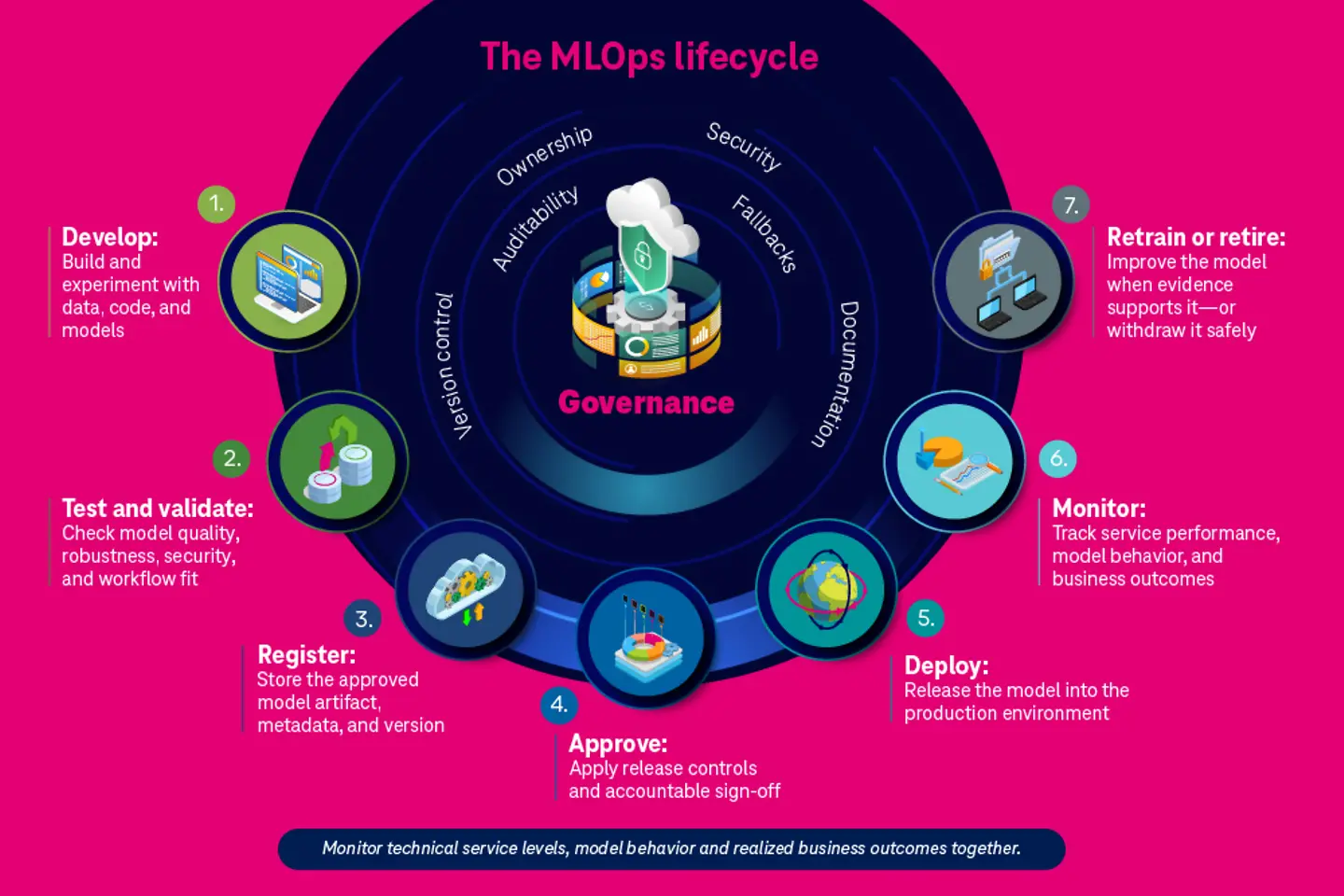
MLOps applies software engineering, data engineering, and operational practices to the machine learning lifecycle. Its purpose is to make model development reproducible, deployment controlled, and production behavior observable. It connects experimentation with the testing, release, monitoring, governance, and maintenance required for dependable enterprise services.
Teams version data references, code, dependencies, parameters, and model artifacts so that results can be reproduced and audited. Automated tests check data contracts, code, model quality, security, and integration before release.
Controlled deployment strategies, such as shadow, canary, or phased rollout, reduce the impact of unexpected behavior and support rollback.
Production monitoring should combine service metrics with model and business metrics. This may include availability, latency, input drift, output distribution, calibration, segment performance, override rates, user feedback, and realized outcomes.
Retraining should be triggered by evidence and managed iteratively, with every update following the same validation and approval controls as the original release.
Automation can orchestrate data validation, feature generation, training, evaluation, model registration, approval, deployment, monitoring, and alerts. The objective is not to remove governance, but to apply it consistently and create traceable evidence.
High-risk changes may still require explicit human review, while routine low-risk updates can follow predefined controls.
Machine learning is becoming more distributed, specialized, and integrated with generative AI. Future enterprise value will depend less on a single model and more on the ability to combine models, data, software, infrastructure, and human expertise securely. Efficiency, sovereignty, traceability, and lifecycle management will become as important as raw model capability.
Running inference close to the data source can reduce latency, bandwidth use, and dependency on continuous connectivity. Edge deployment is relevant for factories, vehicles, utilities, stores, and other environments that require rapid or resilient decisions.
Edge models require secure update mechanisms, device monitoring, hardware-aware optimization, and a plan for synchronizing feedback with central systems.
Organizations are increasingly comparing large general-purpose models with smaller models adapted to a specific domain or task. Smaller models can offer lower latency, lower cost, tighter control, and simpler deployment when the task is well defined.
Multimodal systems can combine text, images, audio, video, and structured data, but they also expand evaluation and governance requirements.
Privacy-enhancing approaches aim to extract value while reducing unnecessary data exposure. Federated learning trains across distributed data sources without centralizing all raw data, while techniques such as differential privacy and secure computation can reduce disclosure risks.
These methods introduce their own trade-offs in accuracy, complexity, communication, security, and auditability and should be selected for a defined need.
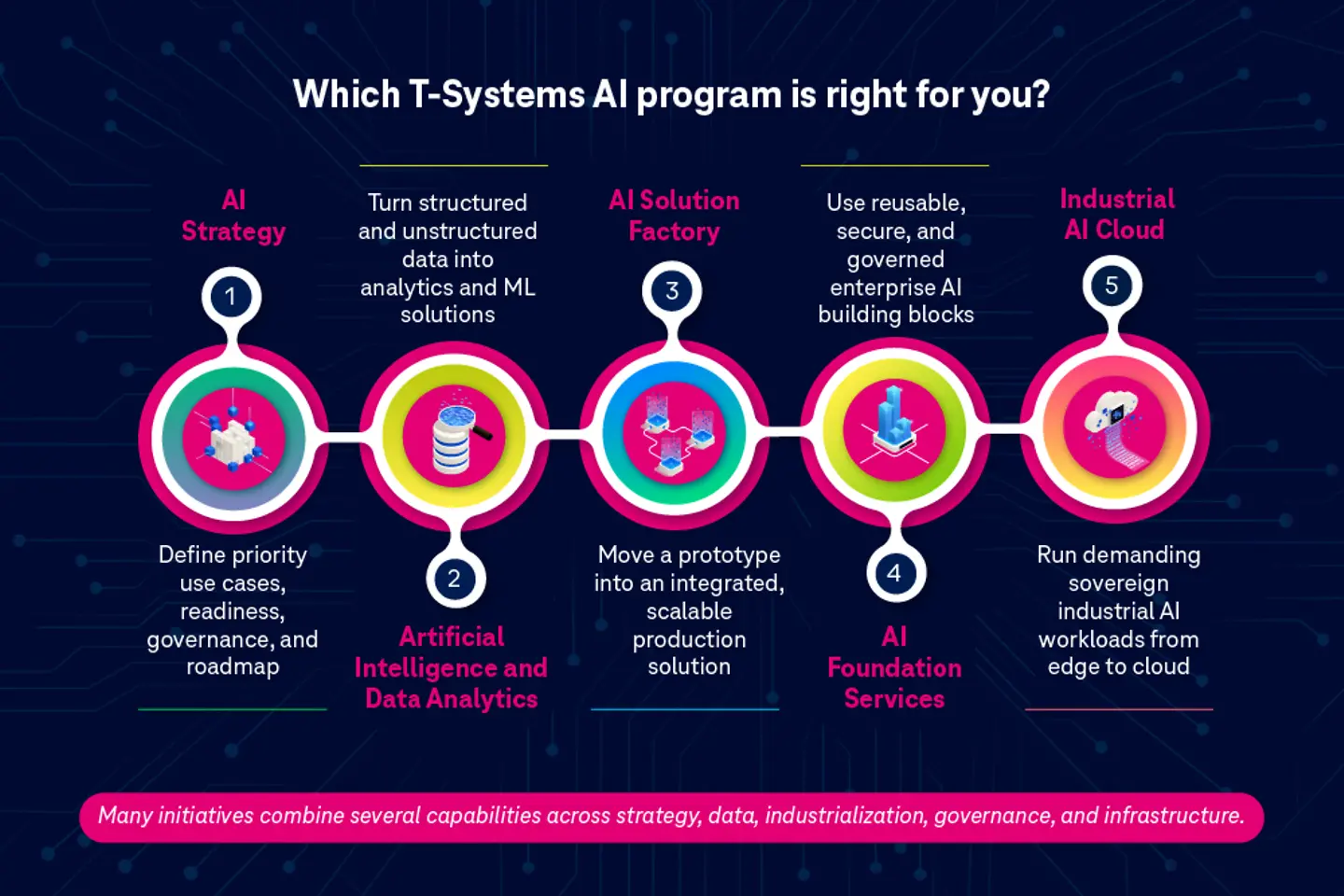
T-Systems can support the machine learning lifecycle from use-case and AI strategy development through data foundations, model engineering, infrastructure, integration, security, and operation. Relevant portfolio capabilities include AI Strategy, Artificial Intelligence and Data Analytics, AI Solution Factory, AI Foundation Services, and Industrial AI Cloud.
The appropriate combination depends on the use case, data sensitivity, latency, model complexity, sovereignty, and operating model.
Machine learning creates value when data, models, infrastructure, security, and business processes work together. T-Systems’ customer projects show how these elements can be combined across telecommunications, automotive, logistics, public infrastructure, network operations, and healthcare sectors. The examples range from establishing secure data foundations to deploying machine-learning models that detect anomalies, interpret images, optimize mobility, and support faster decisions.
For congstar, T-Systems developed a PSA-compliant security solution on AWS for analyzing anonymized data. The environment provides access to data-transformation and machine-learning tools while applying encryption, access controls, multi-factor authentication, logging, regional restrictions, and security automation. T-Systems later extended the environment into a multi-account landing zone, giving congstar a more flexible and secure foundation for developing additional analytics and machine-learning use cases.
An automotive manufacturer in China wanted to understand how drivers used connected-vehicle functions and apply those insights to future services and vehicle development. T-Systems extracted, cleaned, and modeled anonymized data from the connected-car backend and used public-cloud resources for analytics and machine learning. The browser-based service moved from idea to go-live in six weeks, enabling faster insights, new service opportunities, and continuous improvement of the driving experience.
A global logistics provider needed earlier warning of outages affecting customer-facing systems. T-Systems developed individual machine-learning models for anomaly detection using internal production metrics and external data. The models feed a real-time alerting system that informs customer-support and incident-response teams through email, SMS, and Teams Webhook. The solution also supports root-cause analysis, helping the customer resolve incidents more quickly, reduce downtime costs, lower support effort, and improve the end-customer experience.
In Hamburg’s 5G-LOGINNOV project, T-Systems and its partners analyzed data from 400,000 test journeys to examine how connected mobility solutions could improve truck traffic around the port. Machine learning and AI supported the evaluation of platooning, speed recommendations, and low-carbon mobility management. The recorded results showed a 59 percent reduction in time wasted due to congestion, 20 percent lower fuel consumption, and a 17 percent reduction in the carbon footprint.
Deutsche Telekom Technik used manually prepared Microsoft Visio drawings to plan and optimize space in its network operation centers. T-Systems developed the Data Transformator, a machine-learning-powered microservice that combines domain rules with computer-vision deep learning. It automatically recognizes and interprets objects in the drawings, makes the results available through a REST API and front-end application, and creates structured data that can support process automation and a holistic digital twin of the network center. The solution reduces manual effort, saves time, and supports lower operational costs.
Fuse-AI uses artificial intelligence to analyze MRI images and help radiologists identify abnormalities that may indicate cancer. Encrypted scans are processed using scalable resources from T Cloud Public, where the algorithm highlights abnormalities, adds metadata, and returns the results to the radiologist’s system. The solution is designed to support faster and more accurate diagnoses while meeting demanding requirements for secure infrastructure, data privacy, and scalability.
Fuse-AI uses artificial intelligence to analyze MRI images and help radiologists identify abnormalities that may indicate cancer. Encrypted scans are processed using scalable resources from T Cloud Public, where the algorithm highlights abnormalities, adds metadata, and returns the results to the radiologist’s system. The solution is designed to support faster and more accurate diagnoses while meeting demanding requirements for secure infrastructure, data privacy, and scalability.
Machine learning can improve forecasting, automation, risk detection, quality, and customer decisions when it is applied to the right problem and supported by reliable data and governance.
A practical next step is to identify one high-value decision, assess its data and risk profile, and design a measurable path from baseline to pilot and production. T-Systems experts can help evaluate the use case, architecture, controls, and operational model.
Machine learning is a way for computer systems to learn patterns from examples and apply those patterns to new data. Instead of receiving a separate rule for every case, a model is trained to produce an output such as a prediction, classification, recommendation, or anomaly score.
No. Artificial intelligence is the broader field of systems that perform tasks associated with intelligent behavior. Machine learning is one approach within AI. An AI system may also use rules, search, optimization, knowledge graphs, or several methods together.
The principal types are supervised learning, unsupervised learning, semi-supervised learning, self-supervised learning, and reinforcement learning. They differ in whether training uses labeled examples, unlabeled patterns, targets derived from the data itself, or feedback from actions.
During training, an algorithm iteratively adjusts model parameters to reduce errors or improve a defined objective on training data. Validation and test information is then used to check whether the model generalizes to unseen cases. In production, monitoring shows whether changing data requires recalibration or retraining.
The required data depends on the task. It must represent the inputs, outcomes, populations, and operating conditions in scope. Quality, permission, lineage, labels, update frequency, and the ability to collect future feedback are generally more important than volume alone.
Deep learning is a subset of machine learning that uses multilayer neural networks. It is particularly effective for complex images, audio, text, and video, but often requires more data, compute, and specialist controls. Traditional machine learning can be more suitable for structured data and interpretable decisions.
Predictive machine learning usually estimates a class, value, likelihood, ranking, or anomaly. Generative AI produces new content such as text, images, audio, or code. Both can use deep learning, and both require data governance, evaluation, security, and monitoring appropriate to their risks. LLMs are generative AI models designed for language tasks such as summarization, question answering, content generation, and chatbot responses. Both predictive and generative models can use deep learning, and both require data governance, evaluation, security, and monitoring appropriate to their risks.
MLOps is a set of engineering and operational practices used to version, test, deploy, monitor, govern, retrain, and retire machine learning models. It helps organizations move from one-off experiments to reproducible and supportable production services.
Feature engineering is the process of selecting, transforming, or creating variables that make raw data useful for a machine learning model. It may include scaling numerical values, encoding categories, extracting information from text or images, and reducing dimensionality.
Overfitting means a model performs well on training data but poorly on new data because it learned noise or overly specific patterns. Underfitting means it has not learned the important patterns and performs poorly on both training and test data.
Common tools include Python, scikit-learn, XGBoost, TensorFlow, PyTorch, Jupyter notebooks, and MLOps platforms. The right combination depends on the model family, data type, deployment environment, governance requirements, and the skills of the team.
1 AI Risk Management Framework, 2023, National Institute of Standards and Technology
2 European Commission, “AI Act.” Regulation (EU) 2024/1689
3 MLOps: Continuous delivery and automation pipelines in machine learning, Google Cloud Architecture Center, 2024, Google