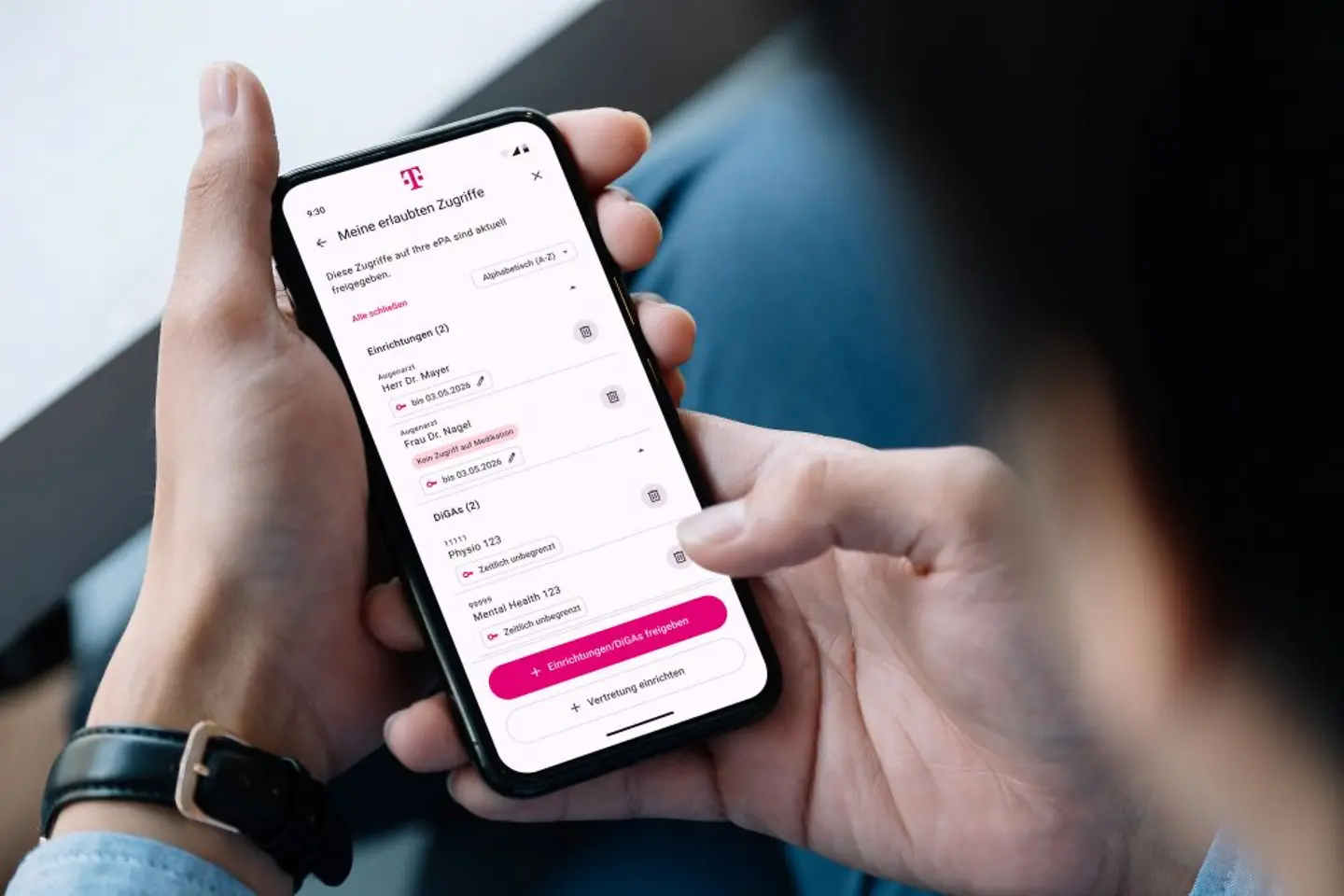
With the nationwide rollout of the electronic patient record (ePA) for all in 2025, it has become the central platform for interoperable digital healthcare. For statutory health insurers, it opens up new opportunities to improve care processes and offer insured individuals genuine added value. Findings, medical letters, and e-prescriptions are centrally available thanks to the ePA, making access to health information easier.
The electronic patient record is no longer merely a digital document repository. It is evolving into a central information platform for all stakeholders in the healthcare sector. Medical information is available where it is needed—securely, up to date, and across sectors. Open standards and interoperable interfaces ensure that health information can be exchanged across sectors between the systems involved.
In everyday clinical practice, the ePA is gradually filled with medical information. This includes, for example, findings from medical practices, discharge letters from hospitals, laboratory values, or medication information. Insured individuals can—depending on the available functions—additionally add their own health documents and manage their records in one central location. In this way, the ePA creates the foundation for digital care processes. Physicians, hospitals, and other service providers can access relevant information, provided the appropriate authorizations are in place. Patients and insured individuals retain control over their health data at all times.
For patients, the electronic patient record means above all one thing: they have their health information available in one central location—from findings and medical letters to medication information. This not only makes it easier for patients to keep track of their own medical history, but it can also significantly simplify changing doctors, hospital stays, or treatment in other European countries.
Because a further step towards networked care is the European perspective: people with chronic conditions will in future be able to use their electronic patient record in other EU countries as well. Health information will thereby become available across borders and support continuous treatment—whether while traveling or during a longer stay abroad in Europe.
Modern ePA solutions support structured health data and make it easier to search for medical information. This allows patients and authorized service providers to find relevant documents more quickly.
For health insurers, the ePA is far more than a digital mandatory programme. It forms the basis for modern health services while simultaneously strengthening the relationship with insured individuals. The focus is above all on a positive user experience. Many existing solutions suffer from complicated registration processes or low user-friendliness. The unfortunate consequence: although the ePA is fundamentally available, its potential is frequently not fully utilized.
At the same time, insured individuals retain control over their data at all times. Through the ePA frontend, they can track who has accessed their patient record, manage permissions, and individually determine which service providers are granted access. Objections to specific functions or data processing can also be managed conveniently. In this way, the ePA combines high user-friendliness with consistent data sovereignty for insured individuals.
A modern ePA therefore relies on simple access, barrier-free applications, and intuitive operation. For health insurers, this means less support effort, greater acceptance among insured individuals, and increased use of digital services.
Equally important is the simplest possible setup of the electronic patient record. A straightforward registration process, secure authentication, and intuitive user guidance make it easier for insured individuals to get started, build trust, and encourage regular use of the ePA app.
The success of the electronic patient record ultimately depends on its use. An ePA only creates added value when it is secure, intuitively operable, and genuinely helpful in everyday life for insured individuals. User-friendliness thus becomes just as important as data protection or technical performance.

Health data is among the most sensitive personal information of all. This is why data protection is not an additional feature, but rather the very prerequisite for insured individuals to accept digital health offerings. A modern ePA protects medical data consistently—not only during storage, but also during processing. Encrypted data storage, secure authentication, traceable access logs, and an infrastructure built to the highest security standards create transparency and trust. For secure access, modern identity solutions such as the GesundheitsID are used. It enables secure login to the electronic patient record and other applications within the telematics infrastructure.
Insured individuals decide for themselves which healthcare providers are permitted to access their electronic patient record. Through the ePA, authorizations can be managed, accesses traced, and—in accordance with legal requirements—objections to certain functions or data processing can be declared. Data protection therefore means not only technical security, but also transparency and control over one's own health data.
The true strength of the electronic patient record lies in making medical information available exactly where it is needed. Particularly when transitioning between a general practitioner, specialist, hospital, or pharmacy, the ePA helps make relevant health information available more quickly. This can prevent unnecessary duplicate examinations and facilitate coordination among all parties involved. In emergencies or unplanned hospital stays, relevant health information can also be made available more quickly—provided the appropriate authorizations are in place.
This helps reduce information gaps, accelerate processes, and support interoperable collaboration among health insurers, medical practices, hospitals, and other service providers. Physicians gain faster access to relevant documents, duplicate examinations can be avoided, and treatment workflows can be made more efficient.
The ePA also supports digital care processes such as the electronically assisted medication process. Current medication information is available in a structured format and facilitates collaboration among various service providers. In this way, the ePA directly contributes to sustainably improving the quality of care. At the same time, media discontinuities between medical practices, hospitals, and other service providers can be reduced. Health information becomes available more quickly where it is needed for treatment.
The future of the ePA does not end with the secure management of medical documents; it simultaneously creates the foundation for new digital health services. Value-added services can be integrated into the ePA ecosystem through standardized interfaces. These include, for example, individual recommendations based on the health data stored in the ePA, prevention offerings, or further digital health applications. Likewise, Digital Health Applications (DiGA) or additional digital health services can be integrated into the ePA ecosystem.
Conceivable examples include digital prevention offerings, individual health information, reminders for preventive check-ups, or personalized recommendations based on the health data stored in the ePA. In this way, the electronic patient record evolves from a document collection into an active health platform.
This creates new opportunities for health insurers to actively support insured individuals and provide personalized services. The ePA thus becomes a platform for innovative health offerings that go beyond the actual patient record and provide additional value.
The electronic patient record is provided by the health insurer and can be accessed through a corresponding app. After registration, insured individuals can view their health data, manage permissions, and track which service providers have accessed their data. Documents are added in the course of everyday treatment by authorized medical practices, hospitals, or other service providers. Depending on the design of the ePA, insured individuals can additionally upload their own documents and actively manage their health information.
Introducing a powerful ePA encompasses far more than developing an app. It requires a secure infrastructure, connectivity to the telematics infrastructure, digital identities, reliable operations, and the continuous further development of the platform.
T-Systems is the only provider in Germany to combine these competencies under one roof. From the development of the ePA records system and the frontend for insured individuals to deployment in the Open Sovereign Cloud, the sectoral identity provider, and ePA value-added services, T-Systems offers all key components from a single source.
For statutory health insurers, this means having a central partner with end-to-end responsibility—from implementation and operations through to further development. At the same time, they benefit from a sovereign, scalable, and secure platform that meets the growing demands of the digital healthcare sector.
T-Systems develops and operates the ePA, including its secure connection to the telematics infrastructure (TI). This includes, among other things, the GesundheitsID, secure communication services, and other key components for data exchange in the healthcare sector.
The electronic patient record is becoming the centerpiece of digital healthcare. It combines security with user-friendliness, strengthens user trust, accelerates care processes, and opens up space for new digital health services.
For health insurers, this represents an opportunity to not only meet regulatory requirements, but to also actively advance the care of their insured individuals. What matters here is a partner who thinks holistically about technology, security, and operations. With an end-to-end solution that brings together all the central components of the ePA from a single source, T-Systems supports health insurers in sustainably unlocking and leveraging the potential of the electronic patient record.
The electronic patient record (ePA) is a digital health record that statutory health insurers provide to their patients and insured individuals. This includes, for example, findings, physician letters, laboratory results, and medication information. The aim of the ePA is to make relevant health data securely available and to facilitate the exchange of information between insured individuals and authorized service providers. This enables treatments to be better coordinated and care processes to be made more efficient.
Like any digital solution, the ePA also places demands on technology, user-friendliness, and data protection. Complex registration processes or a confusing interface can make usage more difficult. At the same time, the processing of sensitive health data requires the highest security standards. Modern ePA solutions address these challenges with intuitive applications, encrypted data processing, and transparent authorization concepts. This is why data protection and data security play a central role in the development of modern ePA Solutions.
Yes. The ePA was developed specifically for processing sensitive health data. Modern solutions rely on encrypted data storage, secure authentication, and a protected infrastructure within the telematics infrastructure. In addition, accesses are logged, so that patients and insured individuals can track at any time who accessed their data and when.
Patients and insured persons retain control over their ePA. They can manage permissions and specify which healthcare providers are allowed to access their health data. In addition, it is possible to track when the patient record was accessed. Objections to certain functions or data processing can also be managed in accordance with the statutory requirements.
The electronic patient record contains medical information relevant to treatment. This includes, among other things, physician letters, findings, diagnoses, laboratory values, medication data, the electronic medication plan, e-prescriptions, vaccination information, and other health-related documents.
In everyday clinical practice, authorized service providers such as medical practices, hospitals, or pharmacies enter this information into the ePA. In addition, patients and insured persons—depending on the functionality of the respective ePA—can also add their own documents and thus complete their health record. This means that important information is available in one central location and can facilitate collaboration among those involved in treatment.
Yes. The electronic patient record is generally accessed through the app of the respective health insurer. A secure identification is required for the initial setup. Depending on the health insurer, this can be done, for example, via the online ID function (eID) of the identity card, a PostIdent procedure, or comparable identification methods. Access is then conveniently provided through the app and a secure digital identity such as the GesundheitsID.
Alternatively, many health insurers also offer identification using the electronic health card (eGK) via an NFC-enabled smartphone or in-person identification at a branch office. Which methods are available depends on the respective health insurer.
Patients and insured persons retain control over their electronic patient record at all times. Through the ePA frontend or the app of their health insurance provider, they can manage permissions and specify which healthcare providers are allowed to access their health data. In addition, they can track when their ePA was accessed.
The ePA is based on a legally regulated opt-out procedure. Insured persons can object to the establishment or use of certain functions and data processing in accordance with legal requirements and adjust their decisions at any time. This is generally possible through the ePA app. Patients and insured persons without a smartphone or without using the app can also declare their objection through their health insurance fund—for example, in writing or through the contact channels provided by the respective health insurance fund.
The ePA is being gradually expanded for cross-border use within Europe. With the appropriate authorization, relevant health information will in future also be available for medical care in other EU countries.
People with chronic illnesses benefit from this in particular. Since they are often treated by various physicians or facilities, the ePA enables a better overview of findings, diagnoses, and medication information. This facilitates coordination among the treating service providers and supports continuous care—both in Germany and, looking ahead, during stays within the EU.
Many physicians see great potential in the ePA to make information available more quickly and to improve collaboration among different service providers. However, the prerequisites for success are high user-friendliness, seamless integration into existing practice and clinic systems, as well as reliable data protection and security standards. The better these prerequisites are met, the more effectively the ePA can support everyday clinical care.