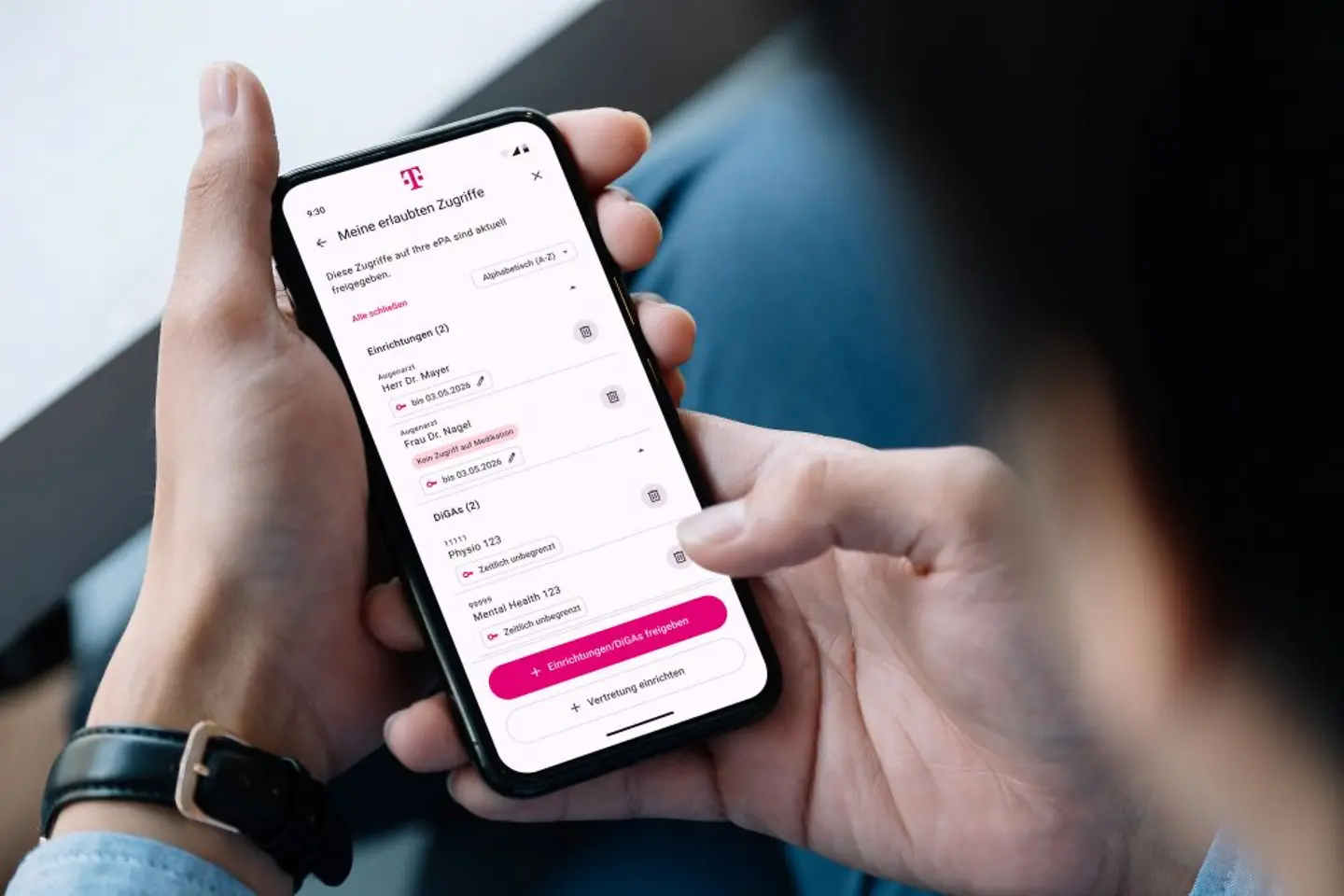
With the sovereign patient record, Deutsche Telekom/T-Systems is launching a new generation of electronic patient records onto the market. The company supplies both the platform and the modern, intuitive applications that health insurance providers make available to their customers.
“We take responsibility with our patient record—we offer a future-proof, sovereign, and trustworthy solution from a single source based on our T Cloud,” explains Gottfried Ludewig, Head of Public and Health at Deutsche Telekom, at the fourth Future Health Day. “Of what use is an ePA that is not used? Insured persons and health insurance companies expect a patient record that is secure, easy to use, and really helpful. That's exactly what we deliver.”
Deutsche Telekom/T-Systems is the only end-to-end provider of electronic patient records (ePA) in the German market: the product, the platform, and the operations are realized entirely from a single source, including sovereign and highly secure provision in the Open Sovereign Cloud, that is part of the T Cloud. The group's patient record is operated entirely in Germany, with all data—including metadata—being processed exclusively in German data centers certified to ISO 27001, BSI C5, and DIN EN 50600.
The sovereign patient record was designed to ensure scalability, modularity, and future viability at the outset. It addresses the weak points of existing ePA solutions, such as limited search functionalities, a lack of support for structured data, and insufficient research options.
The result is a system that not only meets today's legal and technological requirements, but is also prepared for future expansions and innovations. “Our customers don't just receive a product, but a reliable partnership,” says Ludewig.
Deutsche Telekom/T-Systems has been developing customized and secure digital solutions for years—from mobile applications and self-service portals to complex platform modules and specialist procedures for administration and healthcare. In the healthcare sector, the company can draw, in particular, on its experience with secure, interoperable data and platform solutions that can be seamlessly integrated into existing systems and enable the exchange of sensitive information across institutional boundaries.
User centricity is firmly anchored in the development and design process—requirements are developed along specific usage scenarios, for example. Security-related and compliance-relevant functions and information, such as consent processes, transparent data access, and reduced interaction requirements, are designed in such a way that they are comprehensible for insured persons. The sovereign patient record enables intuitive, barrier-free, and reliable access to health information. Deutsche Telekom has already won the German Brand Award several times for its brand and web projects.

With the sovereign patient record, we are laying the foundation for the next stage in the expansion of digital healthcare in Germany.
Another key advantage of the new patient record is its seamless integration into the existing Deutsche Telekom/T-Systems digital healthcare ecosystem. The solution is linked to services such as digital identities, the TI Messenger communication service, and future digital insurance services. This creates a networked system that health insurance companies can use to gradually expand and update their digital services—without media disruptions and parallel isolated solutions, and with significantly reduced integration work.
Deutsche Telekom/T-Systems will present the sovereign patient record for the first time at DMEA from April 21 to 23 in Berlin and show how the solution can be seamlessly integrated into the future vision of a digital ecosystem for insurance companies. The solution is currently undergoing the gematik approval process.
The motto of Deutsche Telekom's trade fair appearance is “Smart Health for Better Care—powered by Data & AI.” At the Bonn-based telecommunications group's stand in Hall 3.2, Stand A-103, the focus will be on sovereign patient records, security, artificial intelligence, hyperautomation applications, and data analytics applications, as well as modern, secure telematics infrastructure and digital identities.