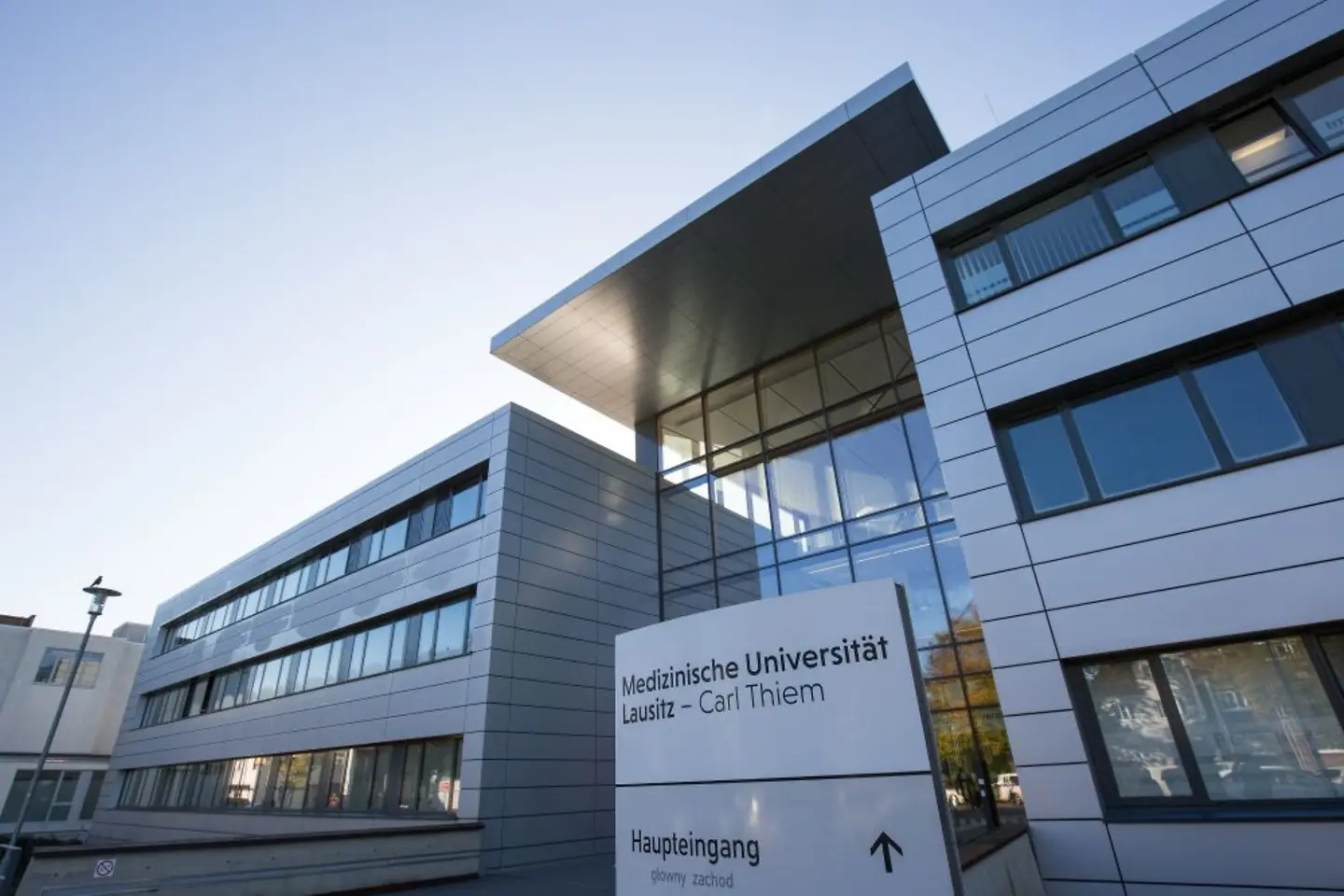
With the mission "Digital. From the ground up. For better healthcare", MUL – CT aims to become a "Model Region for Health Lausitz" and establish new care concepts. The goal: the development of the hospital into a leading location for students, teachers, and researchers in medicine. Further key areas of focus include testing the potential of digitalization in healthcare and health systems research. The state sees particular opportunities for future healthcare in the combination of homecare with telemedicine applications and AI-supported systems. The results from the Model Region for Health Lausitz and the new university hospital are intended to benefit other regions as well.
You can display all external content on the website at this point.
I agree that personal data may be transmitted to third-party platforms. Read more about this in our privacy policy.
How does a secure and scalable cloud infrastructure support the digitalization of a university medical center and the development of new care concepts for the healthcare of the future?
The transition to university medicine brought additional tasks and requirements for MUL–CT beyond hospital IT, particularly due to its focus on digitalization. The Cottbus campus had to maintain clinical operations while meeting growing demands to develop research and teaching infrastructure alongside patient care—the three core responsibilities of a university medical center.
At a university medical center, IT becomes the foundation for scientific work: data platforms, research environments, analysis capacities, and interfaces to other university hospitals and research networks must be established. The use of artificial intelligence places specific requirements on a data center (GPUs). In addition, teaching operations become an independent IT application area.
But MUL – CT goes one step further: in its digital strategy, MUL – CT enshrines the outstanding importance of digitalization for the healthcare of the future. The university hospital sees digitalization as an essential pillar of its mission. It therefore needed a future-proof solution for infrastructure capacities, even as it planned to introduce digital identities as a model university. As a KRITIS-classified institution, MUL – CT must pay particular attention to its information security and the availability of its systems. The focus here is on the reliable care of patients.
As a part of an ideas competition, the MUL – CT examined various options for how the existing IT resources on the clinic campus in Cottbus could be supplemented to support the planned growth. The compelling concept from T-Systems laid the foundation for a long-term innovation partnership and the development of a private cloud tailored to the specific requirements of clinical operations—because it is not being created on the drawing board.
The outsourcing of the production environments to T-Systems' high-security data center network in Magdeburg/Biere proved to be the best solution. The existing location on the campus in Cottbus was to serve as a disaster recovery site and for workloads requiring physical proximity to the campus. Since the hospital operated its application landscape on Cisco technology, T Cloud for Health presented itself as the target platform. The cloud-first strategy was rounded off by the use of T Cloud Public for the research and teaching environment. The Cottbus server location was henceforth to serve as a disaster recovery location. For compliance reasons, the university hospital decided on its own installation of T Cloud for Health.
An important advantage: The platform can be further developed without forcing MUL – CT into a fundamental redesign of its network and security concept. Existing networks and security rules can continue to be used. This reduces dependency on individual technologies and vendors and creates flexibility in the selection and adoption of future solutions.
The site distribution also follows the requirements of clinical operations. Cottbus remains in productive use for latency-sensitive applications and is simultaneously designated as a fallback and recovery site. The Magdeburg and Biere sites complement the environment. Each site is designed to assume the full required capacity, if needed. This enables the platform to absorb both individual site failures and the failure of an entire region.
As part of building the new platforms, MUL – CT will also be piloting digital identities from the fourth quarter of 2026. To do so, it will use the innovative MUL – CT App as a master key for all MUL – CT use cases for its employees and students. The solution from T-Systems is based on the EUDI Wallet technology, an ID wallet developed by Deutsche Telekom. It allows proof of personal identity using the ID card via electronic ID and PIN, as well as Local Ident with an ID card without a PIN at the MUL – CT HR department. The digital identity is also provided from the T Cloud (Open Sovereign Cloud with confidential computing). In addition, MUL – CT will draw on SOC/SIEM security services (Security Operations Center/Security Information and Event Management) from Deutsche Telekom.
"As a new university medical center, we need to bring together patient care, research, and teaching. With T-Systems, we are creating the digital foundation to grow with these tasks and test new care concepts for Lusatia. What is decisive for us is a partner who thinks cloud infrastructure, digital identities, and IT security together and supports our development in the long term."
With the new hybrid cloud infrastructure from the highly secure data center, the Medical University of Lusatia – Carl Thiem has a platform that effectively supports future growth. Medical applications receive a proven and secure operating platform, while research and teaching applications have the necessary resources available at all times, including for short-term peak loads.
With the new cloud backbone, MUL – CT gains the necessary IT capacities to fulfill its research mandate, namely to develop recommendations for the healthcare of the future. The T Cloud for Health has a broad certification basis. This guarantees the highest level of security, even for the medical environment. By the end of 2026, the migration of more than 600 applications from 1,700 VMs of the hospital to the new production environment in Magdeburg/Biere is set to begin.
With the EUDI Wallet, the university hospital is already relying on digital identities that introduce user-friendly and secure identification processes for employees and students.
ISG rates Deutsche Telekom/T-Systems as a Leader in five categories of the study "Private/Hybrid Cloud – Data Center Services, Germany 2026" as well as in the category Hyperscaler Infrastructure and Platform Services in the study "Multi Public Cloud Services, Germany 2026". The study "Cybersecurity – Services and Solutions, Germany 2026" also confirms leading positions in Technical Security Services and Next-Gen SOC/MDR Services. This means that T-Systems has the cloud and security expertise to support MUL – CT as a long-term innovation partner.