Like any other year, 2025 was an eventful year. In my view the past 12 months have been game changing in the way European businesses are considering their risks and how to address those risks. The geopolitical tensions between the three global power hubs, and in particular the rising tensions between the US and Europe, have accelerated digital sovereignty discussions within Europe. The European Commission has clearly articulated visions to augment Europe’s ability to compete in the global technology race and committed significant fundings to build out more digital sovereign solutions within Cloud and AI technologies.
The background is the unfortunate rising mistrust in the US as an allied. Events during the year, like the shut-down of Ukraine’s access to Starlink satellites, revoked access to mail accounts and sanctioned persons at the International Criminal Court, talks about inaugurating allied countries like Canada and Greenland (part of the Danish Kingdom), and trade wars with tariffs as an outcome, have all contributed to the rising concerns. Hence, the burning question becomes: What if Europe’s technology dependency on American tech companies can be used as strategic means against European organizations? What if access to a public cloud is shut down or significantly reduced for a few days, a week, or potentially even longer? What will that mean for the companies and institutions running their core business dependent on these platforms? These are questions we never thought we would have to ask ourselves but unfortunately have to now. Closing our eyes is not an option. In addition, there are privacy concerns of US surveillance laws like the Cloud Act and FISA.

Very recent, the Danish military intelligence agency published their newest threat analysis to the Danish Kingdom (Danish Defence Intelligence Service, Outlook 2025, 2025). In the report’s main conclusion, it is stated: “The United States now uses its economic and technological strength as a means of power, including against allies and partners.”
It is a historic turning point in the portrayal of Denmark’s most important ally since the Second World War.
It depicts Europe is at a crossroad and digital sovereignty has never been more important. It’s timely diligence to ask the “what if” question and make profound actionable decisions ensuring resilience of European companies and institutions. To be clear, this is not a message to run away from American technology at full speed, but a call to revisit the approach to Cloud and technology used more broadly and ask yourself the questions above and ensure your future setup reflects that you keep your sensitive data on platforms that are not subject to interventions from outside Europe. It means a Hybrid Cloud approach is more relevant than ever.
Throughout the past year we have met a substantial number of clients to discuss digital sovereignty. As the year progressed, it was clear the interest gained significant momentum, not least from regulated companies and entities. From exploring if there actually are any relevant European Cloud alternatives in the market (there definitely is), to understanding what digital sovereignty is and how it impacts the risk assessment of the organization, to assessing European platforms via deep dive workshops and proof-of-concepts, to clients also taking actions on signing commercial agreements and starting their build and migration activities.
One note here: There still seems to be some way to go in fully appreciating that European options vary significantly in maturity and enterprise readiness.
We have seen this progressive movement within Financial Services, Public Sector, Pharma and small-medium enterprises that are delivering digital services to highly regulated industries such as the financial sector, life science, and healthcare. My take is the industry, broadly, will come next. I will come back to why.
At the end of November, we took the initiative to set the foundation for a Danish community around our leading European Cloud, Open Telekom Cloud. In just six weeks, from idea to execution, more than 140 engaged people, from executives to students, from the private and public sector, techies and business focused, took part in a full day event with keynote speakers from Danish Industry, the German-Danish Chamber of Commerce, and 2021.AI.
It illustrates the desire to not only learn about European alternatives but taking concrete actions. On stage, we had the pleasure announcing a new strategic partnership with SoftwareOne/Crayon. An agreement that enables SoftwareOne/Crayon to offer sovereign European cloud to their clients, which is available already today. And this is only the beginning of a growing partnership community around our Open Telekom Cloud.
There is no way around that as an organization, you need to do your homework and conduct the needed evaluations of different European Clouds. Features and services are indeed relevant. To what extent offers the European Cloud platform services that enables easy workload deployment and user rights for an example. But perhaps even more importantly, which security standards can the platform live up to and which European and industry regulations does it comply to? There are many aspects, which needs to be evaluated.
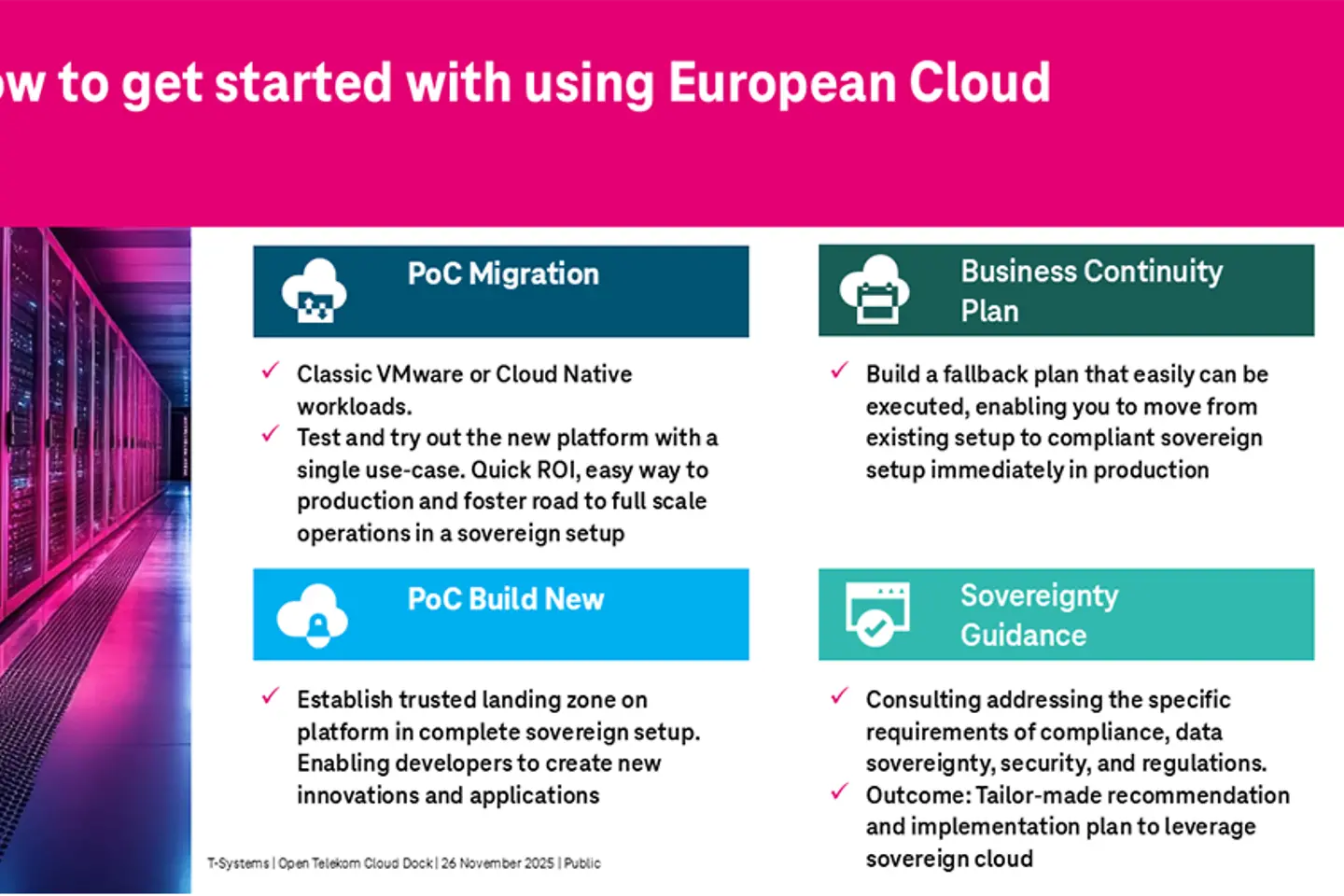
What we see from our many client conversations is, when the platform is examined, there are typically four ways to get started (see graphic). Most likely the traditional way of getting started is a proof of concept, either from migrating an existing workload or application, or enabling your developers to build from scratch. But many organizations sit with a vast and complex application landscape. So, what should be moved to a more sovereign platform and what makes sense to move? These questions can be hard to answer top of mind, why sovereignty guidance on your application landscape can be very relevant.
This year has very much been around understanding the business risks we are facing and looking into European cloud alternatives to traditional hyperscalers. Another unavoidable topic is AI. The promises of AI remain great, and it is paramount to remain competitive. But as with this year’s discussions around sovereign cloud, the same concerns around utilization of AI are now emerging.
We are not discussing digital sovereignty because of the technology, but because it is instrumental for our business resilience. Which data has been used to train the models my business is using, and will my business-critical data be used to further train the model? Where is my data during the entire operations and can I remain compliant to the regulations my organization is affected by? These questions are extremely relevant because the fuel for AI modelling is our sensitive, business-critical data - our most valuable asset.
I’m confident we will talk much more about Sovereign AI in the coming year. A discussion where the business of the organization will be involved. It all falls under the same umbrella: Digital sovereignty. And we are not discussing it because of the technology, but because it is instrumental for our business resilience.
This year, we can celebrate two milestones. Our Open Telekom Cloud turns 10-years and is the leading European public cloud with platform services, GPUs for AI, and the most extensive security and regulation certified platform in Europe. At the beginning of February, we open our Industrial AI Cloud, offering 10,000 GPUs, that are connected to our existing cloud portfolio. That means, T-Systems is one of the few that can offer sovereign Cloud and AI at massive scale in Europe.