
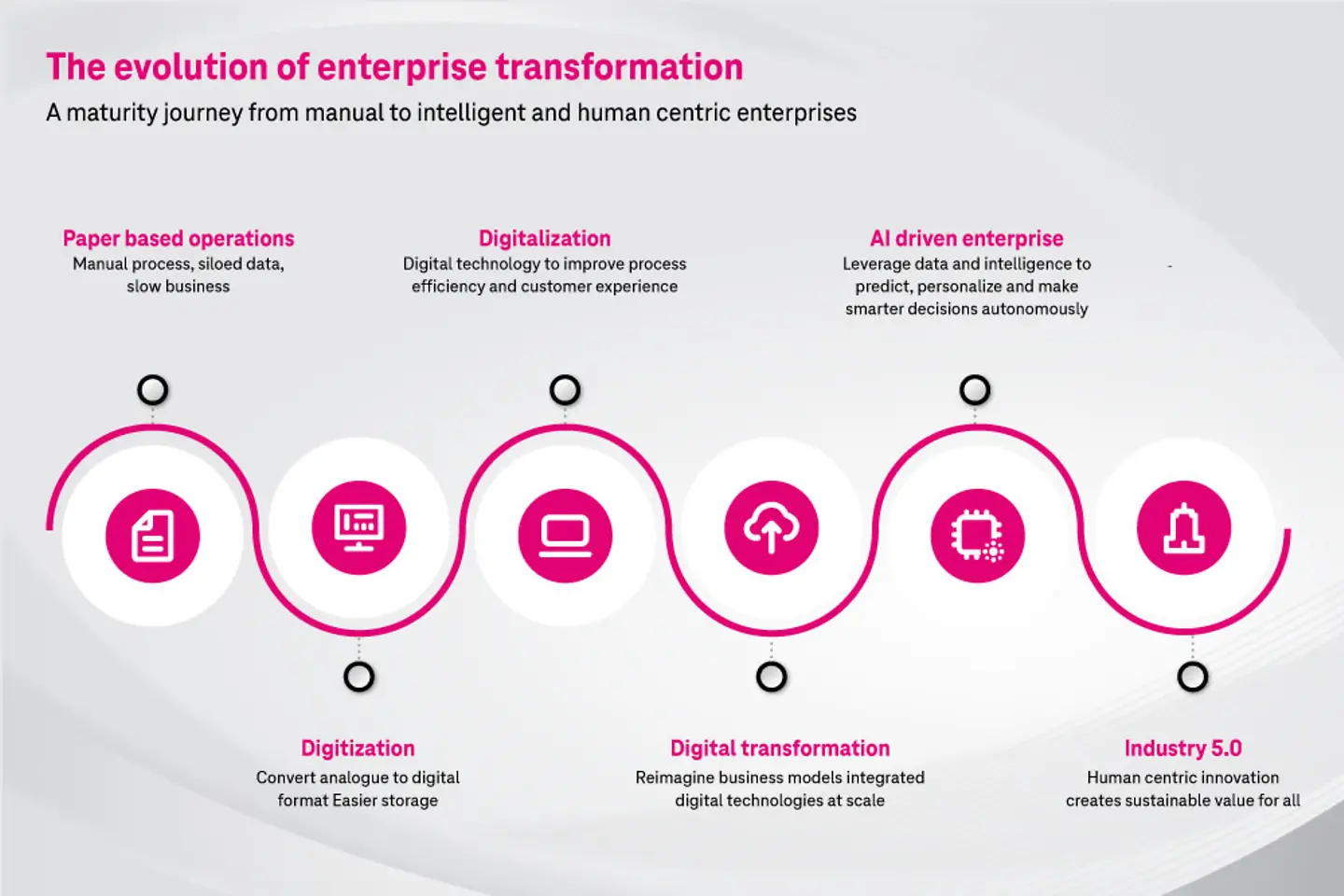
Digital transformation is one of the most widely used terms in business today, yet it is often misunderstood. Organizations frequently use digitization, digitalization, and digital transformation interchangeably, even though they represent different stages of business evolution. Understanding these distinctions is essential because each stage requires different investments, leadership priorities, technologies, and success metrics.
Digitization is the process of converting physical or analog information into digital formats. It is the first step on the transformation journey because digital data forms the foundation for every modern business process.
Examples of digitization include scanning paper invoices into searchable PDFs, converting engineering drawings into digital files, creating electronic patient records, or replacing paper-based contracts with digital documents.
While digitization improves accessibility and reduces manual record keeping, it does not fundamentally change how an organization operates. A paper form that becomes a PDF is still the same process, only in a digital format.
Enterprise perspective
Digitization creates digital information but delivers only incremental business value unless organizations use that data to redesign their processes and decision-making.
Digitalization builds on digitization by using digital technologies to improve existing business processes. Instead of simply converting information into digital formats, organizations redesign workflows to become faster, more efficient, and less dependent on manual intervention.
For example, rather than emailing scanned invoices between departments, a finance team might implement an automated approval workflow integrated with its ERP system. Customer service teams may replace traditional call centers with omnichannel engagement platforms that connect voice, email, chat, and self-service portals. Manufacturers can integrate production planning with supply chain systems to improve visibility and reduce delays.
Digitalization focuses on improving the way work gets done. Organizations often realize measurable benefits through increased productivity, reduced operational costs, faster decision-making, and improved customer experiences.
Enterprise perspective
Digitalization optimizes existing business models. It makes organizations more efficient but does not necessarily redefine how they create value.
Digital transformation represents a fundamental shift in how an organization operates, competes, and delivers value. It combines technology, people, data, processes, and culture to create new business capabilities and operating models.
Unlike digitalization, digital transformation is not limited to improving existing processes. It challenges organizations to rethink products, services, customer experiences, supply chains, and even revenue models.
Consider the evolution of a manufacturing company. A digitized organization stores production documents electronically. A digitalized organization automates production planning and quality management. A digitally transformed organization connects factories, suppliers, engineering teams, and customers through AI-powered platforms, digital twins, predictive analytics, and real-time operational intelligence. Decisions become increasingly data-driven, operations become more autonomous, and innovation accelerates across the enterprise.
Digital transformation is therefore not defined by the technologies an organization deploys, but by the business outcomes it achieves.
Enterprise perspective
Successful transformation enables organizations to become more resilient, innovative, customer-centric, and capable of responding continuously to change.
Executive Insight
Technology is the catalyst, not the destination. Goal is not simply to adopt more technology.
Organizations rarely achieve competitive advantage by implementing cloud platforms or AI alone. They succeed by redesigning business processes, empowering employees with data-driven insights, and creating operating models that continuously evolve alongside customer and market demands. Digital transformation is therefore best understood as a long-term business strategy rather than a technology initiative.
Rather than viewing digitization, digitalization, and digital transformation as separate initiatives, enterprises should think of them as successive stages of maturity.
Digitization creates digital information.
Digitalization improves how work is performed using that information.
Digital transformation uses data, technology, and organizational change to reinvent how businesses create value.
Organizations that stop after digitization often accumulate large volumes of digital information without improving business performance. Those that focus only on digitalization become more efficient but may struggle to compete with organizations that redesign products, services, and customer experiences using AI, cloud platforms, and connected ecosystems. Digital transformation is therefore an ongoing journey toward becoming an intelligent enterprise—one where decisions are driven by trusted data, operations are increasingly autonomous, and innovation becomes part of everyday business.
For modern enterprises, digital transformation extends beyond technology modernization. It requires organizations to rethink every aspect of how they operate.
It changes how leaders make strategic decisions by replacing intuition with real-time data and predictive analytics. It enables employees to collaborate across functions using integrated digital platforms. It strengthens customer relationships through personalized, omnichannel experiences. It allows operations teams to optimize production using AI, industrial IoT, and digital twins. It improves resilience by embedding cybersecurity, governance, and compliance into the design of digital services rather than treating them as afterthoughts.
Most importantly, digital transformation enables organizations to respond faster to disruption. Whether adapting to changing regulations, entering new markets, managing supply chain volatility, or adopting emerging technologies such as generative AI, digitally mature enterprises are better equipped to innovate with confidence.
For European organizations, this transformation must also be grounded in trust. Compliance with regulations such as GDPR, the EU AI Act, NIS2, and sector-specific frameworks is no longer simply a legal requirement—it is becoming a competitive differentiator. Organizations that embed privacy, security, transparency, and governance into their transformation strategies are more likely to build lasting customer trust while accelerating innovation.
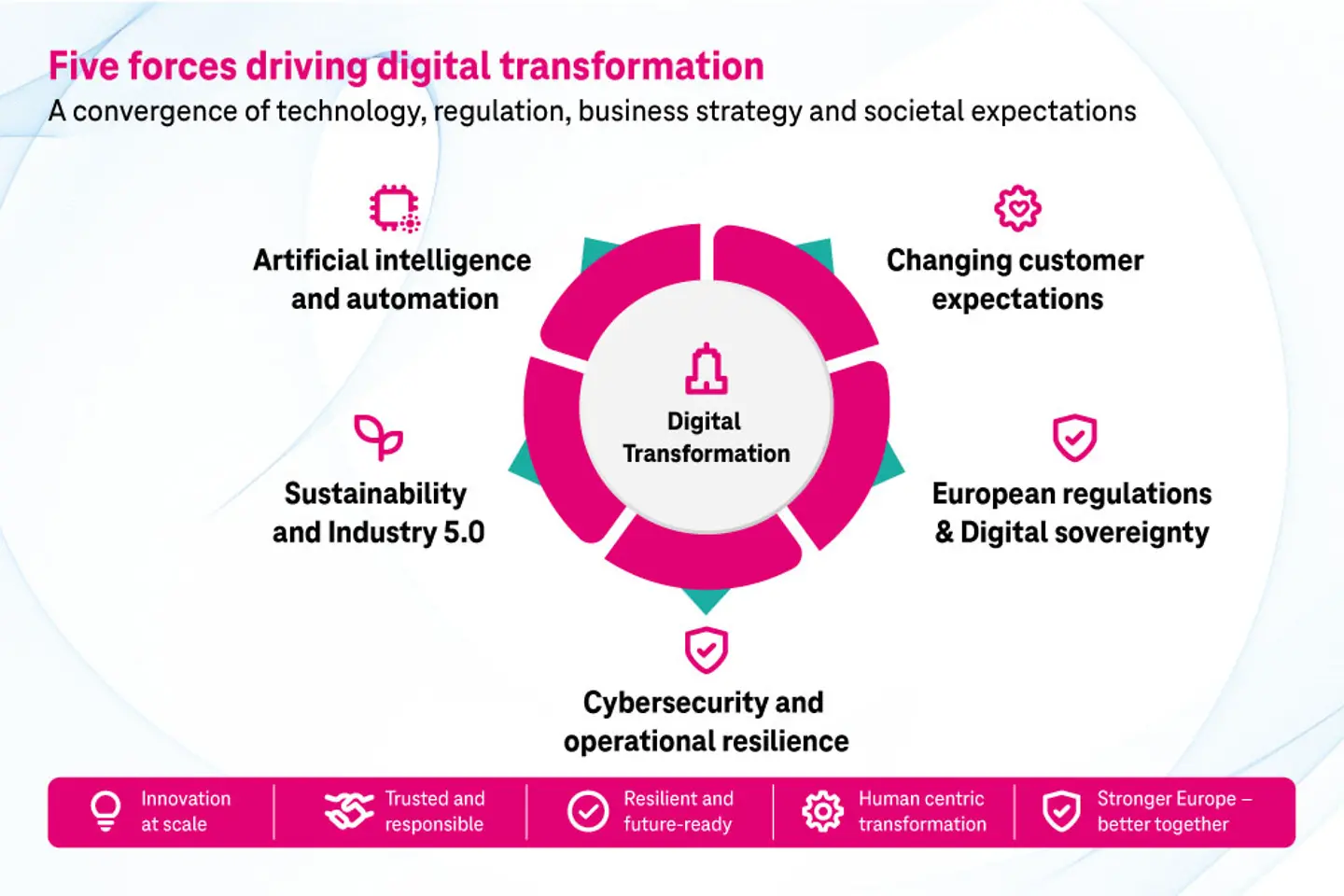
At a high level, digital transformation in the United States and Europe is driven by many of the same forces: AI, cloud computing, automation, data, cybersecurity, changing customer expectations, and the need to modernize legacy systems. The difference lies less in the technologies themselves and more in the business environment in which organizations deploy them. US enterprises often operate in a comparatively market-led environment where technology adoption, commercial scale, venture investment, and speed to market are strong transformation drivers. The US does have extensive privacy, cybersecurity, sector-specific, and federal and state requirements, but its regulatory landscape is generally more fragmented than the EU's. Organizations can therefore encounter different requirements depending on their industry, state, and use case. At the same time, the US has developed voluntary, risk-based approaches such as the NIST AI Risk Management Framework, which provides organizations with a flexible way to manage AI risks across the lifecycle.
Europe approaches transformation within a more harmonized regulatory and policy environment. GDPR established a common framework for protecting personal data across the EU, while newer legislation such as the EU AI Act and Data Act adds further requirements and expectations around responsible AI, data access, transparency, and digital markets. The European Commission describes the AI Act as a risk-based framework with obligations that vary according to the potential risk posed by an AI system. This means that European enterprises increasingly need to consider privacy, security, governance, transparency, data residency, and regulatory compliance as part of the transformation architecture itself, rather than treating them as separate compliance activities.
This difference can influence how organizations approach cloud, AI, data platforms, and digital ecosystems. A US enterprise may primarily evaluate a technology investment through scalability, performance, speed, and commercial potential. A European enterprise is likely to consider those factors alongside questions such as: Where is the data processed? Who controls the infrastructure? Can the organization demonstrate compliance? How will personal or sensitive data be protected? What happens if a critical cloud provider becomes unavailable? Can an AI system be governed throughout its lifecycle? These considerations have contributed to growing interest in digital sovereignty and sovereign cloud capabilities in Europe.
However, regulation should not be viewed simply as a barrier to transformation. It can become an architectural principle and, ultimately, a competitive advantage. Designing privacy, security, explainability, resilience, and governance into digital services from the beginning can increase customer trust and make technologies easier to scale across regulated markets. Europe's approach is therefore increasingly about finding the balance between innovation and trust.
There is also an important economic dimension. Europe's enterprise landscape includes many industrial companies, manufacturers, SMEs, and highly regulated organizations operating across multiple countries and languages. The European Commission's 2026 Digital Decade assessment notes continued progress in business adoption of cloud, data analytics, and AI, while also identifying persistent gaps in advanced technology adoption, digital skills, computing capacity, and infrastructure. Transformation therefore often involves not just adopting new technologies, but connecting complex industrial ecosystems, modernizing long-lived legacy environments, and creating secure data-sharing capabilities across organizational and national boundaries.
For enterprise leaders, the lesson is not that one model is better than the other. The US model often emphasizes speed, scale, and market-led innovation; the European model places greater emphasis on innovation within a framework of trust, resilience, privacy, and sovereignty. European organizations that can combine these strengths—moving quickly while designing for compliance, security, and responsible innovation—can turn Europe's regulatory complexity into an advantage rather than a constraint.
Digital transformation can take different forms depending on what an organization is trying to change. While there is no single universally accepted classification, four types are particularly useful for enterprise leaders: process transformation, business model transformation, domain transformation, and cultural and organizational transformation. In practice, large transformation programs often combine all four.
Process transformation
Process transformation focuses on changing how work gets done. Organizations redesign inefficient, manual, or fragmented processes and use technologies such as automation, AI, cloud platforms, analytics, and IoT to make them faster, more intelligent, and more scalable.
For example, a manufacturer might move from manually monitoring production equipment to using connected sensors, real-time analytics, and AI-powered predictive maintenance. A healthcare provider might automate administrative workflows and connect patient information across systems to reduce duplication and improve care coordination.
The objective is not simply to automate an existing process. The greater opportunity is to rethink the process itself and determine which activities should be eliminated, simplified, automated, or augmented by people and AI.
Business model transformation
Business model transformation changes how an organization creates, delivers, or captures value. Digital technologies can enable organizations to move beyond traditional products and services and develop entirely new revenue streams.
A manufacturer, for example, can evolve from selling equipment to offering equipment-as-a-service, supported by connected assets, remote monitoring, predictive maintenance, and performance analytics. An automotive company can build new digital services around connected vehicles and customer data. A traditional retailer can combine physical stores with digital platforms, personalized services, and data-driven customer engagement.
This type of transformation is often the most strategic because it can change an organization's competitive position and relationship with its customers.
Domain transformation
Domain transformation occurs when digital technologies enable an organization to expand into adjacent business areas or fundamentally reshape an existing domain.
Artificial intelligence is accelerating this type of transformation. Technologies such as AI, digital twins, cloud computing, and advanced analytics are enabling manufacturers to move into areas such as predictive services, digital engineering, and intelligent operations.
Domain transformation can also occur across industry boundaries. A technology-enabled mobility provider, for example, may increasingly operate across transportation, data services, energy, and customer experience rather than within a traditional automotive value chain.
For European enterprises, ecosystem-based transformation is becoming increasingly important as companies participate in cross-industry data spaces and connected value networks.
Cultural and organizational transformation
The fourth type focuses on the organization itself: its people, skills, leadership, culture, operating model, and approach to innovation.
Technology adoption cannot deliver transformation if employees continue to work within outdated structures and incentives. Organizations need new digital skills, cross-functional collaboration, agile ways of working, data-driven decision-making, and leadership models that support continuous experimentation and learning.
This dimension is particularly important when organizations introduce AI. Employees need to understand not only how to use AI tools, but also when to trust their outputs, how to protect sensitive information, and where human judgment must remain part of the decision.
The four types work together
These four types should not be treated as independent transformation programs. They are interconnected.
A manufacturer introducing AI-powered predictive maintenance is undertaking process transformation. If it begins selling equipment based on guaranteed uptime, it may also be pursuing business model transformation. If it develops a new digital services business around connected assets, it is undertaking domain transformation. And if employees, leadership structures, skills, and decision-making processes need to change to support these capabilities, it is also undergoing organizational transformation.
This is why enterprise digital transformation should be viewed as a coordinated change in capabilities rather than a collection of technology projects.
For European organizations, each type also needs to be considered through the lens of trust, regulation, cybersecurity, data governance, and digital sovereignty. A transformation that creates a new AI-enabled service, for example, must consider not only its commercial potential but also how personal data is processed, how AI risks are governed, and how critical infrastructure and information are protected.
The most successful enterprises therefore ask not simply “Which technology should we adopt?”, but “What do we need to transform, what business value will it create, and what capabilities do we need to make that change sustainable?”
Digital transformation does not begin with selecting a cloud platform, deploying an AI solution, or replacing a legacy application. It begins with a business question: What does the organization need to become, and what needs to change to get there?
A digital transformation strategy translates that ambition into a coordinated plan for changing the way an enterprise operates, creates value, serves customers, and responds to disruption. It connects business priorities with technology, data, people, processes, and governance.
For European enterprises, that strategy must also account for a factor that is increasingly inseparable from business transformation: trust. Data privacy, cybersecurity, regulatory compliance, digital sovereignty, and responsible AI need to be considered from the beginning rather than added after technology decisions have already been made.
Without a clear strategy, transformation can quickly become a collection of disconnected technology projects. One department migrates to the cloud. Another introduces AI. A third automates processes. Meanwhile, legacy systems continue operating in parallel, data remains fragmented, and employees struggle with multiple tools and processes.
The result may be more technology without meaningful transformation.
A strategy provides the connection between individual initiatives and enterprise-level outcomes. It helps leaders decide which capabilities should be modernized, which processes should be redesigned, where automation or AI can create value, and which investments should take priority.
It also creates a common direction across business and technology teams. Instead of asking, “Which technology should we implement?”, organizations can ask more valuable questions:
This shift from technology-first thinking to outcome-first thinking is one of the most important characteristics of successful enterprise transformation.
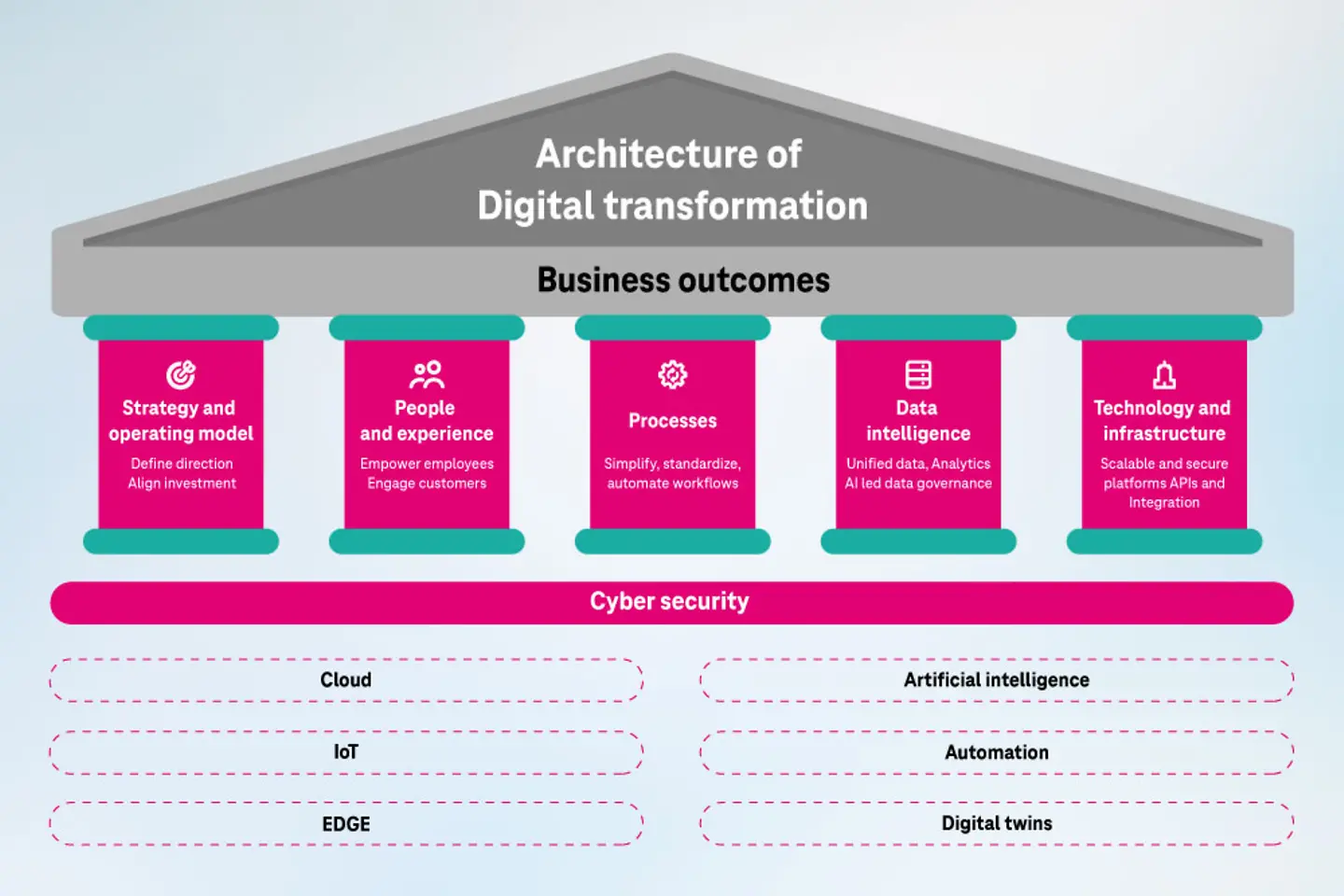
While every transformation is different, successful programs tend to bring together seven interconnected building blocks.
Business strategy and leadership
Transformation requires clear business ambition and visible executive sponsorship. Leaders need to define the outcomes they want to achieve, establish priorities, allocate investment, and make decisions when transformation requires changes to established ways of working.
The CIO, CTO, CDO, COO, and business leaders therefore need to work as one transformation leadership team rather than pursuing separate technology and business agendas.
Customer and employee experience
Transformation should improve experience, not simply internal systems.
For customers, this could mean more personalized services, seamless omnichannel interactions, faster response times, or connected products.
For employees, it could mean easier access to information, intelligent assistants, automated administrative work, better collaboration tools, or decision support powered by AI.
The strongest transformation programs consider both experiences together because employees ultimately shape the customer experience.
Processes and operating models
Legacy processes often become the hidden barrier to transformation.
Automating an inefficient process does not necessarily make it a good process. Enterprises should first identify unnecessary steps, duplicated activities, approval bottlenecks, manual handovers, and organizational silos.
The objective is not simply to automate today's processes. It is to determine which processes should be redesigned, simplified, automated, augmented by AI, or eliminated altogether.
Data and intelligence
Data is the connective tissue of the digital enterprise.
Organizations need reliable, accessible, governed data to support analytics, AI, automation, forecasting, and real-time decision-making. This requires more than collecting additional data. Enterprises must establish data ownership, quality standards, governance, interoperability, and secure access.
For European businesses, data strategy also needs to address privacy, data residency, sovereignty, and sector-specific requirements.
The rise of AI makes this even more important. An organization cannot build reliable AI capabilities on fragmented, inaccurate, or poorly governed data.
Technology and infrastructure
Technology provides the foundation on which transformation is built.
Depending on the business objective, this may include cloud computing, edge computing, AI and machine learning, industrial IoT, APIs, enterprise applications, digital twins, automation platforms, cybersecurity technologies, and modern data platforms.
However, modernization does not always mean replacing everything. A pragmatic strategy determines which legacy systems should be modernized, integrated, retired, or retained.
The objective is to create a technology environment that is scalable, secure, interoperable, and flexible enough to support future innovation.
People, skills, and culture
Technology can be deployed relatively quickly. Organizational capability takes longer to build.
Transformation changes roles, responsibilities, workflows, and decision-making. Employees therefore need the skills, tools, incentives, and confidence to work differently.
Organizations should invest in digital skills, AI literacy, leadership development, cross-functional collaboration, and continuous learning. They also need to involve employees early enough that transformation is something they help shape rather than something imposed on them.
Governance, security, and trust
Governance is often treated as a control function. In a digitally transformed enterprise, it becomes an enabler of scale.
Organizations need clear governance for technology architecture, data, cybersecurity, AI, privacy, compliance, and third-party risk.
For European enterprises, this includes designing transformation around requirements such as GDPR, NIS2, DORA, the EU AI Act, and relevant sector regulations.
The principle should be simple: security, privacy, and compliance by design.
When trust is built into the transformation architecture from the beginning, organizations can innovate faster without creating unacceptable risks later.
Once the transformation ambition and priorities are clear, enterprises need a practical roadmap.
A useful roadmap typically moves through five stages.
Assess the current state
Start by understanding where the organization stands today.
Assess technology architecture, applications, infrastructure, data quality, processes, cybersecurity, organizational capabilities, customer journeys, and digital maturity.
The objective is not to catalogue every weakness. It is to identify the capabilities that most directly affect strategic priorities.
Define the transformation ambition
Translate the business strategy into a clear future state.
What should the organization look like in three to five years? Which customer experience should change? Which processes should become digital or autonomous? Where can AI create measurable value? Which capabilities will differentiate the organization from competitors?
Ambition should be measurable rather than expressed only through technology terms.
Prioritize transformation initiatives
Not every opportunity should become a project.
Prioritize initiatives according to business value, feasibility, risk, strategic relevance, dependencies, and time to value.
A useful portfolio usually combines:
Foundational initiatives that modernize infrastructure, data, security, and applications.
Performance initiatives that improve existing operations and customer experiences.
Innovation initiatives that explore new AI capabilities, digital products, services, and business models.
This balance prevents organizations from spending the entire transformation budget on either legacy modernization or experimental innovation.
Build the roadmap
Transformation should be delivered as a sequence of connected capabilities rather than one enormous program.
Early initiatives should establish foundations while delivering visible business value. Later initiatives can build on those foundations and scale across the enterprise.
For example:
Modernize
Connect
Automate
Predict
Transform
A manufacturer might first modernize its infrastructure, then connect production assets, automate repetitive processes, introduce predictive analytics, and ultimately create AI-driven autonomous operations.
Measure and adapt
A transformation roadmap should never be considered fixed.
Technology, regulations, customer expectations, and competitive conditions change continuously. Enterprises therefore need regular reviews to assess whether initiatives are delivering their intended outcomes and whether priorities need to change.
The roadmap should evolve as the organization learns.
Executive insight
The strongest transformation strategies are not technology roadmaps disguised as business strategies. They are business strategies enabled by technology. Start with the outcome, design the capabilities required to achieve it, and only then determine which technologies can provide those capabilities.

Digital transformation is enabled by a combination of technologies rather than a single platform or solution. The right technology mix depends on an organization's business objectives, industry, digital maturity, and regulatory environment. The most important technologies provide capabilities for connecting operations, managing data, automating work, generating intelligence, and scaling innovation.
Cloud computing provides the flexible infrastructure needed to modernize applications, scale computing resources, and access new digital services without building every capability internally. Hybrid and sovereign cloud models are particularly relevant for European enterprises managing sensitive data or regulated workloads.
Artificial intelligence (AI) and machine learning turn enterprise data into predictions, recommendations, and automated decisions. Generative AI is extending this capability into knowledge work, software development, customer service, engineering, and employee assistance, while industrial AI can optimize production, maintenance, quality, and supply chains.
Data platforms and analytics provide the foundation for turning fragmented information into actionable intelligence. They bring together data from enterprise applications, machines, customers, and external ecosystems and enable organizations to move from reporting what happened to predicting what could happen next.
Internet of Things (IoT) and edge computing connect physical assets to digital systems. Sensors can continuously capture information from machines, vehicles, buildings, and infrastructure, while edge computing enables real-time processing close to where data is generated.
Digital twins create digital representations of physical assets, products, or processes. They allow organizations to simulate scenarios, test changes, optimize performance, and identify potential problems before making changes in the physical world.
Automation and intelligent workflows reduce manual effort and accelerate business processes. Combined with AI, automation can move beyond repetitive tasks toward intelligent process orchestration and decision support.
Cybersecurity technologies provide the trust layer required to operate a connected enterprise. Identity management, zero-trust architectures, encryption, threat detection, and resilient infrastructure protect increasingly distributed digital environments.
Other technologies, including 5G, APIs, modern enterprise applications, robotics, blockchain, and advanced connectivity, can provide additional capabilities depending on the transformation objective.
The critical point is that these technologies create the greatest value when they work together. A connected factory, for example, may combine IoT, edge computing, cloud, data platforms, AI, digital twins, automation, and cybersecurity. The transformation does not come from any one of these technologies. It comes from connecting them to a business process and a measurable outcome.
For European enterprises, technology selection must also consider privacy, data sovereignty, interoperability, regulatory compliance, sustainability, and long-term resilience. The question is therefore not “Which technology should we adopt?” but “Which combination of technologies will help us achieve our strategic outcome securely and sustainably?”
Digital transformation rarely fails because an organization cannot deploy technology. More often, it fails because the organization tries to transform technology without transforming the business around it.
The frequently quoted 70% failure rate should therefore be treated with caution. Different studies define transformation “failure” differently, and the evidence does not support a single universal failure percentage. What is clear, however, is that many transformation initiatives struggle to deliver their expected business value. The reasons are remarkably consistent.
Unclear business objectives are one of the biggest problems. When transformation begins with a technology such as AI or cloud rather than a clearly defined business outcome, organizations can end up implementing impressive technology without solving an important problem.
Lack of executive ownership is another common barrier. Transformation requires decisions about investment, processes, organizational structures, skills, and priorities. Without sustained leadership sponsorship, initiatives can become isolated projects owned by individual departments.
Legacy technology and fragmented data can also limit progress. Organizations may modernize individual applications while leaving the underlying architecture disconnected. AI and automation initiatives then struggle because the data they depend on is incomplete, inconsistent, or inaccessible.
Organizational silos create a similar problem. Customer journeys, supply chains, manufacturing operations, finance, IT, and HR often cross departmental boundaries, yet transformation programs can still be designed around individual functions. The technology may work, but the end-to-end process remains broken.
Perhaps the most underestimated factor is people and change management. Employees may not understand why transformation is happening, lack the skills to use new tools, or perceive new technologies as a threat rather than an opportunity. Even a technically successful implementation can fail to generate value if adoption remains low.
Transformation can also become too ambitious. Large organizations sometimes attempt to modernize everything simultaneously, creating complex programs with long timelines and uncertain benefits. A better approach is to establish a clear transformation ambition, prioritize high-value use cases, build the required foundations, and scale what works.
Finally, security, privacy, and governance can be treated too late. This is particularly risky in Europe, where GDPR, the EU AI Act, NIS2, DORA, and sector-specific requirements can influence how digital services are designed and operated. Discovering compliance or security constraints after implementation can delay or even derail a transformation initiative.
The strongest defense against these failure patterns is to treat transformation as a continuous business change program. Start with outcomes, involve the people affected, establish strong governance, modernize the foundations, measure adoption and business value, and adapt the roadmap as the organization learns.
Ultimately, successful digital transformation is not about completing a technology project. It is about creating an enterprise that can continuously turn technology into measurable business value.

As enterprises become more digital, they also become more dependent on data, cloud platforms, connected devices, AI, APIs, and increasingly complex technology ecosystems. This expands the potential attack surface and means that cybersecurity and regulatory compliance can no longer be addressed after a transformation project has been designed. They need to become part of the transformation architecture from the beginning.
This is particularly important in Europe, where digital transformation takes place within a comprehensive regulatory environment. The GDPR establishes principles for processing personal data, including data minimization, purpose limitation, security, and accountability. NIS2 extends cybersecurity risk-management and incident-reporting requirements across 18 critical sectors, including healthcare, energy, transport, manufacturing, digital infrastructure, and public administration. Financial institutions must also address digital operational resilience under DORA, while organizations deploying AI increasingly need to understand their responsibilities under the EU AI Act.
For enterprises, this changes how transformation should be designed. Cloud migration, for example, needs to consider where sensitive data is stored and processed, who can access it, how identities are managed, and how services remain available during disruption. An AI initiative requires attention to data quality, transparency, human oversight, cybersecurity, and governance depending on the system and its risk classification. Connected factories and IoT environments require protection across both information technology (IT) and operational technology (OT).
The answer is security, privacy, and compliance by design. Identity and access management, zero-trust principles, encryption, continuous monitoring, resilient infrastructure, data governance, secure software development, and incident-response capabilities should be integrated into transformation programs rather than implemented as separate controls later.
This approach is especially important in regulated industries. Healthcare organizations must protect sensitive patient information while enabling secure data exchange. Pharmaceutical companies need traceability, data integrity, and validated digital processes. Defense and public-sector organizations may require particularly strong controls over sensitive information, infrastructure, supply chains, and data sovereignty.
Compliance should therefore not be viewed only as a constraint on innovation. When governance requirements are translated into reusable architectures, controls, and processes, they can provide a trusted foundation on which new services can scale. GDPR itself combines protection of individual rights with a harmonized framework for personal-data processing across the EU.
For European enterprises, digital trust is becoming part of digital competitiveness. Organizations that can demonstrate that their digital services are secure, resilient, transparent, and responsibly governed can innovate while maintaining the confidence of customers, employees, partners, and regulators.
The objective is not simply to become compliant. It is to build an enterprise in which security, compliance, and trust enable transformation rather than slow it down.

Digital transformation takes different forms across industries, but the underlying principle remains the same: connecting people, processes, data, and technology to create measurable business value. Three T-Systems examples illustrate how this works in practice.
Public-sector transformation goes beyond putting services online. The real challenge is connecting fragmented applications, data, and administrative processes so citizens experience government as one connected service.
In Tarragona, Spain, T-Systems is supporting the city's digital transformation by consolidating previously separate municipal systems through the TAO 2.0 platform and private cloud. The approach improves interoperability, collaboration, transparency, and process efficiency while creating a foundation for further digital services.
Transformation principle: Connect systems and data around the citizen journey rather than individual departments.
Read the Tarragona digital transformation success story
Healthcare transformation must balance better patient experiences and operational efficiency with privacy, security, interoperability, and regulatory requirements.
Digital technologies can connect healthcare data, automate administrative work, support clinical decision-making, and enable new services such as telemedicine. T-Systems highlight interoperable healthcare data and secure AI capabilities as important foundations, including solutions that can support administrative tasks while keeping sensitive data within controlled environments.
Transformation principle: Use digital technology to reduce administrative friction and give healthcare professionals more time for patient care.
Read the T-Systems perspective on digital transformation in healthcare
In automotive, digital transformation is changing the vehicle itself. Connected vehicles, software-defined architectures, cloud platforms, AI, digital twins, and over-the-air updates are transforming how vehicles are developed, manufactured, updated, and experienced.
T-Systems highlight digital twins and virtual factory environments as ways to simulate production scenarios before making physical changes. Connected ecosystems and data-sharing initiatives can also help manufacturers and suppliers collaborate more effectively across increasingly complex value chains.
Transformation principle: Connect the product, production environment, ecosystem, and customer throughout the lifecycle.
Read more about digitalization in the automotive industry
What these examples have in common
Whether transforming a city, healthcare organization, or automotive ecosystem, successful transformation moves beyond isolated technology projects. The value emerges when technology, data, processes, people, and governance work together around a clear business or societal outcome.
This is particularly important in Europe, where digital transformation must combine innovation with security, privacy, resilience, interoperability, and digital sovereignty.
Digital transformation should not be measured by the number of applications migrated, AI pilots launched, or processes automated. The real test is whether transformation creates measurable business value and builds capabilities that can scale.
A useful measurement framework should combine four dimensions.
Business value: Track outcomes such as revenue growth, cost reduction, productivity, time to market, customer retention, asset utilization, or operational efficiency. These should be linked directly to the original transformation objectives.
Customer and employee outcomes: Measure customer satisfaction, digital adoption, service resolution times, employee productivity, and adoption of new digital tools. A technically successful solution that nobody uses is not a successful transformation.
Technology and operational performance: Monitor application availability, automation rates, data quality, cloud performance, cybersecurity incidents, and the speed at which new digital capabilities can be deployed.
Transformation health: Track whether initiatives are progressing, whether teams have the required skills, and whether new ways of working are becoming embedded in the organization.
For European enterprises, measurement should also include privacy, compliance, resilience, and sustainability where these are material to the transformation.
Digital transformation is entering a new phase. The focus is shifting from adopting individual technologies to combining them into intelligent, connected, and increasingly autonomous business capabilities.
AI is becoming embedded across the enterprise. Generative AI, AI agents, predictive analytics, and industrial AI are moving beyond experimentation into customer service, engineering, software development, operations, and decision-making. The next challenge will be scaling AI responsibly while maintaining human oversight, security, and measurable business value.
Cloud is becoming more strategic. Enterprises are moving beyond simple cloud migration toward hybrid, multi-cloud, edge, and sovereign architectures. In Europe, digital sovereignty is becoming an increasingly important consideration in decisions about critical infrastructure, data, AI, and cloud services. The European Commission's 2026 technology sovereignty initiatives explicitly focus on strengthening European capabilities in AI, cloud, semiconductors, and open source.
Data ecosystems are expanding beyond organizational boundaries. Industry data spaces and interoperable platforms will enable companies to exchange data with suppliers, customers, partners, and public institutions while maintaining appropriate control.
Digital twins and industrial AI will accelerate the move toward intelligent operations. Organizations will increasingly combine real-time data, simulation, AI, and automation to predict problems and optimize physical operations before intervention is required.
Cyber resilience and digital trust will become transformation priorities. As dependency on digital infrastructure grows, security, privacy, identity, resilience, and regulatory compliance will increasingly be designed into transformation architectures from the beginning.
Finally, digital skills will become as important as digital infrastructure. Europe's 2026 Digital Decade assessment highlights continuing gaps in advanced technology adoption and specialist skills despite progress in cloud, analytics, AI, and connectivity.
The direction is clear: the next generation of digital transformation will be AI-powered, data-driven, connected, secure, sovereign where necessary, and increasingly autonomous. The enterprises that benefit most will be those that combine technological ambition with strong governance, skilled people, and a clear focus on business outcomes.