
Digital sovereignty refers to the ability of governments, organizations, and societies to control their digital technologies, infrastructure, and data according to the regional laws, values, and strategic priorities.
In practical terms, digital sovereignty means maintaining control over how digital technologies are deployed, where data is stored and processed, and who can access critical systems. As digital transformation accelerates across industries, these questions are becoming central to national security, economic stability, and corporate strategy. For example, digital sovereignty in public administration ensures governments retain control over their data, infrastructure, and digital processes while using secure, transparent, and sovereign digital platforms.
Cloud computing, AI, and advanced data analytics are transforming how organizations operate. At the same time, they increase reliance on complex digital ecosystems and external technology providers. In response, governments and enterprises are placing greater emphasis on digital sovereignty to ensure that innovation does not come at the expense of security, compliance, or independence.
Digital sovereignty therefore provides the foundation for secure digital transformation and resilient digital ecosystems.
This growing dependence on digital technologies creates new opportunities but also introduces risks. Organizations can become dependent on external providers or subject to foreign legislation that governs access to their data. Concerns about unauthorized data access, vendor lock-in, and disruptions to critical services have therefore become key drivers of digital sovereignty strategies.
Digital sovereignty addresses these risks by ensuring that organizations maintain control over their digital environment. It enables companies and governments to protect sensitive information, safeguard intellectual property, and ensure that critical digital services remain reliable.
At the same time, digital sovereignty does not mean isolation. Most organizations continue to rely on global digital ecosystems for innovation and scalability. The challenge lies in balancing technological independence with access to advanced technologies and international collaboration.
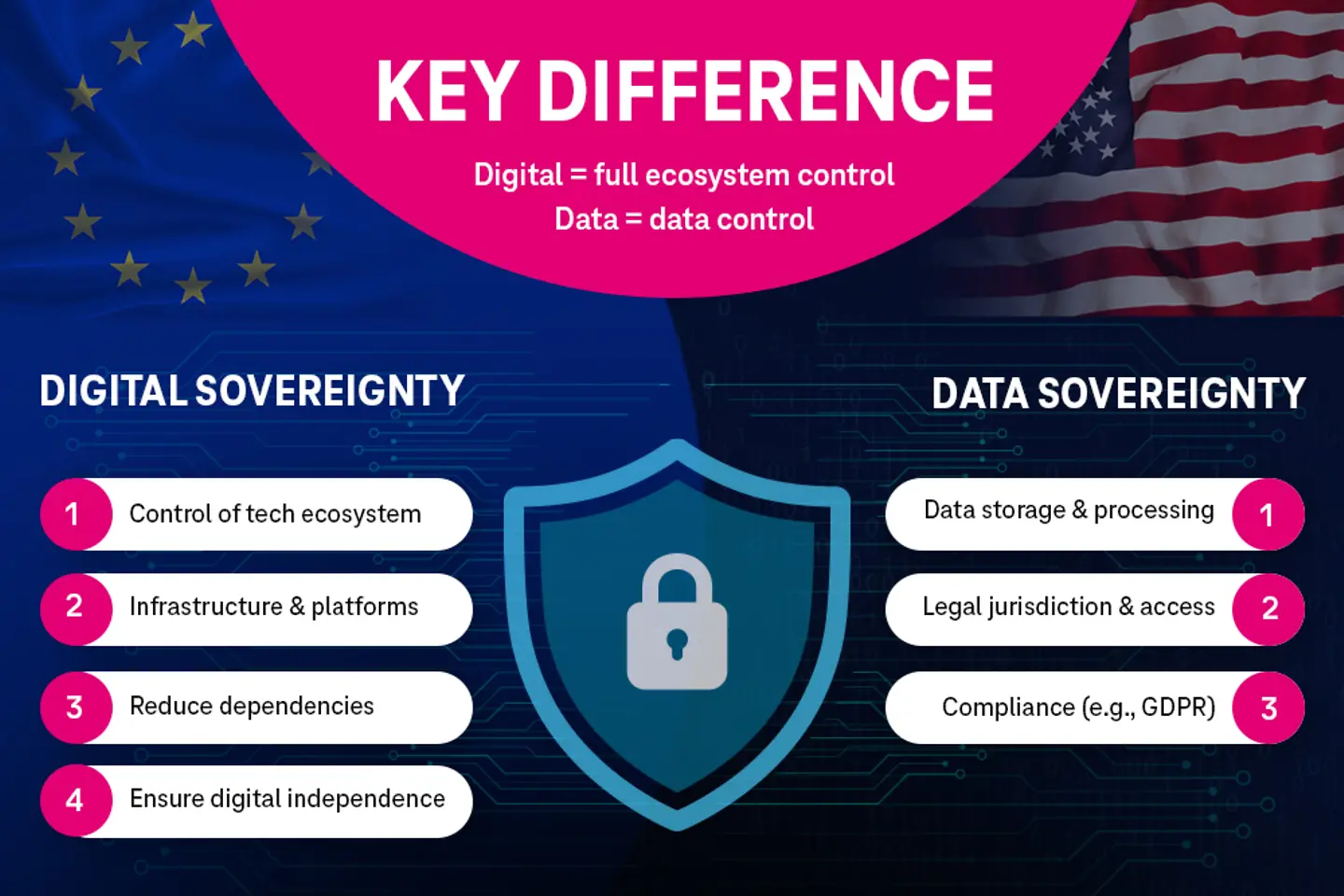
Data sovereignty focuses specifically on the control and legal governance of data, while digital sovereignty covers a broader scope that includes control over digital infrastructure, technologies, platforms, and supply chains. Data sovereignty is therefore one component of the wider concept of digital sovereignty.
Digital sovereignty operates across several interconnected dimensions that together determine the resilience and independence of digital ecosystems.
Data sovereignty ensures that organizations retain full authority over their data. They determine where data is stored, who can access it, and how it is processed.
In cloud environments, maintaining data sovereignty requires strong encryption, access management, and clearly defined data governance policies. Organizations must also ensure that data can be exported, transferred, or deleted when required. These measures help prevent unauthorized access and ensure compliance with legal and regulatory requirements.
Operational sovereignty refers to the ability to run digital systems independently of specific technological platforms.
Organizations should be able to deploy applications in different environments, such as private infrastructure, managed services, or cloud platforms. This flexibility ensures that they can migrate workloads if needed and avoid dependence on a single vendor. Operational sovereignty therefore strengthens resilience and business continuity.
Technological sovereignty focuses on transparency and control over the technologies that power digital systems.
Open standards and open-source software can support technological sovereignty because they allow organizations to audit code, verify security mechanisms, and reduce the risk of hidden dependencies or backdoors.Together, these three dimensions form the foundation for secure and resilient digital ecosystems.
Digital sovereignty ultimately depends on robust digital infrastructure. Data centers, networks, cloud platforms, and AI computing resources form the technological backbone of modern economies. Strengthening regional digital infrastructure has therefore become a strategic priority in many countries. Investments in high-performance computing and AI infrastructure aim to support innovation while reducing reliance on external technology ecosystems. Strong infrastructure also improves resilience. Organizations can maintain critical services even during geopolitical disruptions or supply chain challenges.
Cloud computing plays a central role in digital transformation. It enables organizations to scale services quickly, collaborate globally, and deploy new technologies such as AI. However, traditional public cloud environments may raise concerns about data residency, jurisdiction, and operational control. To address these challenges, organizations are increasingly exploring sovereign cloud solutions.
A sovereign cloud combines the advantages of modern cloud platforms with mechanisms that ensure compliance with regional sovereignty requirements. These mechanisms typically include strict data residency rules, enhanced security controls, and transparent governance of cloud operations. Organizations can therefore benefit from cloud scalability and innovation while maintaining control over critical data and infrastructure.
In practice, most organizations adopt hybrid approaches that combine different infrastructure models. Private infrastructure may offer the highest level of sovereignty, while public cloud platforms provide scalability and advanced services. Hybrid and multi-cloud strategies allow organizations to balance these trade-offs effectively. In this context, private cloud in the age of digital sovereignty is gaining importance, offering greater control, customization, and alignment with regulatory requirements as part of a broader sovereign strategy.
European digital policy plays an important role in shaping digital sovereignty strategies.
Several major regulatory frameworks influence how organizations manage data and digital technologies:
Together, these regulations aim to ensure that digital innovation aligns with European values such as privacy, transparency, and security.
Digital sovereignty is not limited to Europe. Governments around the world are developing strategies to strengthen control over digital infrastructure and technologies. The EU emphasizes regulatory frameworks, privacy protection, and open digital ecosystems. The United States focuses primarily on innovation and market-driven technology leadership. China, meanwhile, pursues a model centered on national control over digital infrastructure and digital platforms. These different approaches reflect broader political and economic priorities and illustrate how digital sovereignty has become a key element of global technology policy.
Cybersecurity is a fundamental pillar of digital sovereignty. Organizations must protect digital infrastructure from cyberattacks, espionage, and unauthorized access. Modern cybersecurity strategies often include strong encryption, secure identity management, continuous monitoring, and regular security audits. Many organizations also implement zero-trust architectures that require verification for every access request. Protecting digital infrastructure ensures that critical services remain operational even in times of crisis and that sensitive data remains secure.
For companies, digital sovereignty represents both a challenge and an opportunity. Organizations must balance innovation with regulatory compliance and operational resilience. Many companies begin by identifying critical digital assets and assessing the regulatory requirements that apply to them. Based on this analysis, they design infrastructure architectures that combine private infrastructure, public cloud functionality, and sovereign cloud platforms such as Open Sovereign Cloud from T-Systems.
External technology partners often play an important role in this process. Organizations rely on specialized expertise to design secure architectures, implement compliance frameworks, and support digital sovereignty initiatives.This combination of internal capabilities and external expertise enables companies to achieve the level of sovereignty required for their specific industry and risk profile.
Corporate sovereignty describes an organization’s ability to maintain control over its digital operations and strategic technologies. Companies strengthen corporate sovereignty by diversifying technology providers, adopting hybrid and multi-cloud architectures, and building internal expertise in critical digital capabilities. These strategies allow organizations to remain agile while protecting their data, infrastructure, and intellectual property.
Digital sovereignty will continue to evolve as technologies such as artificial intelligence, edge computing, and advanced data platforms reshape digital ecosystems. Organizations and governments must therefore adopt flexible strategies that balance sovereignty with innovation. The goal is not isolation but strategic autonomy—the ability to participate in global digital ecosystems while maintaining control over critical technologies and data. For Europe and Germany in particular, strengthening digital sovereignty will remain essential for ensuring technological resilience, economic competitiveness, and secure digital transformation.
You can display all external content on the website at this point.
I agree that personal data may be transmitted to third-party platforms. Read more about this in our privacy policy.
The future of your cloud is sovereign. Managing sensitive data in today’s world requires the best sovereign cloud. Scalability, functionality, and sovereignty – choose the levels based on your needs. Explore our video to learn more about leading sovereign cloud solutions for Europe.
No, digital sovereignty is relevant for both governments and private organizations. While governments focus on national security and public infrastructure, companies apply digital sovereignty to protect business data, ensure compliance, and maintain control over their digital operations.
Digital sovereignty is both a strategic and technical topic. Strategic decisions define how much control an organization needs, while technical implementation ensures that systems, data, and platforms meet those requirements.
Yes, SMEs can address digital sovereignty by selecting compliant service providers, understanding where their data is stored, and avoiding reliance on a single vendor. The level of complexity may differ, but the core principles remain the same.
No, digital sovereignty does not inherently slow down innovation. Organizations aim to adopt technologies in a way that meets regulatory and security requirements while still enabling innovation. The focus is on controlled and responsible use of technology.
Digital sovereignty is not measured by a single metric. Instead, it is assessed based on factors such as control over data, flexibility in infrastructure, compliance with regulations, and independence from specific providers.
Yes, requirements vary by industry. For example, sectors such as healthcare, finance, and public services often face stricter regulatory requirements compared to other industries, influencing how they implement digital sovereignty.
No, digital sovereignty is an ongoing process. As technologies, regulations, and business needs evolve, organizations must continuously adapt their strategies and systems.
Not necessarily. Many organizations integrate digital sovereignty principles into existing environments. This may involve adapting architectures, adding controls, or diversifying providers rather than replacing entire systems.
Digital sovereignty encourages reducing dependency on a single provider. By designing flexible architectures and using interoperable technologies, organizations can avoid vendor lock-in and maintain greater control over their systems.
No, digital sovereignty differs across regions. Countries apply different regulatory frameworks and policy approaches, which influence how organizations implement and prioritize digital sovereignty.