
Big data is information whose scale, speed, diversity, or complexity makes it impractical to manage with conventional, centralized data systems alone. It can include transactions from ERP and CRM systems, clickstreams from digital channels, machine and sensor signals, log files, documents, images, audio, and other information generated continuously across an enterprise.
The distinction is important: big data is not simply a very large database. Traditional systems are optimized mainly for predictable, structured records, and well-defined queries. Big data environments must accommodate rapidly changing volumes, multiple formats, and distributed sources, often while supporting both historical analysis and near-real-time decisions. That requirement changes the architecture: storage and compute need to scale independently, processing is distributed, and metadata, governance, and security become integral rather than optional.
Big data is also not a synonym for analytics or artificial intelligence. Big data describes the data challenge and the infrastructure used to manage it. Analytics turns that data into explanations and insights; data science builds models from it; and machine learning and AI use data to predict, recommend or automate. In practice, these disciplines increasingly meet on a common enterprise data foundation.
An effective way to understand big data is through five characteristics. Volume describes how much data must be stored and processed. Velocity refers to how quickly data is generated and how rapidly it may need to be analyzed. Variety covers the mix of formats and sources. Veracity addresses accuracy, consistency, and trust. Value asks the business question that matters most: can the organization convert the data into a useful outcome?
The fifth V, value, is a useful corrective to the idea that more data is automatically better. A technically impressive platform creates little advantage if the information is unreliable, inaccessible to the people who need it, or disconnected from a measurable business decision.
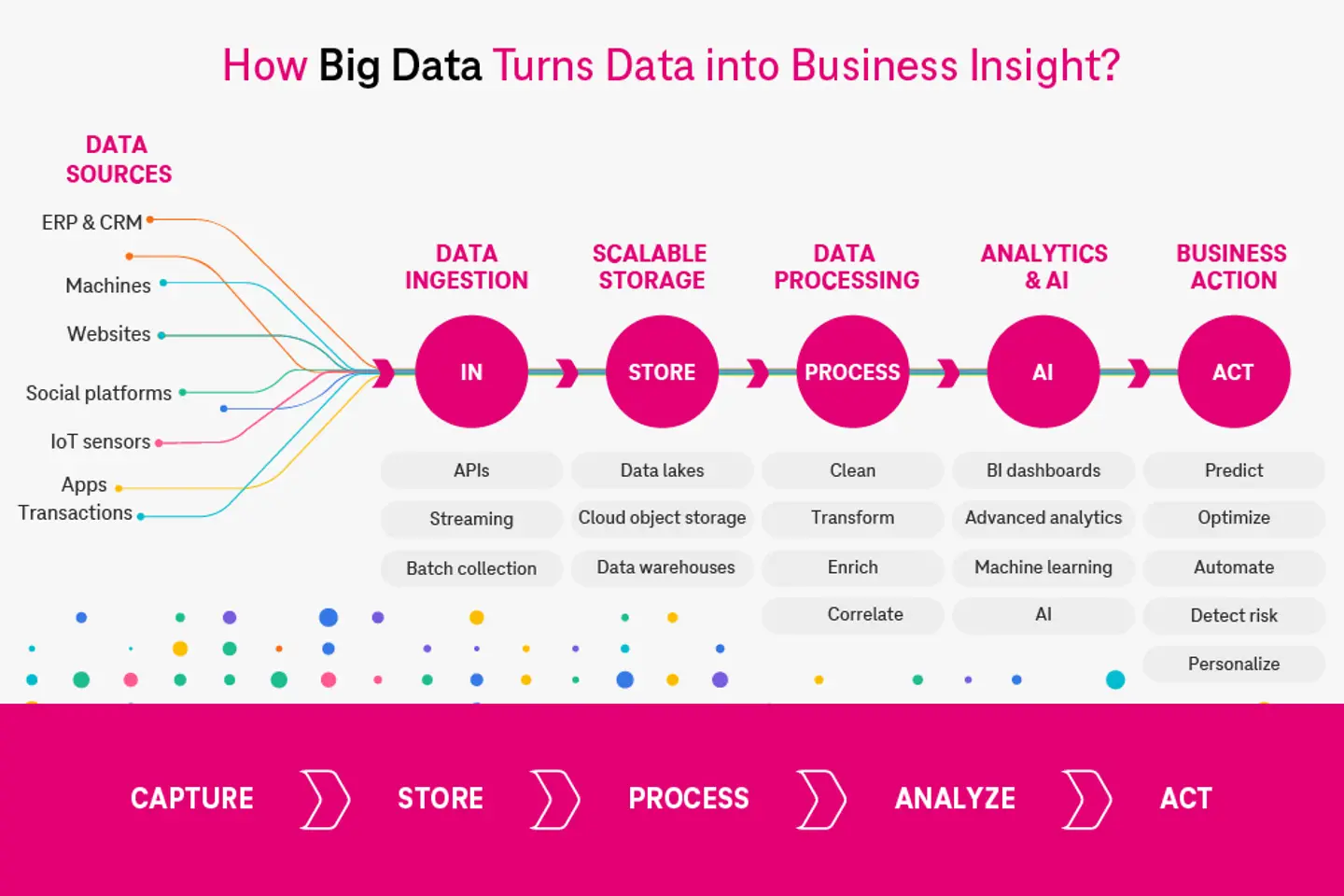
A modern big data environment works as a pipeline rather than as one monolithic database. The exact products vary, but the operating logic is consistent: data is generated, ingested, stored, prepared, analyzed, and delivered into decisions or automated processes. Governance and security should run across every stage.
Data enters from enterprise applications, websites, and mobile apps, partner systems, external datasets, IoT devices, industrial equipment, and infrastructure. Some information arrives in batches, while events such as transactions, telemetry, or customer interactions may need to stream continuously. Integration services and APIs connect these sources without forcing every workload into the same pattern.
Raw and curated information is stored in scalable repositories such as cloud object storage, data lakes, data warehouses, or lakehouse platforms. Separating storage from compute helps enterprises retain detailed data economically while scaling processing resources when demand rises. Architecture choices should reflect data sensitivity, sovereignty, latency, and lifecycle requirements rather than volume alone.
Before data can be trusted for analysis, it often needs to be validated, cleaned, transformed, joined, and enriched with business context. Distributed processing frameworks divide large workloads across multiple compute resources. Batch processing is suited to large historical workloads; streaming processing supports events that need to be evaluated as they arrive.
Prepared data can feed business intelligence, dashboards, statistical analysis, predictive models, and AI applications. The final step is operationalization: an insight should reach a decision-maker, application, or workflow in time to change an outcome. Examples include flagging fraud, adjusting inventory, predicting equipment failure, or prioritizing customer actions.
Governance is the connective tissue of the pipeline. Metadata and catalogs help users understand where data came from and what it means. Access controls, encryption, retention policies, and auditability protect sensitive information. Data ownership and quality rules make analytical results more reproducible and reduce the risk of feeding unreliable information into automated decisions or AI models.
Enterprises typically work with three broad data types. Structured data follows a predefined schema, such as financial transactions, inventory records, or customer master data. Semi-structured data has some organization through tags or metadata but not a rigid table structure; JSON, XML, application events, and log files are common examples. Unstructured data includes documents, emails, images, video, audio, and free text.
These formats originate from three major source groups: people and digital interactions; business systems and transactions; and machines or connected devices. The combination matters. A manufacturer, for example, may correlate ERP production orders with machine telemetry, maintenance histories, quality images, and supplier data. The value emerges from connecting context across sources, not from analyzing each silo separately.
There is no universal ranking of big data products. For enterprise planning, it is more useful to think in five technology categories that together cover the core requirements of a modern data platform.
1. Data lakes, object storage, and lakehouse platforms: These provide elastic repositories for large volumes of raw and curated data. Lakehouse approaches combine the flexibility of a data lake with management and analytical capabilities associated with warehouses.
2. Distributed processing frameworks: Technologies such as Apache Spark process large datasets across clusters and support workloads ranging from data engineering to analytics and machine learning. Hadoop remains present in some estates, but many organizations now use cloud-native and managed alternatives around or beyond it.
3. Streaming and event-processing platforms: Streaming technologies process events as they occur. They are important for fraud detection, IoT monitoring, logistics visibility, customer interactions, and other use cases where the value of an insight declines if processing is delayed.
4. Cloud data warehouses and analytical databases: These platforms provide high-performance SQL analytics, workload management, and scalable compute for reporting and decision support. In many architectures they coexist with lakes or lakehouses rather than replacing them.
5. Data integration, catalog, and governance tools: Integration connects distributed sources; catalogs and metadata make data discoverable; governance controls ownership, lineage, quality, and access. These capabilities are essential when organizations want to reuse trusted data across analytics and AI instead of creating isolated project pipelines.
The best architecture is therefore not the one with the longest technology list. It is the one that meets the required latency, scale, security, sovereignty, and cost profile while remaining manageable for the teams that operate it.
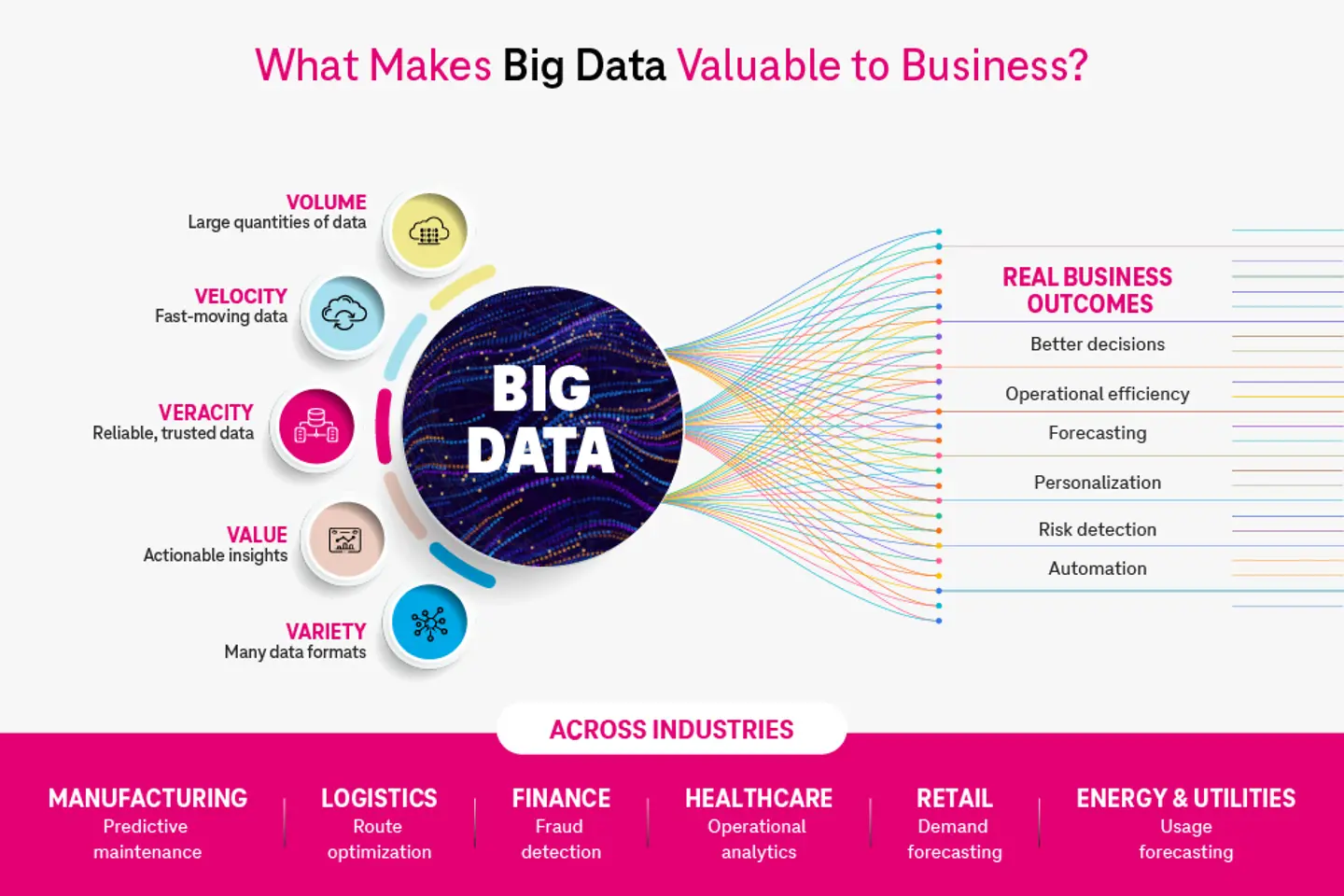
The business case for big data is strongest when data is linked directly to a decision, process, or customer outcome. Large-scale analytics can combine historical context with current signals, giving organizations a more complete view of what happened, why it happened and what may happen next.
Decision-makers can compare current operational signals with historical patterns instead of relying only on periodic reports. This supports scenario planning, forecasting, and earlier intervention when conditions change.
Process and machine data can reveal bottlenecks, waste, and deviations that are difficult to see in small samples. Analytics can then recommend or trigger actions such as rerouting shipments, adjusting capacity, scheduling maintenance, or prioritizing service cases.
Large datasets make anomaly detection more powerful because unusual behavior can be compared with a broader baseline. Financial services can identify suspicious transactions; manufacturers can detect quality deviations; utilities can monitor infrastructure; and supply chains can use real-time signals to anticipate disruption.
Behavioral and interaction data can help organizations tailor products, communications, and services to actual patterns of demand. The same principle can improve employee experiences by identifying friction in internal processes and providing more relevant support.
AI systems depend on accessible, representative, and well-governed data. A modern big data foundation makes it easier to combine enterprise context, historical records, and real-time signals for machine learning, generative AI, and agentic workflows. Data quality and governance remain critical because AI can amplify weaknesses as readily as it can amplify insight.
Automotive development illustrates the challenge clearly. Vehicle prototypes can generate several terabytes of signal data per day during tests. Moving every raw dataset to a central location before analysis can consume bandwidth and delay engineering work.
T-Systems uses a distributed edge analytics approach for this type of scenario. Signal data can be captured and compressed at the edge, enriched with metadata and kept close to where it is generated. Analysis requests are distributed to edge clusters, while only the relevant results travel back over secure connections. T-Systems reports up to 90% lossless compression and data processing around 40 times faster than the referenced standard procedure for its solution. The example shows a core big data principle: sometimes the most efficient strategy is to move the analytics to the data rather than move all the data to the analytics.
Scale creates opportunity, but it also magnifies weaknesses. A data platform that grows without clear ownership or quality controls can become an expensive collection of hard-to-trust datasets. Enterprises therefore need to treat architecture, governance, and operating model as one problem.
Data quality and trust: Duplicates, missing values, inconsistent definitions, and stale records can undermine dashboards, models, and automated decisions. Quality controls should be tied to the business criticality of the data, not applied uniformly without context.
Governance and ownership: Teams need clear accountability for data products, definitions, access, and lifecycle. Without ownership, the same metric can acquire different meanings across functions and analytical results become difficult to reconcile.
Security, privacy, and compliance: Distributed data increases the number of systems, identities, and access paths that must be protected. Encryption, identity and access management, logging, retention controls, and privacy requirements need consistent implementation across cloud, edge, and on-premises environments.
Cost and complexity: Elastic infrastructure can scale quickly in both capacity and cost. Workload design, data lifecycle management, observability, and FinOps disciplines help prevent unnecessary storage, compute, and data-transfer expenditure.
Skills and adoption: A platform does not create a data-driven organization by itself. Business teams need data literacy, while engineering, analytics and governance teams need a common delivery model that moves successful use cases from experiment to production.
Yes, but the vocabulary has matured. “Big data” is less often treated as a standalone technology program and more often appears inside broader discussions of modern data platforms, data products, lakehouses, data fabrics, streaming analytics, and AI-ready data. The original problem has not disappeared. Data continues to arrive from more sources, in more formats and at higher speed, while AI raises the value of making that information accessible and trustworthy.
The strategic shift is from accumulating data to activating it. Enterprises increasingly need architectures that support analytics and AI across hybrid environments while preserving governance, security, and sovereignty. In that sense, big data has become infrastructure for the data-driven and AI-enabled enterprise rather than a destination in itself.
Research consistently links stronger data and analytics capabilities with better business performance, although the size of the effect varies by industry and execution quality. Large enterprises accounted for 65.93% of the big data technology market share, whereas small and medium enterprises are growing at the fastest rate, with a 13.66% CAGR.1
The lesson is not that installing a big data platform automatically improves financial performance. The stronger pattern is organizational: leading companies combine modern technology with high-quality data, long-term analytics strategy, skills, and a culture that embeds data into everyday workflows. The performance question should therefore be framed around business adoption and measurable outcomes, not data volume.
A practical big data program starts with a decision or process that needs to improve. Buying technology first often produces a platform in search of a use case. A value-led sequence keeps architecture choices grounded in measurable outcomes.
1. Define the business outcome: Choose a use case with a clear owner and measurable baseline: lower downtime, faster forecasting, improved fraud detection, reduced logistics cost, or another concrete target.
2. Map the required data: Identify where the relevant data resides, who owns it, how frequently it changes, its sensitivity and whether its quality is sufficient for the intended decision.
3. Set governance and security early: Define access, retention, lineage, privacy, sovereignty, and quality requirements before data is replicated across new environments.
4. Select an architecture for the workload: Decide which data belongs in cloud, edge, or on-premises environments; which workloads require streaming; and where lakes, warehouses, or lakehouses provide the best fit. Avoid unnecessary platform duplication.
5. Prove value with a focused implementation: Build a minimum viable data product or analytical use case, validate the result with business users and measure impact against the original baseline.
6. Industrialize what works: Turn successful patterns into reusable ingestion pipelines, data products, governance policies, APIs, and platform services. This is where isolated analytics projects become an enterprise capability.
T-Systems positions its data and AI services around this end-to-end journey: assessing the existing data landscape, identifying future-proof use cases, designing and implementing the required solution, and supporting secure operations. Its big data and edge analytics capabilities also illustrate how architecture can be adapted when data is globally distributed or costly to move.
Big data remains relevant because the underlying enterprise challenge is becoming more demanding, not less: organizations must connect diverse information, process it at the right speed, protect it across distributed environments and make it usable for analytics and AI. The competitive advantage does not come from collecting the largest dataset. It comes from creating a trusted path from data source to business action.
For enterprises evaluating the next step, the priority is therefore clear: focus on high-value use cases, establish governance and security by design, choose scalable technologies that fit the workload, and build reusable data capabilities that can support both today’s analytics and tomorrow’s AI applications.
Big data refers to datasets that are too large, fast-moving, or diverse for traditional data systems to handle efficiently. It typically combines structured, semi-structured, and unstructured information from business applications, digital interactions, machines, and sensors. Big data therefore describes both demanding data characteristics and the scalable architectures needed to store, process, govern, and analyze them.
Big data works through a pipeline. Data is generated by applications, transactions, devices, and external sources, then ingested into scalable storage. Processing engines clean, transform, and enrich it. Analytics, dashboards, machine learning, or AI then identify patterns and support decisions. Governance, metadata, security, and access controls should span the pipeline, so results remain trustworthy and usable.
Five important technology categories are scalable data lakes or object storage, distributed processing frameworks such as Apache Spark, streaming platforms for real-time data, cloud data warehouses or lakehouse platforms, and data integration and governance tools. The right mix depends on workload, latency, security, sovereignty, existing architecture, and the business outcomes an organization wants to achieve.
A vehicle test program is a practical big data example. Prototypes can generate terabytes of signal data every day from sensors. T-Systems provides an edge analytics approach in which this data is compressed locally, enriched with metadata, and analyzed across distributed edge clusters. Only relevant results are transmitted, reducing bandwidth needs and accelerating analysis for engineering teams.
Yes, although the terminology has evolved. Enterprises increasingly talk about modern data platforms, lakehouses, data fabrics, streaming analytics, and AI-ready data rather than treating big data as a standalone technology category. The underlying challenge remains: organizations must manage rapidly growing volumes and varieties of data reliably, securely, and at a speed that supports analytics, automation, and AI.
Start with a business problem rather than a technology purchase. Identify a high-value use case, map the required data and its quality, define governance and security requirements, and assess the current architecture. Build a small measurable implementation, prove value, then industrialize reusable data pipelines, platform services, and operating practices so additional use cases can scale without creating new silos.
1 Big Data Technology Market Analysis, Mordor Intelligence, 2025, www.mordorintelligence.com