 Image generated with AI
Data is one of the most important resources in every organization. It influences how companies understand customers, manage operations, develop new services, automate processes, and use artificial intelligence. But data only becomes valuable when it is available, secure, understandable, compliant, and reliable.
That is where data management comes in. It creates the foundation that allows companies to move from fragmented information to trusted insights. It helps organizations break down data silos, improve data quality, protect sensitive information, and use data as a strategic asset.
For companies, data management is not only a technical discipline. It is a business capability. It ensures that the right data is available to the right people, systems, and applications at the right time and under the right conditions.
Professional data management helps companies convert raw information into a trusted business asset. It combines strategy, governance, architecture, security, quality, and technology into one coordinated approach.
A good data management practice starts with a business question. Which decision should become faster? Which processes should become more efficient? Which customer experience should improve? Which data is needed for AI, reporting, or compliance?
Once the business purpose is clear, companies can define where data comes from, who owns it, how it is stored, how quality is measured, and how access is controlled. This prevents data from becoming a hidden liability and turns it into a reusable asset.
For companies that want to scale analytics, automation, and AI, data management has become the bridge between business ambition and technical execution.

Data management is about bringing order to information. Data is collected from many sources, stored in suitable systems, prepared for analysis, protected against misuse, and made available for business processes.
However, modern data management is going further. It also defines responsibilities, quality rules, metadata, access rights, compliance requirements, and business meanings. This is essential because companies increasingly use data not only for reporting, but also for automation, real-time decisions, digital services, and AI.
Most organizations already have large amounts of data. The challenge is that this data is often scattered across departments, applications, cloud platforms, legacy systems, spreadsheets, production environments, and documents.
Sales may have one customer view, finance another, and service may be a third. Product data may exist in several systems with different levels of completeness. Management reports may depend on the excel manual versions. In this environment, even simple questions become difficult to answer.
Enterprise data management creates a common framework for data across the organization. It connects systems, defines responsibilities, improves quality, and makes information discoverable. The result is not just better reporting. It is a shared understanding of business.
T-Systems describes this shift as part of data-driven transformation, where organizations move from isolated data ownership toward scalable, governed, and business-oriented data use.1
Data becomes a success factor when it is managed with intention. Companies that treat data as a by-product of IT systems often struggle with poor quality, unclear ownership, and limited trust. Companies that treat data as a strategic asset can use it to improve decisions, innovate faster, and build new business models.
Strategic data management connects data initiatives with measurable business outcomes. It defines which data matters most, which use cases have priority, which platforms are needed, and which governance rules must apply.
This is especially important in Germany and Europe, where companies must combine innovation with compliance, security, and digital sovereignty. Data management therefore supports not only growth but also trust and resilience.
Data management creates value in many areas of business. It improves transparency, reduces manual work, increases trust in reports, supports compliance, and makes digital transformation easier to scale. The benefit is not only that data is stored better. The real benefit is that data can be used better. Teams can find the information they need, understand its meaning, trust its quality, and apply it safely in business processes.
Data management is important because every digital process depends on data. Customer portals, ERP systems, supply chains, AI assistants, predictive maintenance, cloud platforms, dashboards, and automation workflows all rely on accurate and available information. When data is inconsistent or inaccessible, companies lose speed. Decisions take longer, teams duplicate work, and AI projects remain stuck in pilot phases. When data is well managed, companies can act faster and with more confidence.
Digital transformation needs a reliable data foundation. Without it, new platforms and tools cannot deliver their full value. A company may introduce cloud services, automation software, or AI applications, but if the underlying data is incomplete, fragmented, or poorly governed, the outcome remains limited. Data management ensures that transformation projects can scale beyond isolated use cases.
Data becomes a trusted asset when people understand where it comes from, how it has been processed, who owns it, and whether it is fit for purpose. Trust is especially important for management reporting, customer communication, regulatory documentation, and AI systems. If the data is not trusted, the output will not be trusted either.
Improved decision-making
Good decisions depend on good data. Data management helps companies move from gut feeling to fact-based control. When decision-makers can rely on consistent KPIs, transparent data sources, and clear definitions, they can identify risks earlier, react faster to market changes, and allocate resources more effectively.
Better customer communication
Customers expect relevant, consistent, and fast communication. This is only possible when customer data from sales, service, marketing, billing, and operations is connected and reliable.
Data management helps create a more complete customer picture. It supports personalization, faster service, better targeting, and consistent communication across channels.
Creating transparency and accessibility
Data should not remain hidden in systems or departments. At the same time, it must not be shared without control.
Professional data management creates transparency and accessibility through catalogs, metadata, semantic layers, access rules, and governance models. Employees can find and use data more easily, while the organization remains in control.
Professional data management gives companies the structure they need to use data on a scale. It reduces uncertainty, improves efficiency, and enables innovation without losing control. The following advantages are especially relevant for enterprises with complex IT landscapes, hybrid cloud environments, and strict compliance requirements.
Data protection, auditability, retention, and access control are central requirements for modern enterprises. Data management helps companies understand which data they process, where it is stored, who can access it, and which rules apply.
This is increasingly important in Europe. The EU Data Act is part of the European effort to create a fair and innovative data economy.
A strong data foundation helps companies understand customers better. Instead of working with fragmented profiles, teams can use a more complete and reliable view of customer needs, interactions, preferences, and service history. This improves service quality and creates more relevant digital experiences.
Poor data management creates hidden costs. Employees spend time searching for information, reconciling reports, correcting errors, and maintaining duplicate systems.
Professional data management reduces these costs by improving quality, automation, standardization, and reuse.
Data security is more effective when data is classified, governed, and monitored. Companies need to know which data is sensitive, who can access it, and how it is protected.
Data management supports encryption, identity and access management, retention rules, audit trails, and secure data sharing.
As companies grow, data volume and complexity increase. Data management helps build architectures that can scale across business units, cloud environments, and use cases.
Hybrid cloud, sovereign cloud, data mesh, data fabric, and data spaces are all examples of approaches that can support scalable data use.
Many data tasks can be automated. This includes integration, quality checks, metadata capture, access workflows, anomaly detection, and reporting processes. Automation reduces manual work and makes data management more reliable.
Data silos prevent companies from seeing the full picture. They lead to duplicate work, inconsistent reporting, and limited collaboration.
Data management breaks down silos by connecting systems, standardizing definitions, and creating shared access models.
A data foundation is not a single database or platform. It is the combination of architecture, governance, quality, security, and operating model that allows data to be used reliably across the company.
Companies should start by identifying their most important data domains, such as customers, products, suppliers, assets, employees, financials, and operations. For each domain, ownership, quality rules, metadata, and access rights should be defined.
A strong foundation also prepares companies for AI. T-Systems emphasizes that connected, high-quality, and reliable data is essential for successful AI use cases.
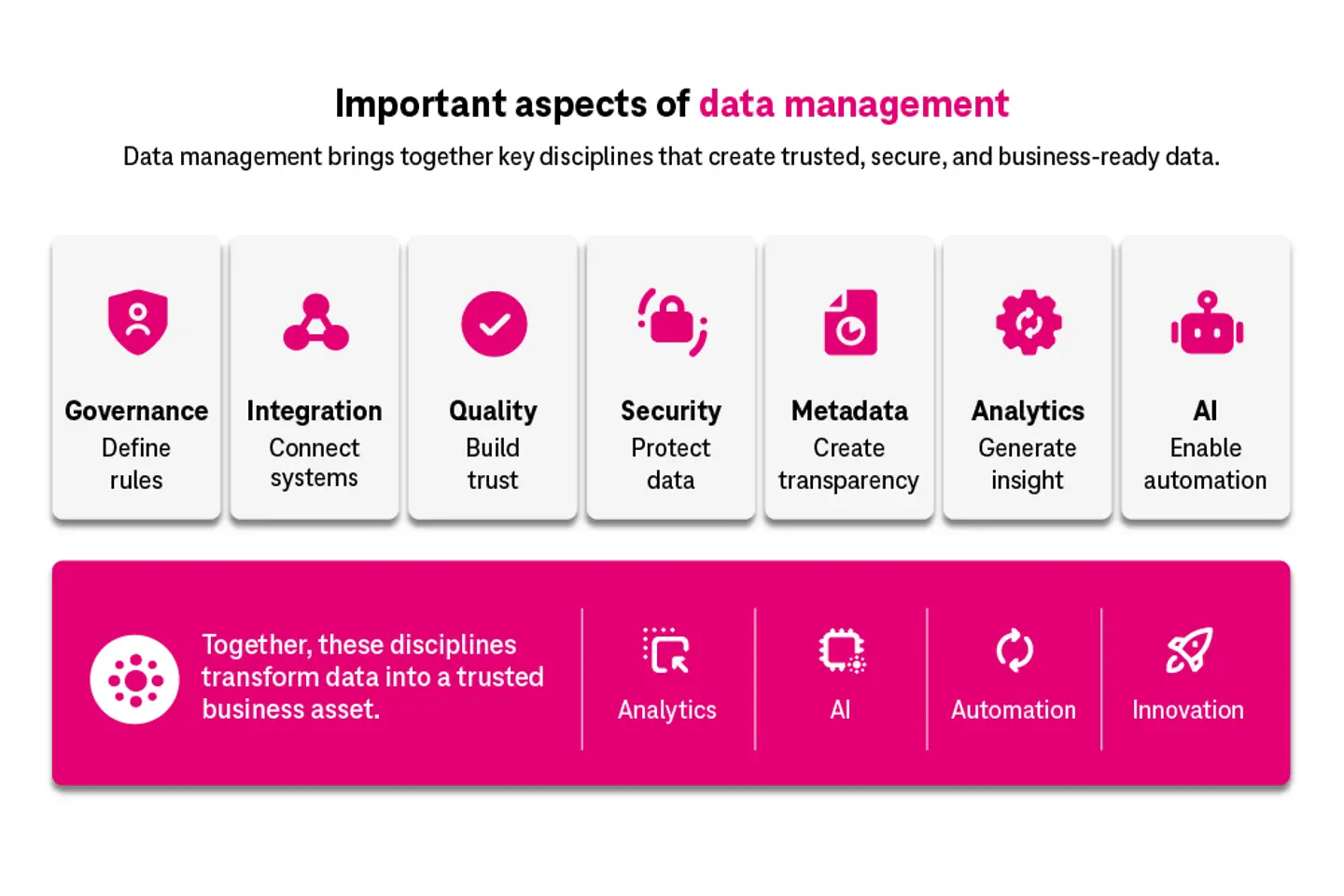
Data management consists of several connected disciplines. Each discipline addresses a specific challenge, but the greatest value is realized when they work together to create trusted, secure, and business-ready data.
Governance: Defines the rules
Establishes policies, standards, ownership, and accountability for data across the organization. Governance ensures data is managed consistently, responsible, and in compliance with business and regulatory requirements.
Integration: Connects systems
Brings data together from applications, databases, cloud platforms, and external sources. Integration creates a unified view of information that enables seamless business processes and decision-making.
Quality: Ensures reliability
Maintains data accuracy, completeness, consistency, and timeliness throughout its lifecycle. High-quality data increases trust and reduces operational risks caused by errors or duplication.
Security: Protects information
Safeguards data from unauthorized access, misuse, loss, or breaches. Security controls help maintain confidentiality, integrity, and availability while supporting compliance obligations.
Metadata: Creates transparency
Provides information about data, including its meaning, origin, ownership, usage, and lineage. Metadata helps users discover, understand, and trust the data they rely on.
Analytics: Turns data into insight
Transforms raw data into meaningful information through reporting, visualization, and advanced analysis. Analytics helps organizations identify trends, measure performance, and support informed decisions.
AI: Uses data to automate, predict, and generate
Leverages trusted data to power intelligent applications, predictive models, and generative AI solutions. AI enhances efficiency, improves decision-making, and unlocks new opportunities for innovation.
When governance, integration, quality, security, metadata, analytics, and AI work together, organizations create a trusted data foundation that drives operational excellence, regulatory compliance, innovation, and business growth.
The areas of data management cover both technical and organizational responsibilities. Companies need platforms and tools, but they also need roles, processes, rules, and accountability. A mature data management approach therefore involves IT, business departments, compliance, security, data owners, architects, analysts, and leadership.
Data integration and processing
Data integration connects information from different sources and prepares it for use. This can include ERP systems, CRM applications, production systems, cloud platforms, partner interfaces, documents, and external data sources. Processing transforms this data into formats that can be used for reporting, analytics, automation, or AI.
Data security
Data security protects information against unauthorized access, loss, manipulation, and misuse. It includes access rights, encryption, monitoring, backup, and incident response. Security must be built into the data lifecycle from the beginning, not added at the end.
Data governance and metadata management
Data governance defines how data is managed, who is responsible, and which policies apply. Metadata management documents the meaning, origin, structure, quality, and usage of data. Together, governance and metadata make data understandable and controllable.
Data observability
Data observability monitors the health of data pipelines and data products. It helps detect missing data, delays, quality issues, schema changes, or unexpected anomalies. This is important because even small data issues can affect reports, automated decisions, and AI outputs.
Master data management
Master data management creates a consistent view of core business objects such as customers, products, suppliers, materials, assets, and locations. Without master data management, companies often struggle with duplicate records, inconsistent naming, and conflicting versions of the truth.
Semantic layer
A semantic layer translates technical data into business-friendly language. It ensures that teams use common definitions for metrics such as revenue, margin, customer, churn, utilization, and product availability. This improves trust in reporting and makes self-service analytics easier.
Shared metadata layer
A shared metadata layer gives teams a common view of data assets, ownership, lineage, quality, and usage. It helps employees understand not only where data is stored, but also what it means and how it can be used.
Ensuring controlled, compliant, and secure data
Controlled data use means that access, sharing, retention, and deletion follow clear policies. This is especially important for regulated industries, personal data, critical infrastructure, and AI applications.
Data management continues to evolve as companies adopt cloud platforms, AI, real-time analytics, and ecosystem-based data sharing. New components such as data mesh, data fabric, data spaces, and AI-assisted governance help organizations manage distributed data landscapes more effectively.
Advanced data management
Advanced data management uses automation, metadata intelligence, AI, and cloud-native capabilities to improve how data is governed and used. It reduces manual effort and helps companies manage increasing complexity.
Data fabric architecture
Data fabric architecture connects distributed data across systems, clouds, and business domains. It uses metadata, governance, automation, and integration services to make data discoverable and usable without forcing everything into one central location.
Data fabric
A data fabric helps companies manage data across complex landscapes. It can connect legacy systems, cloud platforms, analytics environments, and operational applications. The goal is to create a consistent and governed data layer across distributed environments.
Data mesh
Data mesh is a decentralized approach to data management. Instead of one central team managing all data, business domains take responsibility for their own data products. T-Systems describe data mesh as a model built around domain ownership, data as a product, federated governance, and self-service platforms.
Hybrid cloud database strategy
A hybrid cloud database strategy helps companies place data and workloads in the most suitable environment. Some data may remain on-premises. Some may move to private clouds, public cloud, sovereign cloud, or edge environments. The right strategy balances performance, compliance, cost, sovereignty, and scalability.
Hybrid Cloud Deployments
Hybrid cloud deployments help companies combine existing IT landscapes with modern cloud capabilities. They are especially relevant for enterprises that need flexibility while still meeting security, compliance, and operational requirements.
Generative AI
Generative AI increases the importance of data management. AI applications need reliable, governed, and traceable data to produce useful outputs. Without a trusted data foundation, generative AI can produce inconsistent, incomplete, or risky results.
Data management is not the only success factor for generative AI, but it is one of the most important. Generative AI depends on the quality, context, and governance of the data it uses. If the data is fragmented, outdated, or poorly documented, the AI output becomes harder to trust.
Machine learning enables tailor-made results
Machine learning identifies patterns in data and supports use cases such as forecasting, recommendations, predictive maintenance, anomaly detection, and customer segmentation. The more accurate and relevant the data, the better the results can become.
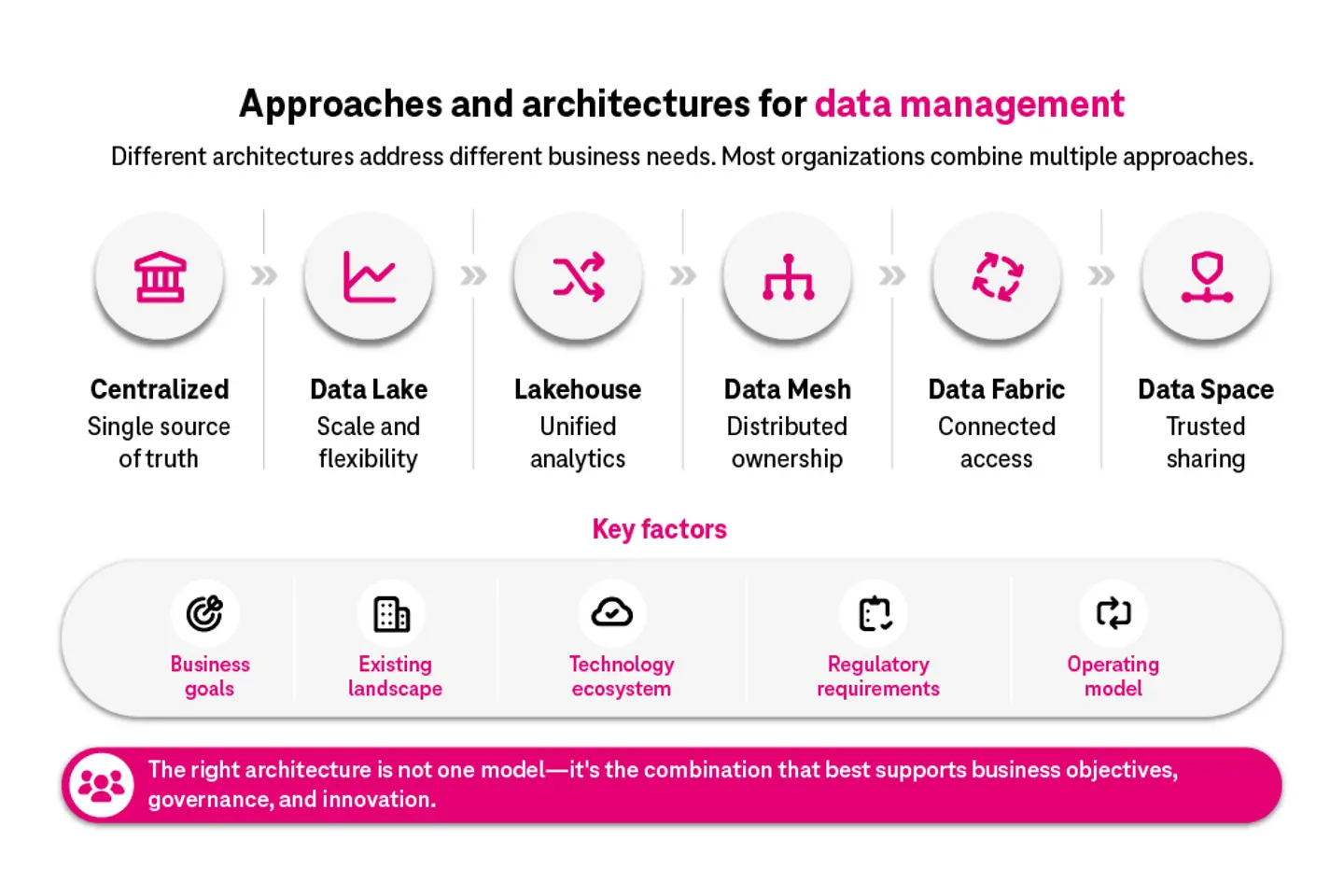
Organizations can adopt different data architectures based on business objectives, data complexity, technology landscapes, and regulatory requirements. Each architecture addresses a specific set of challenges, from centralized reporting to decentralized ownership and cross-organizational data sharing. The most effective strategy is often not a single architecture, but a combination of approaches that work together to deliver agility, scalability, and trust.
Centralized Architecture: Creates a single source of truth
Data is consolidated into a centralized platform managed by a dedicated team. This approach provides strong governance, consistency, and control, making it well-suited for enterprise reporting, compliance, and standardized business processes.
Data Lake: Supports large and diverse data sets
A data lake stores structured, semi-structured, and unstructured data at scale in its native format. It provides flexibility for data science, machine learning, exploration, and advanced analytics while accommodating rapidly growing data volumes.
Lakehouse: Combines flexibility and analytics
A lakehouse brings together the scalability of a data lake and the reliability of a data warehouse. Organizations benefit from unified storage, high-performance analytics, and support for AI and real-time workloads on the same foundation.
Data Mesh: Distributes ownership
A data mesh shifts responsibility for data to business domains closest to the source. Each domain manages and shares its data products while adhering to common governance standards, enabling greater agility and scalability across large organizations.
Data Fabric: Connects fragmented environments
A data fabric creates a unified data experience across on-premises, cloud, and hybrid environments. By using metadata, automation, and intelligent integration, it reduces complexity and enables seamless data access regardless of where data resides.
Data Space: Enables sovereign data sharing
A data space allows multiple organizations to share and collaborate on data while maintaining ownership, privacy, and control. This approach is increasingly important in regulated industries and ecosystems where trusted data exchange is essential.
The right architecture: Often a combination of approaches
Modern organizations rarely rely on single architecture. A company might use a lakehouse for analytics, a data fabric for integration, a data mesh for domain ownership, and data spaces for external collaboration. The optimal architecture evolves alongside business needs, technology innovation, and regulatory requirements.
The goal is not to choose one architecture over another, but to combine the right capabilities to create a scalable, governed, and future-ready data foundation. When aligned with business strategy, these architectures enable trusted data, advanced analytics, AI innovation, and effective collaboration across the enterprise.
Modern data management systems include databases, data warehouses, data lakes, lakehouses, catalogs, governance platforms, master data systems, observability tools, integration platforms, BI tools, and AI platforms. Today, the focus is shifting from storing data to making data usable. Companies want systems that support governance, automation, quality, compliance, self-service, and AI readiness.
Big data management systems
Big data management systems process large, fast, and diverse data sets. They are used in areas such as IoT, manufacturing, logistics, customer analytics, cybersecurity, financial monitoring, and AI training. The challenge is not only volume. Companies must also manage speed, variety, quality, security, and meaning.
The right database and data lakehouse architecture
The right architecture depends on the use case. Databases support operational processes. Data warehouses support structured reporting. Data lakes store large and diverse data sets. Lakehouses combine elements of data lakes and warehouses for analytics and AI.
Data lakes and data warehouses
A data warehouse stores structured, curated data for reporting and analysis. A data lake stores structured, semi-structured, and unstructured data for broader use. Many companies use both. The key is to define how data moves between systems and how governance is applied.
A data warehouse is suitable for stable reporting. A data lake is suitable for large and diverse data. A data mesh is useful when many domains need ownership. A data fabric helps connect distributed systems. A data space supports trusted data sharing across companies. For European organizations, architecture decisions should also consider data sovereignty, legal requirements, and ecosystem collaboration.
The data management process begins with understanding business needs and data sources. It continues with collection, integration, quality checks, storage, governance, analysis, sharing, and lifecycle control. This process should not be treated as a one-time project. Data changes constantly, and the management process must evolve with it.
Data management tasks
Data management tasks include defining sources, assigning ownership, improving quality, managing access, documenting metadata, integrating systems, monitoring pipelines, and supporting business use cases. These tasks require collaboration between IT and business teams. Data cannot be managed effectively if it is seen only as a technical responsibility.
Basics of data processing
Data processing turns raw data into usable information. This can involve cleansing, transforming, enriching, aggregating, and validating data. The goal is to prepare data so it can support reporting, analytics, automation, and AI.
Companies should identify all relevant data sources. These may include ERP, CRM, supply chain systems, service tools, production machines, sensors, documents, partner systems, cloud applications, and public data. The more complete the source overview, the easier it becomes to manage quality, access, and compliance.
 Image generated with AI
Visualization helps people understand data flows, dependencies, quality, and business performance. Dashboards, lineage diagrams, catalogs, and quality scorecards make data management more transparent and easier to control.
Automatically integrate data management
Automation helps companies scale data management. It can support data ingestion, quality monitoring, classification, cataloging, access workflows, and policy enforcement. This reduces manual effort and improves consistency.
Data management can be challenging because data landscapes are complex. Companies must deal with legacy systems, cloud platforms, data silos, quality issues, unclear ownership, regulatory pressure, and growing AI demands. The challenge is not only technical. It is also organizational. Successful data management requires cooperation between business, IT, security, compliance, and leadership.
Compliance and data protection
Compliance and data protection are central challenges. Companies must know what data they process, where it is stored, how long it is retained, who can access it, and whether it can be shared or reused.
Comply with data protection laws
European companies must consider multiple regulatory frameworks. The EU Data Act supports broader access to and use of data in the European data economy. The Data Governance Act is designed to increase trust in data sharing. The EU AI Act introduces phased obligations for AI systems, with important rules.
Data management is changing because business needs are changing. Companies need more real-time insights, more automation, more secure data sharing, and more AI readiness. At the same time, they must meet stricter expectations around compliance, resilience, and sovereignty.
Trends in data management
Important trends include AI-ready data platforms, data mesh, data fabric, data spaces, data observability, hybrid cloud architectures, sovereign cloud, and privacy-enhancing technologies. For European companies, data sovereignty is becoming increasingly important. T-Systems describes sovereign cloud to combine cloud innovation with compliance, control, and protection against unwanted foreign access.
Setting up data management requires a clear roadmap. Companies should not start with tools alone. They should first define goals, responsibilities, and the operating model. A successful setup combines business strategy, data governance, technical architecture, data quality, and employee awareness.
Data management becomes a success factor when it supports real business outcomes. It enables companies to make faster decisions, improve customer experience, reduce risk, scale AI, and create new digital services. In this sense, data management is not a back-office activity. It is a foundation for competitiveness.
In IT service management, data management supports service catalogs, incident management, asset management, configuration management, change management, and automation. Clean and connected data helps IT teams understand dependencies, resolve incidents faster, improve service quality, and create more transparent reporting.
A data strategy defines how data will create value for the business. It connects vision, sources, governance, architecture, quality, and continuous improvement. The strategy should be practical, measurable, and aligned with business priorities.
Step 1: Define your vision
A data vision explains how data should support the company’s future. It may focus on AI, customer experience, operational efficiency, compliance, sustainability, new services, or business model innovation.
Step 2: Set data sources for data management
The next step is to identify relevant sources. This includes internal systems, external data, partner ecosystems, documents, machine data, and cloud platforms. Without source transparency, governance and quality are difficult to manage.
Step 3: Visualization is the be-all and end-all of data management
Visualization makes complexity understandable. Data lineage, architecture views, dashboards, and quality scorecards help stakeholders see how data moves, where risks exist, and where value can be created.
Step 4: Establish Data Governance
Data governance defines the rules of the game. It clarifies ownership, responsibilities, access rights, data quality rules, and decision-making structures.
Step 5: Create transparency and accessibility
A data strategy must make data easier to find and use. Catalogs, glossaries, semantic layers, and secure access models help employees work with data without losing control.
Step 6: Automatically integrate data management
Automation supports scalability. It helps connect sources, monitor pipelines, classify data, enforce policies, and reduce manual effort.
Step 7: Evaluation and realignment
A data strategy should be reviewed regularly. Business goals, technologies, regulations, and AI requirements change. Data management must adapt with them.
In today's digital economy, data is more than an operational asset, it is a strategic enabler for innovation, automation, and growth. To unlock its full potential, organizations need a clear data strategy supported by effective governance. Together, they create the foundation for trusted decision-making, regulatory compliance, and AI-driven transformation.
A data strategy provides the direction for how data is collected, managed, shared, and used across the enterprise. It aligns data initiatives with business goals and helps organizations transform information into measurable business outcomes.
An effective data strategy enables organizations to:
As T-Systems emphasizes in its digital transformation and AI strategy approach, successful organizations combine business objectives with technology, data, and governance capabilities to create sustainable value.
Data governance ensures that data is managed consistently, securely, and responsibly across the organization. It defines decision rights, ownership models, policies, and controls that enable trusted use of data on a scale.
A governance framework clarifies:
Strong governance enables organizations to scale modern architecture such as data mesh while maintaining enterprise-wide standards and compliance requirements.
Data management and data governance are complementary disciplines that work together to turn data into a trusted business asset.
Data management focuses on the operational lifecycle of data: from acquisition and integration to storage, quality management, consumption, and archiving.
Data governance provides the policies, standards, roles, and decision-making structures that guide these activities.
The relationship is simple:
Without governance, data management can become fragmented and difficult to scale. Without effective implementation, governance remains a theoretical framework with limited business impact.
Modern organizations depend on trusted data to enable analytics, AI, and cross-functional collaboration. This requires adherence to a set of core data management principles throughout the data lifecycle.
Key principles include:
Transparency
Ensure that data origins, ownership, lineage, and usage are clearly documented and understood.
Data quality
Maintain data that is accurate, complete, consistent, and fit for purpose.
Security and privacy
Protect sensitive information through appropriate access controls, cybersecurity measures, and privacy safeguards.
Purpose limitation
Use data only for approved and legitimate business purposes.
Accountability
Define clear ownership and responsibility for data assets and processes.
Lifecycle Management
Manage data throughout its lifecycle, from creation and usage to retention and secure disposal.
These principles become increasingly important in regulated industries and AI-driven environments, where trusted data is essential for compliant, ethical, and explainable outcomes.
Organizations that combine a clear data strategy, robust governance, and disciplined data management create the foundations for data-driven transformation. Trusted data enables advanced analytics, powers AI initiatives, supports regulatory compliance, and accelerates business innovation.
The result is a modern data ecosystem that delivers secure, high-quality, and business-ready data—turning information into a strategic advantage.
Data management includes several sub-areas that work together to create a trusted data foundation. Each sub-area supports a different part of the data lifecycle, from master data and metadata to analytics and platforms.
Enterprise data management coordinates data across the entire organization. It creates common standards, governance models, and architectures that allow business units to work with trusted data.
Data management platforms provide the technical capabilities needed to integrate, store, govern, analyze, and share data. They can include catalogs, warehouses, lakehouses, quality tools, integration systems, and governance solutions.
Data analysis and business intelligence turn managed data into insights. They help companies track KPIs, understand performance, identify risks, and make better decisions.
Data management software supports the practical implementation of data strategy. Tools can help companies integrate systems, manage metadata, monitor quality, govern access, store information, and analyze performance. However, tools only create value when they are connected to a clear operating model.
Software solutions can support many areas of data management, including integration, quality, cataloging, master data, governance, analytics, observability, security, and AI.
The best choice depends on the company’s architecture, regulatory requirements, data maturity, and business goals.
Common techniques include data modeling, cleansing, lineage, metadata management, encryption, anonymization, access control, retention management, API integration, streaming, and automated quality monitoring. The purpose of these techniques is to make data more reliable, secure, and usable.
Software-as-a-Service can accelerate data management because companies can use capabilities without building every component themselves. SaaS solutions can improve scalability and speed, but companies still need clear rules for data protection, ownership, access, sovereignty, and integration.
AI changes data management in two directions. On one hand, AI needs well-managed data. On the other hand, AI can help manage data better. It can support classification, duplicate detection, metadata suggestions, anomaly detection, documentation, and quality monitoring. This creates a new opportunity: data management can become more automated, intelligent, and scalable.
Companies should not start AI transformation only by selecting models or tools. They should start with data readiness. AI success depends on data quality, access, governance, lineage, security, and context. If these foundations are weak, AI initiatives may remain experimental.
T-Systems highlights that AI-ready data platforms are becoming essential for organizations that want to scale AI beyond pilots. Source: T-Systems, CIO, CSO and ComputerWoche study.
Data management supports practical business use cases across industries. In manufacturing, it can enable predictive maintenance and production optimization. In retail, it can improve customer personalization and demand forecasting. In logistics, it can support supply chain transparency. In IT, it can improve service management and automation. In public sector and regulated industries, it supports secure and compliant data sharing.
Data management creates value when it connects data to business outcomes. This can mean better decisions, faster processes, new services, lower risk, stronger customer relationships, or more efficient operations.
Many companies already have valuable data, but it remains unused because it is hidden in systems, documents, machines, or departments. Data management helps uncover this potential and turn it into growth.
A common data picture allows teams to work from the same understanding. This reduces contradictions, improves collaboration, and helps management see the business more clearly.
Companies work with different types of data, and each type requires different management approaches. Understanding these differences helps define the right storage, processing, governance, and analysis methods.
Structured data
Structured data follows a fixed format. Examples include customer records, transaction data, invoices, product tables, and ERP entries. It is usually easier to search, process, and analyze.
Semi-structured data
Semi-structured data has some organization but does not fit fully into traditional tables. Examples include JSON files, XML documents, log files, and API responses.
Unstructured data
Unstructured data includes documents, emails, images, videos, audio files, presentations, contracts, and free-text comments. This type of data often contains valuable knowledge, but it requires advanced methods for classification, search, analysis, and AI use.
Modern data management combines concepts such as data governance, data quality, metadata management, master data management, data integration, data architecture, analytics, AI, and secure data sharing. This helps to prepare data so it can be used confidently in business processes.
Many organizations have data treasures that are not yet visible. These may exist in legacy systems, machine logs, customer interactions, service tickets, contracts, or partner ecosystems. Data management helps identify these assets and make them usable in a legally compliant way.
Data quality determines whether data can be trusted. If data is incomplete, outdated, duplicated, or inconsistent, business decisions become weaker. Data quality management ensures that information is accurate, complete, consistent, timely, valid, and fit for purpose.
Data consolidation helps reduce duplicate versions and conflicting reports. Instead of multiple Excel files with different numbers, companies can create one trusted basis for planning, reporting, and decision-making.
National data strategies show that data is no longer only a company topic. It is also a matter of innovation, competitiveness, public services, and digital sovereignty. For companies, this means data management must be understood in a broader economic and regulatory context.
The EU Data Strategy
The EU Data Strategy aims to create a single market for data and support trusted data sharing across sectors. For companies, this creates opportunities for new data-driven services, but also requires stronger governance, interoperability, and compliance.
Data Act
The EU Data Act is intended to improve access to and use of data, especially data generated by connected products and related services.
Data Governance Act
The Data Governance Act supports trusted data sharing and strengthens the European data economy. It is closely connected to the EU’s goal of creating a single market for data. Source: European Commission.
The EU AI Act follows a risk-based approach and introduces phased obligations for AI systems. Important rules apply from August 2, 2026, including requirements that influence transparency, governance, and responsible AI use. Source: European Commission AI Act Service Desk.
For companies, the political framework means that data use must be planned carefully. Organizations need to understand contracts, access rights, data flows, technical controls, governance roles, and compliance obligations. Data management has become a prerequisite for both innovation and regulatory confidence.
High value data sets can support innovation, research, mobility, environmental services, public administration, and new business models. The key is to make such data usable while maintaining security, quality, interoperability, and trust.
A strong data management program combines strategy, governance, quality, architecture, security, metadata, integration, lifecycle management, and analytics. It should not be limited to a single tool or department. It should become an enterprise capability with clear ownership, measurable goals, and continuous improvement.
Data management is a significant task because it touches almost every part of the organization. It requires technology, governance, cultural change, and leadership commitment. But the effort is worthwhile because it creates the foundation for better decisions, stronger compliance, more efficient processes, and scalable AI. A does not simply collect data. It manages data with purpose.
Professional data management helps companies turn fragmented information into trusted insight. It breaks down silos, improves quality, protects sensitive data, and enables digital transformation. For companies in Germany and Europe, data management is also closely linked to sovereignty, compliance, and trust. Those who build a strong data foundation today will be better prepared for AI, cloud transformation, data spaces, and the next generation of digital business.
You can display all external content on the website at this point.
I agree that personal data may be transmitted to third-party platforms. Read more about this in our privacy policy.
The future of your cloud is sovereign. Managing sensitive data in today’s world requires the best sovereign cloud. Scalability, functionality, and sovereignty: choose the levels based on your needs. Explore our video to learn more about leading Sovereign Cloud solutions for Europe.
Data management in a company is usually defined through a data strategy, governance framework, policies, roles, processes, and technical standards. It is regulated through internal rules and external legal requirements. In Europe, this includes data protection requirements, data sharing rules, sector-specific regulations, and AI-related obligations.
Data management is the structured handling of data across its lifecycle. It includes collecting, storing, integrating, protecting, governing, analyzing, sharing, archiving, and deleting data.
In business, data management ensures that information can be used reliably for decisions, operations, reporting, compliance, automation, and AI. It connects data with business value.
Data management is important because companies depend on trusted information. Without reliable data, decisions become slower, reports become inconsistent, and digital initiatives are harder to scale.
Companies need data to serve customers, manage operations, comply with regulations, develop products, and use AI. Data management ensures that this data is accurate, secure, accessible, and usable.
Data is one of the most important business assets. It helps companies understand markets, customers, risks, performance, and opportunities.
Professional data management improves data quality, compliance, security, efficiency, transparency, and decision-making. It also supports scalable AI and digital transformation.
The main components include data strategy, governance, quality, integration, metadata, security, master data, storage, analytics, and lifecycle management. Each component supports a different part of the data value chain.
Data management tasks include identifying sources, defining ownership, improving quality, managing access, documenting metadata, integrating systems, monitoring pipelines, and supporting business use cases. These tasks are both technical and organizational.
Data storage focuses on keeping data in a system. Data management covers the entire lifecycle and includes quality, governance, security, integration, accessibility, and business use.
A data silo is an isolated data source that is difficult for other teams or systems to access. Silos reduce transparency and often lead to duplicate work or inconsistent reporting.
Companies can break down data silos through integration, data catalogs, common definitions, governance, APIs, data mesh principles, and shared ownership. The goal is to create a common data picture across the organization.
Companies can work with experienced data and cloud partners that combine consulting, architecture, governance, analytics, AI, and managed services. The right partner should understand both business goals and technical complexity.
Data management means organizing, protecting, and controlling data so it remains accurate, secure, compliant, accessible, and useful. It turns data from a technical resource into a business asset.
A practical interpretation of the 5 C’s is collect, clean, classify, control, and consume. This means data must be gathered, improved, understood, governed, and used responsibly.
The four common types are structured data, semi-structured data, unstructured data, and metadata. Each type requires different methods for storage, processing, and analysis.
The five stages can be described as collection, storage, processing, governance, and usage. In practice, companies also need archiving, deletion, and continuous improvement.
The five pillars can be defined as governance, quality, architecture, security, and analytics. Together, they create the foundation for trusted data use.
Common types include master data management, metadata management, data quality management, and data lifecycle management. Each supports a specific part of the data landscape.
A common model distinguishes raw data, processed data, information, and insight. The goal of data management is to move data from raw material to actionable knowledge.
A data management framework defines how data is managed in an organization. It includes roles, responsibilities, processes, standards, technologies, and governance rules.
The four traditional types of database management systems are hierarchical, network, relational, and object-oriented. In modern enterprise environments, these are often complemented by cloud databases, NoSQL systems, graph databases, and lakehouse architectures.
1 https://data.europa.eu/en/news-events/news/data-governance-act-after-one-year-ambition-action?utm_source=chatgpt.com