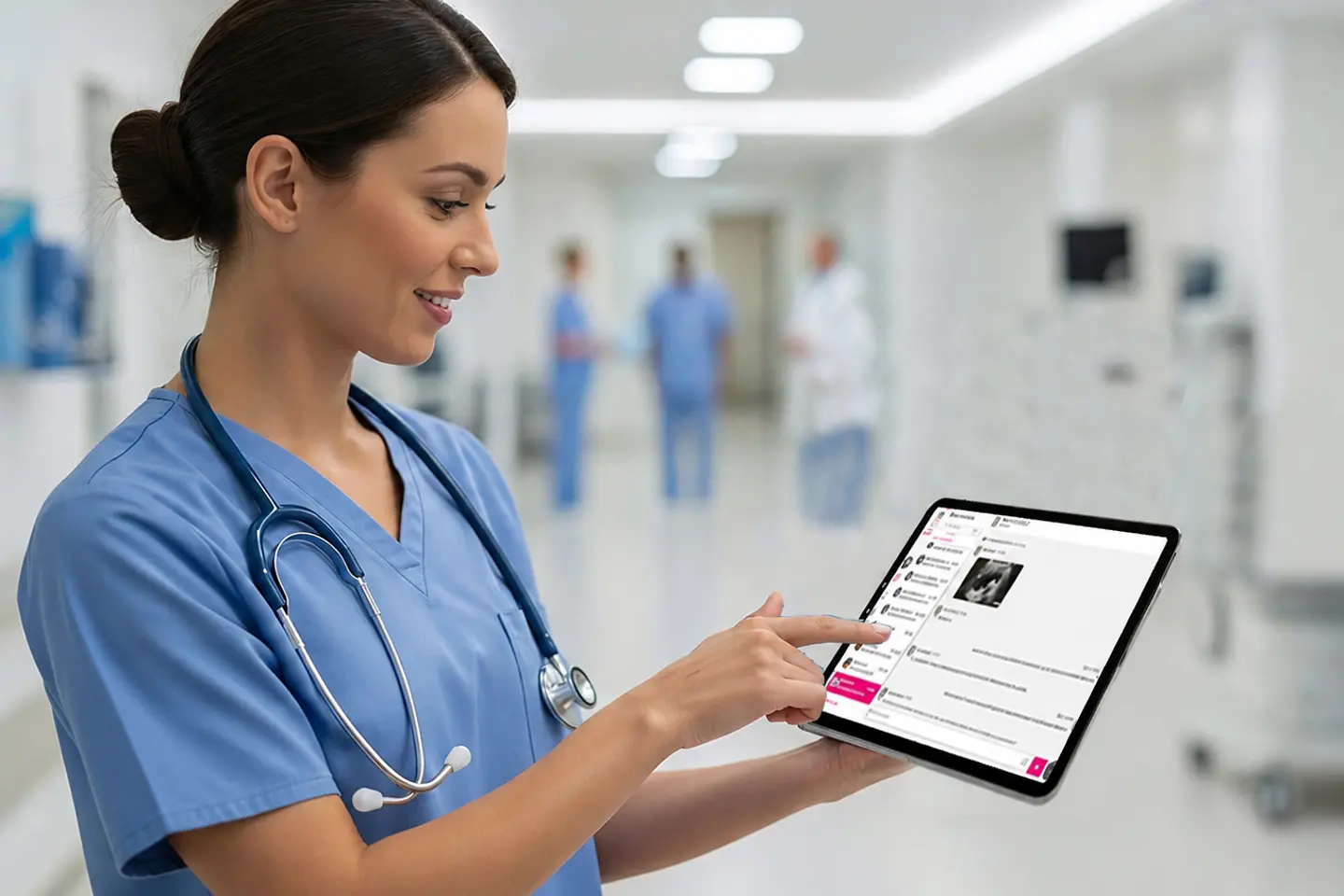
Digitalization in the healthcare sector is advancing—yet in many places, phone calls, emails, and media disruptions slow down collaboration. The TI-Messenger establishes a uniform standard for secure, real-time communication within the telematics infrastructure. For hospitals, this presents an opportunity to accelerate workflows, collaborate across sectors, and set up patient communication on a future-proof basis.
Hospitals have made significant progress in digitalization in recent years. Electronic patient records, modern hospital information systems, and digital specialist applications already support many clinical processes. At the same time, communication between wards, specialist departments, and external partners often still takes place through telephone, email, or various isolated solutions. This costs time, complicates coordination, and increases the risk of media discontinuities. The more strongly institutions collaborate digitally, the more important it becomes to have communication that functions just as securely, quickly, and interoperably as the medical applications themselves.
With the TI-Messenger, gematik is establishing a uniform messenger standard within the telematics infrastructure. Service providers can communicate securely and with end-to-end encryption, regardless of the respective provider. At the same time, the network is continuously growing: statutory health insurers already provide their insured individuals with a TI-Messenger. This creates new opportunities for digital communication between hospitals, patients, and other stakeholders in the healthcare sector. Interoperability ensures that it is not the provider who decides who can be communicated with, but rather the shared standard.
The greatest added value of the TI-Messenger lies not in the exchange of individual messages, but in more efficient processes. Findings can be securely coordinated with colleagues, available beds organized more quickly, or short-notice staffing requests sent simultaneously to multiple teams. The TI-Messenger also shortens communication pathways in discharge management or when queries arise between hospitals, general practices, and care facilities. Information becomes available more quickly where it is needed—without media breaks or time-consuming telephone chains.
The TI-Messenger is evolving far beyond a simple chat application. Through integration into existing hospital information systems, communication can take place directly from familiar working environments. With solutions such as TI-Messenger Pro from T-Systems, this integration can be implemented step by step into existing IT and communication processes. Looking ahead, features such as the documentation of chat histories with patient references and the provision of information from clinical applications are planned, among others. This makes the TI-Messenger a part of digital processes rather than an additional application that staff constantly have to switch between.
With intelligent bots and AI-supported assistance functions, numerous routine tasks can be simplified in the future. Looking ahead, bots will be able to connect staff with the right contacts, answer frequently asked questions, or provide information from internal systems. Employees will receive relevant information directly in the messenger; for example, about duty schedules, responsibilities, or organizational processes. In this way, the TI-Messenger is gradually evolving into a digital workplace for clinical communication.
The TI-Messenger is not just changing communication among service providers. Since mid-2025, statutory health insurers have been providing their insured individuals with a TI-Messenger. This is gradually creating a secure communication channel between hospitals and patients. Looking ahead, organizational matters such as appointment scheduling or follow-up questions could be handled via the telematics infrastructure—provided that hospitals and health insurers make the corresponding applications available. For hospitals, this opens up the opportunity to make organizational processes more efficient and to handle inquiries in a structured manner through a secure communication channel.

The digitalization of the healthcare sector does not end with electronic patient records or digital applications. Only secure, interoperable, and cross-sector communication connects all stakeholders along the care pathway. The TI-Messenger provides the foundation for this. With TI-Messenger Pro, T-Systems supports hospitals in successfully integrating the TI-Messenger into their communication processes and establishing digital collaboration on a future-proof basis.
The TI-Messenger (TI-M) is the messaging service specified by gematik within the telematics infrastructure (TI). It enables secure, end-to-end encrypted communication among service providers, payers, and insured individuals. Unlike conventional messaging services, the TI-Messenger was developed specifically for the requirements of the healthcare sector. Thanks to its interoperability, users of different providers can communicate with one another and easily find authorized contacts through the central directory service.
Statutory health insurers have been required since mid-2025 to provide their insured individuals with a TI-Messenger. There is currently no statutory obligation for hospitals and other service providers to use it. However, with its increasing adoption within the telematics infrastructure, the TI-Messenger is becoming the new communication standard in the healthcare sector. Institutions that introduce it early are laying the foundation for secure, cross-sector collaboration.
The TI-Messenger is aimed at all stakeholders in the healthcare sector: hospitals, medical practices, pharmacies, care facilities, rehabilitation facilities, and payers. Statutory insured individuals receive the TI-Messenger through their health insurer. Typical use cases include interdisciplinary findings communication, discharge management, and follow-up queries among service providers. As the TI-Messenger becomes more widespread, additional use cases will emerge—such as secure communication with patients.
Kommunikation im Medizinwesen (KIM) is primarily used for the secure transmission of structured documents such as physician letters, findings, or eAU messages. The TI-Messenger complements KIM with dialog-oriented, real-time communication—similar to a chat, but within the telematics infrastructure and with end-to-end encryption. Both applications serve different purposes and complement each other.
The TI-Messenger is based on the Matrix protocol and was specified by gematik as the standard for secure communication within the telematics infrastructure. Messages are transmitted with end-to-end encryption and can only be read by authorized communication partners. Through standardized interfaces, users of different TI-Messenger providers can communicate with each other seamlessly. Through the central directory service of the telematics infrastructure, authorized service providers can be easily found and contacted directly—regardless of which TI-Messenger they use.