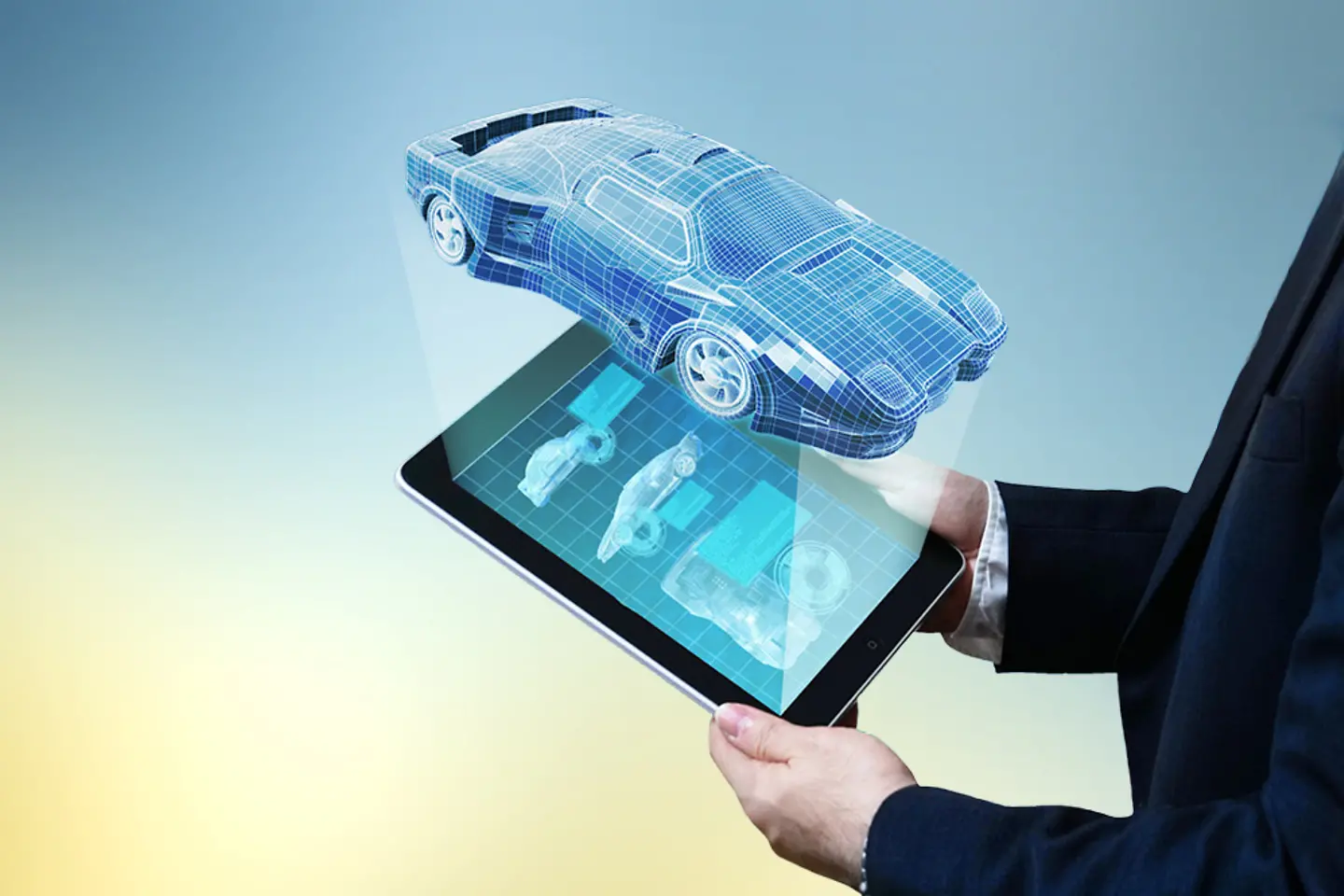
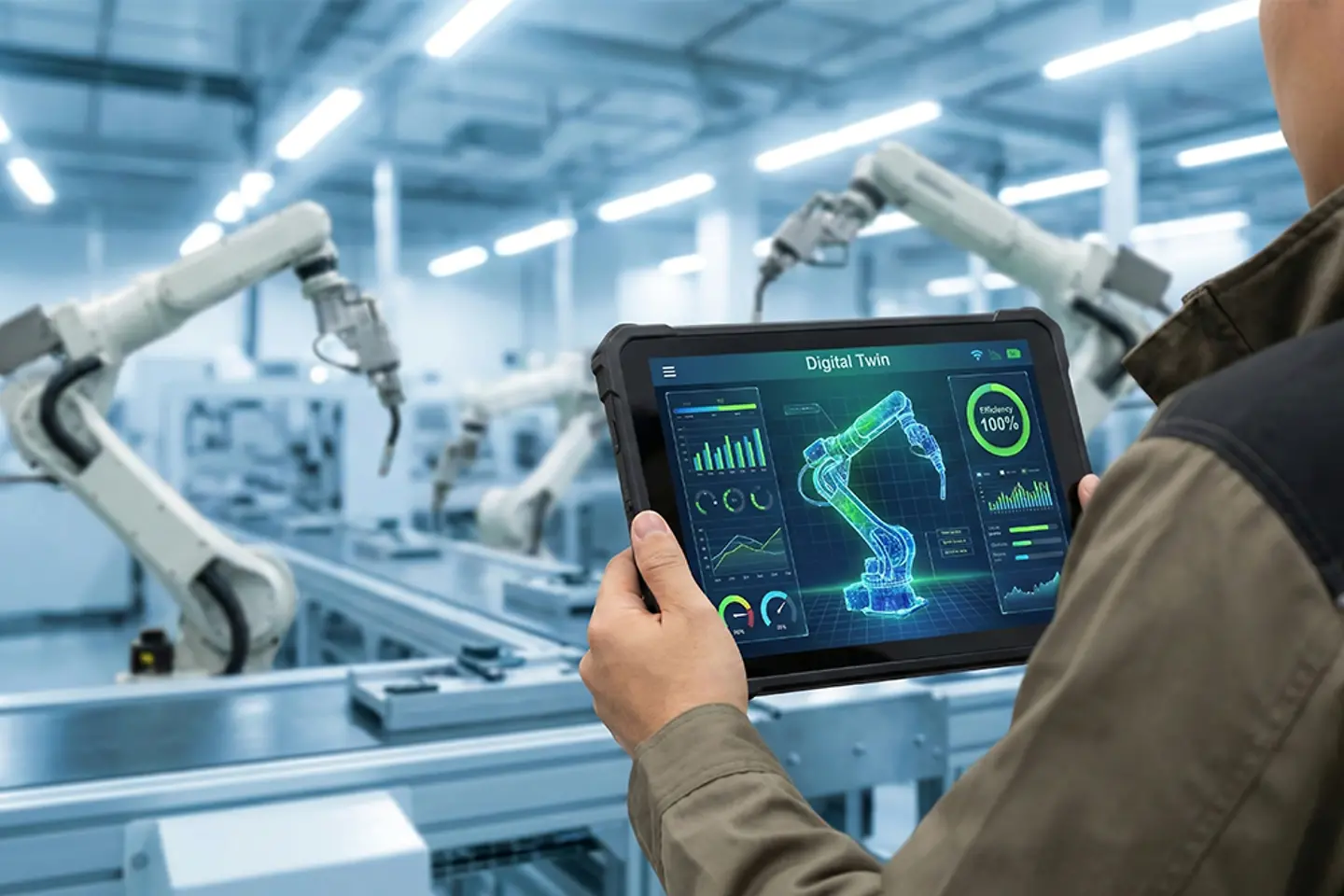
 Image generated with AI
A digital twin is a virtual representation of a physical object, system, or process that uses real-time data to accurately mirror its real-world counterpart's behavior, performance, and conditions at any given moment. Unlike blueprints or a 3D render, a digital twin is alive. It pulls in continuous streams of sensor data, IoT readings, environmental inputs, and operational metrics to stay synchronized with the physical asset it represents. When something changes in the real world — a temperature spike, a pressure drop, a production delay — the digital twin reflects it, often within milliseconds. The result is a system where engineers, operators, and decision-makers can monitor, analyze, simulate, and even control physical assets from within a digital environment. They can run experiments without touching the real machine. They can predict failures before they happen. They can test a proposed design change, see how it performs under a dozen different conditions, and only then commit to building it in the physical world.
At its most fundamental level, every digital twin is built on a few core elements:
These elements work together to create something that is far more than a digital picture. A well-built digital twin is a continuously learning, continuously updating model that reflects the world as it is, not as it was when someone last checked.
The idea behind digital twins is older than most people expect. In the 1960s, NASA began building physical replicas of its spacecraft — not to fly, but to study on the ground. Engineers could mirror what was happening aboard a mission and test different responses in real time. This practice proved its value dramatically in 1970, when an oxygen tank explosion aboard Apollo 13 threatened the lives of three astronauts. NASA used these physical replicas to simulate rescue scenarios from Earth, ultimately bringing the crew home safely. The concept of a virtual, data-connected twin emerged more formally in 2002, when Michael Grieves — then at the University of Michigan — presented a product lifecycle management framework that explicitly linked a physical product to its digital counterpart through continuous data exchange. He described a "mirrored spaces" model: a real space, a virtual space, and a connection between them. The term "digital twin" itself was officially coined by NASA engineer John Vickers in 2010, in a roadmap document outlining the agency's technology needs for the coming decade. From there, this technology developed rapidly alongside the broader rise of IoT, cloud computing, and AI (artificial intelligence). By the mid-2010s, industrial giants like General Electric and Siemens were deploying digital twins at scale in manufacturing and energy infrastructure. Today, this technology has spread across virtually every sector of the global economy. The market reflects this trajectory. According to Fortune Business Insights, the global digital twin market was valued at approximately $24.5 billion in 2025 and is projected to reach $259.3 billion by 2032 — a growth rate that places it among the fastest-expanding technology categories in the world. (1)
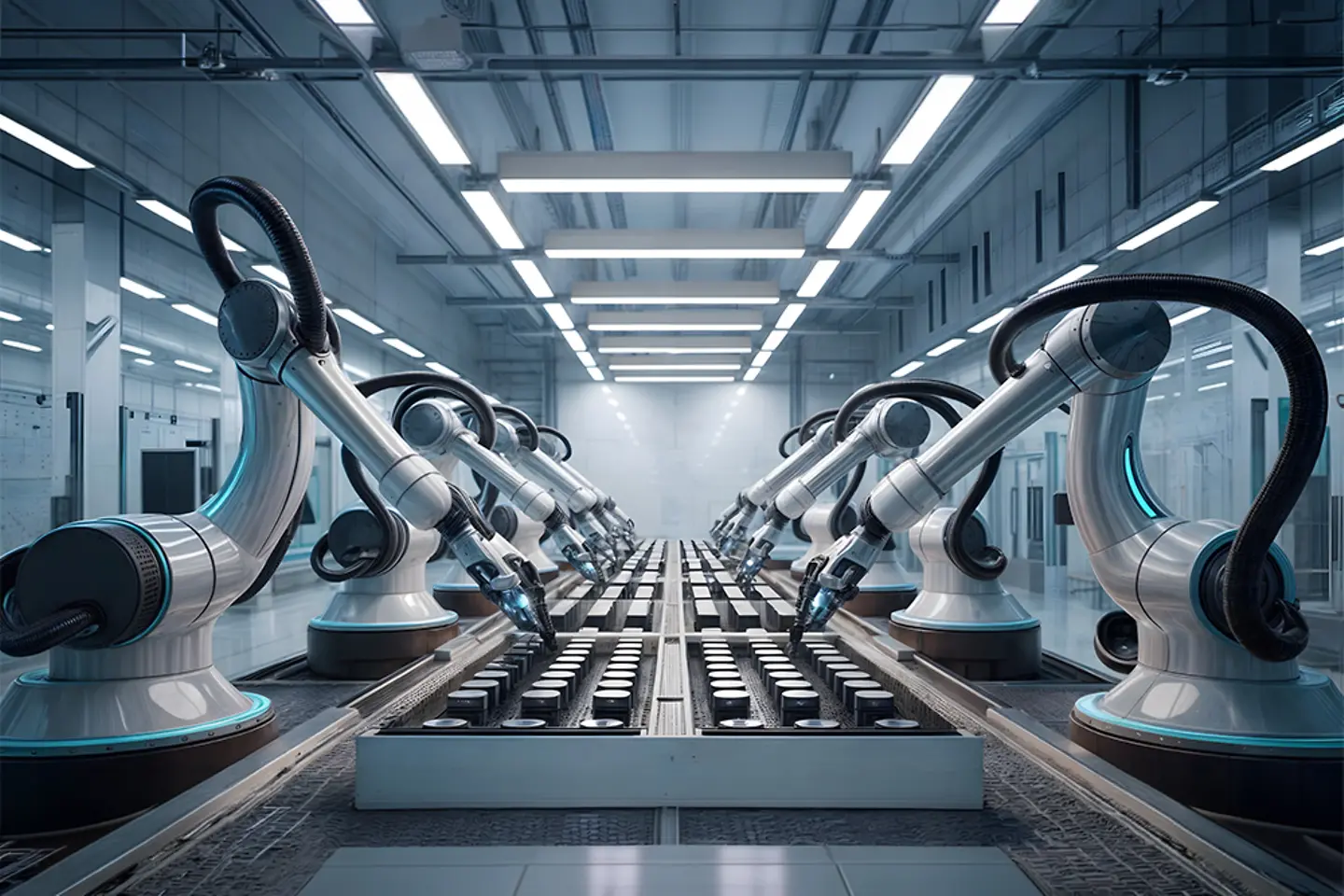
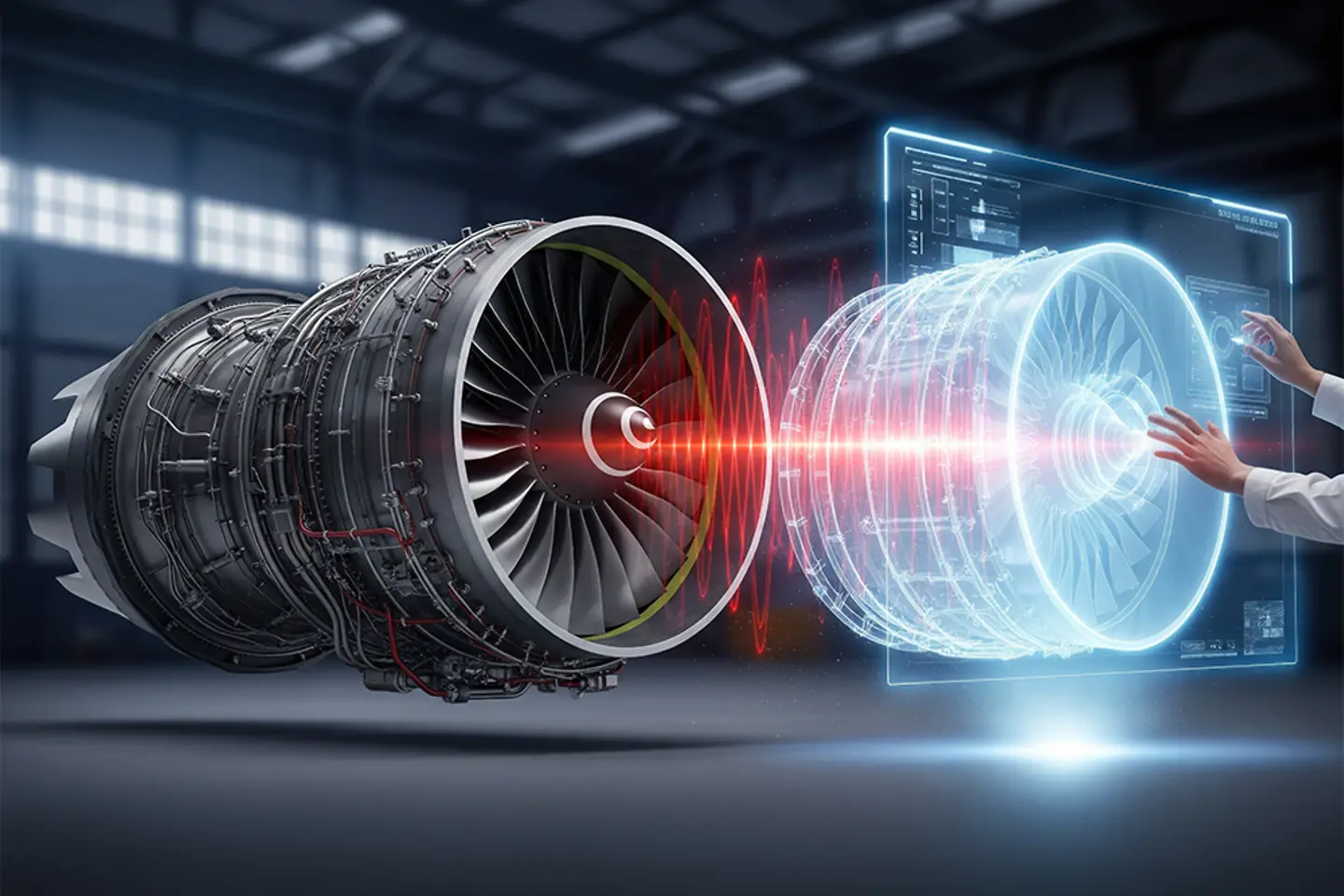 Image generated with AI
Understanding how a digital twin works requires looking at the full lifecycle of information: from physical reality, into the digital model, through analysis, and back to the physical world.
Step 1: Data collection
It starts with instrumentation. Physical assets are equipped with sensors that continuously capture performance, environmental, and operational data — temperature, vibration, pressure, flow rate, position, energy consumption, and dozens of other variables depending on the application. In industrial IoT environments, many assets now come with embedded sensors as standard. In IT environments, virtualization technologies create digital representations of software systems, and software agents collect performance data directly. The volume and velocity of data collected at this stage can be extraordinary. A single modern jet engine may generate more than a terabyte of data per flight. A smart factory floor may have thousands of sensors reporting simultaneously. The infrastructure to capture, transmit, and process this data reliably is itself a significant engineering challenge — one that cloud platforms and edge computing architectures have increasingly made tractable.
Step 2: Virtual modeling
The virtual model is the heart of the digital twin. It is not simply a 3D rendering or a static database. It is a behavioral model: a mathematical and computational representation of how the physical asset functions, responds to inputs, and interacts with connected systems. Building an accurate virtual model requires deep domain knowledge. A digital twin of an aircraft turbine must account not just for its geometry, but for aerodynamic forces, thermal behavior under load, wear rates for different materials, and the influence of neighboring systems like fuel delivery and cooling. This level of fidelity is what separates a useful digital twin from a decorative one. Modern digital twin platforms use physics-based modeling, data-driven modeling (where behavior is learned from historical operational data), and increasingly, hybrid approaches that combine both.
Step 3: Live data integration
Once the model exists, it must stay connected to reality. Live data integration enables continuous, bidirectional communication between the physical asset and its digital counterpart. This synchronization is what gives digital twins their distinctive power. The model is never static; it updates continuously as conditions change. This dynamic connection enables real-time monitoring, early anomaly detection, and predictive analysis that would be impossible with periodic snapshots.
Step 4: Analysis, simulation, and decision-making
With a live, accurate model in place, organizations can do things that were previously impractical or impossible. They can run "what-if" scenarios in the virtual environment — testing proposed design changes, operational adjustments, or stress conditions — without any risk to the physical asset or production process. They can use industrial AI and machine learning to identify patterns in historical data that predict future failures. They can optimize parameters in the virtual model and then push those optimizations back to the real system. This is where the business value of digital twins is ultimately realized: not in the data collection or the modeling, but in the quality of the decisions that better information enables.
These three concepts are frequently confused, and the distinctions matter.
A 3D model is a static representation of an object's geometry at a point in time. It tells you what something looks like. It cannot tell you how it behaves, how it will respond to stress, or what is happening to it right now. 3D models often serve as a foundational visual layer within digital twins, but they are not twins themselves.
A simulation is a scenario run in a virtual environment. It can be highly sophisticated — testing how a bridge will respond to seismic activity, or how a drug will interact with a protein — but it is typically a one-time or periodic exercise. A simulation does not maintain a persistent, live connection to a real-world counterpart. It runs a defined scenario and produces results. Simulations are static in the sense that they do not automatically update when conditions in the real-world change.
A digital twin is continuous, bidirectional, and connected. It does not just run scenarios; it mirrors reality in real time. And crucially, it can send information and control signals back to the physical system — not just observe, but influence. This persistent, live synchronization is the defining characteristic that separates a digital twin from a simulation.
Digital twin implementations exist at different scales, each offering a different level of granularity. In complex industrial environments, multiple types often co-exist and interconnect.
Component twins
The most granular level, component twins (also called part twins) replicate individual components of a larger system — a single valve in a pipeline, a bearing in a motor, a battery cell in an electric vehicle. They provide the deepest level of insight into specific parts, making them particularly valuable for predictive maintenance of highly critical components.
Asset twins
Asset twins replicate complete functional units made up of multiple interacting components — a pump system, a wind turbine drivetrain, a vehicle's suspension assembly. They reveal how components work together and where interactions between parts create performance impacts or failure risks.
System twins
System twins zoom out further, modeling how multiple assets interact within a larger integrated system — a segment of a production line, a building's HVAC and electrical infrastructure, a segment of an energy grid. They identify how changes or failures in one asset propagate through the broader system, supporting more holistic optimization.
Process twins
Process twins provide the broadest view, modeling entire operational workflows — an end-to-end manufacturing process, a supply chain network, a hospital's patient flow. They help organizations understand and optimize performance at the level of the whole operation, not just individual assets.
Hi-fi vs. lo-fi twins
Beyond scope, digital twins also vary in fidelity. High-fidelity (hi-fi) twins use detailed physics-based models and dense sensor arrays to achieve very precise real-world correspondence — ideal for high-stakes applications like aerospace engineering or nuclear plant monitoring. Low-fidelity (lo-fi) twins use simpler models and less dense data to achieve sufficient accuracy for their purpose at lower cost and complexity — appropriate for many manufacturing monitoring and optimization applications.
The right level of fidelity depends on the stakes of the decisions the twin is supporting and the cost of the additional accuracy.
Digital twins are no longer confined to advanced engineering contexts. They are being deployed at scale across a wide range of sectors.
Manufacturing and Industry 4.0
Manufacturing is where digital twins arguably deliver their most immediate and measurable value. A digital twin of a factory floor enables continuous monitoring of every machine's condition and output, real-time quality control, dynamic production scheduling, and supply chain visibility — all within a single, integrated operational picture. In the context of Industry 4.0, digital twins are foundational. They provide the data layer that connects physical production systems to the analytical and AI capabilities that drive smart manufacturing. Factories using digital twins can respond to equipment issues before they cause defects, optimize energy consumption in real time, and simulate the impact of production changes before implementing them.
Energy and utilities
Power generation and distribution are characterized by high asset complexity, high failure costs, and extremely long asset lifecycles. Digital twins address all three. Turbines, transformers, transmission lines, and grid infrastructure can all be modeled and monitored continuously, enabling predictive maintenance programs that extend asset life and reduce outages. In renewable energy, digital twins are becoming essential for optimizing the performance of wind and solar assets — where variability in environmental conditions makes real-time adaptive control significantly more valuable than fixed operational parameters.
Healthcare
Digital twins in healthcare operate at multiple scales. At the patient level, emerging "digital patient" models combine imaging, genomic, physiological, and clinical data to create personalized representations that can help predict how individuals will respond to specific treatments. At the hospital level, operational digital twins model patient flow, staffing allocation, and equipment availability to optimize scheduling and reduce bottlenecks. At the pharmaceutical level, digital twins of biological processes and clinical trials accelerate drug development while reducing costs.
Automotive and mobility
The automotive sector was among the earliest adopters of digital twins on an industrial scale. Vehicle digital twins support design validation, performance testing, and safety certification without the cost and time of full physical prototypes. In the production environment, factory digital twins enable just-in-time production optimization. And increasingly, connected vehicle platforms generate operational twins that update throughout the vehicle's working life, informing warranty management, over-the-air updates, and customer service.
Infrastructure and construction
Engineers use physics-based digital twins to model the structural behavior of buildings, bridges, dams, and other civil infrastructure under a range of loading conditions — wind, seismic activity, traffic, temperature change. This capability supports both design optimization and ongoing structural health monitoring after construction. In smart city initiatives, digital twins of entire urban areas — integrating building data, transportation networks, utility systems, and environmental sensors — support city planning, traffic management, emergency response, and sustainability reporting.
Supply chain and logistics
Supply chain digital twins model the full flow of materials, products, and information from source to customer. They provide visibility into inventory positions, transportation status, supplier performance, and demand signals — enabling organizations to identify vulnerabilities, simulate disruption scenarios, and optimize network configuration. In an environment where supply chain resilience is a board-level concern, this kind of systemic visibility is increasingly valuable.
Accelerated research and development
Digital twins transform product development. Instead of building and destroying physical prototypes to test each design iteration, engineers can simulate dozens of variants simultaneously in the virtual environment, identifying the most promising approaches before committing to physical manufacture. Aerospace and automotive companies have used this capability to dramatically compress development cycles. A design that once required months of physical testing can now be validated in weeks. The savings in time, materials, and engineering hours are substantial.
Predictive maintenance
Unplanned equipment downtime is expensive. According to NIST data, planned production time lost to downtime can represent between 8.3% and 13.3% of total capacity — amounting to $245 billion in losses annually for U.S. discrete manufacturing alone.(2) Digital twins address this by continuously monitoring asset conditions and using AI to detect the early signatures of impending failure — often days or weeks before a conventional inspection would catch them. Maintenance can be scheduled at an optimal time, before failure occurs, rather than reactively after it does. This shifts organizations from reactive and scheduled maintenance to genuinely predictive maintenance, which is both cheaper and more reliable.
Operational efficiency and optimization
Digital twins give operations teams a continuous, data-rich view of how their systems are performing — not how they were designed to perform, but how they perform under real conditions, with real variability. This visibility reveals optimization opportunities that would otherwise remain invisible. Energy consumption, material yield, throughput, quality rates — all of these can be continuously monitored and optimized through the twin. In manufacturing contexts, this kind of continuous optimization can deliver meaningful improvements in cost per unit and overall equipment effectiveness.
Reduced risk through virtual testing
Before a new product goes to market, before a factory retrofit goes online, before a new drug goes to clinical trials — digital twins allow teams to stress-test ideas in a safe, virtual environment. The risks of real-world testing (cost, safety, regulatory exposure, time) can be substantially reduced by virtualizing the critical decision points.
Enhanced oversight and rapid fault diagnosis
In complex systems, the root cause of a failure is often not the component that breaks down visibly, but something earlier in the causal chain. Digital twins, by maintaining real-time visibility into every monitored component, can surface early warning signals and trace fault propagation across a system. This dramatically reduces mean time to diagnosis and repair.
One of the most significant developments in digital twin standardization is the emergence of the Asset Administration Shell (AAS) — a standard framework developed through the Industrial Internet of Things Consortium and the Platform Industry 4.0 initiative. The AAS defines a standardized digital representation for physical assets within the industry 4.0 context. It specifies how assets should describe themselves digitally — their properties, capabilities, documentation, and operational data — in a machine-readable format that allows systems from different vendors to interoperate. This matters enormously in practice. Industrial environments typically involve equipment and systems from dozens of different manufacturers, each with its own data formats, communication protocols, and software interfaces. Without a common standard, integrating these systems into a coherent digital twin is an expensive, custom engineering challenge. The AAS provides a shared language that reduces this integration burden substantially. For organizations building digital twin ecosystems at scale, the AAS is a critical piece of infrastructure — one that determines whether digital twins remain siloed experiments or become genuinely connected, organization-wide capabilities.
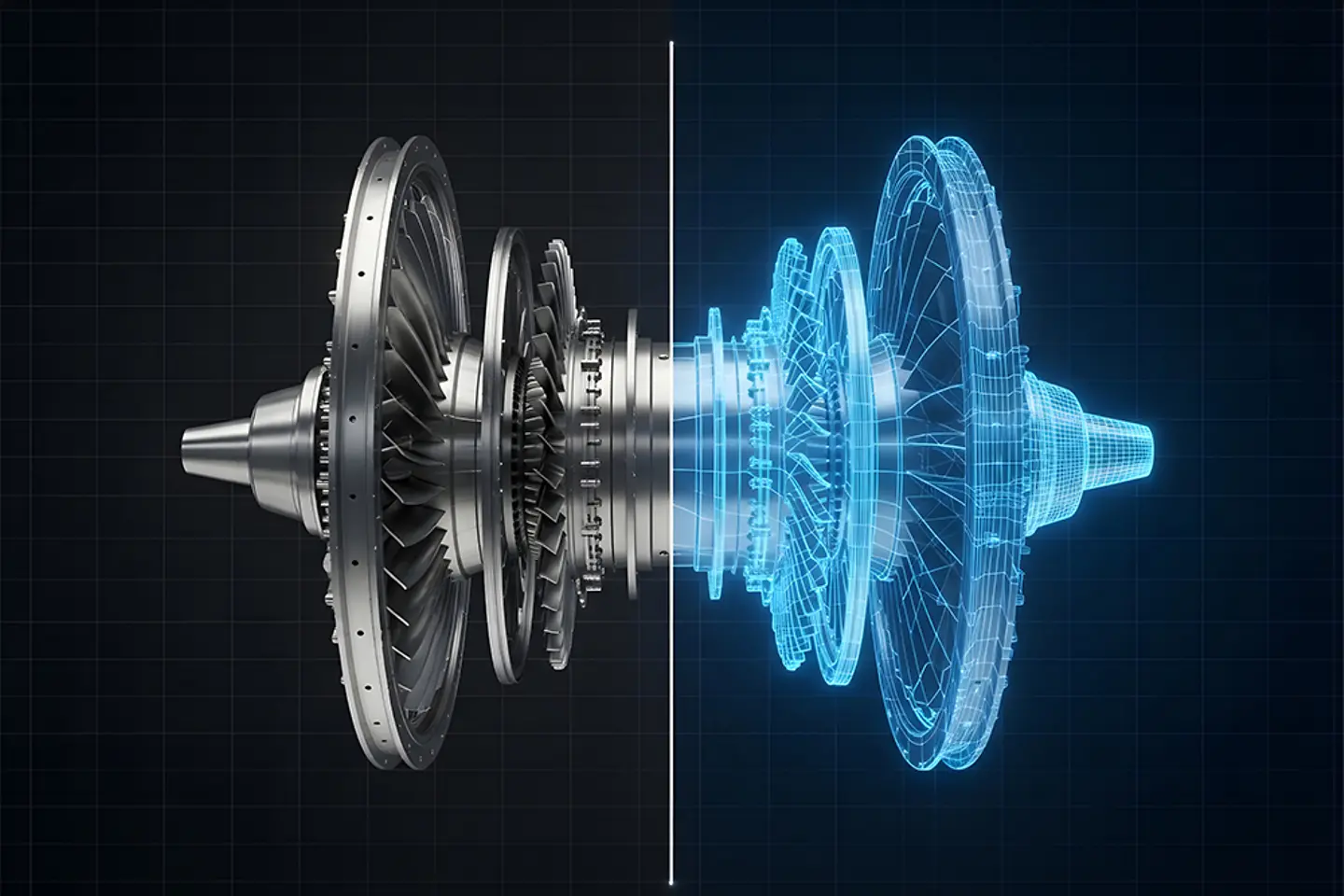 Image generated with AI
The current generation of digital twins is being transformed by artificial intelligence, and the impact is not incremental — it is fundamental. Traditional digital twins relied on physics-based models and rule-based analytics. These are powerful, but they require substantial domain expertise to build and maintain, and they struggle with the complexity and variability of real-world systems at scale. AI and machine learning change this. Machine learning models can be trained on historical operational data to recognize patterns that physics-based models might miss — the subtle vibration signature that precedes a bearing failure, the combination of environmental and operational conditions that correlates with quality defects, the demand signal patterns that predict supply chain disruptions.
Generative AI extends this further, enabling digital twins that can not only predict how a system will behave under known conditions, but generate synthetic scenarios — combinations of inputs that have never occurred — and evaluate how the system would respond. This capability dramatically expands the value of pre-deployment testing.
The convergence of AI with digital twins is also enabling a new generation of autonomous operations — where the digital twin not only monitors and analyzes but makes operational decisions and implements them without human intervention. This is not science fiction; it is already operational in areas like cloud infrastructure scaling, energy grid balancing, and autonomous manufacturing cells.
The digital twin market is in a period of rapid maturation and expansion. Several developments are shaping where the technology is heading.
Digital Twin as a Service (DTaaS) is gaining momentum. Rather than building and maintaining their own digital twin infrastructure, organizations can access sophisticated twin capabilities through cloud platforms — reducing the technical barrier to entry and accelerating time to value.
Digital doppelgängers the digital twins of human beings are moving from research curiosity toward practical application. These can model individual health trajectories for personalized medicine, create synthetic user populations for product testing, or automate repetitive cognitive tasks.
Interoperability and standardization are becoming the central challenges. As digital twins proliferate, the value of connecting them — within an organization and across supply chains — grows rapidly. Standards like the AAS, DTDL (Digital Twin Definition Language), and W3C Web of Things are building the foundation for a more connected digital twin ecosystem.
Sustainability is emerging as a major use case. Digital twins can model and optimize the energy consumption, material use, and emissions profile of products, factories, and supply chains — making them powerful tools for organizations working toward net-zero commitments. By simulating the full lifecycle impact of design decisions before production begins, digital twins shift sustainability from a reporting function to a design discipline.
NIST's ongoing research program on digital twins for advanced manufacturing reflects the growing recognition that standards, testing methodologies, and validation frameworks are as important as the technology itself for realizing the full value of digital twins at scale.
Building and operationalizing a digital twin is a complex undertaking that spans strategy, architecture, integration, data engineering, and ongoing operations. T-Systems brings together the capabilities across this full stack, partnering with organizations from initial concept through to scaled deployment.
Our approach covers:
IT architecture and infrastructure for digital twins, including cloud and edge environments designed for the data volumes and latency requirements of real-time industrial applications.
IoT integration and data pipeline engineering, connecting physical assets to digital models through reliable, scalable data infrastructure — including integration with existing industrial systems, ERP platforms, and third-party data sources.
AI and analytics capabilities that transform raw operational data into actionable insight — from anomaly detection and predictive maintenance models to optimization algorithms and simulation engines.
Industry-specific expertise across manufacturing, automotive, energy, healthcare, and public sector with deep understanding of the operational context that determines whether a digital twin delivers real value or remains a technology demonstration.
Security and compliance, ensuring that digital twin deployments meet the data governance, cybersecurity, and regulatory requirements of each industry and jurisdiction. Whether you are taking the first steps toward a digital twin pilot or scaling an existing program across a global operation, T-Systems has the expertise and partnerships to support the journey.
Digital twin technology is maturing rapidly, and the organizations that build capability now are establishing competitive advantages that will compound over time. Whether the goal is reducing downtime, accelerating product development, improving sustainability performance, or building genuinely autonomous operations digital twins are increasingly how the world's most sophisticated industrial organizations are achieving it. T-Systems partners with companies across industries to design, build, and operate digital twin programs that deliver measurable results.
In manufacturing, digital twins support predictive maintenance, production optimization, quality control, factory planning, and supply chain management — continuously monitoring and improving operations in real time.
No — a digital twin is a modeling and simulation framework. AI is frequently used within digital twin platforms to power analytics, pattern recognition, and predictive capabilities, but the twin itself is the virtual representation of the physical asset.
In construction, digital twins model structural behavior under load, support building information modeling, and enable ongoing monitoring of completed infrastructure for structural health and maintenance planning.
In the Industry 4.0 context, digital twins are the virtual representation layer of smart manufacturing — connecting physical production systems to data analytics, AI, and cloud platforms to enable real-time optimization, predictive maintenance, and autonomous operations.
Building a digital twin involves instrumenting the physical asset with sensors, constructing a virtual model that accurately reflects the asset's behavior, establishing a real-time data pipeline between the two, and building the analytics layer that turns data into insight. Standards like the Asset Administration Shell are helping to make this process more systematic and interoperable.
Digital twin architecture refers to the technical infrastructure that underpins a digital twin — including the sensor and IoT layer, the data pipeline and integration layer, the modeling and simulation layer, the analytics and AI layer, and the visualization and interface layer.
By continuously monitoring asset condition data and applying machine learning to detect early signatures of impending failure, digital twins enable maintenance to be scheduled proactively — before failure occurs — rather than reactively after breakdown.
Enterprise digital twins typically rely on a combination of industrial IoT platforms, data streaming infrastructure (such as Apache Kafka), cloud data lakes, and real-time analytics engines. Integration with ERP, MES, and SCADA systems is also typically required to give the twin full operational context.
Scaling digital twin simulations typically involves cloud-native architectures that can dynamically provision compute resources, edge computing deployments that reduce latency for time-critical applications, and modular twin designs that allow component and asset twins to be aggregated into system and process twins progressively.
The technology stack varies based on the use case and business goals. We utilize knowledge graphs to integrate and organize data from multiple sources, making it structured, searchable, and context-rich. For advanced visualization and virtual modeling, we collaborate with partners such as NVIDIA Omniverse to support immersive simulations and enable real-time collaborative environments.
(1) Fortune Business Insights, Einpresswire, 2025
(2) National Institute of Standards and Technology research (NIST)