You can display all external content on the website at this point.
I agree that personal data may be transmitted to third-party platforms. Read more about this in our privacy policy.
Multicloud means that an organization uses cloud services from two or more providers. It becomes a deliberate strategy when workloads are assigned to those providers using clear criteria and governed through a common operating model.
Multicloud describes provider diversity: several cloud providers. Hybrid cloud describes a combination of deployment types, usually public cloud with private cloud or on-premises systems that work together. An enterprise can use both at once, creating a hybrid multicloud.
No. Resilience requires an architecture that can continue or recover when a component, zone, region, or provider fails. Cross-cloud resilience needs replicated data, compatible capacity, traffic switching, automated recovery, and regular testing. Simply running unrelated workloads on two providers does not protect either workload.
It can be. Multiple providers may improve price-performance for selected workloads, but they can also add connectivity charges, duplicated tools, support contracts, skills, and governance effort. Compare total cost and unit economics, not list prices.
It can expand the choice of regions, sovereign platforms, and operating arrangements available for a workload. Sovereignty still depends on precise controls covering data location, jurisdiction, administrative access, encryption keys, subcontractors, and operational autonomy.
Usually not without preparation. Containers, open interfaces, and infrastructure as code can improve portability, but applications often depend on provider-specific data services, identities, APIs, and operating processes. Define the required degree of portability, maintain exportable data and documentation, and test the exit path. The EU Data Act reduces certain switching barriers, but it cannot remove architectural dependencies created by the customer’s design.
Avoid adding a provider when one cloud meets the workload’s business, regulatory, and technical needs; when teams lack the capacity to secure and operate another platform; when tightly coupled components would need constant cross-cloud communication; or when the only benefit is theoretical bargaining power.
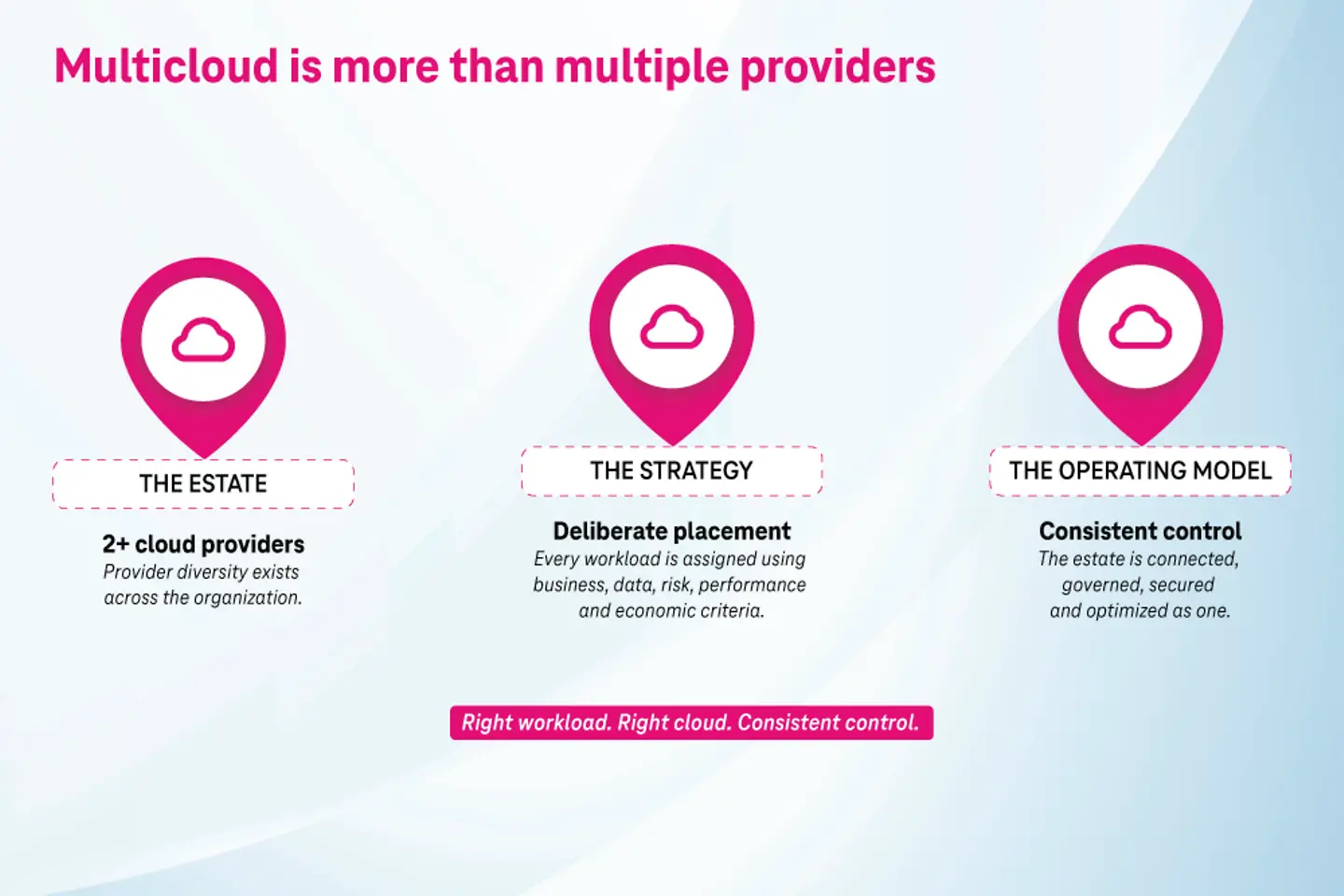
Multicloud means using cloud services from more than one provider.³ But an enterprise does not have a multicloud strategy simply because different teams have opened accounts on different platforms. Multicloud becomes strategic when every workload has a deliberate destination and the estate is connected, governed, secured and optimized through one operating model: the right workload, on the right cloud, under consistent control.
Multicloud is an IT model in which an organization uses services from at least two cloud providers. Those services may include infrastructure, platforms and software, and the environments may operate independently or exchange data and services.
In enterprise use, the term usually describes workloads distributed across multiple public cloud providers. A wider estate may include private, sovereign and edge environments. Definitions vary because some describe provider diversity while others describe the entire mixed estate.
For decision-makers, a useful definition has two layers:
The first can happen through procurement, team autonomy, software-as-a-service adoption, mergers or shadow IT. The second requires design.
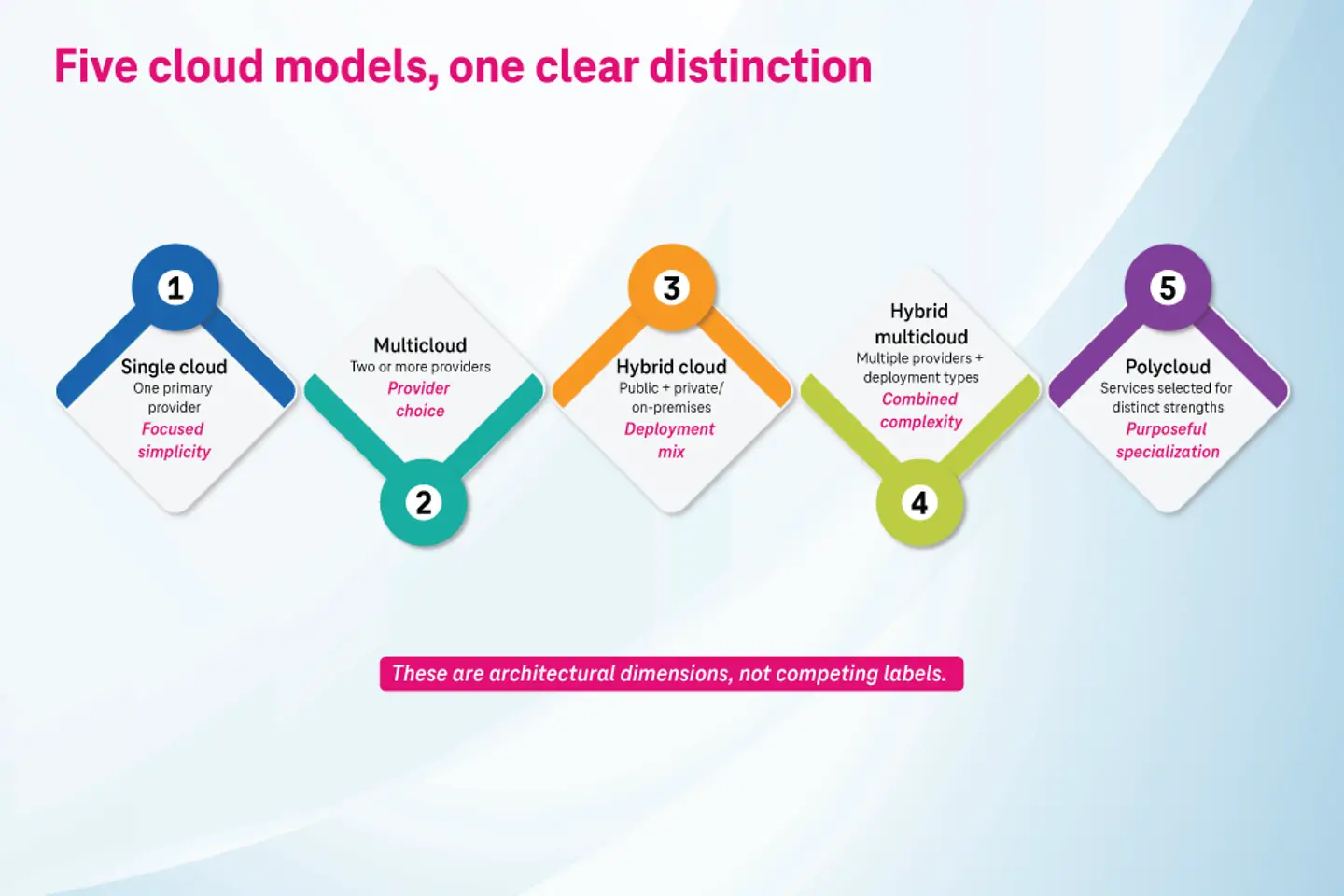
Multicloud and hybrid cloud answer different questions. Multicloud concerns how many cloud providers an organization uses. Hybrid cloud concerns which infrastructure types work together, typically public cloud combined with private cloud or on-premises systems. They can therefore coexist.
These are architectural dimensions, not competing labels. A business might keep latency-sensitive processing at the edge, core systems in a private cloud, selected data in a sovereign environment and analytics in public cloud. That is both hybrid and multicloud.
Accidental multicloud is common. Business units buy SaaS independently, developers choose familiar platforms or an acquisition brings a second provider. Each decision may be reasonable, but the combined result can lack ownership, architecture standards and cost visibility.
A deliberate strategy makes each placement auditable. It defines approved environments, connectivity, identity, security, financial ownership and exit requirements. It also permits consolidation: a second platform that contributes no differentiated value may be better removed.
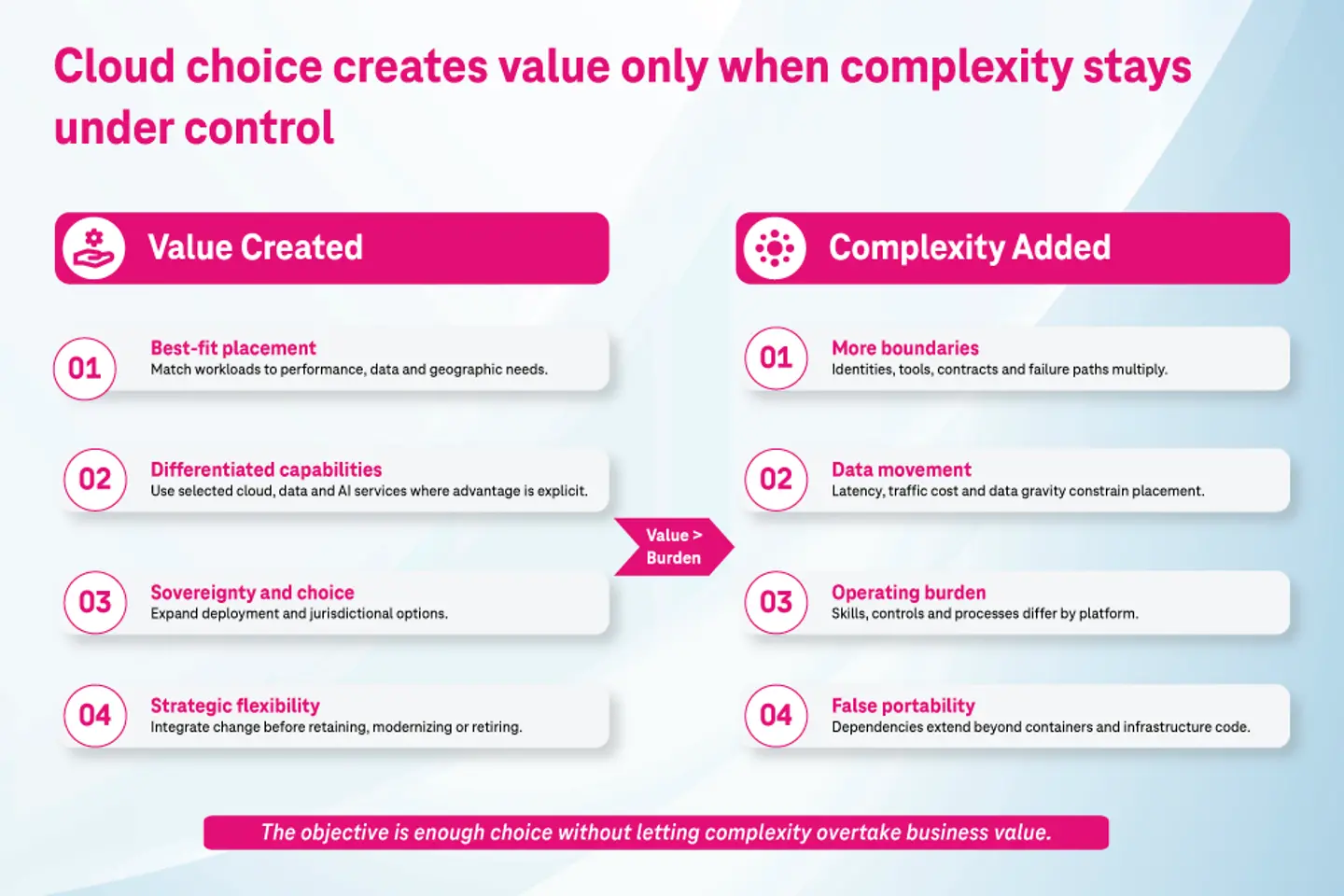
The strongest reason to adopt multicloud is not abstract freedom. It is the ability to meet requirements that a single environment cannot meet as effectively, provided the value exceeds the additional operating burden.
Workloads differ. A customer application may prioritize global reach; a production system may need predictable latency near a factory; regulated data may require locations or controls. Placement should follow these requirements rather than a default provider.
Cloud platforms specialize in different services. Multicloud can give teams access to selected capabilities without moving the entire estate. A differentiated managed service may accelerate delivery while making migration harder; that can be rational when the advantage is explicit and accepted.
Provider diversity can reduce concentration risk, but it does not itself create resilience. A service running in one cloud does not fail over merely because the organization has a contract with another. Cross-cloud recovery needs replicated data, compatible capacity, tested automation, synchronized security controls, traffic management, realistic recovery objectives and teams able to operate the alternate environment.
Resilience across zones or regions within one provider is often sufficient. Cross-cloud continuity is justified when the risk model warrants its extra cost and complexity.
European enterprises must translate sovereignty into specific controls: where data and metadata are stored, which jurisdictions can affect them, who can administer systems, how encryption keys are controlled, which subcontractors participate and whether operations remain possible if a supplier relationship changes. A multicloud portfolio can offer a broader set of deployment and jurisdictional options, but compliance still attaches to each workload, data flow and shared-responsibility boundary.
The EU Data Act has applied since 12 September 2025. Its provisions require data-processing service providers to remove obstacles to switching and support interoperability, with switching charges due to be withdrawn from 12 January 2027.¹² This improves the contractual and technical environment for choice, but it does not make applications automatically portable. Architecture, data models, identity, operations and testing remain enterprise responsibilities.
Mergers, divestitures and modernization produce heterogeneous estates. Immediate consolidation may create more disruption than value. A governed model lets the enterprise integrate operations first, then retain, modernize or retire environments deliberately.
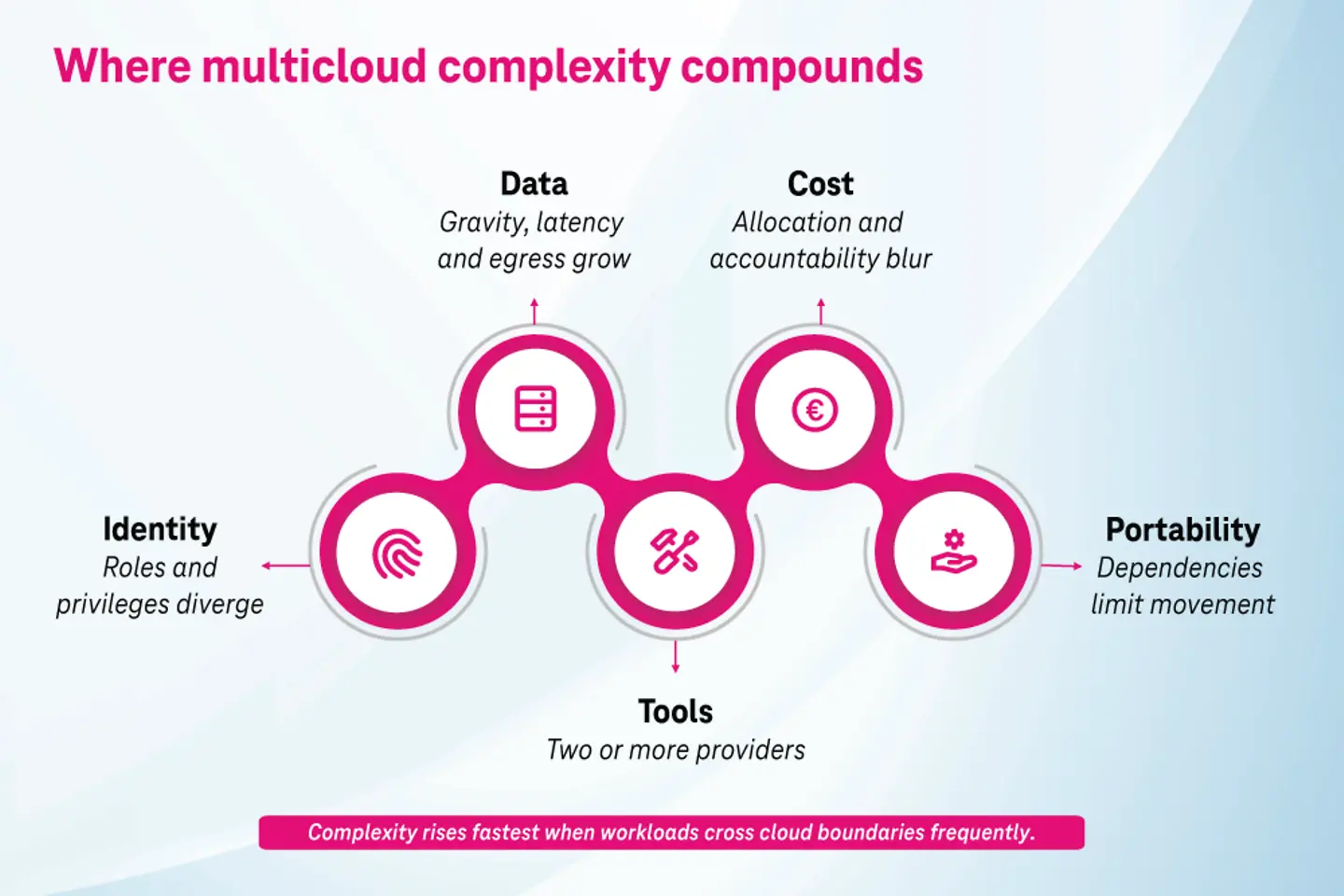
Every additional cloud introduces another operational boundary. That boundary has its own concepts, APIs, service limits, commercial models and shared-responsibility assumptions. Complexity grows fastest where workloads cross those boundaries frequently.
Account structures, roles, policies, logging formats and security services differ between providers. Without federation and common control objectives, privileges accumulate, evidence becomes hard to assemble and incident responders lose time correlating events. Consistency does not mean replacing every native security service with one generic tool. It means defining common outcomes, using provider-native controls where they are strongest and normalizing evidence into a unified security process.
Large datasets attract applications because moving data repeatedly is slow, costly and operationally risky. A seemingly attractive analytics or AI service in another cloud can become uneconomic if it requires continuous transfer of high-volume operational data. Tightly coupled components distributed across clouds can also add network latency and expand the number of partial-failure scenarios.
The practical rule is to keep compute close to the data it uses most, minimize synchronous cross-cloud calls and model traffic in both architecture and total cost. Connectivity is not a late networking task; it is a placement constraint.
Each platform adds tools, processes and specialist knowledge. Reusable landing zones help, but teams still need provider-specific expertise; generic tooling cannot erase differences between databases, identity systems or managed AI services.
Bills use different service names, units, discounts and allocation structures. Shared connectivity, security, observability, support and duplicated tooling may sit outside the apparent cost of a workload. Without consistent tagging and ownership, optimization becomes a central reporting exercise rather than a decision engineers and product owners can act on.
Containers and infrastructure as code improve repeatability, but they do not make an entire application portable. Dependencies can include managed databases, event services, identity integrations, proprietary APIs, data formats, operational runbooks and staff skills. Portability should therefore be scoped: which component must move, to which destination, within what time and with what acceptable loss of functionality?
Workload placement should begin with business outcomes and application dependencies, not a provider feature comparison. The decision unit is rarely a single server. It is a business service with data, integrations, users, recovery needs, licenses and an operating team.
Business Value
Data sensitivity
Dependencies and data gravity
Latency and user location
Availability and recovery
Portability and exit
Total cost
Skills and operations
Data classification should precede placement. Sensitivity, residency, retention and lifecycle rules need to travel with the data into backups, logs, replicas and analytics outputs. Then evaluate performance, resilience and total cost under realistic demand. Finally, decide deliberately where cloud-native differentiation is worth deeper dependency and where standardized deployment patterns are more valuable.
The result should be a documented placement policy, not a one-time spreadsheet. Services, prices, regulations and dependencies change, so decisions need scheduled review.
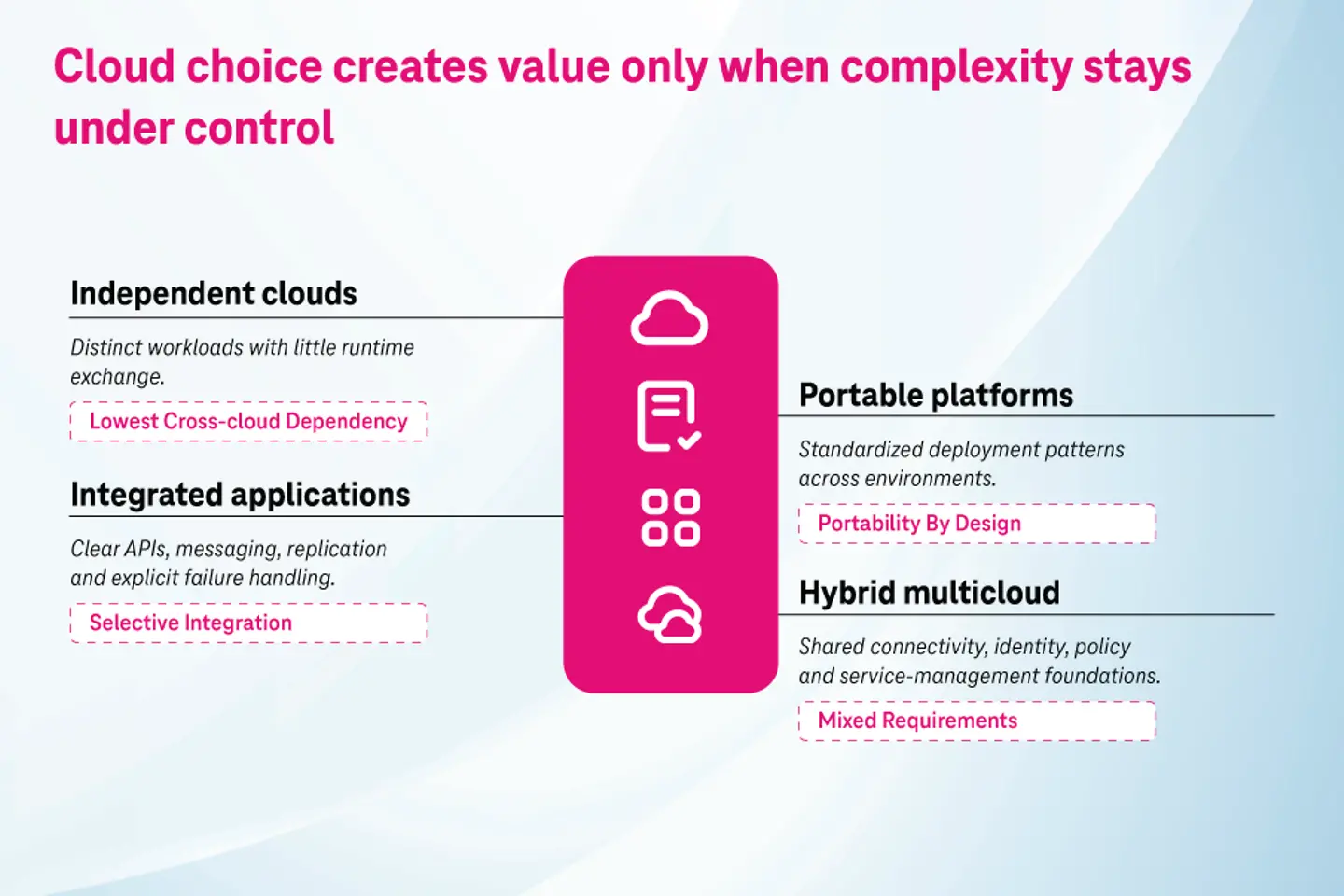
This is often the most manageable pattern. Workload groups use different providers but exchange little data at runtime. Common governance, identity and reporting sit above them, while application components stay together. It supports provider choice without introducing unnecessary cross-cloud latency.
Some processes must connect services in different clouds. Use clear APIs, asynchronous messaging where appropriate, controlled replication and explicit failure handling. Avoid distributing a tightly coupled transaction path unless a measured requirement justifies it.
Containers, Kubernetes, infrastructure as code and open telemetry can create a consistent delivery experience across environments. Yet standardization has a cost, and the lowest common denominator can block useful native services. Portability is a design choice, not a universal requirement.
This pattern fits workloads with mixed requirements: local processing, protected data, existing systems and scalable public-cloud capabilities. Its success depends on treating connectivity, identity, policy and service management as shared foundations. Without those foundations, the architecture becomes a collection of technical islands.
A single strategic provider may be preferable when requirements are met, the organization is early in its cloud journey, teams are small, workloads are closely coupled or the added provider would exist only as theoretical leverage. Concentrating expertise can improve delivery speed and reduce duplicated controls. The responsible architecture is the least complex model that satisfies the business and risk case.
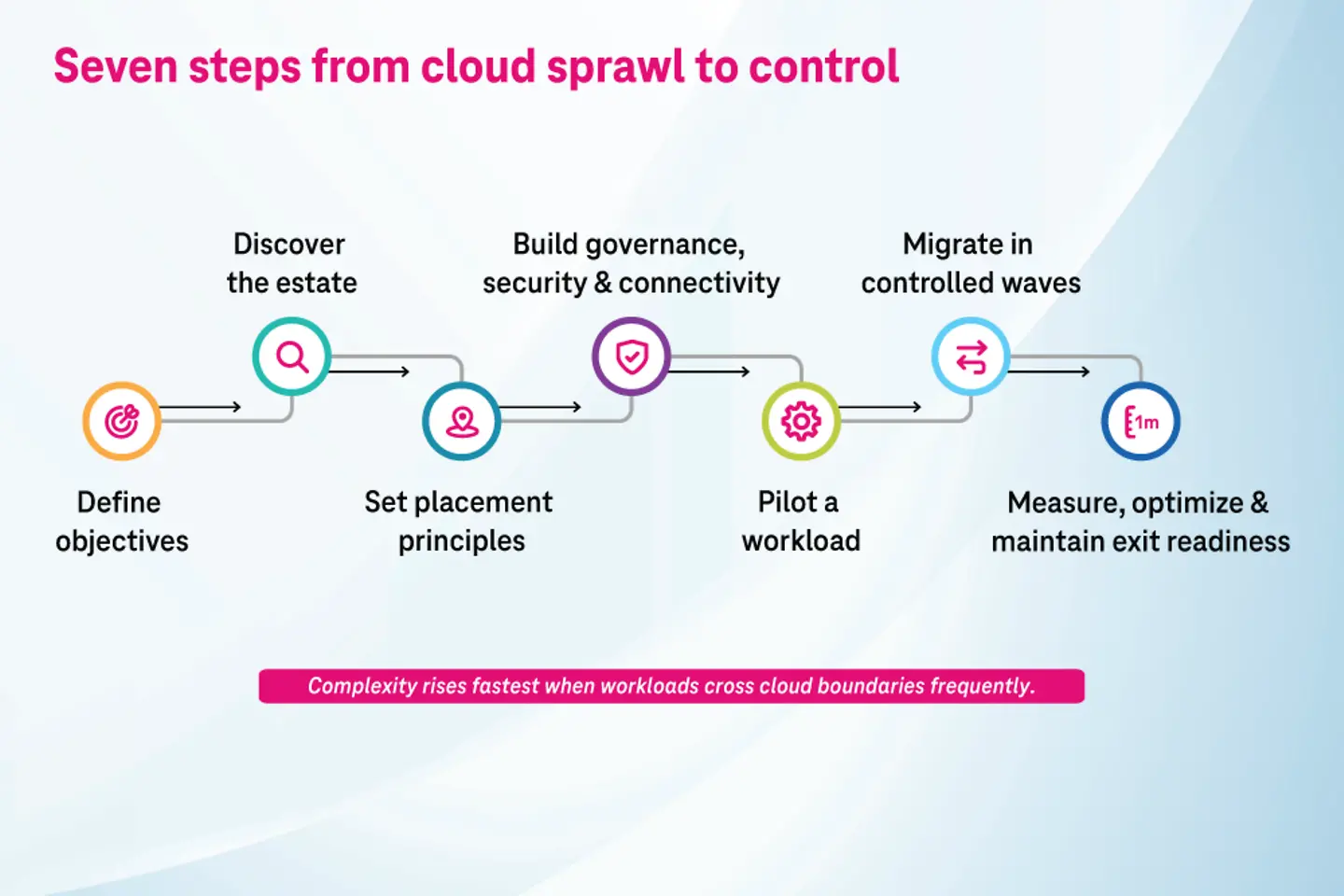
Multicloud value is realized in operations, not procurement. The operating model must create consistent outcomes while preserving enough provider-native capability to avoid turning every cloud into generic infrastructure.
Define approved connection patterns between users, sites, data centers, public clouds, private clouds and edge locations. Include bandwidth, routing, segmentation, encryption, domain-name services, traffic inspection and egress economics. T-Systems’ Multi Cloud Connectivity Platform adds a dedicated connectivity layer that joins up multi cloud ecosystems with end-to-end security and compliance. It is designed to reduce provisioning time from weeks to minutes, support one vendor contact, one SLA and one solution, and provide scalable Pay-As-You-Go bandwidth with clear governance and control.
Establish authoritative identities, strong authentication, least privilege, separation of duties and short-lived access. Map common control objectives to each provider’s implementation, automate policy checks and consolidate security-relevant logs. The BSI’s C5 catalogue is one useful reference for assessing cloud-service information-security controls in the German market; it does not replace the customer’s own risk assessment or shared responsibilities.
Landing zones encode account structures, network baselines, logging, identity integration, encryption and policy. Automated provisioning gives teams a compliant starting point and creates evidence by design. Reusable modules should standardize what truly needs to be common while allowing provider-specific modules for differentiated services.
A business service may cross several platforms even when its components do not. Operations therefore need end-to-end service maps, comparable telemetry, shared severity definitions, clear escalation paths and coordinated change records. Incident exercises should include provider and network failures, identity compromise, data corruption and loss of management-plane access.
FinOps connects engineering, finance, procurement and business owners so that cost decisions reflect value. Common allocation metadata, budgets, forecasts, anomaly detection and unit economics make provider bills comparable. Cost per transaction, customer, workload or model inference is more actionable than total monthly spend alone. The FinOps Framework emphasizes allocation, unit economics and shared ownership of technology use.
A central platform function should own guardrails, approved patterns and shared services. Provider specialists retain depth while product teams own workload reliability and consumption. Security, data, finance, procurement and business stakeholders need explicit decision rights; no responsibility should disappear between providers.
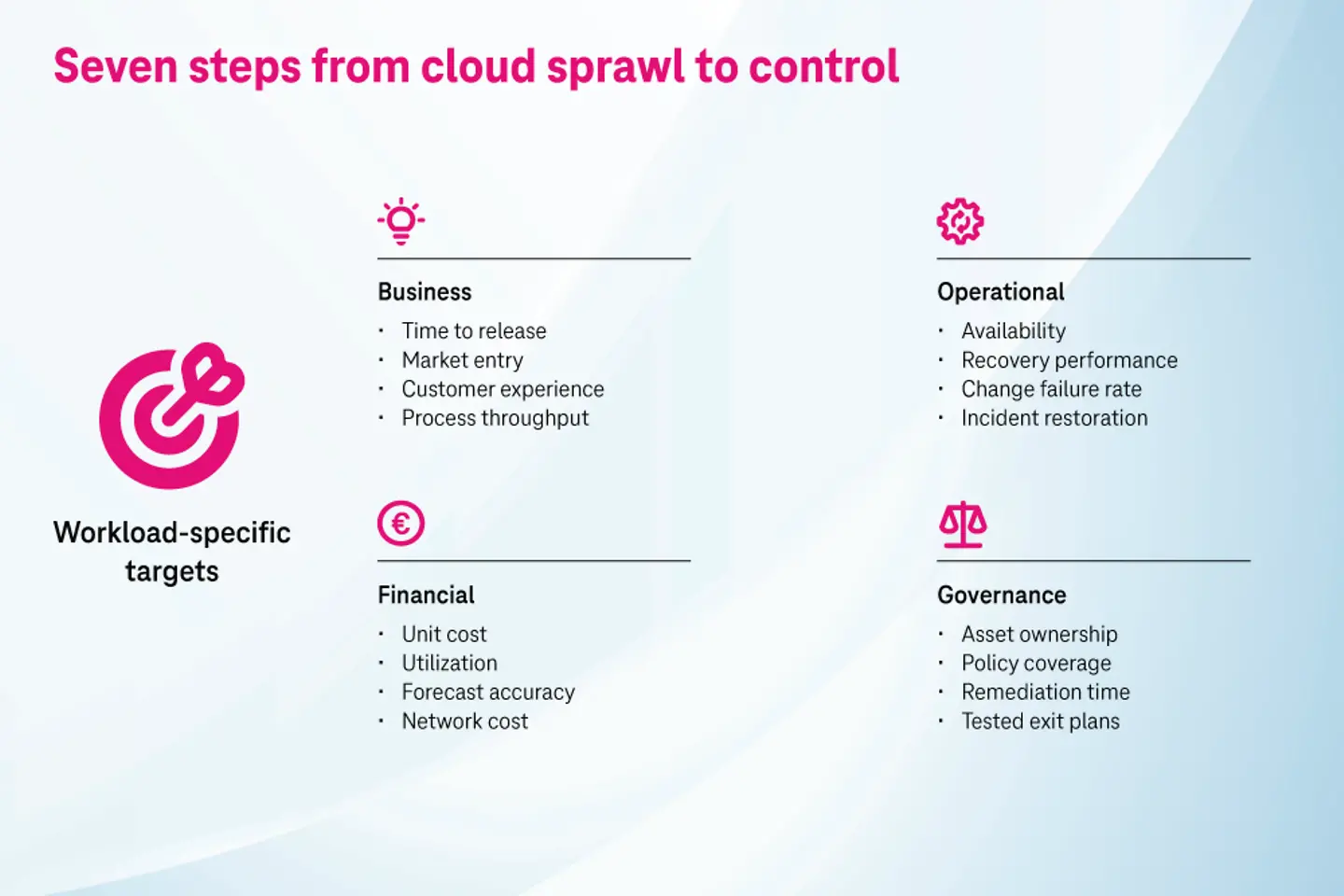
Success is not the number of workloads migrated or providers contracted. Use a balanced scorecard:
Targets must be workload specific. A higher unit cost can be rational if it buys a valuable reduction in latency or time to market. Conversely, nominal saving is not a success if it increases incident risk or operating labor.
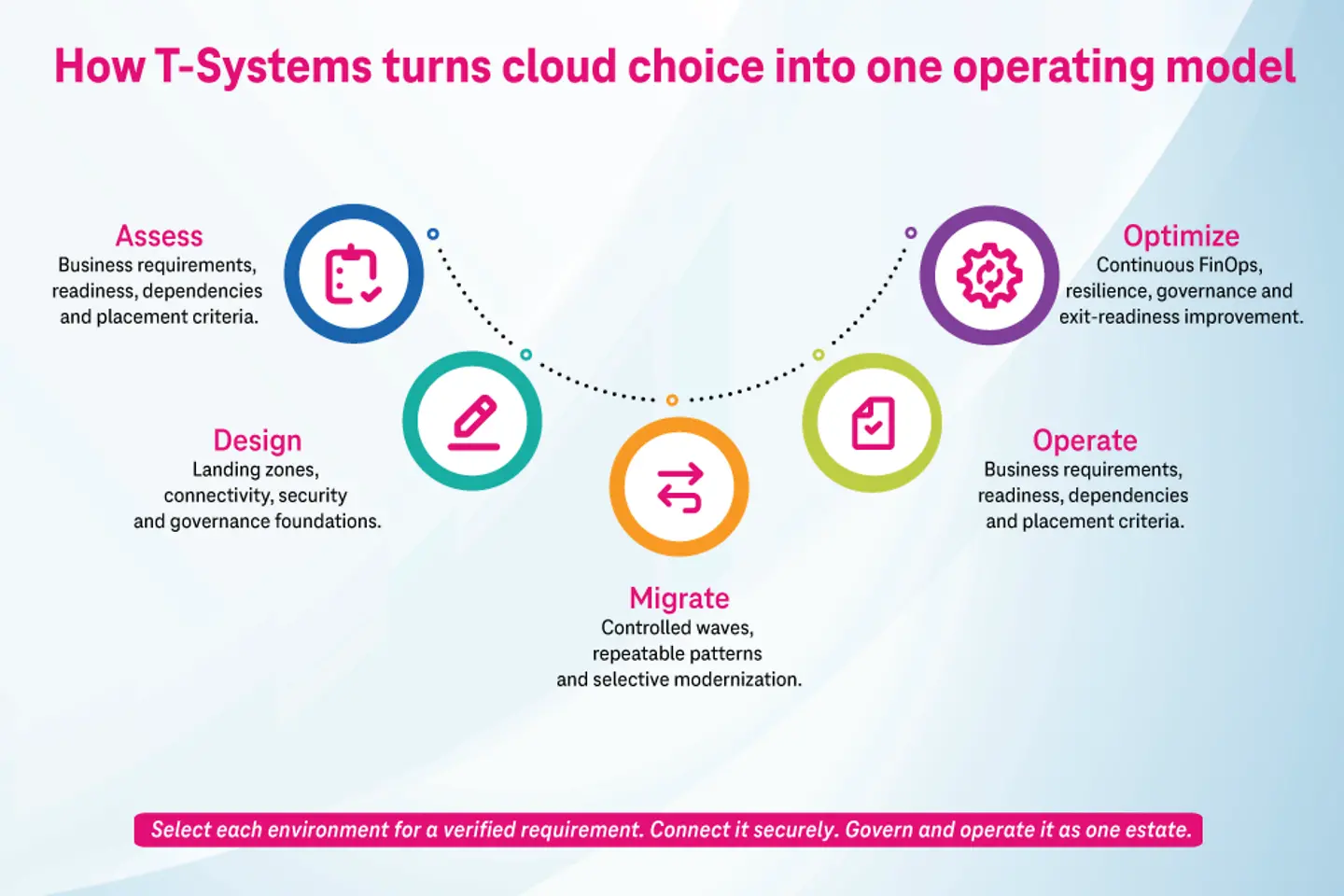
T-Systems approaches cloud choice as an end-to-end transformation and operations question. Its cloud portfolio combines T Cloud platforms with hyperscaler environments and professional and managed services. That supports a workload-first mix across public, private, hybrid and sovereign options rather than assuming one destination for every application.
The work can begin with assessment: clarifying business requirements, cloud readiness, application dependencies and placement criteria. It then extends into migration, landing-zone design, connectivity and continuous operations. T-Systems Cloud Managed Services are positioned around operating infrastructure, platforms and applications across heterogeneous environments through a unified model.
Where financial control is the priority, T-Systems’ FinOps Cloud Services include maturity assessment, optimization support and FinOps as a Service for continuous cost management and transparency.
These capabilities matter because multicloud economics cannot be solved during procurement alone; usage, architecture and business demand change continuously.
The T-Systems perspective is therefore deliberately practical: select each environment for a verified workload requirement, connect it securely, apply consistent governance, make cost and responsibility visible, and operate the result as one enterprise estate. The goal is not uniform technology. It is consistent control.
Multicloud should give the enterprise control over placement, risk and change, not merely a longer supplier list. Before adding another platform, assess the application estate, data flows, placement criteria, governance maturity, connectivity, skills and cloud economics. Then decide whether the new boundary creates enough value to justify operating it.
T-Systems can support that assessment and help design, connect, govern and operate the resulting cloud mix. The useful first question is not “Which cloud should we buy next?” It is “What does this workload require, and how will we control it throughout its lifecycle?”