 Image generated with AI
Artificial intelligence (AI) investments are gathering more steam. Globally, AI investment is accelerating at a pace few technologies have matched. According to IDC, AI spending in the Asia Pacific alone is expected to reach $175 billion by 2028, growing at a CAGR of 33.6%.1
In this blog, discover how companies such as Micron, Intel, and many more are riding on the AI bandwagon.
Across industries, automation is moving beyond repetitive tasks into intelligent decision-making. For instance, the Asia Pacific robotic process automation (RPA) market is projected to grow at 31.4% CAGR between 2026 and 2033, signaling a massive transformation in industrial operations.2
Now zoom in to Singapore. The country is not just participating; it is setting the pace. With a S$1 billion AI investment commitment by 2030, Singapore is doubling down on advanced manufacturing and Industry 4.0 initiatives.3
As highlighted in the T-Systems APAC AI report, AI is no longer a future bet. It is a current growth driver, expected to generate 50% of new digital economic value by 2030.4 The message is clear—the tide has turned, and those who do not ride it risk being left behind.
Manufacturers are not adopting AI for the sake of innovation theater. They are doing it because it delivers measurable business value. At its core, manufacturing is a game of efficiency, precision, and scale. AI enhances all three.
Take predictive maintenance, for instance. Instead of reacting to machine failures, AI analyzes sensor data to predict breakdowns before they happen. This reduces downtime, which, in manufacturing, can cost thousands per minute. Manufacturers can reduce 25% of maintenance costs through predictive maintenance.5
Then comes quality control. AI-powered computer vision systems can detect defects faster and more accurately than human inspectors. Companies are seeing defect detection rates improve significantly while reducing wastage. Some companies are achieving over 99% accuracy in defect detection.6
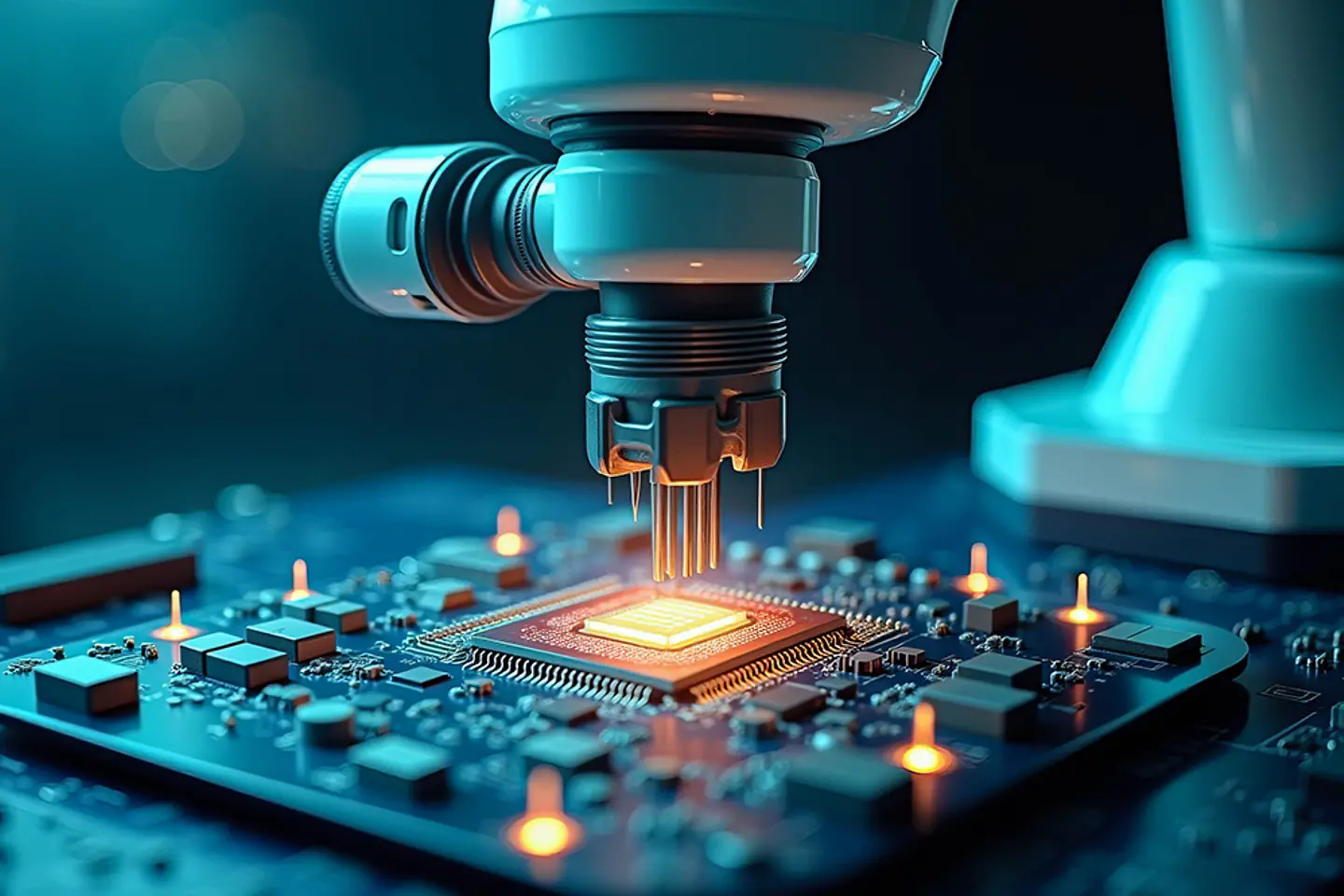 Image generated with AI
Intel saved costs by using AI-powered computer vision to detect defects much earlier in the semiconductor manufacturing process. Instead of identifying issues after production is complete, the system flags problems in real time, allowing immediate correction or rework. This early intervention significantly reduces material waste and prevents costly downstream failures. As a result, Intel has been able to cut scrap and operational inefficiencies, leading to savings of up to $2 million annually while also improving product quality.7
Supply chain optimization is another big win. AI can forecast demand, adjust inventory levels, and even recommend alternative suppliers in real time.
These areas could be the low-hanging fruit for manufacturers:
In fact, nearly half of workers using AI save about an hour per day, freeing up time for higher-value tasks. In simple terms, AI helps manufacturers do more with less. And in a margin-sensitive industry, that is the difference between leading the pack and playing catch-up.
It is one thing to talk about AI. It is another to see it in action. Singapore-based semiconductor and advanced manufacturing firms have been early adopters of AI-driven smart factory models. For example, companies such as ST Engineering and firms operating within Singapore’s advanced manufacturing ecosystem are leveraging AI for predictive analytics and automation.
ST Engineering is a Singapore-based global technology, defense, and engineering group that specializes in innovative solutions for the aerospace, smart city, and defense sectors. With operations all over the world, and last reported revenues of S$12.35 billion in 2025, the company is pushing its AI initiative even further.
ST Engineering is investing S$250 million into “Physical AI” and "Factory of the Future" programs to integrate autonomous robotics, generative AI (GenAI) assistants, and predictive maintenance across its shop floors. These initiatives focus on human-machine teaming, using real-time data and computer vision to automate complex tasks such as aircraft engine inspections and precision welding.
This digital transformation is significant because it aims to reduce turnaround times by 7.5 days and save thousands of man-hours through automated material tracking and quality control.8
The country’s manufacturing sector is heavily investing in smart manufacturing technologies, including AI, IoT, and robotics, as part of its Manufacturing 2030 vision.9
The result is a tightly integrated ecosystem where machines, data, and decision-making systems work in harmony. Think of it as moving from a factory floor to a “thinking factory”.
And this is not limited to large enterprises. Government-backed initiatives are enabling small and medium enterprises (SMEs) to adopt AI through funding, sandboxes, and innovation hubs. The lesson here is simple—AI is not just for tech giants. With the right ecosystem, it becomes accessible, scalable, and impactful.
If today’s factories are smart, tomorrow’s will be autonomous. We are moving towards a future where production systems are self-optimizing. Machines will not just follow instructions; they will learn, adapt, and improve continuously.
According to IDC predictions, 50% of new economic value in APAC by 2030 will come from AI-driven digital businesses.
GenAI is also entering manufacturing. Beyond chatbots, it is being used for:
Meanwhile, digital twins are becoming more sophisticated. Entire factories can be simulated in virtual environments, enabling companies to test changes before implementing them in the real world. Industry leaders are also betting on “lights-out manufacturing”, where facilities operate with minimal human intervention.
But perhaps the biggest shift is cultural. 68% of CEOs expect AI to fundamentally change their business models. The factories of the future will not just produce goods. They will generate insights, predict trends, and drive strategic decisions.
Despite the promise, AI adoption is not smooth sailing. One of the biggest challenges is data. Up to 80% of businesses cite data silos and outdated infrastructure as major barriers to AI adoption.
Manufacturers often have legacy systems that were never designed for AI. Integrating these systems with modern data platforms is easier said than done. Then comes the talent gap. While AI enthusiasm is high, only 33% of workers say they fully understand advanced AI systems. There is also a lack of governance. Many organizations experiment with AI in isolated pockets without a clear strategy. This leads to fragmented efforts and limited impact. And finally, ROI skepticism remains. Globally, only about 25% of AI initiatives have delivered expected returns between 2023 and 2025.10
It is a classic case of “too many cooks spoil the broth”. Without alignment, even the best technology can fall short.
So, how do you turn AI ambition into business results? The answer lies in a structured, end-to-end approach.
This is where T-Systems comes in. As highlighted in the APAC AI report, T-Systems provides an end-to-end managed approach, helping organizations move from strategy to implementation and continuous optimization.
Where we can help you get started:
Instead of reinventing the wheel, manufacturers can partner with experts who have already walked the path. With AI, experience is not just valuable, it is critical.
At the end of the day, every investment must answer one question. What is the return? AI delivers on multiple fronts. Operational efficiency improves through automation and predictive insights. This directly reduces costs. Productivity increases as employees spend less time on repetitive tasks and more on innovation.
Quality improves, leading to fewer defects and higher customer satisfaction. And perhaps most importantly, decision-making becomes faster and more accurate. There are also less obvious benefits. AI enables better forecasting, reduces risk, and opens new revenue streams through data-driven services.
In a competitive market like Singapore, these advantages are not optional. They are essential. With AI, manufacturers can save both time and money.
When Micron Technology looked at its Singapore manufacturing operations, it faced a familiar but formidable challenge. Semiconductor production is a game of microscopic precision, where even the smallest defect can ripple into massive yield losses. Traditional monitoring systems were no longer enough to keep pace with the sheer complexity of 570,000 sensors, 229 million control points, and 30 terabytes of data generated every day.
So instead of patching gaps, Micron chose to rethink the system altogether. It built an AI-driven manufacturing environment powered by real-time analytics and computer vision, analyzing over 2.3 million wafer images every week. Every wafer, every tool, and every process step became a source of intelligence. The goal was simple, but ambitious: move from reacting to problems to predicting them before they occur.
The results speak volumes. AI now helps Micron detect defects within 10 seconds, optimize production in real time, and continuously improve yield. This shift has delivered tangible business outcomes, including a 4% improvement in tool availability, 18% increase in labor productivity, and 22% reduction in product scrap.
Manufacturing output has increased by 10%, while quality issues have dropped by 35%, and time to market has been cut by 50%. In an industry where margins are tight and competition is relentless, Micron has turned AI into a clear competitive edge. It is no longer just running factories; it is running factories that think.11
AI in manufacturing is no longer a distant dream. It is happening here and now, especially in innovation-driven markets like Singapore. The opportunity is massive, but so is the complexity.
That is why having the right partner makes all the difference. T-Systems combines global expertise with deep regional knowledge to help manufacturers:
If you are looking to move from experimentation to execution, now is the time. Download the full “T-Systems AI in APAC” report to explore deeper insights, real-world use cases, and a practical roadmap for your AI journey.
Or better yet, start a conversation with T-Systems and see how AI can transform your manufacturing operations. Because in this race, the early movers are already setting the pace!
1 Asia Pacific AI Spending, 2025, IDC
2 Asia Pacific RPA Market Size, 2025, Grand View Horizon
3 AI Investment News, 2026, EDB Singapore
4 AI APAC Report, 2026, T-Systems
5 Predictive Maintenance in Manufacturing, 2026, Bridgera
6 AI Vision Accuracy Article, 2026, Overview AI
7 Computer Vision and AI for Inline Inspection, 2023, Intel
8 AI Program News, 2025, IT Brief Asia
9 Singapore Advanced Manufacturing, 2022, Trade Government
10 AI APAC Report, 2026, T-Systems
11 Micron Article, 2024, Micron Technology