Artificial intelligence (AI) is already shaping how companies design, manufacture, maintain, and scale their operations. In industry especially, AI is becoming a defining competitive factor—for machines, processes, supply chains, quality assurance, and entirely new business models.
I am convinced that AI has the potential to transform value creation across our entire economy. According to an Accenture study, if European companies significantly strengthen their AI capabilities, they could increase annual revenues by around €200 billion. The greatest potential lies precisely where Europe has traditionally been strong: in industry and critical infrastructure such as energy, telecommunications, and utilities—areas where industrial AI can turn data, processes, and machines into real competitive advantages.
But for Europe to fully unlock this enormous potential, it will take more than high-performance and sovereign infrastructure. Companies and public institutions also need a mindset focused on execution. We need to act on the opportunities in front of us—now. These were exactly the topics I discussed with tech journalist Robert Weber on the “The Industrial AI Podcast”. He invited me to talk about our new AI factory in Munich alongside the Hannover Messe trade fair. I was very happy to do so, because one thing is clear to me: Germany and Europe need to deliver on industrial AI now.
In the heart of Munich, we at Deutsche Telekom and T-Systems built an industrial AI cloud—open, secure, sovereign, and scalable—in record time. Designed for industry and mid-sized businesses, as well as public administration, defense, and research.
Our AI factory is exactly what Germany and Europe have been missing to bring AI into factories and public institutions without giving up control over sensitive data. Many talked about it—we simply built it.
The numbers behind the AI factory are equally impressive: 10,000 NVIDIA Blackwell GPUs (DGX B200 and RTX Pro 6000), 20 petabytes of storage, and up to 500 quadrillion computing operations per second. In a very short time, this significantly expanded Germany’s AI computing capacity. In other words: serious AI compute power. But hardware alone is not the point. The real question is what customers can achieve with it.
That is why the podcast was not just about GPUs. More importantly, it focused on real-world applications: digital twins, factory simulation, predictive maintenance, quality inspection, and process optimization.
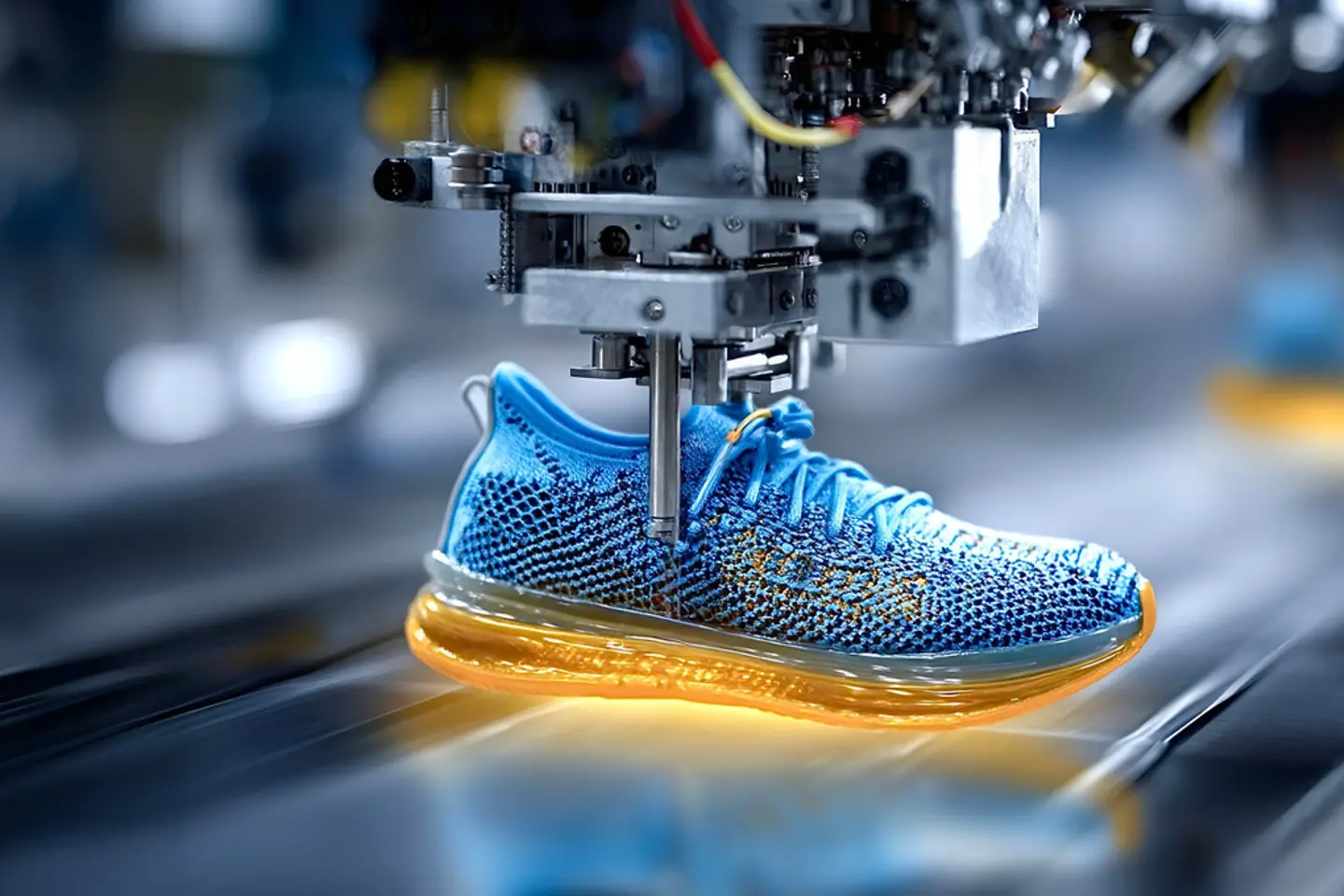
One of our major automotive customers, for example, can use industrial AI to simulate production sites before physically rebuilding production lines. A mid-sized manufacturer of air-conditioning systems uses AI to analyze machine sounds and identify when a system may fail—preventing downtime before it happens. AI and automation are also opening up entirely new opportunities for competitive textile manufacturing in Europe.
And that is what this is ultimately about: making existing data usable, improving processes, and scaling specialized expertise.
In short, we bring the technology to the table. Our customers bring their data and domain expertise. Together, we combine the best of both worlds and help companies, research institutes, and public authorities move to the next level.
With our comprehensive consulting portfolio, we make getting started with industrial AI as simple as possible for both large enterprises and mid-sized companies. This is especially important for the Mittelstand (small and medium-sized companies). Not every company has a large IT department with hundreds of specialists.
Many businesses know their machines, processes, and customers inside out. What they need is support in turning that knowledge into practical AI applications—and scaling them successfully.
This is exactly where our end-to-end offering comes in: infrastructure, cybersecurity, connectivity, compute power, cloud solutions, and business applications from leading partners such as SAP and Siemens. We provide a fully integrated, sovereign technology stack that covers the entire value chain.
Customers can start with simple “GPU as a Service” offerings. Or they can choose “AI as a Service” and receive a complete end-to-end solution from a single source.

The market has been waiting for an offering like this. Our AI factory is already operating at 50 percent capacity. Many companies want to test, train, scale, and securely operate industrial AI.
Of course, an investment on this scale does not happen casually. You do not invest €1 billion out of pocket change. But for us, the decision was clear: we wanted to take this step. We wanted to invest in Germany—for our companies, for our economy, and for Europe as a whole.
And demand proves the point: the market was waiting for exactly this kind of offering. Our AI factory is already running at 50 percent capacity. Many companies want to test, train, scale, and securely operate industrial AI. At the same time, in an era of global geopolitical tensions, they also want to retain access to and control over their data. Digital sovereignty is no longer a secondary argument—it has become a part of industrial competitiveness itself.
That is why I emphasized in the podcast that our Munich AI factory is also a signal. With our industrial AI cloud, we have created the first lighthouse project of the “Made for Germany” business initiative. It demonstrates that Germany is still capable of delivering major projects quickly and professionally. What it takes is courage, a willingness to roll up our sleeves, and the determination to take responsibility.
The decisions shaping our economic and social future with AI are being made right now. We should seize this unique opportunity to shape AI according to our own values and vision—instead of watching from the sidelines.
Why industrial AI is about far more than large language models, how Munich became a “model gym” for industrial AI, and how companies can use Telekom’s AI factory for their own projects—these are the topics discussed by T-Systems CEO Ferri Abolhassan and tech journalist Robert Weber on “The Industrial AI Podcast.”
Hear it for yourself —the conversation is only around 15 minutes long (starting at minute 21:30).

You can display all external content on the website at this point.
I agree that personal data may be transmitted to third-party platforms. Read more about this in our privacy policy.