 Image generated with AI
Cloud rarely becomes difficult on day one. The first workload moves, a product team provisions an environment in minutes, and a business unit adopts a software service without waiting for a long infrastructure cycle. The early story is speed. The harder chapter begins when that success repeats across teams, providers, and countries. Identities multiply, data crosses new boundaries, and costs lose context. Soon, nobody can confidently answer a simple question with confidence: who is accountable for this resource, this risk or this bill?
Cloud governance is the system of decision rights, policies, processes, controls and evidence that closes this control gap. It keeps cloud use aligned with business value, security, compliance, cost and operational objectives. It determines who may decide, which outcomes are mandatory, how teams can act within approved boundaries, how exceptions are handled, and how the organization proves that controls continue to work.
That definition is deliberately broader than cloud management. Cloud management performs day-to-day activities such as provisioning, monitoring, patching and optimization. Governance establishes the direction and accountability behind those activities. It connects executive priorities to architecture standards, landing zones, identity controls, data rules, service management, financial accountability and measurable risk.
The central tension is clear: an enterprise needs more consistency, but the cloud created value precisely because it distributed the ability to act. Effective governance resolves that tension by centralizing the few decisions that require enterprise consistency and distributing the rest through approved patterns, self-service platforms and automated guardrails. It replaces repeated permission-seeking with a clear field of play.
This is the T-Systems point of view: governance belongs inside the cloud operating model, not above it as a separate compliance layer. A consistent model across private, public and hybrid environments can connect security, compliance, performance and cost control while preserving workload choice. T-Systems cloud managed services describe this unified operational approach across infrastructure, platforms and applications.
Imagine a European manufacturer that begins with one customer application in public cloud. A factory team then adds an edge analytics service, finance adopts software-as-a-service, a national business unit selects another provider, and the data team prepares a generative AI pilot. Each decision may be rational on its own. Together, they create a hybrid and multi-cloud estate whose business services, data flows, contracts and risks no longer fit inside one technical or organizational boundary. This running example is hypothetical, but the governance problem it illustrates is typical of enterprise cloud growth.
Cloud governance matters because it turns that distributed power into accountable action. The objective is not control for its own sake and it is not a return to centralized ticket queues. It is to let teams move quickly without renegotiating security, architecture, finance and compliance requirements for every workload. A well-designed framework makes the approved path easy, the risky path visible and the prohibited path difficult or impossible.
The benefits appear when governance stops being a document and begins shaping the daily path to cloud. For the manufacturer, the same owner and classification metadata that makes a resource chargeable also makes it reachable during an incident. The same landing zone that gives developers a ready environment gives security teams consistent logs. The same lifecycle rule that removes an abandoned test environment reduces both waste and attack surface. Governance creates compound value because its controls serve several business questions at once.
Governance creates a reliable inventory of accounts, subscriptions, projects, resources, owners and environments. Naming standards, mandatory tags, approved service catalogs and lifecycle states make resources searchable and attributable. Capacity, performance and resilience can then be managed against business criticality rather than provider-by-provider dashboards.
Resource governance should cover creation, modification, scaling, backup, recovery, retention and retirement. A resource without an owner, data classification, cost center or expiry rule is not merely untidy; it is harder to secure, fund, recover and decommission.
The immediate gain is visibility. The deeper gain is decision quality: the enterprise can compare resources by business criticality and lifecycle state instead of trying to reconstruct meaning from provider-specific consoles after the fact.
Shadow IT grows when approved services are slow, unclear or unsuitable. Governance reduces it by pairing policy with a usable service path: an approved catalog, preconfigured environments, transparent exception routes and procurement visibility. Discovery controls can identify unsanctioned accounts or services, but prevention depends on making governed options responsive to real business demand.
The goal is not to suppress local innovation. It is to bring experiments into a managed lifecycle before they hold sensitive data, become operational dependencies or create contractual exposure.
In the running example, the AI pilot should not have to wait for a fully bespoke approval. It should have a governed experimental path with defined data, identity, cost and expiry boundaries—and a clear route into production if the experiment proves valuable.
Reusable controls reduce repeated review. If identity, network, logging, encryption, backup, cost tagging and evidence collection are built into landing zones and deployment pipelines, teams do not need to reassemble the same proof for every workload. Exception review can then focus on genuinely unusual risk instead of routine configuration.
Automation is most effective when policy intent is precise. A rule should name its scope, owner, control objective, enforcement mode, evidence source, exception process and review date. That structure turns governance from a collection of documents into an operable system.
This changes the role of governance specialists. Their time moves away from checking the same settings repeatedly and toward the decisions that genuinely require context: new data use, unusual supplier exposure, a material exception or a trade-off between resilience and cost.
Cloud governance improves security by making responsibility, minimum controls and escalation paths explicit. It clarifies which controls belong to the cloud provider, which remain with the customer, and which are shared; it also prevents teams from assuming that moving a workload transfers accountability for identities, data, configuration or application security.
These benefits establish the promise of governance. The next question is how to keep that promise when priorities compete. Principles provide the answer: they define the bargain between enterprise control and team autonomy before individual rules are written.
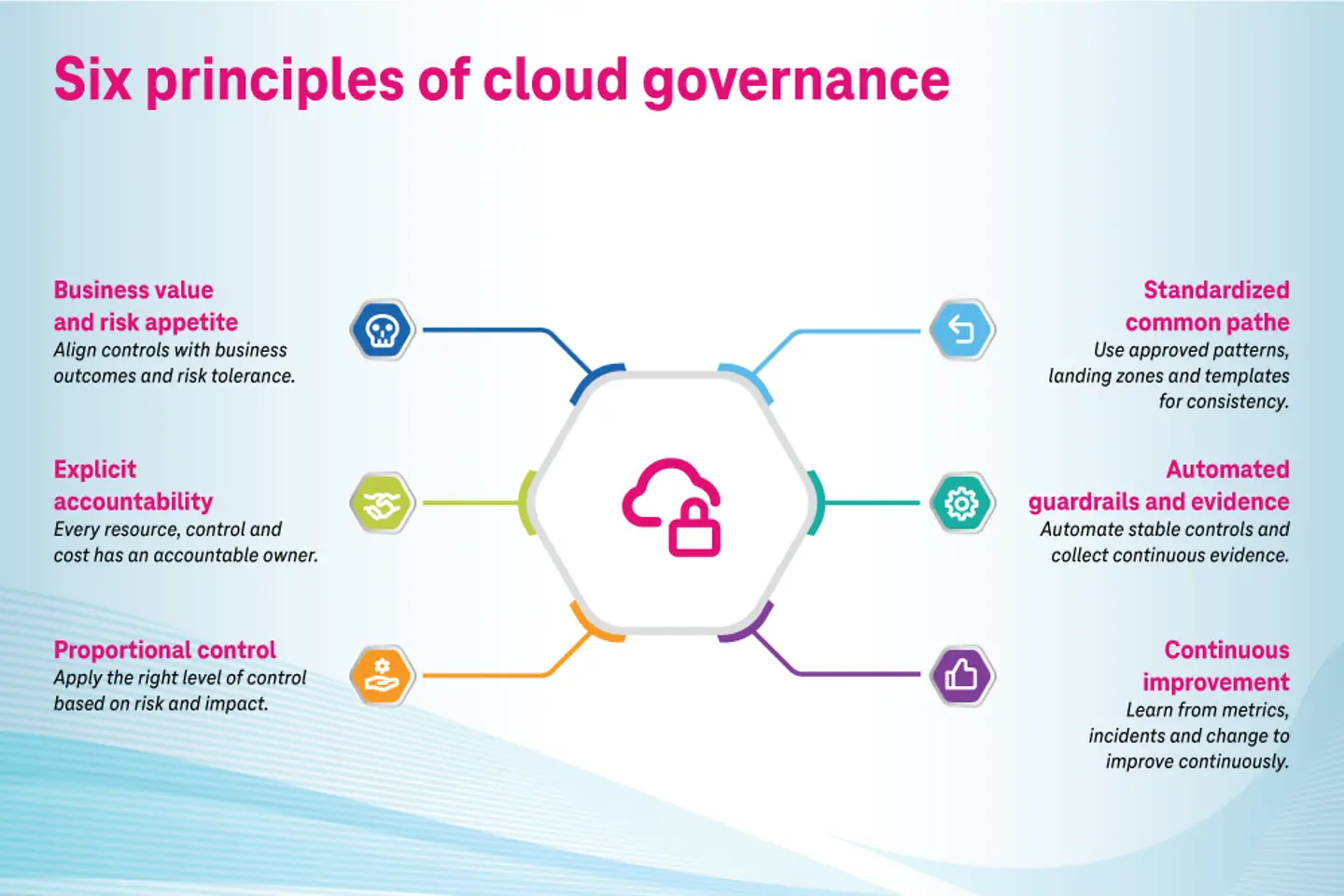
Principles are the constitution of the cloud operating model. They resolve recurring trade-offs before a project deadline or incident forces a hurried decision: speed versus assurance, global consistency versus local need, automation versus human judgment, and optimization versus resilience. They create a stable basis even as providers, services and regulations change. The following six principles are an editorial synthesis for enterprise hybrid-cloud governance; they are not presented as a proprietary standard.
Together, the six principles create a coherent bargain. Teams gain a faster, reusable path and meaningful room to choose; the enterprise gains ownership, proportional control, evidence and lifecycle discipline. The framework components are where that bargain becomes operational.
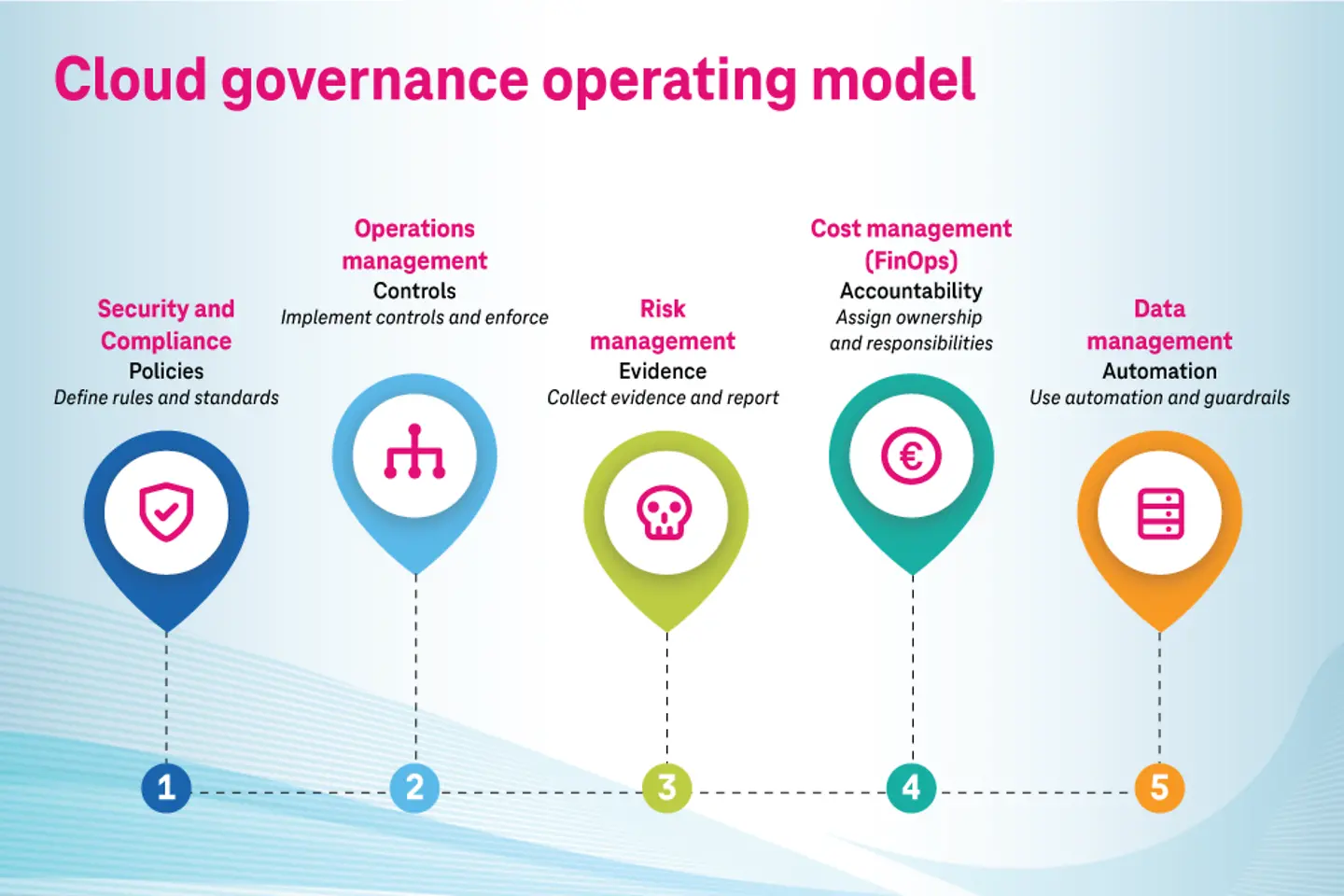
A cloud governance framework converts the bargain into coordinated management domains. The domains below require different expertise, but the business experiences them as one system. When the manufacturer launches its AI-enabled maintenance service, the dataset, model endpoint, compute environment, user identities, operational service, supplier contract and cloud bill describe the same business capability. Governance fails if each function sees only its own fragment.
The framework should therefore share one resource inventory, one classification model, one exception process and a common measurement cadence. The five components are not parallel workstreams; they are connected views of the same decisions.
Data management defines classification, ownership, permitted use, residency, retention, lineage, quality, access, encryption and deletion requirements. In cloud environments, these requirements must follow data across storage services, analytics platforms, backups, logs, integrations and AI pipelines. Catalog metadata should connect each dataset to its owner, purpose, sensitivity, jurisdiction and retention rule.
For personal data, the European Commission emphasizes accountability and data protection by design.Technical and organizational safeguards should be considered from the earliest stages of processing. Cloud data governance should therefore shape architecture and defaults, not arrive only at the privacy review.
For the maintenance use case, teams must decide where sensor and service data can be stored and how it can be used. They must also define who can reuse the data, how long derived datasets remain valid, and whether the data can be used for model training or retrieval.
Operations governance sets service levels, observability, change controls, configuration baselines, patching responsibilities, capacity rules, backup and recovery objectives, incident response, continuity testing and decommissioning. It should create a consistent operational picture across providers while preserving platform-specific engineering where that delivers value.
A unified operating model matters because a business service often crosses several environments. Governance should evaluate the end-to-end service, not only each cloud account in isolation.
The customer does not experience separate cloud platforms when the service fails. Operations governance must follow the complete dependency chain from factory edge to network, cloud platform, data service, AI component and business application.
Security and compliance governance maps obligations and risk outcomes to technical and procedural controls. Core topics include identity and privileged access, network segmentation, vulnerability management, encryption and key control, secure development, logging, threat detection, incident handling, supplier assurance and audit evidence.
European requirements differ by sector and role. NIS2 implementing rules include technical and methodological cybersecurity requirements for relevant digital infrastructure and service providers, including cloud computing and managed service providers. DORA has applied to in-scope financial entities since January 17, 2025, and requires governance of ICT risk, resilience testing, incidents and third-party risk. Legal and compliance teams should confirm applicability to the organization and each workload.
The narrative shift is from proving compliance at intervals to operating in a way that continuously produces credible evidence. Security and compliance become design inputs and observable service qualities, not a final gate.
Cloud cost governance connects consumption to accountability and value. It defines allocation standards, budgets, forecasts, anomaly thresholds, unit economics, commitment authority, optimization routines and showback or chargeback. Cost controls should begin during architecture and product planning, not after the invoice arrives.
The right cloud strategy treats financial accountability as a collaboration among engineering, finance and business teams. Its governance capability emphasizes policies, decision rights, risk thresholds, automation and continuous review across technology spend.
This reframes the bill. Compute and storage are no longer anonymous infrastructure lines; they become the cost of a product outcome, owned by the team able to influence its design and consumption.
Risk management identifies uncertainty, assesses likelihood and impact, selects treatments and records accepted residual risk. The cloud risk register should cover security, privacy, availability, concentration, supplier dependency, portability, sovereignty, financial commitments, skills, operational resilience and exit feasibility. Risks need owners, tolerances, treatments, evidence and review dates.
Workload placement is a governance decision because the appropriate environment depends on the combined risk and value profile. Public, private, sovereign and on-premises options are not maturity stages on a single ladder; they are placement choices with different control, economics, latency, ecosystem and jurisdiction implications.
Seen together, the five components let the enterprise make one defensible placement decision rather than five disconnected approvals. Yet even a well-designed framework can fail in practice. The next obstacle is adoption: whether people can and will use the governed path.
The hardest governance problems are usually organizational rather than technical. Policies fail when teams do not understand their purpose, cannot comply through available platforms, or face conflicting incentives. A control may be correct and still ineffective if the only route to compliance takes longer than the business opportunity allows.
Implementation therefore requires product thinking. The governed path has users, friction, reliability and an adoption curve. The governance team must understand those users, remove avoidable friction, measure adoption and improve the experience, while holding firm on outcomes that protect the enterprise.
Governance can be perceived as a brake when it is introduced after teams have already adopted different accounts, tools and working methods. A sudden attempt to centralize every decision creates resistance and long exception queues. The better sequence is to baseline the current estate, prioritize the highest risks, publish minimum viable guardrails and migrate teams toward reusable landing zones in waves.
Another challenge is policy portability. Provider-native controls are valuable, but the enterprise still needs common outcomes, ownership and evidence across platforms. Express the control objective once, then implement and test it in platform-appropriate ways.
For the manufacturer, this means the factory team may keep a platform-specific deployment pattern, but it cannot invent a different meaning for production, a different owner model or a different threshold for privileged access. Local implementation can vary; enterprise outcomes must remain legible.
Data is duplicated, and moved across services faster than manual registers can track. Teams may classify storage but overlook logs, caches, snapshots, model-training extracts or software-as-a-service exports. Data governance therefore needs automated discovery and classification, lineage where consequential, and contracts for data movement between systems and organizations.
Residency is only one part of sovereignty. Organizations may also need to evaluate who can administer systems, who controls encryption keys, which jurisdiction governs the provider, how support access is handled, and whether workloads and data can be moved or exited.
The difficult question is rarely where the database is in isolation. It is whether the organization can trace and control the full data journey, including copies, logs, derived features, model prompts and support access—across the service lifecycle.
Security teams must manage a changing attack surface without blocking self-service. Common failure modes include excessive privilege, unmanaged machine identities, inconsistent logging, exposed services, configuration drift and unclear incident responsibilities. Controls that depend on periodic screenshots or manual sampling struggle to keep pace with ephemeral infrastructure.
The answer is not full automation at any cost. Automated remediation should be risk-tiered, tested and observable. A low-risk tagging defect may be corrected automatically; an action that could interrupt a critical service may require approval or a controlled maintenance window.
These challenges expose why organizations need architecture framework rather than a larger stack of policies. References and standards can help, but only if their roles are clear and their controls converge into one operating model.
No single framework can carry the whole narrative from board-level accountability to a machine-testable cloud configuration. Enterprise governance, cybersecurity, cloud controls, financial management, service operations, data and regulation work at different levels. The task is not to choose a winner; it is to compose them into one control architecture with no duplicated authority and no invisible gaps.
Use enterprise governance to set decision rights, risk frameworks to define outcomes, cloud control libraries to add platform relevance, and operating disciplines to make controls executable. Best practice is to maintain a single control register that links each control to its objective, source obligations, owner, platform implementations, evidence, testing method, exceptions and review date. This reduces duplicated controls and makes gaps visible.
The result should feel simpler than the source material behind it. A product team should not need to interpret seven frameworks. It should receive one classified path, one set of responsibilities, one control outcome and one evidence route. Designing that experience is the practical work of implementation.
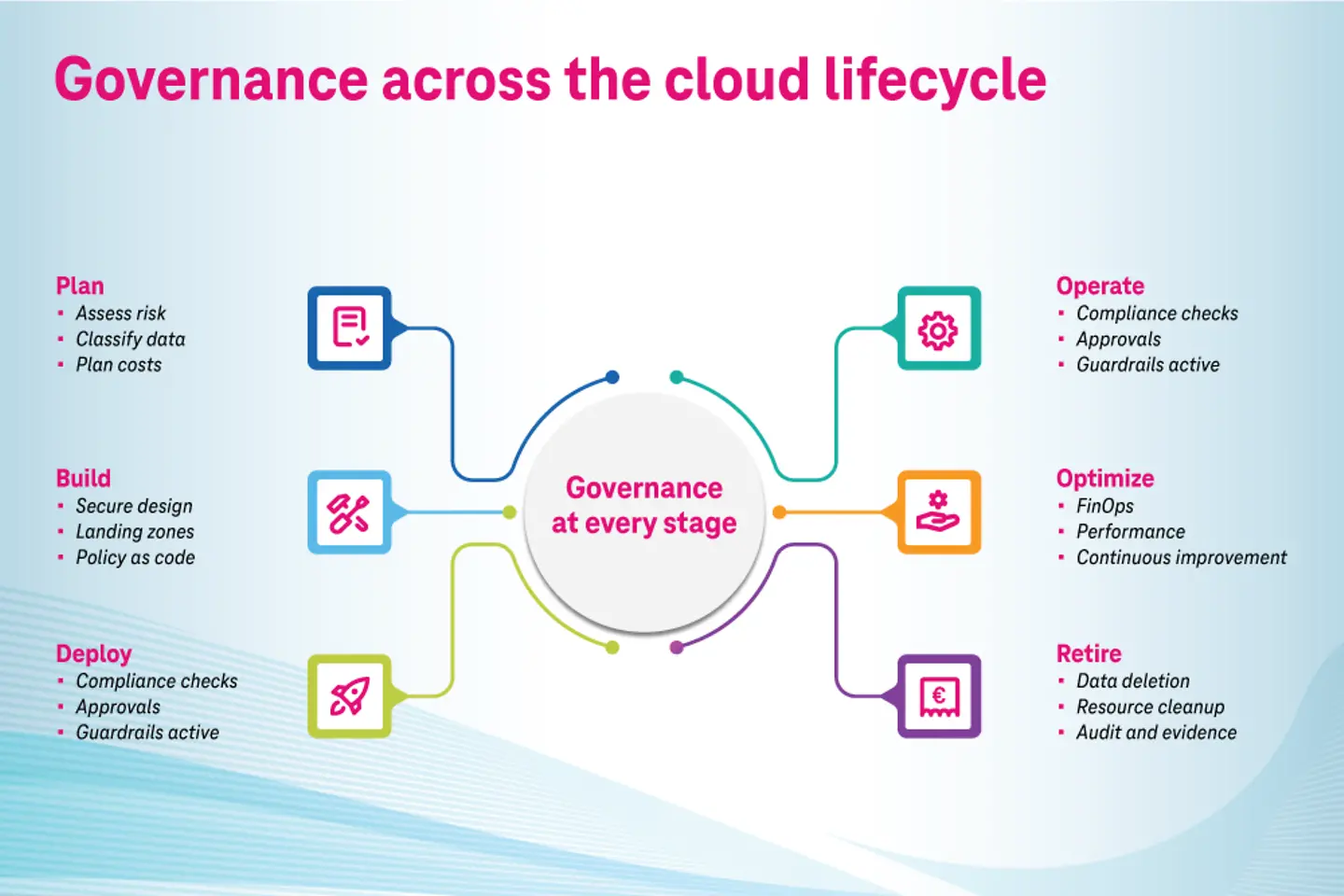
Design starts with a business journey, not a provider console. Take a real workload from idea to retirement and ask where the organization must make a consistent decision, where a team needs freedom, and where evidence must survive. Identify critical services, regulatory scope, data classes, risk appetite, current capabilities and decision bottlenecks. Then build the minimum governance model that can make that journey safer and faster.
For the hypothetical manufacturer, the maintenance service provides that thread. Finance needs cost ownership, operations need end-to-end service visibility, data teams need permitted-use rules, security needs shared-responsibility clarity, and the business owner needs a release path. A practical design package connects those needs through principles, scope, decision rights, classification, reference architectures, a control catalog, landing-zone requirements, an exception workflow, an evidence model, metrics and a review cadence.
Begin with the economic story of the workload. Define a cost allocation hierarchy that mirrors how the business makes decisions: product, business unit, environment, owner and cost center. Require metadata at provisioning, establish budgets and anomaly thresholds, and decide who may purchase long-term commitments. Use unit measures such as cost per transaction, customer or workload where they support product decisions.
Optimization must preserve service objectives. Rightsizing, scheduling, storage-tiering and architectural changes should be evaluated against performance, resilience, security and engineering effort. Savings without maintained outcomes are not value.
Next, make the service operable before it becomes important. Create standard landing zones with identity, network, logging, backup and policy hooks. Define service ownership, operational readiness criteria, observability standards, recovery objectives and change paths. Integrate governance checks into CI/CD and infrastructure-as-code pipelines so issues are detected before deployment where possible.
Operational governance also needs an exit path. Maintain dependency inventory, data export procedures, contractual exit provisions and tested recovery or migration options in proportion to concentration and continuity risk.
Then govern the asset that travels furthest: data. Establish a common classification model and translate it into storage, access, residency, encryption, retention and sharing rules. Assign data owners and stewards, maintain an inventory of high-value or regulated datasets, and connect data lineage to critical reporting, analytics and AI use cases. Automate discovery where practical but retain accountable human decisions about purpose and acceptable use.
Finally, turn risk and obligations into controls that can travel with the workload. Map outcomes to controls once, then deploy those controls across platforms. Define identity baselines, privileged-access workflows, encryption and key requirements, secure configuration, vulnerability and patching expectations, logging, threat detection, incident response and evidence retention. Clarify the shared-responsibility model for every service category and supplier.
Compliance evidence should be a by-product of normal operations: configuration state, pipeline results, access reviews, recovery tests, vulnerability status and exception approvals should flow into an evidence repository with ownership and retention. Continuous evidence does not eliminate audits; it makes them more representative and less disruptive.
At this point the framework has content, but content does not make decisions. The operating model needs a team with enough authority to maintain the common path and enough proximity to delivery to understand where it breaks.
A cloud governance team is not a parliament for every technical choice. It is the steward of the bargain between enterprise consistency and team autonomy. Often connected to a cloud center of excellence or platform organization, it should be small enough to decide, broad enough to represent material risk and value, and linked to existing enterprise governance rather than becoming an isolated cloud committee.
The team translates strategy and risk appetite into principles, policies, reference patterns, guardrails, metrics and exception decisions. It coordinates domain owners, resolves cross-functional conflicts and sponsors the governed platform experience. Its success is not the number of reviews completed; it is the proportion of ordinary delivery that no longer needs bespoke review.
Core membership typically includes an executive sponsor, cloud platform or architecture lead, security and compliance lead, FinOps or finance representative, operations or service-management lead, data governance representative, procurement or legal input, and rotating workload or business representatives. Membership should follow the decisions in scope, not organizational prestige. The people who build and consume the governed path need a voice alongside the people who set its boundaries.
Document which decisions the team can make, which it recommends, and which require executive, risk, legal or business approval. Authority should include the right to publish mandatory cloud policies, require evidence, approve defined exceptions, escalate risk and retire obsolete standards. Decision time targets prevent authority from becoming reason for delay.
Scope should name covered entities, environments, service models, suppliers, lifecycle stages and risk domains. Include software-as-a-service and AI services where they create cloud, data or supplier risk. Explicit exclusions are as important as inclusions, because ambiguous scope produces duplicate governance or unmanaged gaps.
The example below is a starting point. “A” means accountable, “R” responsible, “C” consulted and “I” informed. Each activity should have one clearly accountable role; local titles and regulatory responsibilities must be adapted.
| Activity | A | R | C | I |
| Set cloud strategy and risk appetite | Executive sponsor | Cloud governance office | Security/risk, finance, business leaders | Platform and workload teams |
| Maintain policies and control catalog | Cloud governance office | Domain control owners | Legal, audit, platform, data, FinOps | Workload teams |
| Build and operate landing zones | Platform engineering lead | Platform engineering | Security, operations, FinOps | Governance office, workload teams |
| Classify workload and data | Workload owner | Product team and data steward | Security, privacy, architecture | Governance office |
| Approve material exceptions | Named risk or business authority | Exception owner | Governance office, security, finance | Audit and affected teams |
| Allocate and optimize cloud cost | Product or business owner | FinOps and engineering | Finance, platform, procurement | Governance office |
| Responding to cloud incidents | Service owner | Operations and security response teams | Provider, legal, privacy, business | Governance office and executives |
| Review of governance performance | Executive sponsor | Cloud governance office | Domain owners, audit, business leaders | Cloud community |
The RACI turns coordination into named accountability; the seven-step cycle below puts that accountability to work.
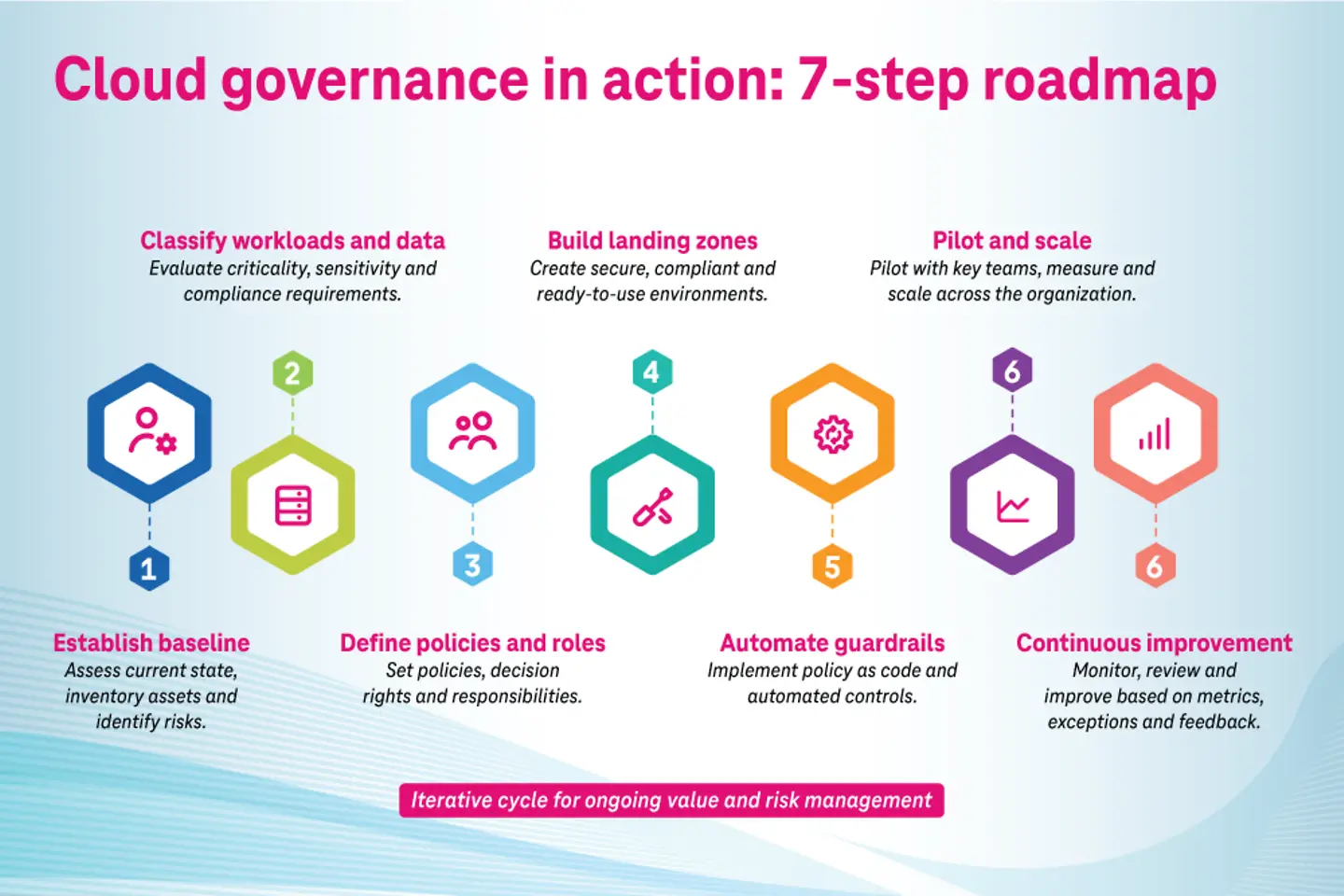
The following seven-step sequence turns governance from an organizational intention into a working cloud experience. The steps are ordered, but the cycle remains iterative: evidence from operation continuously refines classification, policies, platforms and priorities.
Establish the mandate and baseline. The manufacturer first agrees with what governance must protect: safe production, compliant data use, controllable cost and continued delivery speed. It inventories cloud accounts, suppliers, workloads, data, spend, owners, controls and known exceptions, then identifies the few gaps that create the greatest exposure or friction.
Classify workloads, data and decisions. The maintenance service is classified by criticality, sensitivity, jurisdiction, availability, financial exposure and dependency. Classification determines which parts can use self-service, which need review and which are prohibited, so control intensity follows consequence rather than organizational habit.
Define principles, roles and policies. The organization publishes its principles, decision rights, RACI and policy hierarchy. Mandatory outcomes are concise; standards and implementation guidance explain how to meet them. Exceptions have owners, evidence, expiry dates and escalation routes.
Build the governed platform path. Platform teams turn policy into a usable landing zone with identity, connectivity, logging, encryption, backup, metadata and service-catalog hooks. The product team receives a faster starting point, while governance receives a consistent control foundation.
Automate guardrails and evidence. Stable controls move into infrastructure templates, pipelines and configuration policies. The enterprise begins in detect mode where impact is uncertain, then moves carefully to prevention or remediation. Evidence remains traceable to the policy outcome it supports.
Pilot, measure and scale. The maintenance service becomes a representative pilot rather than a special exception. The team measures provisioning time, exception age, control coverage, cost allocation, security findings and user experience. It fixes the path before applying the model to more workloads and business units.
Operate and improve continuously. Governance becomes a cadence, not a launch project. Metrics, incidents, audit findings, provider changes and new regulations refine the model. When the manufacturer adds AI agents or a new sovereign placement requirement, the same decision system evolves instead of being rebuilt from scratch.
The opening problem now returns at a higher level. Cloud distributed the power to provision infrastructure; AI distributes the power to generate content, analyze data and act through software. The manufacturer’s maintenance pilot may begin as a model that recommends intervention. It may later become an agent that retrieves operational data, opens a service ticket or triggers a workflow. Each increase in autonomy turns a technical capability into a governance decision.
AI changes cloud governance in two directions. It can improve detection, analysis and operational response, while AI workloads introduce new data, models, compute, supplier and accountability risks. These two directions should share common evidence architecture, but they require separate governance: using AI to support cloud governance does not automatically govern the AI system itself.
AI can help summarize configuration drift, correlate cost and operational anomalies, prioritize findings, suggest remediation, classify support requests and explain policy in context. It can reduce investigation time when it works over authoritative inventories, policies and telemetry. The value is not an AI layer floating above weak governance. It is the ability to reason over clean ownership, classification, policy and telemetry that already exist. Keep consequential enforcement bounded. Require traceable inputs, confidence thresholds, human approval for high-impact actions, least-privilege identities, change records and rollback. An AI recommendation should not become an unreviewed policy exception or production change simply because it is fluent.
The reverse direction is more consequential. AI governance should inventory systems and models, assign accountable owners, classify use cases, document intended purpose, govern training and retrieval data, assess suppliers, test performance and risk, control access, monitor deployed behavior, handle incidents and define retirement. Cloud governance supplies many enabling controls, but model risk, human oversight, transparency, intellectual property and impact assessment require additional expertise.
In Europe, the AI Act applies through a phased and recently amended timeline; organizations should verify their role, system classification and applicable dates against the current European Commission AI Act Service Desk timeline and obtain legal advice for consequential interpretations.
AI readiness is therefore not a race to acquire computing. It is the ability to connect governed data, suitable compute, secure connectivity, model and application operations, skills and cost controls around a defensible workload placement. Hybrid cloud can place datasets and workloads according to latency, sovereignty, security, performance and economic requirements while still exposing a consistent operating and governance model.
A T-Systems perspective is to treat this as a portfolio decision rather than a public-versus-private binary. T-Systems combines its own cloud platforms with hyperscaler and supports the cloud lifecycle from strategy and migration to operations and continuous optimization. Governance provides the common language for placing each AI component and for proving that data, access, operations and cost remain controlled across that portfolio.
The story that began with cloud speed ends with governed choice. The enterprise does not need to reverse autonomy or force every workload onto one platform. It needs a common way to decide, operate and prove that different placements still serve the same business, security, sovereignty and cost outcomes.
A practical next step is to select one business-relevant AI or modernization workload and run a governance design workshop around it: map data and model flows, classify risk, compare placement options, assign responsibilities, identify reusable controls and define evidence before committing to a platform. One workload makes the governance model concrete; the reusable path it produces is how the organization scales with confidence.
¹ National Institute of Standards and Technology: The NIST Cybersecurity Framework (CSF) 2.0, NIST Cybersecurity White Paper, February 2024, published by NIST.² European Commission: Data Act, policy page, January 2024 with application from September 2025, published on Shaping Europe’s digital future.
³ European Banking Authority: ESAs publish first set of rules under DORA for ICT and third-party risk management and incident classification, press release, January 2024, published by the European Banking Authority.
⁴ European Commission: Commission Delegated Regulation (EU) 2025/532 on subcontracting ICT services supporting critical or important functions, delegated regulation, March 2025, published in EUR-Lex.
⁵ Bundesamt für Sicherheit in der Informationstechnik: Cloud Computing Compliance Criteria Catalogue (C5), criteria catalogue, published by BSI.
⁶ FinOps Foundation: Governance, Policy and Risk, FinOps Framework capability guidance, published by the FinOps Foundation.