 Image generated with AI
In simple terms, data governance answers one essential question: who is allowed to do what with which data, under which rules, and with what level of accountability?
This makes data governance a critical foundation for every modern enterprise. Companies are generating and using more data than ever before across cloud platforms, business applications, connected devices, AI models, analytics tools and partner ecosystems. But data alone does not create value. Data creates value only when it is accurate, understood, available, protected and trusted.
T-Systems describes data-driven transformation as a way for companies to collect, structure, analyze and use data to improve efficiency, create transparency, optimize processes and build new business models. Yet many organizations still struggle with fragmented systems, inconsistent data and limited visibility. Data governance provides the operating model that turns this complexity into control.
Data governance is therefore not just an IT discipline. It is the foundation for trusted decisions, scalable AI, regulatory compliance and sustainable digital business.
Data has become one of the most valuable assets in modern business. Organizations rely on data to optimize operations, improve customer experiences, support regulatory compliance, drive innovation and increasingly power artificial intelligence (AI) initiatives. However, data can only create value when it is accurate, accessible, secure and trusted.
This is where data governance comes in.
Data governance is the framework of policies, processes, roles and technologies that defines how data is managed, protected, accessed and used across an organization. It establishes accountability for data assets and ensures that information remains consistent, reliable and compliant throughout its lifecycle.
For many enterprises, the challenge is no longer collecting data, it is managing growing volumes of information spread across cloud platforms, business applications, departments, partners and geographic regions. Without governance, organizations often struggle with duplicate records, inconsistent definitions, poor data quality, security risks and increasing regulatory complexity.
As businesses continue to accelerate digital transformation, data governance has evolved from an IT concern into a strategic business capability. It helps create a common understanding of data across the enterprise, ensuring that employees, business units and technology teams work from trusted information rather than conflicting versions of the truth.
Why do enterprises need data governance?
Organizations today operate in an environment where data flows continuously across hybrid infrastructures, cloud environments and digital ecosystems. As a result, maintaining visibility and control over enterprise data has become increasingly challenging.
Data governance helps address these challenges by creating clear ownership structures and decision-making processes. It ensures that data quality standards are consistently applied, sensitive information is protected, and regulatory requirements can be met with confidence.
Governance also supports better business outcomes. When data is trusted, organizations can make faster decisions, improve operational efficiency and gain more value from analytics investments. Business users spend less time validating information and more time generating insights that drive growth and innovation.
The importance of governance becomes even greater as organizations adopt AI and advanced analytics. AI systems depend on high-quality, well-understood data. Without governance, organizations risk introducing inaccurate, biased or non-compliant data into critical business processes and AI models.
Today's enterprises must manage data across increasingly distributed environments. Information may be stored in multiple clouds, shared with partners, processed by AI systems or transferred across jurisdictions. This complexity introduces new challenges related to security, compliance, transparency and control.
Data governance provides the foundation needed to navigate this landscape. It enables organizations to understand where data resides, who has access to it, how it is used and whether it complies with internal policies and external regulations.
In the context of digital sovereignty, governance becomes particularly important. Organizations need more than secure infrastructure, they need the ability to maintain control, accountability and transparency over their data assets throughout their lifecycle. Effective governance helps establish this control while supporting innovation and collaboration.
Ultimately, data governance enables enterprises to transform data from a potential source of risk into a strategic asset. By creating trust in data, organizations can confidently embrace cloud transformation, scale AI initiatives, strengthen compliance and build the foundation for long-term digital success.
Data governance works by translating business, regulatory and security requirements into practical rules for data use. These rules define how data is created, classified, stored, shared, secured, improved and retired.
A good governance model starts with visibility. Organizations first need to know which data exists, where it is stored, who owns it and how it flows through systems. From there, governance defines the responsibilities and controls that keep this data trustworthy throughout its lifecycle.
For example, customer data may be assigned to a business data owner, documented in a data catalog, classified according to sensitivity, protected by role-based access, monitored for quality and linked to retention rules. The same logic can apply to financial data, product data, supplier data, employee data, operational data or AI training data.
Modern governance should not slow down business. It should make data easier to find, easier to understand and safer to use. This is why many enterprises are moving toward federated governance models, where central standards are combined with domain-level ownership. T-Systems’ data mesh approach follows this direction by supporting decentralized, domain-oriented data management with federated governance and integration.1
In practice, data governance works best when it becomes part of daily data work, embedded into platforms, workflows, cloud environments, catalogs, analytics pipelines and AI development.
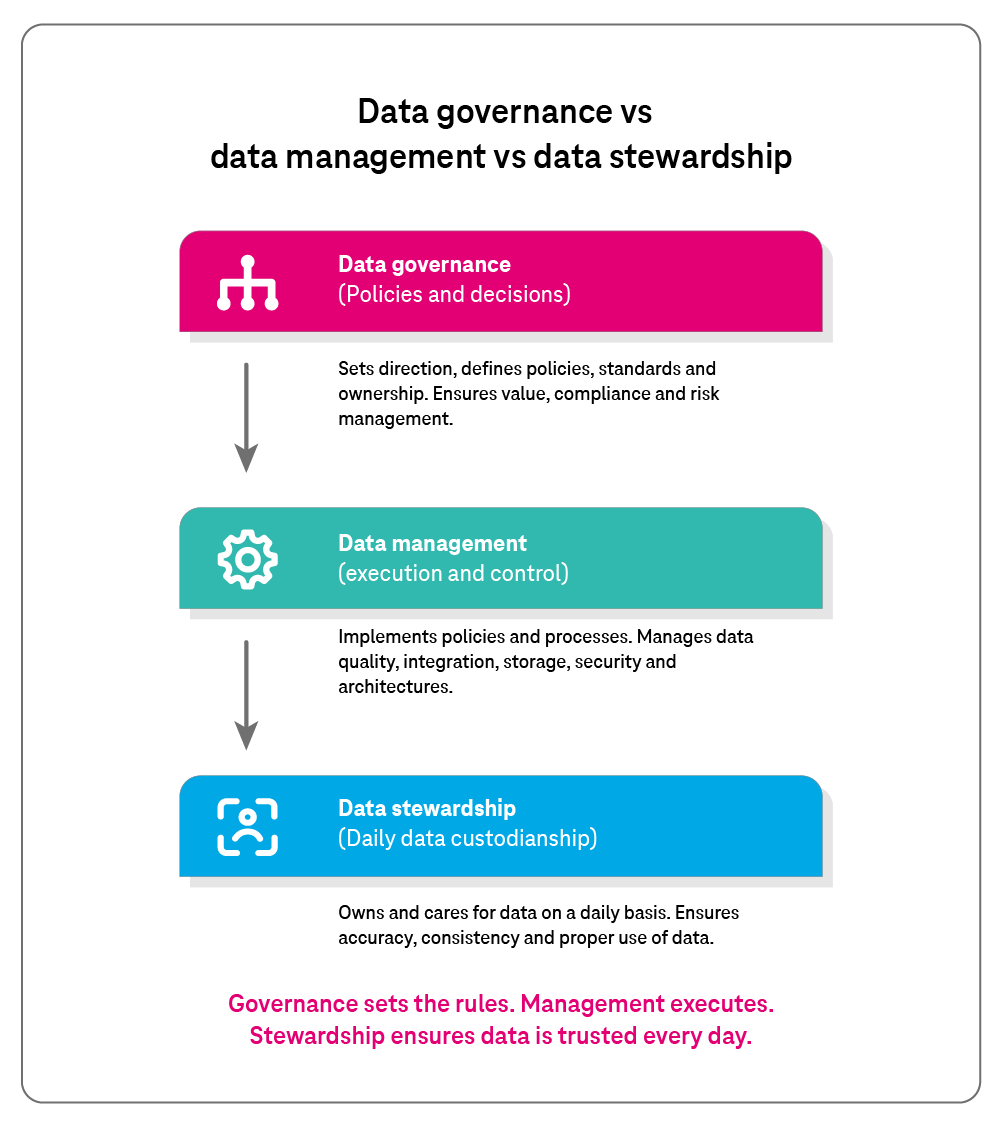
Data governance and data management are closely connected, but they are not the same. Data governance defines the rules. Data management executes them.
Data governance determines who owns data, what quality standards apply, who can access it, how long it should be retained, how it must be protected and how compliance can be proven. Data management covers the technical and operational activities that collect, store, integrate, process, secure and deliver data.
The core difference is simple: governance decides how data should be handled; management makes that handling possible. A company may have a modern data lake, fast pipelines and scalable cloud infrastructure. But if teams do not know which dataset is authoritative, whether sensitive data is protected, who owns a data domain or how quality is measured, then the data environment remains difficult to trust. In that case, data management exists, but governance is missing.
The opposite is also true. Governance policies without data management capabilities remain theoretical. Rules need platforms, processes and automation to become real. This is why data management needs data governance. Together, they create the foundation for reliable reporting, trusted analytics and production-grade AI.
Data governance matters because every digital strategy depends on trusted data. Artificial intelligence, automation, customer experience, predictive maintenance, financial planning, supply chain optimization and sustainability reporting all rely on data that is accurate, contextualized and secure.
Without governance, companies often face the same problems: different departments use different definitions for the same KPI, business users cannot find the right dataset, data quality issues delay analytics projects, sensitive data is not consistently protected, and AI initiatives struggle because the underlying data is incomplete or unreliable.
This is especially relevant for AI. T-Systems emphasizes that companies need a clearly defined strategy, secure data foundations and responsible implementation to become truly AI-enabled enterprises. AI must be integrated into strategies, processes and decision-making while taking data protection and data security into account.
Data governance gives this transformation a reliable base. It defines the standards for data quality, clarifies ownership, controls access, documents lineage and creates transparency. As a result, business teams can make decisions with confidence, IT teams can operate data platforms more efficiently, and compliance teams can prove that data is handled responsibly. For enterprises, data governance is no longer optional. It is the difference between having data and being able to use data with trust.
As organizations become increasingly data-driven, terms such as data governance, data management and data stewardship are often used interchangeably. While these disciplines are closely connected, they serve distinct purposes within an enterprise data strategy. Understanding the differences is essential for building an effective governance framework and ensuring that data remains trustworthy, accessible, secure and valuable throughout its lifecycle.
Data governance establishes rules, policies, responsibilities and decision-making structures that guide how data should be handled across an organization. It defines accountability and creates a framework for ensuring that data is used consistently, securely and in compliance with regulatory requirements.
Data management, on the other hand, focuses on the operational execution of those rules. It encompasses the technologies, processes and activities required to collect, store, integrate, maintain and deliver data to business users. In simple terms, data governance determines what should happen, while data management determines how it happens.
For example, a governance policy may require customer data to be retained for a specific period and protected according to defined security standards. Data management teams implement the systems, workflows and controls that enforce those requirements in practice. Without governance, data management lacks direction. Without management, governance remains a set of policies without operational impact.
Data stewardship is another important discipline that supports governance but does not replace it. While governance establishes accountability at an organizational level, data stewards are responsible for maintaining the quality, consistency and usability of specific data domains. They act as custodians of data assets and help ensure that governance policies are applied in day-to-day operations.
Typical stewardship activities include:
Data governance defines the standards. Data stewardship helps enforce them.
The simplest way to understand the relationship between these disciplines is to view them as different layers of a data operating model.
Each discipline addresses a different question:
| Discipline | Primary question | Focus |
| Data governance | What rules should guide data usage? | Policies, accountability and control |
| Data management | How is data collected, stored and delivered? | Processes, technology and operations |
| Data stewardship | How do we maintain data quality and trust? | Oversight, quality and consistency |
Data governance: establishes control and accountability for data across the organization. It operates at an enterprise-wide level and is typically led by executive leadership and governance councils. Its primary focus is defining policies, standards and accountability frameworks that guide how data is managed and used. Success is measured by the organization's ability to achieve compliance, build trust and maintain clear accountability for its data assets.
Data management: focuses on executing the operational processes required to collect, store, integrate and maintain data. Its scope covers the systems, platforms and processes that support data throughout its lifecycle. Responsibility generally lies with IT and dedicated data teams, whose goal is to ensure that data remains available, reliable and performs efficiently. Success is measured by the effectiveness and reliability of these operational capabilities.
Data stewardship: is responsible for maintaining the quality, consistency and usability of data within specific business domains, such as customer, financial or product data. Business users and designated data stewards oversee these activities, ensuring that governance policies are applied in day-to-day operations. Their work focuses on monitoring data quality, resolving issues and improving data over time. Success is measured by the accuracy, consistency and overall usability of data for business decision-making.
Although these disciplines have different responsibilities, they are highly interdependent. Governance establishes policies that guide how data should be managed. Data management implements those policies through processes and technologies. Data stewardship ensures that data remains aligned with governance objectives over time.
For example, a governance framework may define data quality requirements for customer information. Data management systems enforce validation rules and data integration processes, while data stewards continuously monitor quality metrics and address issues as they arise. Organizations achieve the greatest value when governance, management and stewardship operate as a coordinated ecosystem rather than as isolated initiatives.
The balance between governance and management often depends on the business objective.
Governance typically takes the lead when organizations need to:
Data management takes the lead when organizations need to:
In practice, successful organizations do not treat governance and management as separate projects. Governance provides the strategic framework, while management delivers the operational capabilities required to achieve business outcomes.
One of the most common reasons for data governance initiatives to fail is the lack of sustained organizational support. Governance cannot succeed as an isolated IT effort. It requires active participation from executive leadership, business stakeholders, compliance teams and operational data owners. Without clear sponsorship, accountability structures and business alignment, governance programs often become policy documents that are rarely implemented in practice.
Successful organizations embed governance into everyday business processes, provide clear ownership of data assets and continuously measure outcomes such as data quality, compliance performance and business value creation. Ultimately, effective data governance is not about creating more rules. It is about enabling the organization to trust its data, make better decisions and confidently support innovation, AI adoption and digital transformation.
For many organizations, data governance was once viewed as a desirable but non-essential initiative, something that could be addressed after core technology projects, cloud migrations or digital transformation programs were completed. That perspective is rapidly changing.
Today, organizations operate in an environment where data is generated and shared across cloud platforms, business applications, connected devices, partner ecosystems and AI systems. At the same time, regulatory requirements are becoming more stringent, cybersecurity threats are increasing, and business decisions are increasingly dependent on data-driven insights.
Without effective governance, organizations often struggle with inconsistent data, unclear ownership, limited visibility and growing compliance risks. These challenges can undermine digital transformation efforts, reduce trust in analytics and limit the value organizations derive from their data assets.
The rise of artificial intelligence has further elevated the importance of governance. AI models are only as reliable as the data used to train and operate them. Poor data quality, insufficient transparency or weak access controls can lead to inaccurate outcomes, increased risk and reduced confidence in AI-driven decision-making.
Data governance is therefore no longer simply a compliance exercise or an IT initiative. It has become a necessity for business. Organizations need a clear framework for managing data quality, security, ownership and usage if they want to support innovation, leverage AI responsibly and maintain regulatory compliance.
In the context of digital sovereignty, governance becomes even more critical. Maintaining control over where data resides, who can access it and how it is used requires more than infrastructure choices alone. It requires clearly defined governance policies, accountability structures and operational controls.
As organizations continue to expand their digital ecosystems, the question is no longer whether data governance is necessary. The question is how quickly and effectively it can be implemented to create a trusted foundation for growth, resilience and innovation.
Data governance defines roles, responsibilities and processes for transparent, secure and accountable data management across the enterprise. By establishing clear standards for data quality, access, protection and usage, organizations can unlock greater business value from their data assets while reducing risk and supporting regulatory compliance. The benefits extend far beyond IT, enabling better decision-making, trusted AI, operational efficiency and long-term digital resilience.
Data-driven decisions are only as reliable as the data behind them. Data governance helps organizations establish consistent definitions, ownership structures and quality standards that improve the accuracy of reporting and analytics.
When data is governed effectively, business users can work with trusted information rather than spending time validating datasets or reconciling conflicting reports. This reduces errors, improves confidence in insights and enables faster decision-making across departments.
For advanced analytics, business intelligence and artificial intelligence initiatives, governance ensures that analytical models are built on reliable and consistent data foundations.
Innovation depends on access to trusted data. When employees can quickly discover, understand and use relevant information, organizations can accelerate digital transformation initiatives, improve operational efficiency and develop new business models.
Data governance reduces time spent searching for information, resolving data inconsistencies and managing duplicate records. Teams can focus on innovation and value creation instead of correcting errors or navigating fragmented data environments.
Governed data also enables organizations to adopt emerging technologies such as AI, automation and predictive analytics with greater confidence and lower risk.
Many organizations possess vast amounts of data but struggle to convert it into measurable business value. Data governance helps transform data from a passive resource into a strategic asset.
By improving visibility into data assets, establishing accountability and creating consistent management practices, governance enables organizations to identify new opportunities for optimization, revenue generation and customer engagement.
Whether supporting operational excellence, strategic planning or AI-driven innovation, governance helps maximize the return on data investments across the enterprise.
Organizations operate in an increasingly complex regulatory environment where privacy, data protection and accountability are critical business requirements.
Data governance provides the policies, controls and oversight needed to support compliance with regulations such as GDPR, industry-specific mandates and emerging data governance frameworks.
Through clear rules for data collection, storage, processing and sharing, governance helps organizations demonstrate compliance, reduce regulatory risk and strengthen stakeholder trust.
One of the key challenges of modern data management is balancing accessibility with protection. Employees, partners and applications require timely access to information, while organizations must safeguard sensitive data from unauthorized use.
Data governance helps strike this balance by establishing role-based access controls, data classification frameworks and usage policies that enable secure access without creating unnecessary barriers.
As a result, organizations can support productivity and collaboration while maintaining control over critical information assets.
Data delivers value only when it can be accessed by the right people at the right time. Governance frameworks establish clear procedures for managing data access, sharing and availability across the organization.
By defining ownership, permissions and access workflows, governance reduces bottlenecks and improves the discoverability of trusted data assets.
This is particularly important in hybrid and multi-cloud environments, where data may reside across multiple platforms and jurisdictions.
Data quality is one of the most visible outcomes of a successful governance program. Governance establishes standards and processes that help ensure data remains accurate, complete, consistent and up to date throughout its lifecycle.
By assigning accountability for data quality and implementing monitoring mechanisms, organizations can identify and resolve issues before they impact reporting, customer experiences or operational processes.
High-quality data supports better business decisions, more reliable analytics and stronger AI performance.
As cyber threats continue to evolve, organizations must adopt a proactive approach to protecting sensitive information. Data governance provides a structured framework for managing security requirements across the data lifecycle.
This includes defining security policies, classifying sensitive information, controlling access permissions and monitoring data usage. Governance also supports incident response and risk management activities by ensuring that critical data assets are properly documented and protected.
A strong governance framework strengthens organizational resilience and helps maintain trust among customers, employees, partners and regulators.
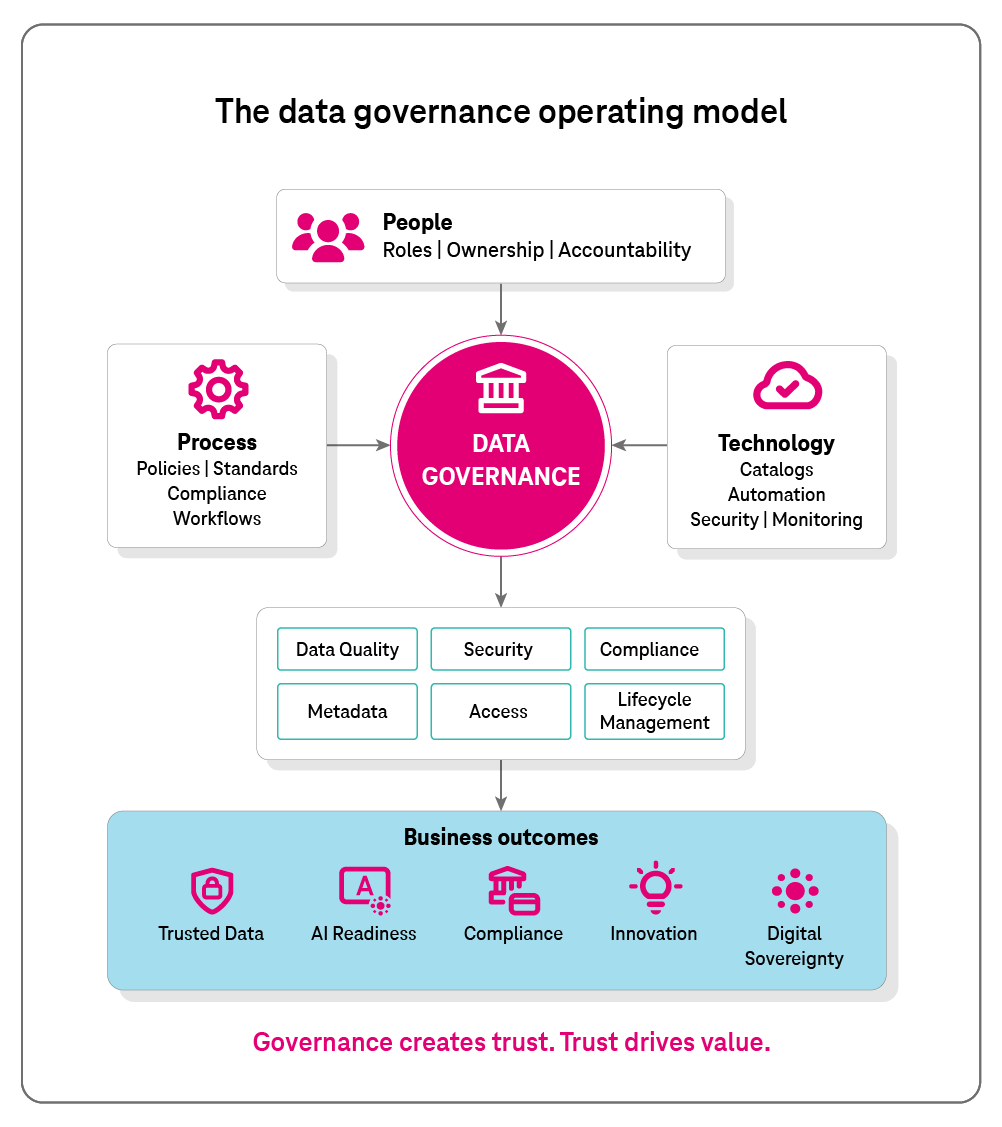
Data governance delivers significant benefits, but implementing and scaling a governance program is not without challenges. As organizations generate, store and share increasing volumes of data across cloud platforms, business applications and partner ecosystems, maintaining control and consistency becomes more complex.
Many governance initiatives struggle not because of technology limitations, but because of organizational, operational and cultural barriers. Understanding these challenges is essential for developing a governance strategy that can deliver sustainable business value.
Implementing data governance requires more than establishing policies and procedures. Organizations must create a framework that aligns people, processes and technology around a common set of data standards and objectives.
One of the most significant implementation challenges is defining clear ownership and accountability. Data often spans multiple departments, business units and systems, making it difficult to determine who is responsible for maintaining quality, approving access and ensuring compliance.
Organizations must also integrate governance into existing business processes without creating unnecessary complexity or slowing down operations. Striking the right balance between control and agility is critical to long-term success.
In addition, governance initiatives frequently involve multiple stakeholders with competing priorities. Aligning business, IT, compliance, security and leadership teams around a shared vision requires strong communication and executive sponsorship.
Even when governance frameworks are well designed, adoption can be difficult.
Employees may perceive governance as an administrative burden or an obstacle to productivity. Business users often prioritize speed and flexibility, while governance introduces standards, controls and approval processes that may initially seem restrictive.
To encourage adoption, organizations must clearly communicate the business value of governance. Employees should understand how governance improves data quality, enables better decision-making, supports compliance and reduces operational risk.
Successful adoption also depends on creating a culture of accountability. Governance should be viewed as a shared responsibility rather than a task assigned exclusively to IT or compliance teams.
Training, change management initiatives and ongoing stakeholder engagement play a critical role in embedding governance practices into everyday operations.
Many organizations operate complex technology environments that have evolved over years or even decades. Data is often distributed across legacy systems, cloud platforms, departmental applications and external data sources.
As a result, organizations frequently encounter:
These inconsistencies reduce trust in enterprise data and make it difficult to establish standardized governance processes.
A strong governance framework helps create consistency across the data landscape by establishing common standards, definitions and metadata practices. Over time, this supports greater interoperability and a more unified view of enterprise information.
Modern organizations rely on data to drive decision-making, innovation, automation and customer engagement. At the same time, employees, partners and AI-powered applications require faster access to growing volumes of information.
This increased demand creates a governance challenge: how can organizations make data widely accessible while maintaining security, privacy and compliance?
Without appropriate controls, expanded access can increase the risk of unauthorized usage, data breaches and regulatory violations. Excessive restrictions, however, can limit collaboration and reduce business agility.
Data governance helps organizations balance these competing priorities through role-based access controls, data classification frameworks, clear usage policies and continuous monitoring. The goal is to provide the right people with the right data at the right time without compromising security or accountability.
A lack of organizational support is one of the most common reasons data governance initiatives fail.
Governance requires sustained commitment from executive leadership, business stakeholders and operational teams. Without visible sponsorship and clear accountability, governance programs often struggle to gain traction and deliver measurable outcomes.
Common signs of insufficient support include:
Successful governance programs are driven from the top and supported throughout the organization. Leadership must position governance as a business priority rather than a purely technical initiative.
When governance is aligned with strategic goals such as digital transformation, AI adoption, regulatory compliance and digital sovereignty, organizations are more likely to secure the support needed for long-term success.
Data governance does not happen by accident. It requires a structured framework that defines how data is managed, protected and used across an organization. A data governance framework serves as the foundation for establishing accountability, improving data quality, reducing risk and ensuring that data supports business objectives.
As organizations generate increasing volumes of data across cloud platforms, business applications, connected devices and AI systems, governance frameworks help create consistency in an otherwise complex and fragmented environment. They provide the policies, standards, roles and processes that enable organizations to manage data as a strategic business asset rather than a by-product of operations.
An effective data governance framework aligns business priorities with data management practices. It establishes clear ownership, defines decision-making processes and creates transparency around how data is collected, stored, shared and used throughout its lifecycle.
Importantly, governance frameworks are not purely technical constructs. Successful frameworks combine people, processes and technology to ensure that governance becomes an integral part of how the organization operates. They help business leaders, compliance teams, data professionals and technology stakeholders work toward a common objective: creating trusted, secure and valuable data that supports innovation and growth.
While the structure of a governance framework may vary depending on an organization's size, industry and regulatory environment, most successful frameworks are built around a common set of foundational capabilities.
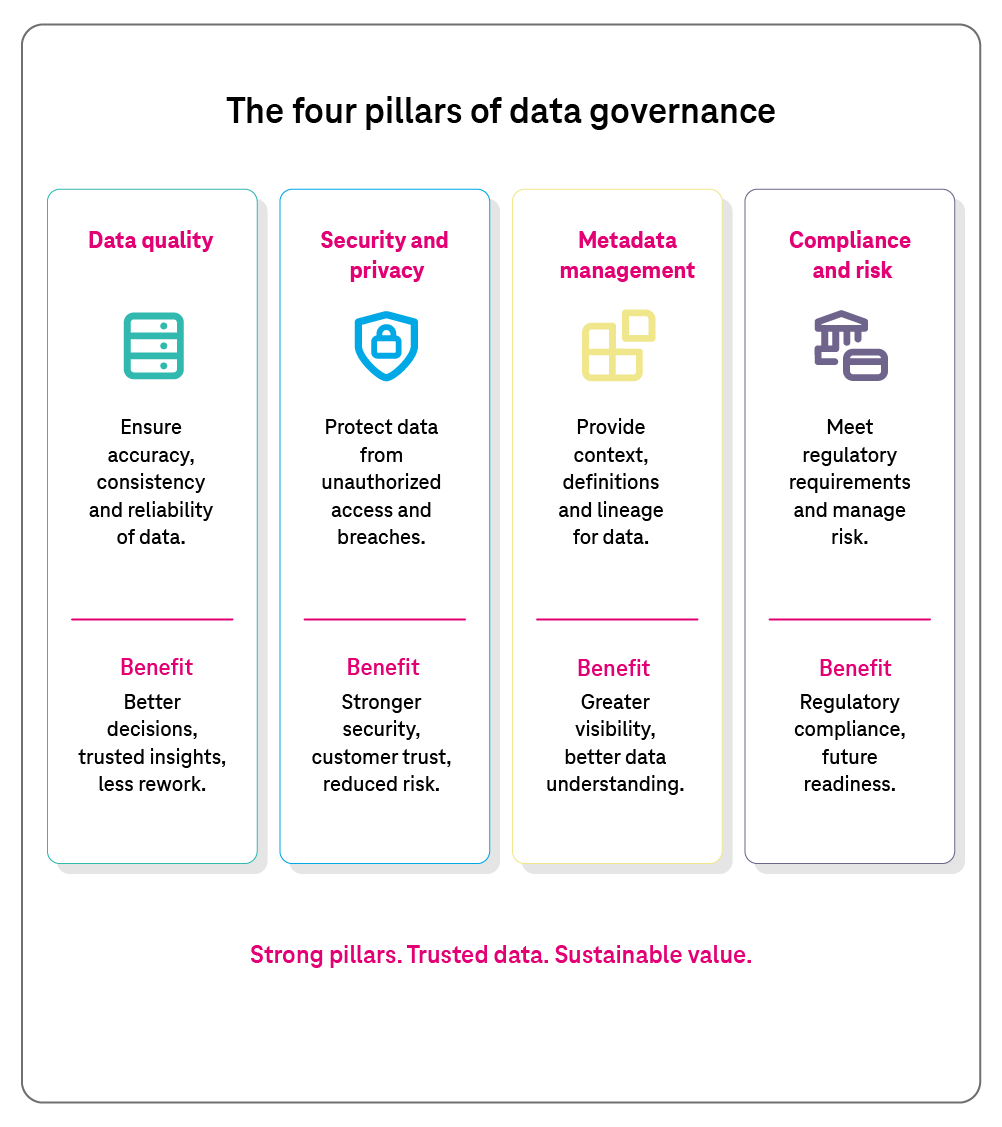
A strong data governance framework rests on four interconnected pillars: data quality, data security and privacy, metadata management, and compliance and risk management. Together, these pillars create the foundation for trusted data and sustainable governance practices.
Data quality is often considered the cornerstone of data governance. Organizations rely on data to make decisions, automate processes, deliver customer experiences and train AI models. If that data is inaccurate, incomplete or inconsistent, the value of every downstream activity is compromised.
Governance helps establish quality standards, ownership structures and monitoring processes that ensure data remains reliable throughout its lifecycle. By defining what constitutes high-quality data and assigning accountability for maintaining it, organizations can increase confidence in analytics, reporting and business decision-making.
As data volumes continue to grow, protecting sensitive information has become a business-critical priority. Governance frameworks establish the policies and controls needed to ensure that data is accessed, used and shared appropriately.
This includes defining access rights, classifying sensitive information, supporting privacy requirements and ensuring compliance with relevant regulations. Effective governance enables organizations to protect data without limiting its business value, striking a balance between security, accessibility and innovation.
Organizations cannot govern data effectively if they do not understand what data they have, where it originates or how it is used.
Metadata management provides the context needed to make data discoverable and understandable. It documents key information about data assets, including ownership, business definitions, lineage, classifications and usage patterns.
By improving visibility into the data landscape, metadata management helps organizations reduce duplication, improve collaboration and support more informed decision-making. It also plays a critical role in data discovery, compliance and AI readiness.
The regulatory landscape surrounding data continues to evolve. Organizations must comply with a growing number of requirements related to privacy, security, industry regulations and cross-border data sharing.
A governance framework helps organizations identify, assess and manage data-related risks while demonstrating compliance with applicable regulations. It creates the controls, documentation and oversight mechanisms needed to support audits, reduce exposure to risk and build trust with customers, partners and regulators.
Beyond regulatory compliance, this pillar helps organizations develop a proactive approach to risk management, ensuring that data can be used confidently and responsibly across the enterprise.
These four pillars are most effective when they operate as part of a unified governance framework rather than as isolated initiatives. High-quality data loses value if it is not properly secured. Strong security controls become less effective without visibility into data assets. Compliance efforts depend on accurate metadata and clearly defined ownership structures.
Together, the pillars create a governance model that enables organizations to trust their data, support innovation and maintain control in increasingly complex digital environments.
As businesses continue to invest in cloud transformation, artificial intelligence and data-driven business models, a well-defined governance framework becomes essential for turning data into a secure, reliable and strategic asset.
The "5 C's" provide a simple way to understand the key elements required for effective data governance:
In practice, these principles support a common governance objective: creating trusted, secure and business-ready data that can be used confidently for analytics, AI, operational processes and strategic decision-making.
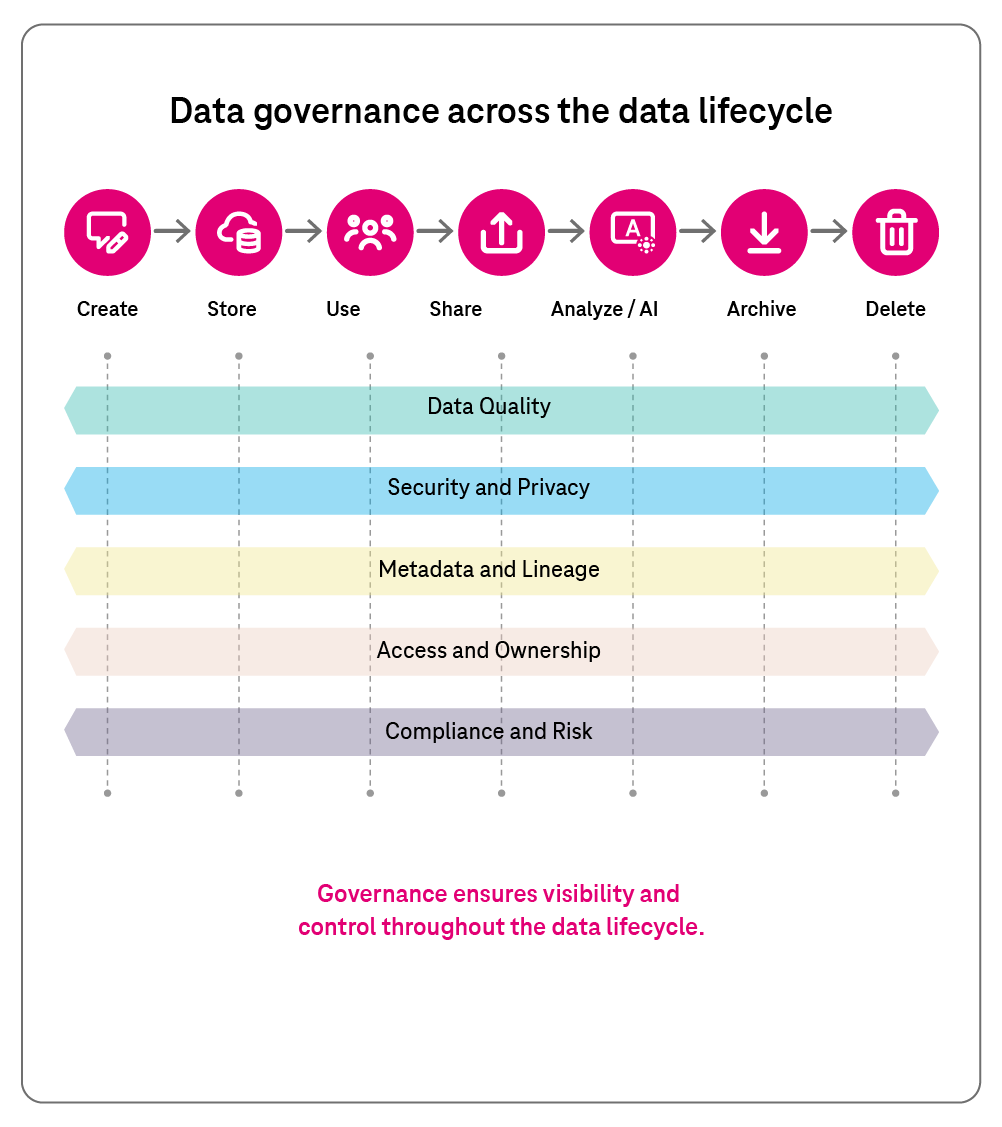
Data is a strategic business asset that creates value only when it is trusted, secure, accessible, and managed responsibly throughout its lifecycle. From the moment data is created and stored, through its use, sharing, and analysis in AI-driven environments, to its eventual archival and deletion, effective data governance provides the visibility, control, and accountability needed to maximize business outcomes while minimizing risk.
At T-Systems, governance is embedded across every stage of the data journey, ensuring that data quality remains consistent, security and privacy are maintained, metadata and lineage provide transparency, ownership and access rights are clearly defined, and compliance requirements are continuously met. This integrated approach enables organizations to confidently leverage data for operational excellence, innovation, advanced analytics, and responsible AI adoption, while maintaining regulatory compliance and protecting sensitive information. By establishing governance as a continuous, enterprise-wide capability rather than a standalone function, T-Systems helps organizations transform data into a trusted foundation for informed decision-making, sustainable growth, and digital transformation—ensuring visibility and control throughout the entire data lifecycle.
Cloud computing has transformed the way organizations store, process and use data. As enterprises increasingly adopt hybrid and multi-cloud environments, data is no longer confined to a single data center or technology platform. Instead, information moves across cloud providers, applications, geographic regions and business ecosystems, creating new opportunities for innovation, but also new governance challenges.
Cloud data governance is the practice of applying governance principles, policies and controls to data stored and processed in cloud environments. It ensures that organizations can maintain visibility, accountability and control over their data regardless of where it resides.
The objective is not simply to protect data in the cloud. Effective cloud data governance enables organizations to balance accessibility, security, compliance and business agility while supporting modern digital transformation initiatives.
The shift to cloud environments has significantly increased the complexity of data management. Organizations often operate across multiple cloud platforms while maintaining connections to on-premises systems, third-party services and partner ecosystems. As data flows between these environments, maintaining consistency and oversight becomes more challenging.
Without a governance framework, organizations may struggle to answer critical questions:
Cloud data governance provides the mechanisms needed to answer these questions and maintain trust in enterprise data.
A cloud governance framework typically builds upon traditional data governance principles while addressing the unique characteristics of cloud environments.
Data classification plays an important role by helping organizations identify sensitive, regulated and business-critical information. Once classified, data can be managed according to appropriate security, privacy and retention requirements.
Access governance ensures that users, applications and partners can only access the data necessary for their roles and responsibilities. This reduces risk while supporting collaboration and operational efficiency.
Metadata management provides visibility into where data originates, how it moves across environments and how it is being used. This transparency is essential for compliance, auditing and effective decision-making.
Cloud governance also includes continuous monitoring to ensure that policies remain effective as data volumes, users and cloud services evolve.
As organizations become increasingly dependent on cloud services, concerns around data sovereignty and control continue to grow.
Many organizations must comply with requirements related to data residency, cross-border data transfers and industry-specific regulations. Simply knowing where data is stored is no longer sufficient. Organizations also need transparency into who can access data, how it is processed, and which jurisdictions may have legal authority over it.
Cloud data governance helps establish these controls by creating clear policies for data ownership, access, sharing and lifecycle management. In this way, governance becomes a critical enabler of digital sovereignty, helping organizations maintain control over their assets while benefiting from the scalability and flexibility of cloud technologies.
As cloud adoption accelerated, the industry recognized the need for a common framework to help organizations govern data consistently across cloud environments. To address this challenge, the EDM Council developed the Cloud Data Management Capabilities (CDMC) framework.
CDMC provides a set of best practices and control objectives for managing and governing data in cloud environments. The framework focuses on areas such as data accountability, security, privacy, sovereignty, interoperability and lifecycle management.
Rather than prescribing specific technologies, CDMC provides guidance on the capabilities organizations should establish to ensure that cloud data remains secure, compliant and trusted. It has become an important reference model for organizations seeking to strengthen governance across hybrid and multi-cloud environments.
Cloud adoption has fundamentally changed the way organizations manage and govern data. Information is no longer stored within a single data center or controlled environment. Instead, it is distributed across public clouds, private clouds, SaaS platforms, edge environments and partner ecosystems. While this creates greater flexibility and scalability, it also introduces new governance challenges.
A cloud data governance framework extends traditional governance principles into cloud environments. It provides the policies, controls and accountability structures needed to ensure that data remains secure, compliant and trustworthy regardless of where it is stored or processed.
Effective cloud governance focuses on maintaining visibility across distributed environments, enforcing consistent security controls, managing data access and supporting compliance with regional and industry-specific regulations. It also plays a crucial role in helping organizations achieve digital sovereignty by maintaining control over critical data assets while leveraging the benefits of cloud technologies.
Organizations rarely achieve governance excellence in a single step. Governance capabilities evolve over time as processes mature, responsibilities become clearer, and technologies become more integrated.
Maturity models help organizations assess their current governance capabilities and identify areas for improvement. They provide a structured approach for evaluating governance across dimensions such as data quality, metadata management, compliance, security, ownership and operational effectiveness.
Rather than pursuing governance perfection immediately, leading organizations use maturity assessments to establish realistic roadmaps that align governance investments with business priorities. This approach helps ensure that governance evolves alongside digital transformation initiatives and changing regulatory requirements.
Successful data governance is not determined by policies alone. It requires consistent execution, organizational commitment and alignment with business objectives. While governance frameworks differ across industries and organizations, the most effective programs are built upon a common set of principles that help create trust, transparency and accountability.
To guarantee successful implementation, focus on these five data governance principles
Consistency is the foundation of effective governance. Organizations must establish common definitions, standards and policies that apply across business units and technology environments.
When employees work with shared terminology and clearly documented processes, data becomes easier to understand, manage and trust. Standardization also reduces ambiguity and supports regulatory compliance by ensuring that governance requirements are applied consistently throughout the organization.
Organizations cannot govern data they cannot locate, understand or monitor.
Data visibility provides insight into where information resides, how it flows across systems and who is responsible for it. Combined with effective controls, this visibility enables organizations to identify risks, enforce policies and support informed decision-making.
As data ecosystems become increasingly complex, visibility becomes a critical prerequisite for governance success.
Many organizations struggle with conflicting versions of the same information across different systems and departments.
A Single Source of Truth (SSOT) helps address this challenge by establishing authoritative data sources for critical business information. Rather than relying on multiple disconnected records, users can access consistent and trusted data across the organization.
An SSOT improves reporting accuracy, reduces duplication and strengthens confidence in business decisions.
The scale and complexity of modern data environments make manual governance increasingly difficult.
Automation enables organizations to classify data, monitor quality, enforce policies and manage access controls more efficiently. It reduces administrative effort while improving consistency and scalability.
As organizations adopt AI and advanced analytics, automated governance capabilities become essential for maintaining control over growing data volumes.
Governance is not a one-time initiative. Business requirements, regulations and technologies continue to evolve, creating new risks and opportunities.
Organizations should regularly assess governance effectiveness, monitor key performance indicators and update policies when necessary. Continuous improvement helps ensure that governance remains aligned with business objectives and emerging challenges.
Although governance principles provide a strong foundation, organizations frequently encounter practical challenges during implementation. Legacy systems, fragmented ownership structures, inconsistent data architectures and competing business priorities can make governance difficult to sustain.
The most successful organizations address these challenges by treating governance as an ongoing business capability rather than a compliance project. By combining clear standards, executive sponsorship, operational accountability and continuous improvement, they create governance programs that scale alongside the organization.
Data governance encompasses a broad range of interconnected initiatives that work together to create trusted, business-ready data.
These initiatives typically include data quality management, metadata management, master data management, privacy and security governance, compliance management, lifecycle management and increasingly, AI governance.
Rather than operating as isolated activities, these dimensions form a connected governance ecosystem.
Improvements in one area often strengthen outcomes across others. For example, effective metadata management improves data discovery, while stronger data quality initiatives support more reliable analytics and AI outcomes.
As governance programs mature, organizations increasingly integrate these dimensions into a unified operating model that supports enterprise-wide data management and digital transformation goals.
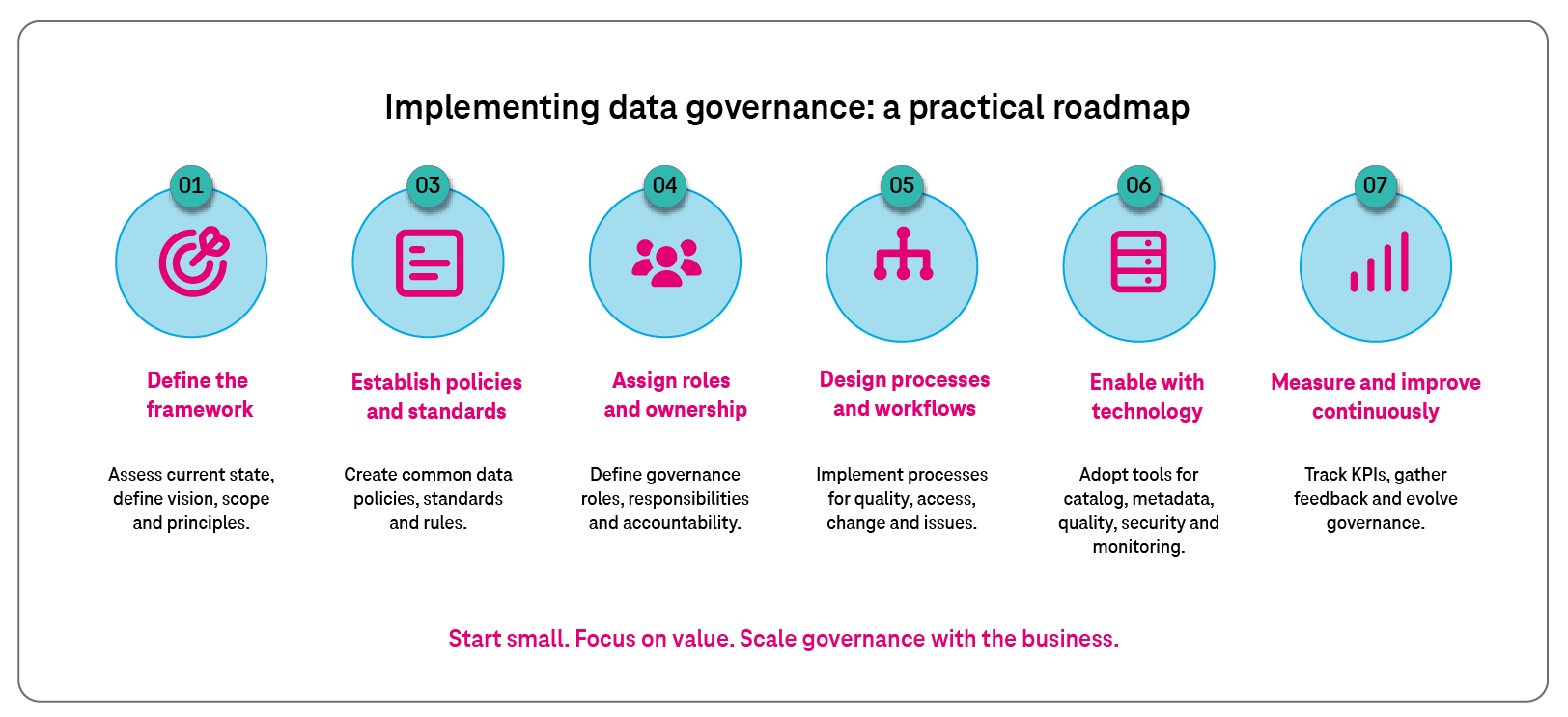
Implementing data governance requires a structured approach that combines strategy, accountability, processes and technology. While every organization follows a different path, successful implementations typically begin with clear business objectives and expand gradually across the enterprise.
Governance initiatives often emerge in response to specific business challenges such as regulatory requirements, poor data quality, cloud transformation programs or AI adoption initiatives.
Rather than attempting to govern all data at once, organizations typically begin with high-priority domains where governance can deliver measurable business value. This phased approach helps build momentum and demonstrates the practical benefits of governance.
Governance success should be measured through business outcomes rather than policy creation alone.
Organizations often evaluate governance performance based on improvements in data quality, compliance readiness, operational efficiency, access management and user trust in enterprise data.
Meaningful metrics help demonstrate value and secure ongoing support from leadership and stakeholders.
Although governance programs vary, successful implementations generally follow six key steps.
Establish a data governance framework
Define governance objectives, accountability structures and operating principles that align with business priorities.
Establish clear data governance guidelines
Create policies, standards and procedures that define how data should be managed, protected and used.
Assign roles and responsibilities as part of data governance
Clearly identify data owners, stewards, governance leaders and supporting stakeholders.
Implement data governance processes
Integrate governance requirements into operational workflows and business activities.
Integrate data governance technologies
Deploy tools that support automation, visibility, monitoring and policy enforcement.
Check and continuously improve
Regularly review governance performance, identify gaps and refine governance practices as business requirements evolve.
Technology plays a critical supporting role in modern governance programs. While governance is fundamentally about people, processes and accountability, technology enables organizations to apply governance principles at enterprise scale.
Modern governance platforms provide capabilities that help organizations automate governance activities, improve visibility and maintain control across increasingly complex data environments.
These technologies support everything from metadata management and data quality monitoring to access governance and compliance reporting.
A data catalog serves as a centralized inventory of enterprise data assets.
It provides business and technical users with information about data sources, ownership, classifications, lineage and usage. By making data easier to discover and understand, catalogs help improve transparency and support governance objectives.
Data cataloging creates an organized and searchable view of enterprise data assets. It helps users locate trusted information more efficiently and reduces dependence on institutional knowledge.
Classification helps organizations identify sensitive, regulated and business-critical information. Once data is classified, appropriate controls can be applied to support security, privacy and compliance requirements.
Governance technologies support security through access controls, monitoring, encryption and policy enforcement mechanisms that protect data throughout its lifecycle.
Access auditing provides visibility to who can access specific data assets and how those permissions are being used. This supports compliance, risk management and security governance initiatives.
Data discovery tools help organizations locate, understand and evaluate data assets across distributed environments, including hybrid and multi-cloud infrastructures.
Governance technologies increasingly support secure data sharing across business units, partners and digital ecosystems. These capabilities enable collaboration while maintaining appropriate controls over access, usage and compliance requirements.
As data becomes an increasingly valuable economic and strategic resource, governments and regulators are developing frameworks to encourage trusted data sharing while protecting privacy, security and sovereignty. In the European Union, one of the most significant initiatives in this area is the Data Governance Act (DGA).
The Data Governance Act establishes a framework for increasing the availability of data and promoting trustworthy mechanisms for data sharing across the European Union. Rather than regulating how organizations internally govern their data, the Act focuses on creating trusted conditions for data exchange between public authorities, businesses and citizens.
The overarching objective is to unlock the value of data while ensuring that individuals and organizations maintain confidence in how data is accessed, shared and used. Together with other European initiatives, including the Data Act and the European Strategy for Data, the DGA supports the development of a secure and sovereign European data economy.
For organizations operating in regulated industries or across multiple jurisdictions, the Data Governance Act reinforces the importance of transparency, accountability and strong governance practices as foundations for trusted data sharing.
One of the concepts introduced by the Data Governance Act is data altruism.
Data altruism refers to the voluntary sharing of data by individuals and organizations for purposes that serve the public interest. Examples include scientific research, healthcare innovation, environmental protection and the development of public services.
The goal is to create mechanisms that allow data to be shared responsibly and transparently while respecting privacy rights and maintaining trust. Organizations that facilitate data altruism must meet specific transparency and governance requirements designed to protect participants and ensure that data is used only for approved purposes.
By encouraging voluntary data sharing, the European Union aims to support innovation while maintaining strong ethical and governance standards.
The Data Governance Act also introduces the concept of data intermediation services.
These services act as neutral intermediaries that facilitate data sharing between organizations, individuals and public entities. Their role is not to exploit data for their own commercial benefit but to create trusted environments where data can be exchanged securely and transparently.
Data intermediation services may support activities such as business-to-business data sharing, business-to-government data exchange and personal data sharing under user control.
For organizations participating in digital ecosystems, these services can help reduce barriers to collaboration while ensuring compliance with governance, privacy and security requirements.
Modern organizations rarely operate within a single jurisdiction. Data increasingly moves across countries, cloud environments and global business ecosystems.
International data streams play a critical role in supporting digital services, global supply chains, research collaboration and cross-border business operations. At the same time, they create governance challenges related to privacy, security, compliance and digital sovereignty.
Organizations must understand where data is stored, how it moves between jurisdictions and which legal frameworks apply to those transfers. Effective data governance helps maintain transparency and control across international data flows while supporting compliance with regional regulations and business requirements.
As data becomes more globally interconnected, governance serves as a key mechanism for balancing openness, innovation and sovereignty.
To support consistent implementation of the Data Governance Act, the European Union established the European Data Innovation Board (EDIB).
The Board brings together representatives from EU Member States, regulatory authorities and relevant stakeholders to promote best practices, facilitate cooperation and provide guidance on data-sharing initiatives.
Its role includes supporting the development of common standards, encouraging interoperability and helping ensure that data-sharing frameworks operate consistently across the European Union.
The Board reflects the broader European objective of creating a trusted and competitive data economy built on transparency, collaboration and strong governance principles.
Large volumes of valuable data are held by public-sector organizations. In many cases, this information could support innovation, research and economic growth if it could be accessed and reused responsibly.
The Data Governance Act establishes mechanisms that facilitate the re-use of certain categories of protected public-sector data while preserving confidentiality, privacy and intellectual property rights.
Examples may include data related to healthcare, transportation, environmental monitoring or public administration.
Organizations seeking access to such data must comply with specific conditions designed to protect sensitive information and ensure responsible usage.
By creating clear rules for re-use, the Act seeks to increase the societal and economic value of public-sector data while maintaining appropriate safeguards.
As data governance becomes increasingly important for compliance, risk management and digital transformation, many organizations invest in professional certifications to develop governance expertise and establish common standards across teams.
Governance certifications help professionals build knowledge in areas such as data quality, metadata management, compliance, privacy, risk management and governance operating models. They also provide organizations with greater confidence that governance initiatives are supported by recognized best practices.
Several industry-recognized certifications focus on data governance and related disciplines, including programs offered by professional associations and data management organizations. While certifications alone do not guarantee governance success, they can help establish a common foundation of knowledge and support the development of governance capabilities across the enterprise.
Ultimately, successful governance depends on a combination of skilled professionals, effective processes, executive sponsorship and the right technology enablement.
Despite its growing importance, data governance is often misunderstood.
Data governance is not a technology product, a software platform or a compliance checklist. While governance tools can support governance activities, technology alone cannot establish accountability, ownership or trust.
Data governance is also not the same as data management. Governance defines the policies, responsibilities and decision-making structures that guide how data should be managed, while data management focuses on the operational execution of those requirements.
Nor is governance solely a security or regulatory initiative. Although governance supports privacy, security and compliance objectives, its purpose extends far beyond risk reduction. Effective governance enables organizations to improve data quality, support analytics, accelerate innovation and maximize the value of enterprise data.
Perhaps most importantly, data governance is not a one-time project. It is an ongoing organizational capability that evolves alongside business priorities, technologies and regulatory requirements.
Organizations that treat governance as a continuous discipline rather than a temporary initiative are better positioned to build trust in their data, support responsible AI adoption and achieve long-term digital resilience.
Data governance cannot succeed through technology alone. While platforms, catalogs and automation tools play an important role, governance ultimately depends on people making informed decisions about how data is defined, managed, protected and used.
For this reason, effective governance requires clearly defined roles and responsibilities. Every stakeholder involved in creating, maintaining or consuming data should understand their level of accountability. Without clear ownership, governance initiatives often struggle with inconsistent standards, unresolved quality issues and limited adoption across the organization.
As organizations become increasingly data-driven, governance responsibilities are also expanding beyond IT departments. Business leaders, compliance teams, data specialists and executive stakeholders all contribute to establishing a culture of accountability and trust.
Responsibility for data governance is typically distributed across multiple roles rather than assigned to a single individual or department. The exact structure varies depending on the size and complexity of the organization, but successful governance programs usually combine executive sponsorship with operational oversight. Executive leadership provides strategic direction and ensures governance initiatives remain aligned with business objectives. Operational teams translate governance principles into day-to-day processes, while business stakeholders help define standards and priorities for the data they rely on. This collaborative model helps ensure that governance remains both practical and business focused.
In many organizations, the Chief Data Officer (CDO) serves as the executive sponsor for data governance. The role is responsible for defining the organization's data strategy, promoting data-driven decision-making and ensuring that governance initiatives support broader business goals. The CDO typically acts as a bridge between business and technological functions. Rather than focusing solely on technical implementation, the role helps establish policies, accountability structures and governance priorities that support long-term business value.
As organizations continue to invest in AI, advanced analytics and digital transformation, the Chief Data Officer increasingly plays a strategic role in ensuring that data remains trustworthy, accessible and compliant.
Data owners are accountable for specific data domains, such as customer data, financial data, employee records or product information.
Their primary responsibility is to ensure that the data under their ownership meets business requirements while complying with governance policies and regulatory obligations. They make decisions regarding access, quality expectations, retention requirements and acceptable usage.
Because data owners understand both the business context and operational requirements of their data, they play a critical role in translating governance principles into practical outcomes.
Data stewards support governance by maintaining the quality, consistency and usability of data assets.
While data owners are accountable for decision-making, stewards are often responsible for the operational activities that help maintain governance standards. This may include monitoring data quality metrics, maintaining metadata, documenting business definitions and helping resolve inconsistencies across systems.
Data stewards act as custodians of trusted information. Their work helps ensure that data remains understandable, reliable and fit for business use.
As governance initiatives mature, organizations often establish governance councils or committees to provide strategic oversight and cross-functional coordination.
These groups typically include representatives from business units, IT, security, compliance, risk management and data leadership functions. Their role is to review governance priorities, resolve conflicts, approve standards and ensure alignment across the organization. Governance committees are particularly valuable in large enterprises where data assets span multiple departments, regions and technology platforms.
Although governance structures vary, successful programs share a common principle: accountability should be clearly defined at every stage of the data lifecycle. From executive sponsors and data owners to stewards and technology teams, each stakeholder contributes to creating an environment where data can be trusted and used responsibly. Governance becomes significantly more effective when responsibilities are documented, understood and integrated into everyday business processes.
Rather than viewing governance as a standalone initiative, leading organizations embed accountability into their operating model. This creates a culture in which data quality, security, compliance and value creation are shared responsibilities across the enterprise.
Technology alone cannot create trusted data. Organizations also need a clear strategy that defines how governance will support business priorities, regulatory obligations and long-term digital transformation goals. A data governance strategy provides this direction. It establishes the vision, principles and roadmap required to govern data consistently across the organization while ensuring that governance activities remain aligned with business outcomes.
Without a strategy, governance efforts often become reactive, fragmented and difficult to scale. Policies may exist, but they are applied inconsistently. Ownership may be defined, but accountability remains unclear. As a result, organizations struggle to realize the full value of their data assets.
A data governance strategy is a structured approach to managing data as a strategic business asset. It defines how governance will be implemented, who will be responsible for key decisions, which policies and standards will apply and how success will be measured over time. More importantly, a governance strategy connects data-related activities to broader business objectives. Whether the goal is improving customer experiences, supporting AI adoption, strengthening compliance or enabling digital sovereignty, governance should serve a clearly defined purpose.
As data volumes continue to grow, organizations face increasing complexity in managing information across cloud platforms, applications, business units and external ecosystems. A governance strategy helps create consistency within this environment. It provides a common framework for decision-making and ensures that governance activities are prioritized according to business value rather than isolated technical requirements.
An effective strategy also improves stakeholder alignment. When business leaders, technology teams and governance professionals share a common vision, governance initiatives are more likely to gain support and achieve sustainable outcomes.
Although every organization approaches governance differently, successful strategies generally begin with a clear understanding of current capabilities and future objectives.
The first step is assessing the existing data landscape, including governance maturity, quality challenges, compliance requirements and organizational priorities. From there, organizations can define governance goals, establish accountability structures and identify the policies needed to support their objectives.
Technology decisions typically follow these foundational steps rather than leading them. Governance tools are most effective when they support a clearly defined operating model rather than attempting to compensate for missing processes or ownership structures.
Finally, organizations should establish measurable outcomes that allow them to evaluate progress and continuously refine their approach.
Modern organizations rarely operate in isolation. Data increasingly moves across cloud environments, business ecosystems, supply chains and AI platforms. As a result, governance strategies must extend beyond traditional organizational boundaries. A unified and open approach enables organizations to govern data consistently while supporting collaboration, innovation and secure information sharing.
This is particularly important in the context of digital sovereignty, where organizations need visibility and control over data regardless of where it is stored, processed or exchanged. Governance provides the framework that makes this level of control possible while maintaining the flexibility required in modern digital environments.
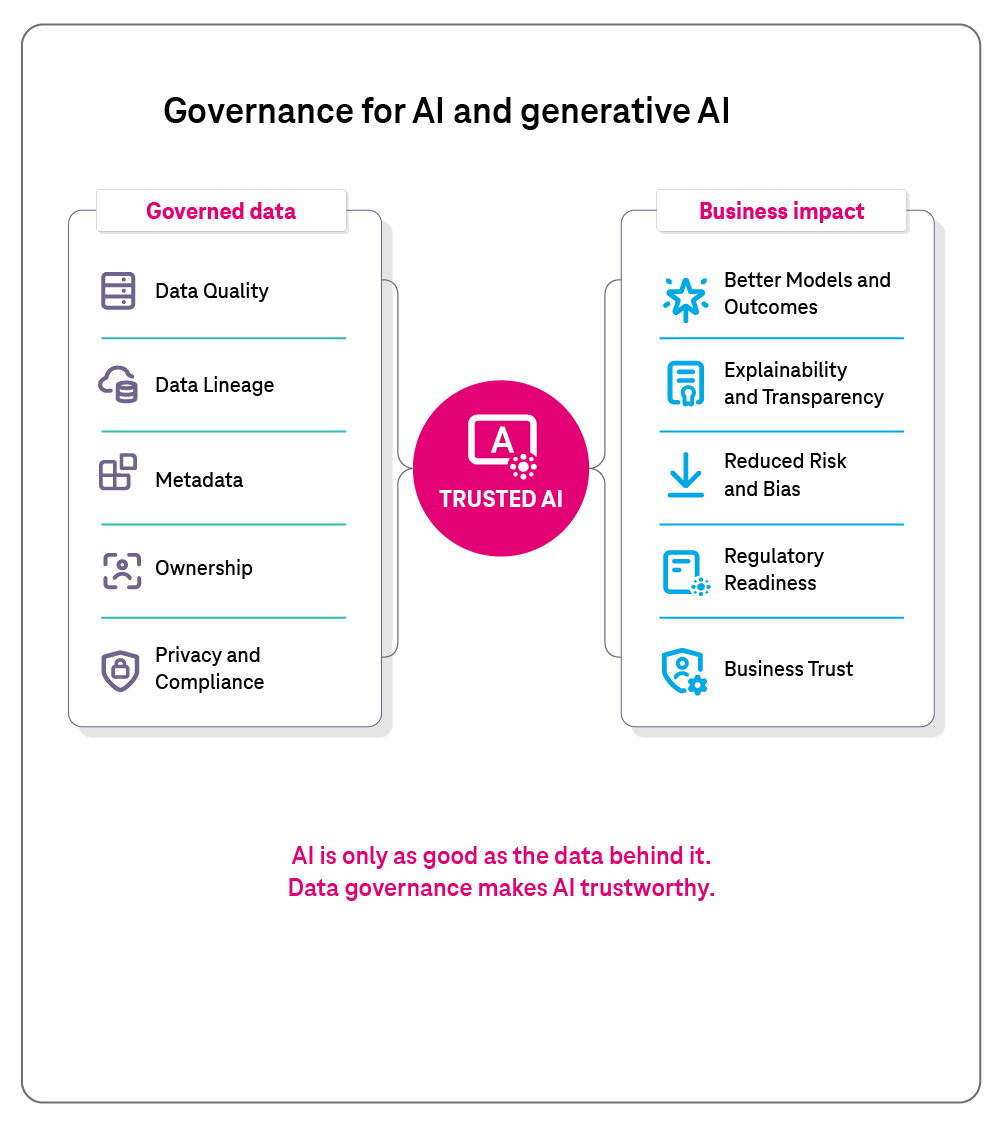 Image generated with AI
The rise of artificial intelligence and generative AI has transformed data governance from a back-office discipline into a strategic business capability. Organizations are rapidly adopting AI to improve decision-making, automate processes and create new customer experiences. However, the effectiveness of AI systems depends directly on the quality and trustworthiness of the data on which they are built.
AI models learn from data. If the underlying data is incomplete, inaccurate, biased or poorly documented, the resulting output may be unreliable. Governance helps organizations establish the controls needed to ensure that data used for AI initiatives is accurate, consistent and appropriately managed.
Data quality is one of the most important governance requirements for AI. Organizations must understand where data originates, how it has been transformed and whether it remains fit for its intended purpose. Governance supports this through data quality management, metadata management and data lineage capabilities that provide transparency into the complete journey of a dataset.
Governance also plays a critical role in ensuring accountability. As AI systems become increasingly integrated into business processes, organizations must be able to explain how decisions are made and demonstrate compliance with emerging regulatory requirements. Governance frameworks help establish clear ownership, document data sources and create audit trails that support transparency and trust.
In addition, AI initiatives often require access to large volumes of data spread across multiple systems and cloud environments. Governance ensures that access is granted appropriately, sensitive information is protected, and usage remains aligned with organizational policies and regulatory obligations.
Ultimately, trustworthy AI begins with trustworthy data. Organizations that invest in data governance create the foundation necessary for responsible AI adoption, improved model performance and long-term confidence in AI-driven outcomes.
Most organizations understand the value of data. The challenge is turning that value into measurable business outcomes. As data volumes continue to grow, many enterprises find themselves navigating a complex landscape of legacy systems, cloud platforms, business applications, regulatory requirements and rapidly evolving AI technologies. Data exists everywhere, but visibility, consistency and accountability often do not. The result is a growing gap between the data organizations possess and the value they can derive from it.
Data governance helps close this gap. By establishing clear responsibilities, common standards and transparent processes, organizations can create the conditions necessary for data-driven decision-making, operational efficiency and sustainable innovation. Governance enables businesses to move faster with greater confidence because decisions are based on information that is understood, trusted and properly managed.
Yet implementation is rarely straightforward. Governance initiatives frequently encounter challenges such as fragmented data landscapes, organizational silos, competing business priorities and limited ownership. Success requires more than policies and technology. It requires alignment between business strategy, operating models and data management practices.
This is where many organizations seek external expertise. Governance must be tailored to the realities of each business, its regulatory environment and its technological ecosystem. A global enterprise operating across multiple jurisdictions faces very different governance requirements than a company managing data within a single market.
T-Systems supports organizations throughout this journey from defining governance strategies and operating models to implementing the processes, technologies and controls needed to scale governance across complex enterprise environments. By combining expertise in cloud, data, security and regulatory requirements, T-Systems helps organizations establish governance structures that are practical, sustainable and aligned with long-term business objectives.
The most successful organizations view governance not as an administrative exercise, but as a foundation for future growth. As businesses continue to expand their use of cloud technologies, data ecosystems and AI-driven applications, the ability to manage data consistently and responsibly will become an increasingly important competitive advantage. Organizations that invest in governance today are better positioned to unlock value from their data tomorrow.
You can display all external content on the website at this point.
I agree that personal data may be transmitted to third-party platforms. Read more about this in our privacy policy.
Managing sensitive data in today’s world requires the best sovereign cloud. Scalability, functionality, and sovereignty: choose the levels based on your needs. Explore our video to learn more about leading Sovereign Cloud solutions for Europe.
Data governance is the set of rules, roles and processes that ensure enterprise data is accurate, secure, compliant and usable.
Data governance is important because business decisions, analytics, AI, compliance and customer trust depend on reliable and protected data.
Data governance defines how data should be owned, protected and used. Data management performs the technical work of storing, integrating, processing and delivering data.
Data governance defines the framework and accountability model. Data stewardship applies that framework in daily operations by maintaining definitions, quality and documentation.
Examples include assigning a data owner for customer data, defining standard KPI definitions, classifying sensitive data, controlling access, documenting lineage and monitoring data quality.
The main principles are accountability, transparency, data quality, protection, usability, compliance and continuous improvement.
Responsibility is shared between the Chief Data Officer, business data owners, data stewards, IT, security, compliance and business users.
It helps organizations document data ownership, classify sensitive data, control access, manage retention, monitor usage and produce audit evidence.
It ensures AI systems use data that is accurate, approved, secure, documented and compliant. This improves reliability and reduces risk.
Data governance is often considered part of the wider data management discipline, but it has a distinct role: it defines rules, ownership and accountability.
Accountability is at the core of data governance. Every critical dataset needs clear ownership, quality expectations and usage rules.
Data management is important, but generative AI needs governed data management. AI requires trusted, secure and contextualized data to produce reliable enterprise outcomes.