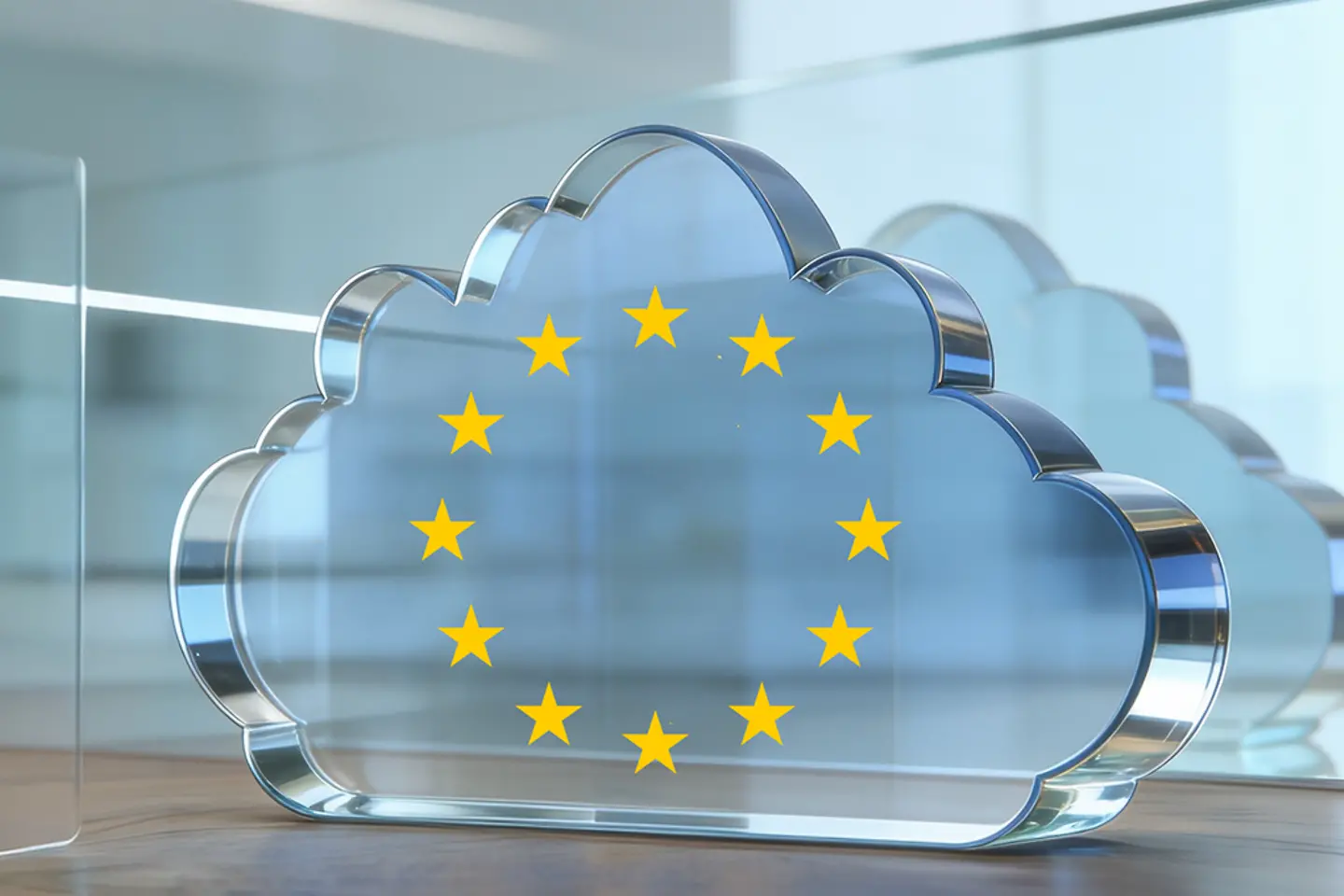
 Image generated with AI
Europe is strong when it acts. When companies and public administrations make concrete decisions. When they regain control, strengthen security, and create genuine freedom of choice. For too long, we have been discussing how dependent we have become on key digital technologies. Now begins the phase in which these dependencies are practically reduced.
This is exactly what we are experiencing right now: in industry, in public administration, among global corporations, in governments, authorities, and mid-sized companies. Particularly where sensitive data is processed—in critical infrastructures, in healthcare, in public administration, in manufacturing, and in mobility. I call this the emancipation of Europe.
Emancipation does not mean isolation. Nor does it mean turning away from technology partners in other parts of the world. On the contrary: cooperation, open ecosystems, and access to the best technologies remain crucial. At the same time, Europe must once again be able to determine for itself where data is stored, who operates systems, which legal framework governs them, and which dependencies we are willing to accept.
Sovereignty means freedom of choice. And freedom of choice is only genuine when a European option is also available.
A current example of this is Volkswagen. Together with us, the Group is building its new Group Private Cloud. It is intended to become a central infrastructure for applications across all Volkswagen Group brands. New IT applications will find their home there in the future. In the long term, many existing applications are also set to migrate to this cloud. This is more than an IT project. It is a strategic signal.
Volkswagen produces, develops, and sells in Europe, China, the United States, and many other markets. Data is generated everywhere in this process: production data, customer data, research data, measurement data, development data. This data has long since ceased to be merely a by-product of digitalization. It is part of the value chain, a trade secret, a competitive factor—and, in a geopolitically uncertain world, also a risk.
For global companies, this raises a new question: what happens when data flows are blocked? Or when sensitive information resides in legal jurisdictions where other states have the ability to gain access?
Volkswagen has found a clear answer to this: a second, sovereign data world. This is not a rejection of public clouds and not a blanket departure from hyperscalers. It is an additional infrastructure for particularly important and sensitive applications. A data island with drawbridges: connected when it makes sense—isolated when it is necessary.
This is the essence of modern sovereignty. Not everything needs to be in a private cloud. What matters is that critical systems can reside where companies retain control over data, operations, and the legal framework. Volkswagen therefore reviews its systems according to their criticality. For particularly important applications, data must be stored in Europe. That is precisely why the Group Private Cloud is being implemented.
Sovereignty therefore does not begin with ideology. It begins with a sober risk analysis: Which data is critical? Which applications are business-critical? Which dependencies are acceptable—and which are no longer? Anyone who answers these questions honestly will quickly arrive at the conclusion: Europe needs its own high-performance cloud options.
What is needed is an infrastructure for critical applications, controllable data locations, and transparent security standards. It must fit into existing IT landscapes, modernize them step by step, and at the same time open up a perspective for AI.
Volkswagen has chosen our T Cloud as the central platform in this context. It forms the technological foundation for the VW Group Private Cloud and is being built and operated in existing Volkswagen data centers. Volkswagen uses the capacities exclusively and can transfer them into its own ownership if needed.
This gives Volkswagen more than just technical control. The group is also strengthening its economic sovereignty. Anyone with their own sovereign cloud alternative negotiates differently with external providers. They are no longer without alternatives and can make differentiated decisions about which workloads belong in a public cloud, which belong in a private cloud, and which need to be particularly protected.
Volkswagen also takes a differentiated approach geographically. The group’s IT landscape is divided into regions—Europe, the USA, the Americas excluding the USA, China, and Asia excluding China. Where the legal situation permits, separate private clouds are to be established, tailored to the respective legal and technical requirements. The rollout begins at existing data centers in Wolfsburg and Ingolstadt, followed by an expansion into Asia.
Sovereignty is therefore not the same everywhere. It must align with the market, the legal system, and the level of risk. Customers therefore do not need a one-size-fits-all solution, but a cloud portfolio with different levels of sovereignty.
And this example dispels an old misconception: many still believe that sovereignty is automatically more expensive. That is not the case. With our T Cloud, we combine lower costs with greater independence and greater security. We can even undercut many hyperscaler cloud offerings on price.
For me, the key point is this: Sovereign cloud is not a step backward into the romance of on-premises data centers. It is modern cloud—but with control. It combines industrial performance with European reliability.

Sovereign cloud is not a step backward into the romance of private data centers. It is modern cloud—but with control. It combines industrial performance with European reliability.
The second example comes from public administration. Here, too, we are witnessing a turning point. T-Systems is bringing sovereign cloud infrastructure to German public administration with T Cloud. Our T Cloud is part of the framework agreement for cloud and AI services awarded by GovTech Deutschland.
This may sound technical at first. In reality, it is very concrete: federal, state, and local authorities will be able to procure cloud and AI infrastructure simply and directly in the future—without lengthy individual procurement processes and under clearly defined conditions. For procurement officers and IT decision-makers in public authorities, this represents a paradigm shift. It is about access instead of effort, speed instead of paperwork, and reusable platforms instead of individual solutions.
That is precisely what public administration needs. Digitalization must not start from scratch every time. If one agency develops a good digital solution, another agency should not have to build it all over again. This requires standardized, modular, and secure runtime environments. The GovTech Framework creates this foundation.
The German state should not only demand digital sovereignty, but actively drive and leverage it: with local data centers, European cloud infrastructure, clear standards for security, data protection, and operations, as well as platforms that make applications in public administration scalable.
As a final example: Andorra. Government and public authorities will in future only be permitted to obtain cloud services from selected providers. We at T-Systems are certified with our T Cloud as the only European provider.
That, too, is a strong signal! Digital sovereignty does not only affect large countries. It is equally important for smaller states that want to modernize their administration, strengthen their economy, and protect their technological autonomy.
Andorra Digital recognizes T Cloud as a sovereign, secure, and interoperable cloud solution that meets European standards for data protection, business continuity, and service quality. The goal is clear: public administration and businesses should be able to use a cloud infrastructure that is resilient, data protection-compliant, and high-performing at the same time.
This is not about symbolic politics, but about concrete digitalization: Infrastructure-as-a-Service, Platform-as-a-Service, Managed Storage, databases, security, identity management, consulting, support, maintenance—complemented by data, analytics, AI, and infrastructure management. This is how digital capability is created.
A pattern emerges from these concrete projects: Volkswagen in industry. GovTech Deutschland and Andorra Digital in public administration. They all demonstrate: sovereign cloud is no longer a niche topic. It is becoming the foundation of strategic decisions.
This is not about locking out hyperscalers. That would be wrong. The major platforms have enormous innovative power. Many companies will continue to use them. We also work with leading technology partners. But the era of having no alternative must come to an end.
Europe needs a both/and approach: the performance of global ecosystems and its own European offerings. Public cloud, private cloud, hybrid cloud, and multi-cloud must work together. Open architectures, interoperability, and the ability to choose the appropriate level of sovereignty depending on the criticality of data and processes will be decisive.
For some workloads, a classic public cloud is sufficient. Others require additional controls. Particularly critical applications belong in a private cloud or in a sovereign public cloud within the European legal framework. What matters is: the customer must have the freedom to choose.
The cloud market is one of the most important technology markets of our time. Cloud is the foundation for AI, automation, digital administration, and industrial competitiveness. Those who lack control here lose room to shape the future.
That is why Europe can no longer afford to be just a user. We must become shapers again: building infrastructures, developing partner ecosystems, and making technologies operational. Not at some point in the future, but now!
The coming years will determine whether Europe continues to merely keep pace in cloud and AI—or actively helps shape it once again. Volkswagen, GovTech, and Andorra show that the change has begun. Europe is emancipating itself digitally. Not against others. But for itself.