
Emergency medicine is the ultimate stress test for any technology. Nowhere is the pressure higher than in the trauma bay—the central treatment area of an emergency department. Here, time pressure, complexity, and responsibility converge. Within minutes, interdisciplinary teams must identify, prioritize, and treat life-threatening injuries. Communication happens almost entirely verbally while diagnostics and treatment begin simultaneously. In such situations, digitalization cannot mean more forms or administrative workflows. What matters is cognitive support in extreme situations. This is exactly where the next evolution of artificial intelligence (AI) begins: agent-based systems that do more than document—they understand, structure, and prioritize information.
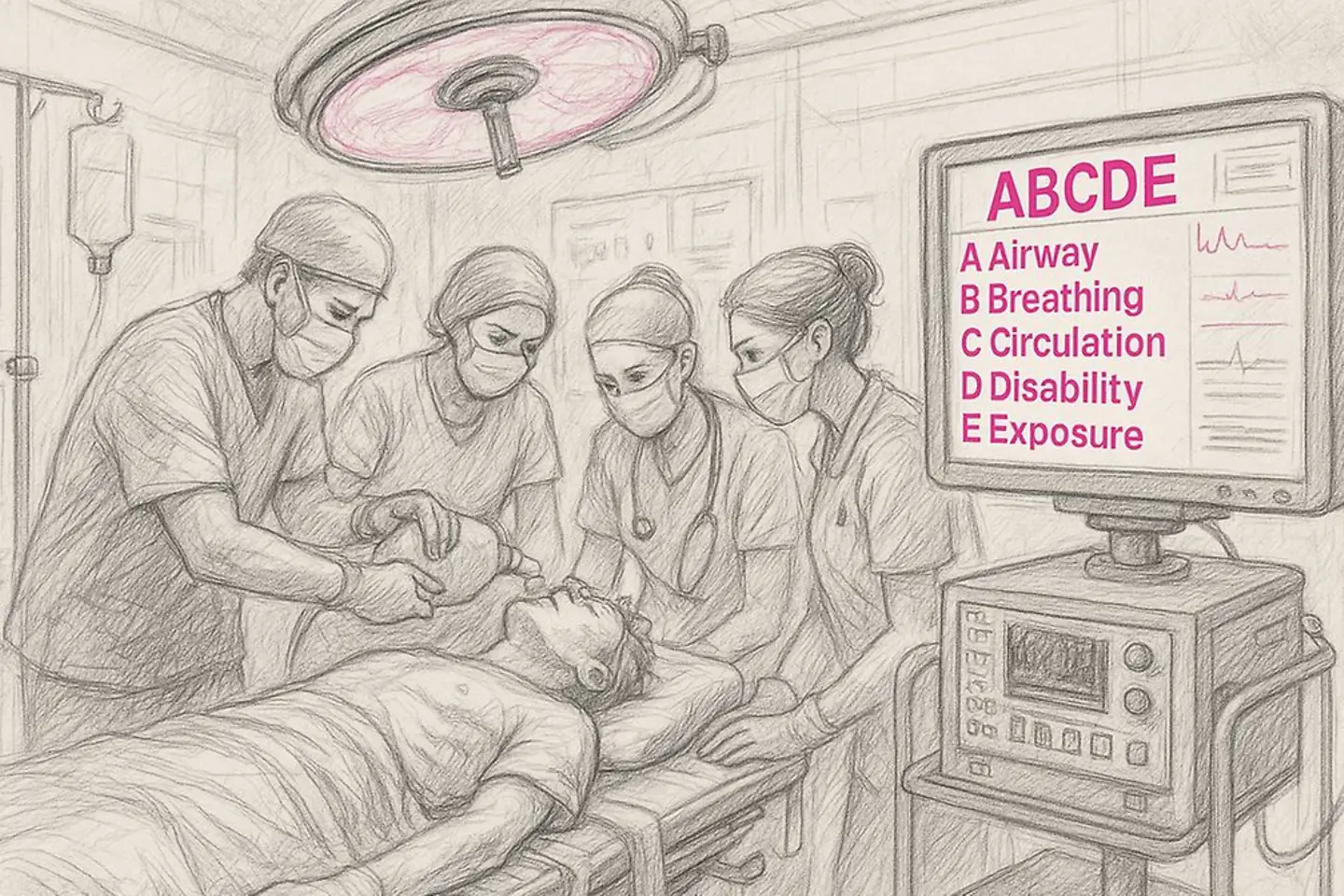 Image generated with AI
© Image is generated with AI
Trauma care follows the internationally established ABCDE protocol. First the airway is secured (Airway), followed by breathing and circulation (Breathing, Circulation). Neurological status is assessed next (Disability), and finally the entire body is examined to gather additional information (Exposure). This structured approach forms the backbone of trauma care.
At the same time, trauma teams experience what can be described as “information bursts”— findings, interventions, and decisions are communicated rapidly and often simultaneously. During these moments, cognitive load increases dramatically. Research and practical experience show that these situations are exactly when the risk of information loss and poor prioritization increases.
An AI agent can help. By transcribing conversations in the trauma bay in real time, analyzing them semantically, and structuring them along the ABCDE framework, it can reduce the cognitive load for the medical team.
The system recognizes references to breathing sounds, blood pressure readings, or anticoagulant medication. It assigns them to the appropriate clinical priorities and visualizes the current status in a structured live display.
Fragmented communication becomes a coherent operational picture. The AI effectively acts as a digital co-pilot, maintaining situational awareness while the medical team focuses on patient care.
This capability is powered by modern language models based on the Transformer architecture. These machine-learning models are specifically designed to process natural language. They can analyze large volumes of information in context and identify complex relationships. Unlike traditional rule-based systems, transformer models can adapt to new situations. This adaptability is essential in emergency medicine. No two trauma cases are the same. Injury patterns, pre-existing conditions, medications, and situational factors vary widely. A rigid decision tree would quickly reach its limits. The solution therefore combines Transformer-based transcription models with reasoning models. For specialists: the live documentation is generated by an AI agent running on an NVIDIA DGX Spark system.
However, AI in the trauma bay must not be a black-box experiment. It must be explainable, robust, and reliable. For this reason, the system is developed through an iterative, simulation-based process closely aligned with clinical practice. Realistic trauma simulations generate training data and allow the AI to be tested in controlled environments. Only once it performs reliably under near-real conditions will it gradually be introduced into clinical workflows.
Another key benefit lies in automated documentation. Treating severely injured patients generates extensive documentation requirements—from hospital quality processes to national trauma registries. Today, these tasks consume valuable time from highly trained professionals.
An AI agent can extract relevant information directly from the transcript and automatically populate structured forms. This reduces administrative workload and improves data quality, because information is captured directly during the treatment process.

AI in the trauma bay must not be a black-box experiment. It must be explainable, robust, and reliable.
In emergency medicine, performance alone is not enough. Systems must meet the highest standards for data protection, resilience, and availability. A solution that depends entirely on a stable Internet connection would pose a risk in critical situations. That is why the architecture is designed as a cloud-edge continuum. The AI can run locally within the hospital on dedicated hardware—fully offline and independent of external infrastructure. At the same time, integration with a sovereign European cloud enables scalable operation, model training, and secure data processing according to European standards. This combination of edge capability and cloud integration ensures resilience while maintaining digital sovereignty.
This brings us to the project that reflects this strategic ambition. Deutsche Telekom, the Fraunhofer Institute for Intelligent Analysis and Information Systems IAIS, and Merheim Hospital, part of Kliniken der Stadt Köln, have joined hands for this project. Within the European IPCEI-CIS program, the partners are developing an AI-supported live display for trauma care based on realistic simulation scenarios. What is emerging is more than a medical application. It is a model for secure AI infrastructures in Europe. Modular software components, agent-based frameworks, lightweight edge models, and automated training pipelines can be applied to other safety-critical environments—from critical infrastructure to industrial operations. In this sense, the trauma bay becomes a driver for a sovereign and trustworthy AI ecosystem in Europe.
At the same time, organizations are rethinking how AI is used. The shift is moving away from isolated tools towards integrated assistance systems that support real-world processes. The key principle is: technology must adapt to clinical workflows—not the other way around. Introducing such systems therefore requires more than technical excellence. It requires change management, training, and clear governance structures. Acceptance grows when AI is perceived as a tool that expands professional capabilities rather than restricting them. Demographic trends and increasing medical complexity will further strengthen the need for cognitive support. Older patients with multiple chronic conditions and complex medication regimens place increasing demands on diagnostics and decision-making. AI can help by making knowledge available in context and providing structured decision support—without replacing medical responsibility.
To further develop the advanced language models—often referred to as Large Language Models (LLMs)—used in the trauma-bay agent, we will also leverage our Industrial AI Cloud. With the launch of the first AI factory for industry in Munich, we—together with SAP, Siemens, and additional partners—are building a technology stack “Made in Germany”. This stack integrates connectivity, operations, AI infrastructure, and platform- and software-as-a-service offerings. Our T Cloud infrastructure provides a secure, sovereign, and scalable foundation. The project will also benefit from significant AI computing power, including 10,000 NVIDIA GPUs of the latest Blackwell generation.
Looking ahead, the trauma-bay agent is planned to become a part of our Magenta AI Health Box platform.
The Magenta Health AI Box is a sovereign AI platform designed for hospitals and health insurers. It combines applications such as AI Receptionist and Patient Summary with open data integration and secure T-Cloud infrastructure. Rather than relying on isolated point solutions, the platform offers a modular system for automation, documentation, and decision support—fully GDPR-compliant and scalable.
Another promising application of AI in healthcare is our “Talk to your data” platform. The solution enables direct access to knowledge across distributed data sources. An AI agent searches, links, analyzes, and visualizes data—making information accessible through a simple chat interface. Early pilot projects demonstrate the potential. Analyses that once required up to six hours can now be completed in less than one hour.
The benefits are particularly visible in hospitals. Diagnoses, lab results, medication plans, and clinical reports often reside in different systems. With “Talk to your data”, physicians can query this information directly, visualize patient histories, and identify correlations. The AI can also highlight inconsistencies—for example, when laboratory values do not match the documented treatment.
Technologically, the solution is based on the Agentic AI platform of T-Systems and its AI Foundation Services. Sensitive data remains protected: the platform runs entirely within the T Cloud infrastructure, ensuring full data sovereignty.
One thing is clear: AI does not save lives on its own. But it can create the conditions that enable better decisions in critical moments. If agent-based systems can be safely integrated into highly critical environments such as the trauma bay, the result will be more than a new application. It will mark a shift from reactive documentation to proactive, intelligent assistance. And that is where the true transformative potential of AI lies.