Germany's hospitals are under enormous pressure: rising patient numbers, a shortage of skilled workers, and economic challenges are meeting an increasingly ageing population. At the same time, international experience shows that in certain cases patients can be safely treated at home. Hospital at Home opens up new possibilities for this—when medical, organizational, and digital processes work together.
Hospital at Home is far more than a concept for the future: international studies show that selected patients can be safely treated at home today—with at least comparable clinical outcomes and in some cases economic advantages. A US study found, for example, 38 percent lower direct costs for acute episodes and a 30-day readmission rate of 7 percent instead of 23 percent.1
Established programs in Europe and Australia also demonstrate how Hospital at Home can be scaled. In Barcelona, the model was initially reimbursed at a flat rate of 918 euros per patient, compared to costs of 2,879 euros for conventional hospital treatment—with a satisfaction rate of 98 percent.2 In the Australian state of Victoria, Hospital at Home has already reached a scale equivalent to a hospital with 500 beds.
This care model is fundamentally different from traditional home care or outpatient care. While the latter supports people primarily with nursing tasks and in everyday life, Hospital at Home transfers selected services—which would otherwise require a hospital stay—entirely to the home setting. The patient's own home temporarily becomes the place of treatment, while clinical responsibility remains with the hospital.
International results highlight the model’s potential, but differences in healthcare and reimbursement systems limit their direct applicability to Germany. The evidence is particularly robust for carefully selected patient groups and models with strong clinical and personal care. A platform with wearables and a dashboard alone does not therefore make a virtual care unit.
For patients, Hospital at Home means more than a change of location. They can live in their familiar surroundings during treatment while remaining closely connected to the hospital. The prerequisite is that the home situation allows for safe care. Family members must also be taken into account: they can provide support, but must not become a substitute for professional medical or nursing services.
While the healthcare systems of other countries have already firmly established Hospital at Home, Germany is still at the beginning. The legal foundations for inpatient-equivalent care exist in principle: under Section 39 SGB V, it is a form of hospital treatment. However, it has so far been regulated primarily in psychiatry. For somatic acute care, a nationwide standard reimbursement pathway is lacking.
Clinics do not, however, need to wait for future standard care regulations. Various funding routes are already available today. These include, in particular, selective contracts within the framework of special care under § 140a SGB V, pilot schemes, and the Innovation Fund, as well as hospital-specific fees under § 6 KHEntgG. For models involving early discharge, pre- and post-inpatient services may also play a role.
This makes financing itself a part of the operating model. Clinics must clarify early on which patient groups and services are included, which partners are needed, and how staffing, logistics, technology, and care costs are financed.
International experience shows that the model can indeed offer economic advantages; yet savings on beds or individual treatment episodes alone do not constitute a business case. Staffing and logistics costs, technical infrastructure, reimbursement, as well as avoided admissions and readmissions must be considered together. International benchmarks provide orientation, but cannot be transferred directly to the German healthcare system.
The decisive question is therefore no longer solely whether Hospital at Home is possible in Germany. Clinics must decide under which medical, organizational, and economic conditions they can build a viable model.
Hospital at Home should not begin as an IT project, but as a new clinical care model. The central prerequisites for Hospital at Home include appropriate patient selection, a safe home environment, clearly defined clinical responsibility, available medical and nursing resources, functioning care logistics, and interoperable digital systems.
Rather than immediately including as many patient groups as possible, a focused entry with standardizable indications is recommended. These can include, for example, selected infections, COPD, heart failure, or geriatric conditions. An individual clinical suitability assessment remains a prerequisite. The home situation itself is also relevant: Is safe treatment possible? What support is needed? And what role can family members take on?
Home-based care does not end with digital contact. Medications, infusions, oxygen, diagnostics, point-of-care diagnostics, medical devices, and transport must be reliably available. Medical professionals must be able to conduct a home visit when needed. If a patient's condition deteriorates, a clearly defined and rapid pathway back to the hospital is required.
Medical responsibility remains at hospital level. Clear responsibilities, regular medical and nursing assessments, and defined escalation pathways are therefore essential. Televisits can complement personal contacts, while telemonitoring and digital monitoring help to detect relevant changes at an early stage.
The treatment pathway must not disappear from the clinic's IT system at the front door—data from telemonitoring, televisits, diagnostics, and home visits must flow into clinical processes without media discontinuities. Interoperability and data sovereignty become additional strategic prerequisites with regard to the electronic patient record and the European Health Data Space.
What matters is not solely the bed days saved. Clinics should record treatment outcomes, readmissions, escalations, patient experience, costs per episode, and avoided hospital admissions. Only when clinical quality, safety, and economic viability are sound should the model be expanded to additional indications and patient groups.
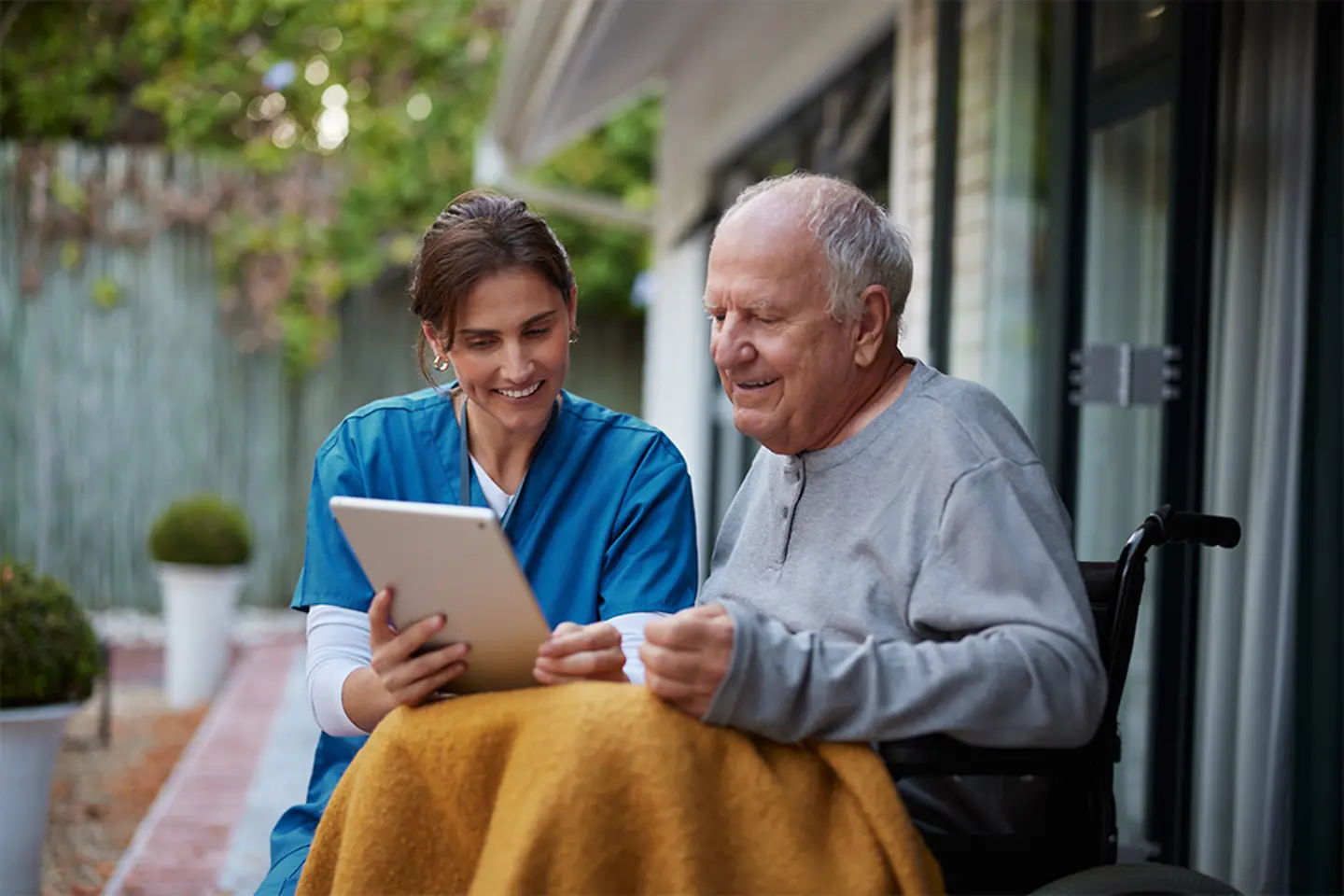
After being admitted to a Hospital at Home programme, the hospital remains responsible for the treatment. The patients are at home, but continue to be cared for according to a defined clinical treatment pathway. Medical and nursing professionals visit them at home depending on their individual needs.
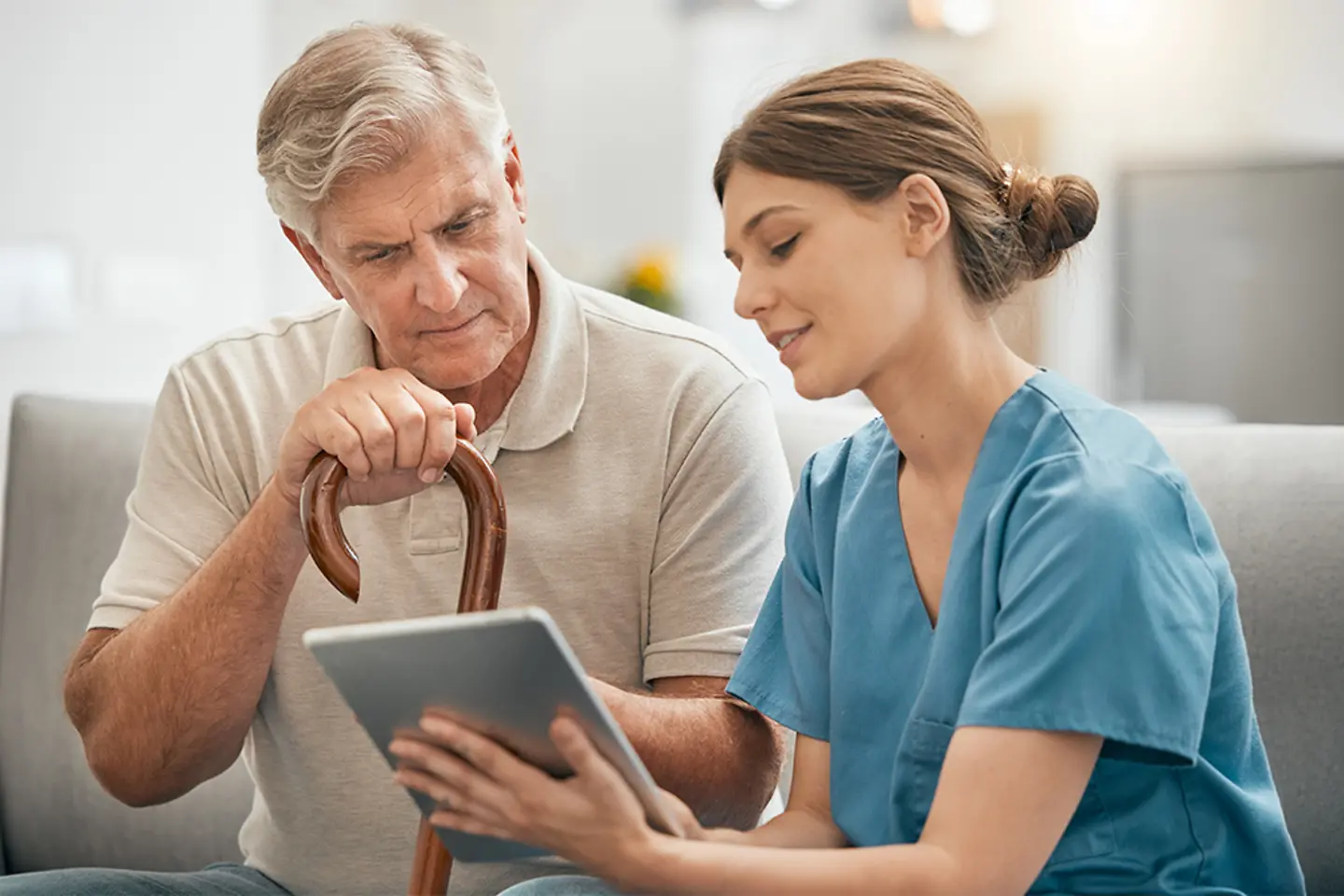
Digital technologies complement personal care. In telemonitoring, relevant health and vital data is recorded and made available to the treatment team. Digital monitoring can help detect changes at an early stage. Televisits additionally enable direct exchange with medical professionals from a distance.
If measurements or the condition of a patient show abnormalities, defined escalation processes are triggered. Depending on the situation, a televisit, an additional home visit, diagnostics, or a transfer back to the hospital may become necessary.
This is what fundamentally distinguishes Hospital at Home from a purely telemedicine offering: digital applications complement personal medical and nursing care—but do not replace it.
Telemonitoring, televisits, and digital monitoring form only a part of a much larger system. What is decisive is how medical responsibility, staffing, logistics, technology, and external care partners are connected into a robust overall process.
Not every service needs to be provided by the hospital itself. General practitioners, outpatient care services, laboratories, pharmacies, emergency services, and other partners can be a part of this model. Clear responsibilities are key to this:
This organization is also crucial in addressing the shortage of skilled workers. When implemented correctly, Hospital at Home can relieve the burden on nursing staff. Consolidated visit routes, televisits, and centralized monitoring can replace a part of the permanent presence at the hospital bedside with plannable deployments, while simultaneously relieving pressure on the wards. Without well-thought-out staffing, route, and visit planning, however, home-based care can instead generate additional workload.
The business case must therefore go beyond the number of bed days avoided. Staffing and logistics costs, technical infrastructure, costs per treatment episode, as well as avoided admissions and readmissions must be considered alongside clinical quality, safety, and patient satisfaction.
The more care is shifted from the hospital to the home, the more important a seamless data architecture becomes. Monitoring data, diagnostics, medical documentation, and information from home visits must be securely available and capable of being integrated into existing clinical processes. Isolated solutions, by contrast, make scaling more difficult.
This is precisely where T-Systems comes in. The Medical Command Center can support monitoring, alerting, and the central management of distributed patients. Tele Live Assessment and Tele Remote Assessment enable medical assessments from a distance. Solutions for Remote Patient Monitoring and connectivity create further prerequisites for networked care—even outside of metropolitan areas.
A vendor-neutral data foundation connects home-based care with clinical systems. synedra AIM, for example, can consolidate multimodal data such as images, findings, documents, videos, and monitoring data. iMedOne and mobile applications help ensure that treatment is documented outside the hospital as well and remains visible to the healthcare professionals involved.
Added to this are T Cloud for Health, TI-Connect, TI-Messenger, as well as connectivity to the electronic patient record and digital identities. Cybersecurity and compliance solutions protect distributed care. Consulting ultimately supports hospitals in bringing together governance, architecture, and business case.
T-Systems therefore does not simply deliver individual technologies for home-based care. The goal is a sovereign, interoperable, and controllable digital foundation for a viable clinical operating model—so that Hospital at Home can evolve from a pilot project into a scalable form of care.
Hospital at Home refers to a care model in which eligible patients receive inpatient or inpatient-equivalent services in their own home. Medical responsibility, diagnostics, therapy, and defined escalation pathways remain in place. Telemonitoring and televisits can support the care provided.
Hospital at Home is suitable for carefully selected patients whose health condition allows for safe treatment at home. International programs treat, for example, certain infections, COPD, heart failure, or geriatric patients. Clinical instability, on the other hand, is a clear exclusion criterion.
Home-based care can avoid or shorten hospital stays and enable patients to receive treatment in their familiar surroundings. International studies on Hospital at Home show, for suitable patient groups, among other things comparable clinical outcomes, high satisfaction, and in some cases fewer readmissions and lower costs.
In telemonitoring, relevant health and vital data of patients outside the hospital is recorded and made available for medical care. Digital monitoring can help detect changes at an early stage. However, it replaces neither clinical responsibility nor defined processes for home visits or a possible transfer back to the hospital.
In telemonitoring, health data is recorded and monitored remotely. A televisit, on the other hand, enables direct medical or nursing exchange with patients from a distance. In Hospital at Home, both instruments can be combined to continuously support care at home.
For somatic Hospital at Home, there is currently no nationwide standard reimbursement pathway in Germany. Possible financing routes include, among others, special care under Section 140a SGB V, hospital-specific fees under Section 6 KHEntgG, as well as pilot projects, and the Innovation Fund. Pre- and post-inpatient treatment can also play a role in models involving early discharge.
A viable operating model is crucial. This includes appropriate patient selection, clear clinical responsibilities, 24/7 escalation pathways, and reliable logistics for medications, diagnostics, and medical devices. Equally important are interoperable IT systems and the networking of clinics, general practitioners, as well as care and emergency services.
Hospital at Home is not to be equated with conventional home-based care. In Hospital at Home, certain inpatient or inpatient-equivalent medical services are transferred to the patients' homes. Clinical responsibility remains with the hospital. Home-based care, by contrast, primarily supports nursing tasks and the management of daily life.
1 David M. Levine, Kei Ouchi, Bonnie Blanchfield et al.: Hospital-Level Care at Home for Acutely Ill Adults: A Randomized Controlled Trial, randomized controlled trial, January 2020, Annals of Internal Medicine, Volume 172, Issue 2, pages 77–85.
2 Carme Hernández, Jesus Aibar, Nuria Seijas et al.: Implementation of Home Hospitalization and Early Discharge as an Integrated Care Service: A Ten Years Pragmatic Assessment, prospective pragmatic study, May 2018, International Journal of Integrated Care, Volume 18, Issue 2, Article 12.