Every growth strategy eventually runs into operational complexity. As organizations expand across markets, systems, and business models, siloed processes can slow decision-making and innovation. Cloud ERP (Enterprise Resource Planning) addresses this challenge by creating a connected enterprise core that delivers real-time insights, greater resilience, and the flexibility to evolve with changing business demands.
Cloud ERP software is an enterprise resource planning system delivered through cloud infrastructure, providing a unified platform for managing several business functions such as finance, supply chains, and business data. As organizations scale across markets, products, and digital channels, managing business processes through disconnected systems becomes increasingly difficult. Cloud ERP addresses this challenge by bringing critical functions together on a single, cloud-powered platform that provides real-time visibility and greater operational agility. According to McKinsey, the underlying market for cloud infrastructure is projected to reach $3.4 trillion by 20401. For modern enterprises, cloud ERP is no longer just a technology upgrade. It is the digital foundation for operational excellence, enabling faster decisions, and continuous business transformation.
Cloud ERP reaches its full potential when paired with modern cloud services that provide scalability, security, and innovation. While ERP serves as the operational core of the business, cloud services strengthen the infrastructure, platform capabilities, data management, and governance frameworks needed to keep that core agile and future-ready. This combination is becoming increasingly important as organizations pursue artificial intelligence (AI), automation, and data-driven decision-making. For CIOs and digital transformation leaders, the conversation is no longer about migrating ERP to the cloud. It is about building an intelligent enterprise foundation where cloud ERP, infrastructure, analytics, security, and AI services work together to accelerate operational excellence, business resilience, and sustainable growth.
Cloud ERP programs succeed when people, processes, and technology move together. Even the most advanced platform will fall short if teams do not understand why the change is happening, how their daily work will improve, and what support is available during the transition. Organizations should treat adoption as a core workstream, not a post-go-live activity. This means appointing executive sponsors, involving process owners early, building a network of super users, communicating business benefits in plain language and creating role-based training for finance, procurement, supply chain, operations and service teams. A practical adoption plan should also measure progress. Useful indicators include training completion, process usage, data quality, ticket volumes, time-to-close for critical workflows and user feedback after go-live. These signals help leaders identify where teams need further support and where business processes require refinement.
ERP has long been the operational backbone of organizations, connecting finance, procurement, manufacturing, supply chains, customer service, and workforce management. Yet many organizations continue to rely on fragmented, aging systems that struggle to keep pace with modern business requirements. As markets become more competitive and customer expectations continue to rise, business leaders increasingly need real-time visibility across the enterprise. Cloud ERP systems address this challenge by bringing critical business functions together within a single, connected environment that can be accessed securely from virtually anywhere. Unlike traditional ERP environments that often require extensive infrastructure management and lengthy upgrade cycles, cloud ERP provides continuous access to modern capabilities. Organizations can benefit from integrated workflows, centralized data, and automated processes that reduce manual effort and improve consistency across departments. These advantages extend beyond operational efficiency. By creating a unified source of business information, cloud ERP enables decision-makers to respond faster to emerging opportunities, changing market conditions, and supply chain disruptions.
Cloud ERP helps organizations improve collaboration. Teams that once operated within departmental silos can work with the same data, processes, and performance metrics. Whether supporting global manufacturing operations, multinational finance organizations, or complex distribution networks, cloud ERP provides a shared operational foundation that supports business alignment. This improved transparency often leads to better planning, stronger governance, and more effective execution of business strategies. Perhaps most importantly, cloud ERP transforms ERP from a static system of record into a dynamic platform for continuous innovation. Organizations can take advantage of emerging technologies such as AI, machine learning, predictive analytics, and process automation without rebuilding their ERP environment. As a result, cloud ERP becomes an essential enabler of digital transformation rather than simply a tool for transaction processing.
For many organizations, ERP represents one of the most significant technology investments they will ever make. Yet the value of ERP does not come from software licenses or infrastructure alone. It comes from adoption, process optimization, data quality, and the organization's ability to continuously evolve with changing business needs. Cloud ERP supports greater return on investment by reducing many of the constraints associated with traditional ERP environments. Rather than allocating substantial resources to hardware maintenance, system patching, and infrastructure upgrades, organizations can focus their efforts on improving business processes and delivering measurable outcomes. This shift enables IT teams to spend less time maintaining systems and more time supporting strategic initiatives.
Business environments rarely stand still. New competitors emerge, customer demands evolve, regulatory requirements change, and economic conditions fluctuate. As a result, organizations increasingly require technology platforms that can adapt at the same speed as the business itself. A cloud-based ERP system provides this flexibility. Because infrastructure resources can be scaled according to demand, organizations are better positioned to support growth, expansion, seasonal fluctuations, and new business models. Whether entering new markets, launching new product lines, or integrating acquisitions, cloud ERP can support change without requiring extensive infrastructure investments.
In today's competitive landscape, speed has become a strategic differentiator. Organizations that can identify trends earlier, act on insights faster, and respond to disruption more effectively often outperform their competitors. Cloud ERP enables this speed by centralizing data and providing real-time access to key operational information. Instead of relying on disconnected systems, spreadsheets, and delayed reporting cycles, organizations can work from a consistent and current view of business performance. Finance teams can close reporting periods faster. Supply chain teams can respond more effectively to fluctuations in demand. Operations leaders can identify inefficiencies before they become costly problems.
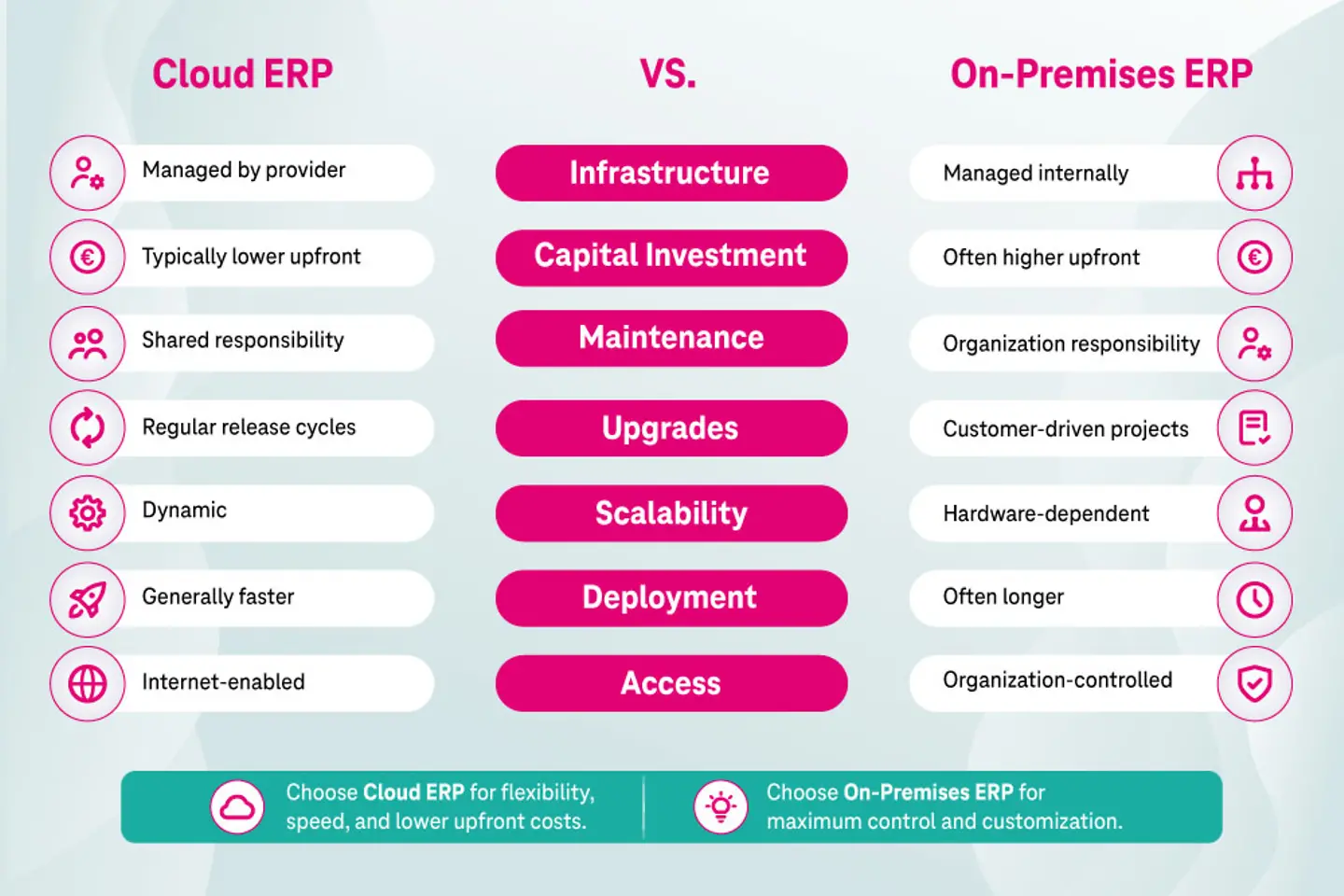
Cloud-based ERP has transformed the way organizations manage core business processes. Instead of maintaining ERP software on local servers, companies access applications through the cloud, allowing employees, partners, and decision-makers to work from anywhere with an internet connection. This approach provides flexibility, scalability, and continuous innovation while reducing the burden of managing infrastructure. Traditional on-premises ERP systems are installed and operated within an organization's own data center. Businesses purchase licenses, invest in hardware infrastructure, and assume responsibility for system maintenance, updates, backups, security controls, and performance optimization.
Organizations are increasingly adopting cloud ERP solutions to support digital transformation initiatives, improve business agility, and accelerate innovation. Cloud platforms enable businesses to connect finance, supply chain, production, customer service, procurement, and analytics in a unified environment. The result is improved visibility across operations and faster access to the insights needed for strategic decision-making. For enterprises pursuing modernization, cloud ERP offers a future-ready foundation that can evolve alongside changing business requirements. As markets become more dynamic and customer expectations continue to rise, organizations need systems capable of adapting quickly without extensive disruption. Cloud ERP delivers that flexibility while ensuring continuous access to new technologies and business capabilities.
While on-premises ERP solutions can provide a high degree of customization and direct control over infrastructure, they often require significant financial investment and dedicated IT resources. Managing servers, storage, networking equipment, and software upgrades can consume time and budget that could otherwise be directed toward innovation and growth initiatives. Many organizations continue to rely on on-premises ERP systems because of historical investments, industry-specific requirements, or legacy integrations. However, as businesses seek greater agility and scalability, the limitations of traditional infrastructure become increasingly apparent. Long implementation cycles, complex maintenance requirements, and costly upgrade projects can create barriers to digital transformation.
One of the most significant differences between cloud ERP and on-premises ERP lies in operating costs. On-premises environments typically involve high upfront investments in hardware, infrastructure, software licenses, and implementation services. Businesses must also budget for ongoing maintenance, security, upgrades, and IT staffing requirements. Cloud ERP solutions generally operate on a subscription-based model, allowing organizations to spread costs over time while reducing capital expenditures. Infrastructure management responsibilities are shared with the cloud provider, enabling businesses to focus resources on strategic initiatives rather than routine system administration.
Upgrading traditional ERP systems can be a complex, time-consuming process that requires extensive planning, testing, and business disruption management. In many cases, organizations postpone upgrades because of the associated cost and risk, resulting in outdated systems that lack modern functionality. Cloud ERP dramatically simplifies this process. Updates are delivered regularly by the provider, ensuring that organizations benefit from the latest innovations, security enhancements, and performance improvements without large-scale upgrade projects. This continuous innovation model allows businesses to remain competitive while minimizing disruption.
Modern cloud ERP platforms are designed to provide consistent performance regardless of user location. Employees, suppliers, customers, and business partners can access critical information through secure web interfaces, supporting remote work, hybrid operations, and global collaboration. Cloud environments are optimized to handle fluctuating workloads, ensuring reliable performance during periods of increased demand. Automated resource allocation enables organizations to maintain responsiveness while avoiding the costs associated with overprovisioning infrastructure. Easy accessibility also improves productivity. Employees can access real-time information from multiple devices, accelerating decision-making and enabling faster responses to business challenges. Whether working in the office, at a customer site, or remotely, users remain connected to the systems and data they need.
Implementing an on-premises ERP system often involves purchasing hardware, configuring infrastructure, and completing extensive installation processes before users can begin working with the system. These activities can extend project timelines significantly. Cloud ERP solutions reduce deployment complexity by eliminating much of the underlying infrastructure setup. Organizations can focus on business process design, data migration, and user adoption rather than managing servers and hardware procurement. Rapid deployment enables businesses to realize value faster. New locations, departments, or business units can be onboarded more quickly to support growth initiatives and accelerate digital transformation programs. This speed-to-value is a critical consideration for organizations seeking to remain competitive in rapidly changing markets.
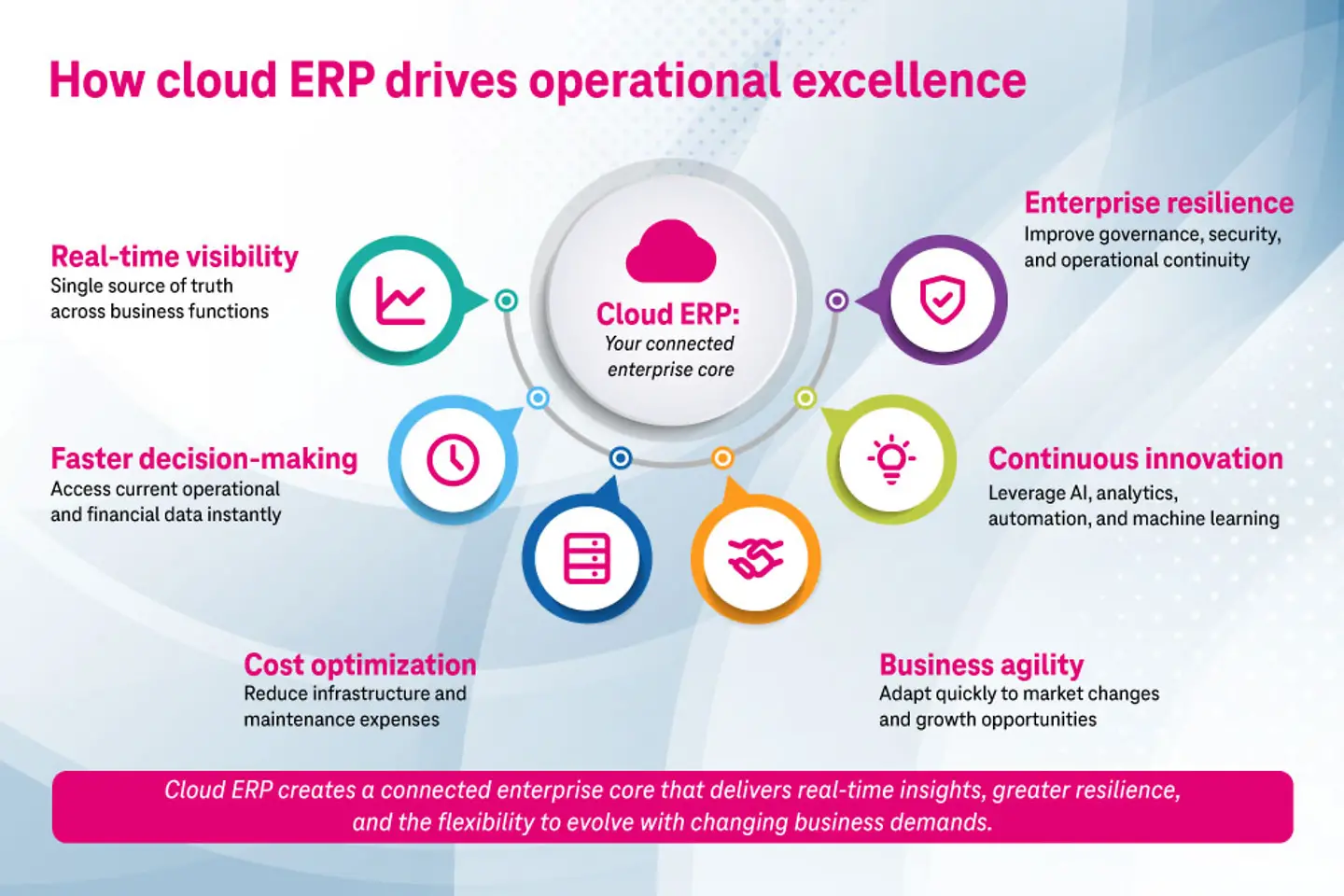
Cloud ERP has emerged as a strategic enabler for organizations seeking to reduce costs, increase operational agility, and support long-term business growth. Unlike traditional ERP environments that often require substantial investments in hardware, infrastructure, and ongoing maintenance, cloud ERP provides a flexible, subscription-based model that aligns technology costs with actual business needs.
This shift allows organizations to redirect resources from infrastructure management toward innovation, customer engagement, and value-generating initiatives.
One of the strongest business cases for cloud ERP is the potential for cost optimization. Traditional on-premises ERP systems require organizations to purchase and maintain physical servers, networking equipment, storage systems, backup infrastructure, and data center facilities. In addition to these capital expenditures, businesses must allocate resources for software upgrades, security management, disaster recovery, and specialized IT personnel. Cloud ERP significantly changes this financial model. By moving ERP workloads to the public cloud, organizations can replace large upfront investments with predictable operational expenses. Infrastructure management responsibilities are largely shifted to the cloud provider, reducing the need for internal resources dedicated to server maintenance and system administration. As a result, businesses gain greater financial flexibility while lowering the total cost of ownership over the lifecycle of the system.
Public cloud ERP offers organizations access to enterprise-grade technology without the complexity of managing the underlying infrastructure. Businesses can leverage highly resilient cloud environments designed to deliver availability, security, and performance at scale. This enables organizations to focus on optimizing business processes rather than maintaining servers and data centers. A key advantage of public cloud ERP is the ability to access continuous innovation. Cloud providers regularly introduce new capabilities, including advanced analytics, machine learning, workflow automation, and artificial intelligence services. Organizations can adopt these innovations more quickly than they could in a traditional on-premises environment, helping them remain competitive in rapidly evolving markets.
Growth introduces complexity. Expanding into new markets, launching products, increasing transaction volumes, and managing larger workforces all create additional demands on business systems. Cloud ERP is designed to scale efficiently and support these evolving requirements. Modern cloud platforms allow organizations to add users, storage, processing power, and functionality without major infrastructure changes. This scalability enables businesses to grow confidently while maintaining operational consistency across locations and business units. Cloud ERP also supports business innovation by providing access to advanced technologies and integration capabilities. As organizations expand, they can introduce new services, connect additional systems, and automate complex processes without rebuilding their ERP foundation.
Midmarket organizations face unique challenges. They must compete with larger enterprises while operating with limited resources and tighter budgets. Cloud ERP helps level the playing field by providing access to sophisticated business capabilities without substantial infrastructure investments. By adopting cloud ERP, midmarket companies can improve operational efficiency, streamline workflows, and gain greater visibility into business performance. These capabilities enable leaders to make informed decisions and respond more effectively to market opportunities. Cloud ERP also supports future growth by providing enterprise-level functionality that can scale alongside the business. Instead of replacing systems as requirements evolve, organizations can extend and enhance existing capabilities within the same cloud platform.
Cloud ERP systems are suitable for organizations of all sizes across a wide range of industries. Startups benefit from rapid deployment and low initial investments, while midsize businesses gain access to enterprise-grade capabilities that support growth and competitiveness. Large enterprises leverage cloud ERP to modernize operations, standardize processes, and improve global collaboration. Organizations with distributed workforces, multiple locations, or complex supply chains particularly benefit from centralized data and consistent access to information. Businesses pursuing digital transformation initiatives often view cloud ERP as a strategic platform that enables innovation, operational excellence, and long-term resilience in an increasingly digital economy.
A balanced ERP strategy should consider not only the benefits of cloud ERP but also the risks that can affect cost, control, compliance and long-term agility. Addressing these challenges early helps organizations make better vendor decisions and build stronger governance into the program. For SMEs, these risks can be more acute because lean IT teams, limited sourcing budgets and tighter compliance resources leave less room for remediation once a platform decision has been made.
A cloud ERP platform can become difficult to change if business processes, customizations, integrations and data models are tightly tied to one provider. Buyers should evaluate exit options, data export capabilities, integration portability and contractual flexibility before committing. This is particularly important for SMEs, where limited vendor management capacity and smaller integration budgets can make switching providers disproportionately complex and expensive.
Organizations operating in regulated markets must understand where ERP data is stored, processed, backed up and accessed. Data residency, sovereign cloud options, encryption, access controls and auditability should be reviewed during vendor selection. For SMEs without large legal or compliance teams, data sovereignty requirements should be translated into clear residency, backup, access and auditability criteria before procurement begins.
ERP rarely operates alone. Legacy applications, customer platforms, logistics systems, analytics tools and industry-specific applications may require secure, reliable integration. Integration requirements should be documented before choosing a deployment model.
Poor master data can weaken the value of a modern ERP platform. Organizations should cleanse, classify and validate data before migration and define clear ownership for data quality after go-live.
ERP implementation changes how teams work. If communication, training and leadership alignment are weak, employees may return to old workarounds. Adoption should be measured and managed throughout the program.
Subscription fees, add-ons, storage, integrations, customizations and support can increase the long-term cost of ERP. A total cost of ownership model should include implementation, operations, governance and future scaling needs. For SMEs with lean IT budgets, even small add-ons, storage increases, custom integrations or premium support requirements can erode the cost predictability that made cloud ERP attractive in the first place.
Security, compliance, and data protection are among the most critical considerations for organizations evaluating cloud ERP solutions. As ERP systems manage sensitive business information, including financial records, customer data, supply chain transactions, employee information, and operational insights, organizations must ensure that these systems are protected against cyber threats, unauthorized access, and regulatory violations. Modern cloud ERP platforms are designed with security and compliance at their core, offering advanced capabilities that often exceed the protection levels available in many traditional on-premises environments.
SaaS (Software-as-a-Service) ERP is a cloud-based ERP solution that is delivered over the internet and accessed through a web browser. Instead of purchasing, installing, and managing ERP software on company-owned servers, organizations subscribe to the software and use it as a service hosted by the provider. With SaaS ERP, the software provider is responsible for maintaining the infrastructure, managing updates, applying security patches, ensuring system availability, and delivering new features. Businesses simply access the platform online and pay a recurring subscription fee based on users, functionality, or consumption. Organizations use SaaS ERP to manage core business processes such as financial accounting, procurement, inventory management, manufacturing, supply chain operations, human resources, customer relationship management (CRM), and reporting through a unified cloud platform.
In a SaaS ERP model, the ERP application is hosted in secure cloud data centers operated by the software provider. Users log in through a web browser or mobile application to access real-time business data from anywhere with an internet connection. Because the solution is centrally managed, all users work on the same version of the software. Updates, new features, and security enhancements are automatically deployed by the provider, eliminating the need for lengthy upgrade projects and reducing the burden on internal IT teams.
One of the primary advantages of SaaS ERP is reduced upfront investment. Organizations do not need to purchase servers, storage systems, networking equipment, or data center infrastructure. Instead, they pay a predictable subscription fee, improving financial flexibility and reducing capital expenditures. SaaS ERP also offers greater scalability. As business requirements evolve, companies can easily add users, expand storage, introduce new modules, or support additional locations without significant infrastructure investments. Another key benefit is accessibility. Employees can securely access business applications from offices, homes, customer locations, or remote sites, enabling collaboration and supporting modern hybrid work environments.
SaaS ERP is a specific type of cloud ERP delivered as a fully managed, subscription-based service that users access through a web browser. While every SaaS ERP solution operates in the cloud, not every cloud ERP solution follows the SaaS model. Cloud ERP is a broader category that includes public, private, hosted, and hybrid cloud deployments, giving organizations varying levels of control over infrastructure, customization, and management. Let’s understand the difference between SaaS ERP and cloud ERP on a deeper level from the below criteria:
| SaaS ERP | Cloud ERP | |
| Deployment model | Delivered as a fully managed software service over the internet | Can be deployed in public, private, hosted, or hybrid cloud environments |
| Infrastructure | Shared infrastructure managed entirely by the vendor | May use dedicated infrastructure or cloud resources allocated to a specific customer |
| Architecture | Typically multi-tenant, where multiple customers share the same software environment | Can be single-tenant or multi-tenant depending on deployment requirements |
| Customization | Primarily configuration-based with limited code-level modifications | Supports extensive customization, specialized workflows, and deeper application changes |
| Database access | Limited or no direct database access | Greater control over databases and underlying system architecture |
| Updates | Automatic updates are delivered simultaneously to all customers | Updates can often be scheduled, tested, or deferred based on business needs |
| IT management | Minimal internal IT involvement required | Often requires internal or outsourced IT support for administration and integrations |
| Cost structure | Predictable per-user or subscription- based pricing | Costs may vary based on infrastructure, storage, customization, and support requirements |
| Implementation speed | Typically faster deployment with standardized processes | Longer implementation timelines due to customization and configuration needs |
| Scalability | Easily scalable through subscription upgrades | Highly scalable, but may require infrastructure planning and capacity management |
| Maintenance | Vendor handles maintenance, patches, backups, and security | Responsibilities are shared between the provider and customer, depending on the hosting model |
| Best fit | Organizations seeking simplicity, speed, and lower upfront investment | Organizations with complex business processes, compliance needs, or extensive customization requirements |
If your organization is growing rapidly, needs quick implementation, wants to minimize upfront investment, and prefers a standard, best-practice approach to business processes. SaaS ERP is ideal for companies that want automatic updates, reduced IT overhead, and predictable subscription costs while benefiting from continuous innovation delivered by the software provider. Choose Cloud ERP with a private, hosted, or single-tenant deployment model if your organization requires extensive customization, industry-specific business logic, strict regulatory compliance, dedicated infrastructure, or greater control over integrations and data management. This approach is particularly valuable for enterprises with complex operational requirements or legacy systems that cannot easily adapt to standardized software environments. In short, SaaS ERP prioritizes simplicity, speed, and operational efficiency, while private or hosted Cloud ERP prioritizes flexibility, customization, and control.
In a multi-tenant ERP model, multiple customers use the same core application environment while their data remains logically separated. The provider manages shared infrastructure, updates and capacity across customers, which can support standardization, efficient scaling and faster access to new features. In a single-tenant ERP model, one customer uses a dedicated application instance or dedicated resources. This approach can give organizations more control over configuration, update timing, performance tuning and specialized compliance requirements, although it may require more planning and governance. The right choice depends on business priorities. Multi-tenant models often fit organizations seeking speed, simplicity and standardized processes. Single-tenant or private models may suit organizations with complex integrations, strict regulatory expectations, specialized workflows or requirements for dedicated infrastructure control.
SaaS ERP platforms are built with security as a foundational requirement rather than an afterthought. Providers understand that customers entrust them with critical business data and therefore implement multiple layers of protection to safeguard information and ensure service continuity. In addition to technical security controls, leading SaaS ERP providers regularly undergo independent audits and certification programs to validate their security practices. Compliance with internationally recognized standards such as ISO 27001, SOC 1, SOC 2, GDPR, and other regional regulations provides organizations with additional confidence that their information is being managed according to established best practices.
The security of a cloud ERP environment depends not only on the platform itself but also on how it is implemented, configured, and managed. Modern cloud ERP solutions provide organizations with extensive security controls that allow them to define policies, manage user permissions, monitor activity, and protect critical business processes. Role-based access control is one of the most important security features within cloud ERP systems. Organizations can assign permissions based on specific job responsibilities, ensuring that employees, contractors, and partners access only the information they need to perform their tasks. This minimizes the risk of unauthorized data exposure while supporting governance requirements.
While cloud environments offer numerous advantages, effective governance remains essential for protecting business-critical information. One of the key security benefits of cloud ERP is centralized data management. Rather than storing data across multiple disconnected systems, organizations consolidate information within a unified platform. Encryption plays a crucial role in protecting sensitive business information. Cloud ERP providers typically encrypt data during transmission and while stored within cloud environments, it helps to ensure confidentiality and reduce the risk of data exposure. Compliance is another major consideration. Organizations operating in regulated industries must comply with sector-specific requirements related to data handling, reporting, retention, and privacy.
In today's digital economy, business success depends on the ability to connect processes, people, and data in real time. Organizations can no longer rely on disconnected systems, spreadsheets, and manual workflows to keep pace with changing customer expectations, market volatility, and increasing competitive pressure. They need a modern technology foundation that provides visibility across the entire business while enabling innovation, agility, and continuous improvement. A cloud ERP system delivers exactly that capability. Cloud ERP serves as the digital backbone of the modern enterprise by unifying finance, procurement, sales, production, supply chain, customer management, project execution, and analytics within a single integrated platform. Instead of operating through isolated applications and fragmented data sources, organizations gain access to a centralized environment where information flows seamlessly between departments. This connectivity improves operational efficiency, accelerates decision-making, and empowers teams to respond proactively to business opportunities and challenges.
Cloud-native ERP software is designed specifically for modern cloud environments rather than being adapted from legacy on-premises applications. Modern ERP solutions leverage microservices, API-driven connectivity (Application Programming Interface), automated updates, and cloud infrastructure services to deliver exceptional user experiences and operational efficiency. Award-winning cloud ERP platforms are also recognized for their innovation, usability, functionality, and customer value. By investing continuously in product development and emerging technologies, cloud providers help organizations remain competitive in an increasingly digital marketplace. Through its cloud transformation expertise, T-Systems assists businesses in identifying, implementing, and optimizing ERP solutions that align with their strategic goals while maximizing return on investment.
A modern cloud ERP system consists of multiple business applications working together within a single, integrated platform. Each module addresses a specific operational area while sharing information seamlessly across the organization. This eliminates data silos, improves collaboration, and ensures decision-makers have access to accurate and up-to-date information. Rather than investing in separate systems for finance, sales, production, inventory, procurement, and customer management, organizations can manage all core business functions through one connected ecosystem. This integrated approach improves efficiency, reduces complexity, and creates a foundation for intelligent business processes.
Customer expectations continue to rise across industries. Businesses must deliver personalized experiences, respond quickly to inquiries, and maintain strong relationships throughout the customer life cycle. A cloud ERP system with integrated customer relationship management capabilities enables organizations to achieve these objectives while improving sales and service performance. By centralizing customer information, interactions, opportunities, and support activities, CRM functionality provides a complete view of every customer relationship. Sales teams can track leads more effectively, marketing teams can execute targeted campaigns, and customer service representatives can resolve issues faster using real-time information.
Procurement and scheduling activities play a crucial role in operational efficiency and business performance. Cloud ERP systems provide centralized visibility into supplier relationships, purchasing activities, inventory requirements, and production schedules, enabling organizations to optimize resources and reduce operational risk. Real-time data allows procurement teams to make informed purchasing decisions based on demand forecasts, supplier performance, and inventory levels. Automated workflows streamline approval processes, reduce manual effort, and ensure purchasing activities align with organizational policies.
Efficient inventory management is essential for maintaining customer satisfaction, controlling costs, and supporting business growth. Cloud ERP warehouse management capabilities provide real-time visibility into stock levels, inventory movements, storage locations, and fulfillment activities. Organizations can automate inventory tracking, improve stock accuracy, and reduce the likelihood of shortages or overstock situations. Barcode scanning, mobile access, and integrated inventory controls further enhance operational efficiency while reducing manual errors.
Manufacturing organizations face increasing pressure to improve efficiency, reduce costs, and meet customer expectations. Cloud ERP production management capabilities provide end-to-end visibility into manufacturing operations, enabling businesses to optimize planning, scheduling, and execution activities. Production teams can track materials, resources, work orders, and manufacturing performance in real time. This visibility helps improve resource utilization, reduce downtime, and ensure production schedules remain aligned with customer demand.
Financial processes form the foundation of business management. Cloud ERP systems streamline financial accounting through automation, integrated reporting, and real-time visibility into organizational performance. Organizations can automate routine tasks such as billing, reconciliations, expense management, tax calculations, and financial reporting. This reduces administrative effort while improving accuracy and compliance. Finance teams spend less time on manual data entry and more time generating insights that support strategic decision-making.
Digital commerce has become a critical growth channel for organizations across industries. Cloud ERP systems support e-commerce success by connecting online storefronts directly with core business processes such as inventory management, order fulfillment, customer service, and financial accounting. This integration ensures that product information, pricing, inventory status, and customer data remain synchronized across channels. Customers receive accurate information and consistent experiences, while businesses benefit from greater operational efficiency and reduced manual effort.
As digital business processes continue to evolve, electronic invoicing has become increasingly important for improving efficiency and supporting regulatory compliance. Cloud ERP systems simplify invoicing by automating invoice creation, delivery, validation, and processing. Organizations benefit from faster transaction cycles, improved accuracy, and reduced administrative overhead. Automated workflows minimize manual intervention while helping ensure compliance with country-specific invoicing regulations and reporting requirements.
Projects represent significant investments of time, resources, and capital. Effective project management requires visibility into budgets, schedules, resource allocation, risks, and performance metrics. Cloud ERP systems provide integrated project management capabilities that improve planning, execution, and control. Project teams can monitor progress in real time, track resource utilization, manage dependencies, and identify potential issues before they impact outcomes. Centralized information improves collaboration among stakeholders while ensuring greater accountability throughout the project lifecycle.
Every organization has unique business processes, operational priorities, and industry requirements. While core ERP functionality addresses common business needs, many organizations require additional capabilities that support specialized operations, regulatory obligations, or strategic initiatives. Modern cloud ERP platforms offer extensive ecosystems of add-ons, extensions, and specialized applications that allow organizations to tailor solutions to their specific requirements. These capabilities can include advanced analytics, industry-specific workflows, artificial intelligence services, compliance management tools, workforce applications, and automation solutions.
Cloud ERP platforms are built around open architectures that support integration through APIs, connectors, and cloud services. This enables organizations to connect applications across departments while maintaining consistent information and process flows. For organizations pursuing digital transformation, an open ERP platform creates a foundation for innovation. New technologies can be integrated more easily, helping businesses adapt quickly to market changes while preserving the value of existing investments.
You can display all external content on the website at this point.
I agree that personal data may be transmitted to third-party platforms. Read more about this in our privacy policy.
What does SAP Business Suite mean today? In this episode of SAP Plain Talk with T-Systems, learn how the term has evolved from its roots in the classic SAP ERP world into an integrated portfolio of cloud ERP, data platforms, AI and business services.
Different industries face unique challenges, regulatory requirements, and operational complexities. Modern cloud ERP platforms address these needs through industry-specific capabilities that align technology with business requirements.
The automotive industry depends on highly coordinated supply chains, strict quality requirements, and complex manufacturing operations. Cloud ERP solutions provide visibility across suppliers, production processes, logistics networks, and inventory management activities. Organizations can improve operational efficiency while responding more effectively to supply chain disruptions and market changes.
Retail organizations must deliver exceptional customer experiences while managing inventory, promotions, store operations, and omnichannel sales channels. Cloud ERP provides real-time visibility across the value chain, helping retailers optimize inventory levels, improve forecasting accuracy, and create seamless customer experiences across physical and digital channels.
E-commerce businesses require scalable systems capable of handling fluctuating demand, rapid growth, and complex fulfillment requirements. Cloud ERP enables organizations to manage orders, inventory, customer relationships, and financial processes within a unified environment that supports sustainable growth and operational efficiency.
Food and beverage companies operate under stringent quality standards and regulatory requirements. Cloud ERP supports traceability, production planning, quality management, inventory control, and compliance processes while helping organizations reduce waste and improve operational performance.
IT service providers require visibility into projects, resources, service delivery, and financial performance. Cloud ERP solutions help organizations manage customer engagements, allocate resources effectively, streamline invoicing processes, and improve profitability through integrated project and business management capabilities.
The solar and photovoltaic industry involves complex projects that span engineering, procurement, installation, maintenance, and customer support. Cloud ERP provides end-to-end visibility into project execution while improving coordination, financial management, and operational planning across the entire project lifecycle.
Cosmetics companies must manage product innovation, regulatory compliance, manufacturing operations, and global distribution networks. Cloud ERP solutions help streamline product development, optimize inventory management, improve supply chain visibility, and support business expansion in highly competitive markets.
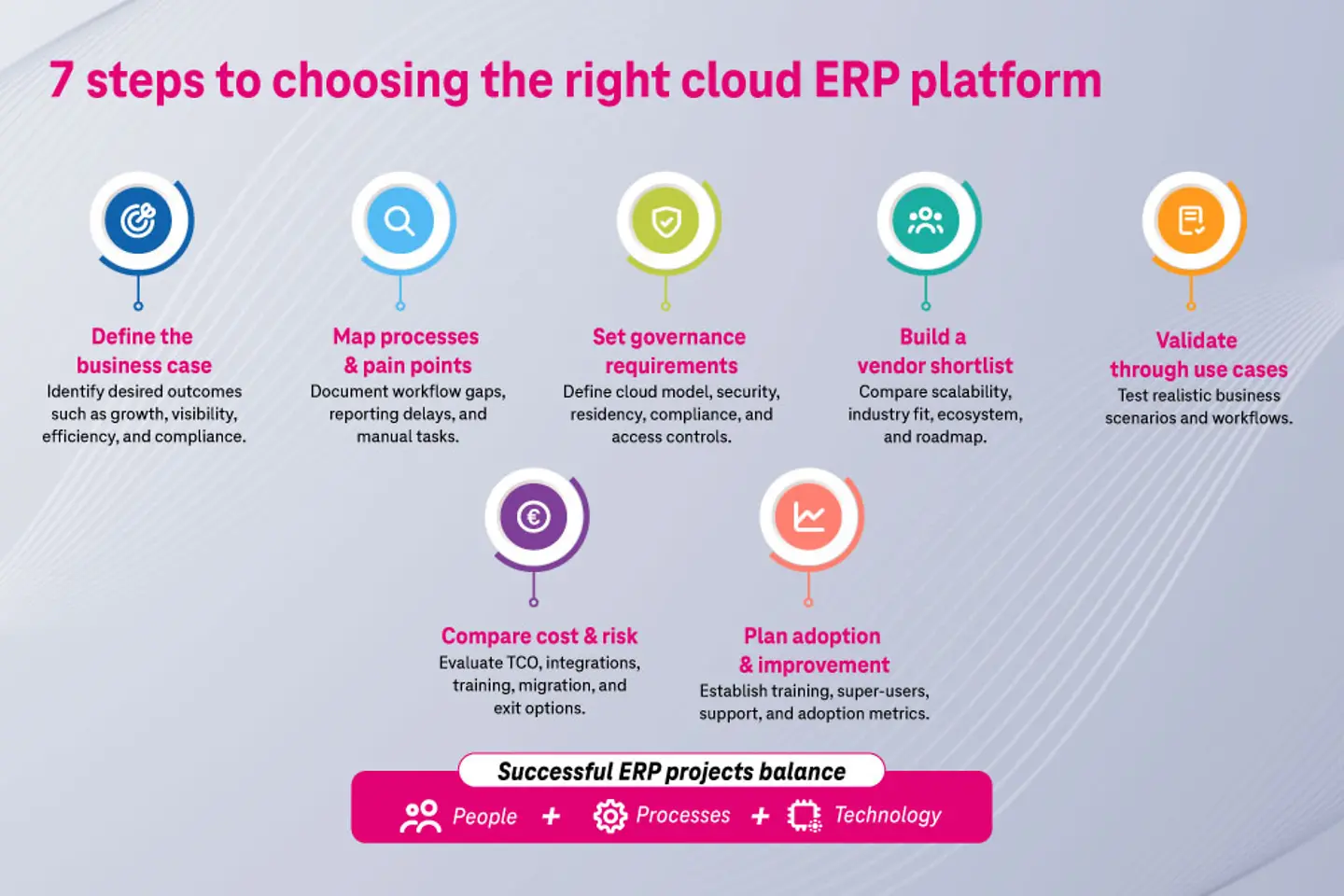
The following framework converts ERP evaluation from a feature comparison exercise into a structured procurement journey. It helps buyers align business needs, technical expectations and governance requirements before selecting a vendor.
Choosing the right cloud ERP vendor requires more than comparing features. Use this checklist to evaluate business fit, security, integration capabilities, and long-term costs to make a confident, future-ready investment decision.
Ensures ERP supports value creation rather than forcing unsuitable workflows.
Reduces the risk of outgrowing the platform.
Clarifies control, update timing, resource allocation and governance implications.
Cloud ERP is a business management system delivered through cloud infrastructure that connects core functions such as finance, supply chain, procurement, manufacturing, inventory, customer management, and analytics on a single platform. Unlike traditional ERP systems hosted on local servers, cloud ERP is accessed through the internet, enabling organizations to manage operations from anywhere while gaining real-time visibility across the business.
Cloud ERP helps organizations improve operational efficiency, reduce infrastructure complexity, and gain real-time insights into business performance. Key benefits include lower IT maintenance requirements, greater scalability, faster deployment, continuous software updates, improved collaboration, stronger data visibility, and easier access to emerging technologies such as AI, automation, and advanced analytics.
The primary difference lies in deployment and management. On-premises ERP is installed and maintained within an organization's own data center, requiring significant investments in hardware, maintenance, and upgrades. Cloud ERP is hosted in the cloud and managed by the provider, allowing organizations to reduce infrastructure costs, scale faster, access automatic updates, and support remote work more effectively.
SaaS ERP is a type of cloud ERP delivered as a subscription-based service through a web browser. While all SaaS ERP solutions are cloud-based, not all cloud ERP solutions are SaaS. Cloud ERP can also include private cloud, hosted, or hybrid deployments that provide greater infrastructure control and customization options for organizations with specific business or compliance requirements.
Yes. Leading cloud ERP providers implement advanced security measures such as encryption, multi-factor authentication, identity and access management, continuous monitoring, automated backups, and disaster recovery capabilities. Many platforms also comply with recognized standards and regulations, including ISO 27001, SOC, and GDPR requirements, helping organizations protect sensitive business data and maintain compliance.
Selecting the right cloud ERP solution requires evaluating business objectives, industry requirements, scalability needs, integration capabilities, customization requirements, security expectations, and total cost of ownership. Organizations should assess leading platforms such as SAP, Microsoft Dynamics 365, Oracle, Sage, Odoo, and other providers based on their long-term digital transformation goals rather than focusing solely on software features.

Riddhi is a marketing consultant at T-Systems ICT India who explores the latest advances in AI, cloud, security, and enterprise IT through research-driven storytelling.
¹ Riding the hyperscaler wave: The investment opportunity in cloud ecosystems, Julien Gagnon, Ruben Schaubroeck, Thomas Schumacher, with Jaime Echevarria and Maxandre Hirt, representing views from McKinsey's Private Capital Practice, September 19, 2025, McKinsey & Company in the Private Capital Insights section