 Image generated with AI
Agri and off-highway sectors have relied on engineering excellence and better products for success. But as connected machines, Industrial AI, and cloud platforms mature, value is increasingly created beyond the product. The next generation of market leaders will be those that connect engineering, manufacturing, dealers, partners, and customers into intelligent ecosystems that continuously learn, adapt, and deliver measurable business outcomes.
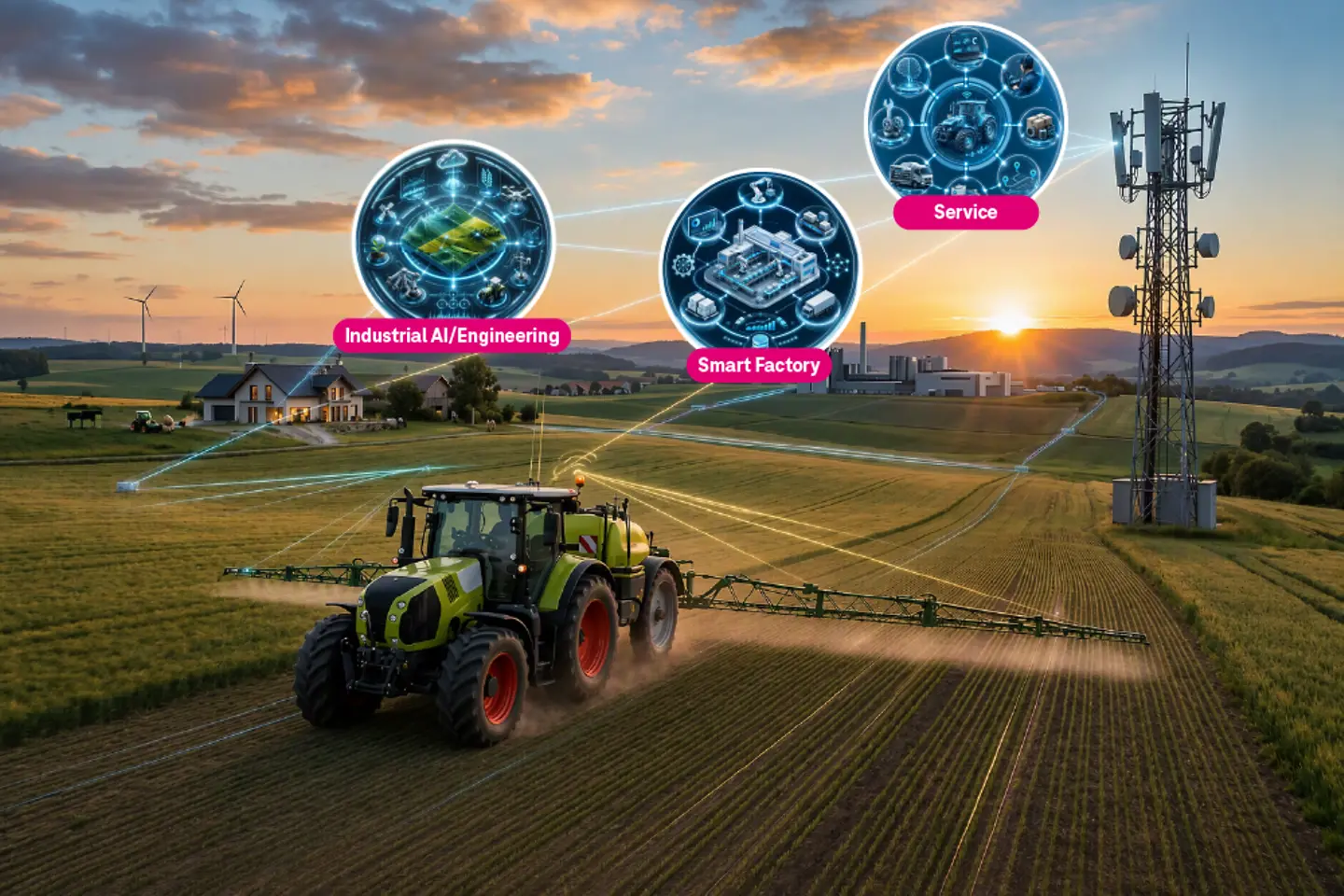 Image generated with AI
A farmer buying a tractor today is making a very different calculation than a decade ago. Input costs have exploded and many farmers report price increases of 80 to 250 percent for fertilizer and crop protection products in recent years, according to McKinsey.1 Labor is scarce and margins are thin. Under this pressure, automation, precision agriculture, and data-driven decision-making are no longer innovation showcases. They are survival economics.
For agri and off-highway OEMs, this changes the terms of competition. For decades, the industry competed with engineering excellence: robust machines, reliable uptime, strong dealer networks, productivity in the field. While those fundamentals still matter, they no longer decide who wins on their own.
My thesis is simple: the machine remains the product, but the ecosystem becomes the advantage. But most OEM digital platforms will fail to capture that advantage for a simple reason: they are built as products when they need to be built as orchestration layers.

Connected equipment only becomes strategic when it changes decisions: in the field, in service, in engineering and in production. Otherwise, it remains telemetry.
The digitization of agriculture is moving from experimentation to industrialization. Deloitte estimates nearly 300 million IoT endpoints in precision farming, livestock management, and equipment tracking by end of 2024, roughly 50 percent above 2022 levels.2 The question is no longer whether the ecosystem gets built. It is who can orchestrate it.
Four fields will decide this are as follows:
Telematics, remote diagnostics, machine health, field data, and over-the-air updates are becoming table stakes. Collecting the data is the easy part. The differentiator is turning machine, field, dealer, and service data into a secure, interoperable, scalable service layer.
To be clear: this is not a capability gap. The leading OEMs are digitally impressive with advanced telemetry, cloud platforms, AI-enabled machines are genuinely pioneering innovation in the field. What is striking is that almost all of them are placing the same strategic bet: a closed, single-brand platform, designed as much for lock-in as for customer value.
That bet fights the reality of agriculture, which is one of the most fragmented ecosystems in industry: mixed fleets from competing manufacturers, agricultural contractors running those fleets across dozens of farms, farm-management systems, dealers, agronomic advisors, satellite and weather data and third-party software. Farmers will not run three portals for three machine brands. And contractors, who must handle a substantial share of fieldwork in many European markets, will tolerate it even less. They will gravitate toward whoever integrates the mess.
The winners will not build the best app. They will orchestrate the ecosystem that includes their competitors' machines.
Agri and off-highway OEMs build some of the most complex machines in the industrial world, mechanics, hydraulics, electronics, embedded software, and increasingly autonomous functions, all under stricter regulation, shorter cycles, and rising R&D cost.
AI, simulation, and digital twins can be genuine accelerators here, but only under one condition: they must attack a specific bottleneck. The right question is not "How can we use AI?" but "Where in the engineering process does AI measurably reduce time, physical testing effort, validation complexity, or risk?"
Every engineering AI initiative should be able to name its bottleneck and its baseline otherwise it is experimentation, however well-intentioned.
These machines are complex, variant-rich, built in globally distributed plants with long product lifecycles. It is nothing like high-volume consumer manufacturing. Smart factory capabilities such as MES and shopfloor integration, predictive quality, bottleneck analytics, and digitally supported worker processes raise transparency and resilience.
But the real prize is the closed loop: when product data, production data, and field data are connected, and the OEM stops optimizing reactively and starts learning continuously. A field failure pattern feeds back into design and quality inspection within weeks, not model generations.
That loop is only possible for OEMs who win field one. In that sense, the factory and platform are increasingly two sides of the same data strategy.
This is the most underestimated field, and it contains one of the most important warning signals in industry.
The share of post-warranty repairs that farmers handle in-house rose from 33 percent in 2018 to 44 percent in 2023, per McKinsey1, while the share going to dealerships and authorized service centers declined. Service is where OEMs build lifecycle revenue and lasting customer relationships. If this shift continues, they risk losing the customer connection that underpins everything from data and software to upgrades and financing.
The response must make service digital, predictive, and frictionless: parts prediction, digital maintenance workflows, e-commerce for spares, telematics-based service contracts, proactive rather than reactive engagement.
OEMs do not need to become software companies. They need to treat software, data, cloud, and AI as part of their industrial operating system and they need to stay grounded in what customers actually pay for.
A survey conducted by Boston Consulting Group of 1,000 farmers3 is a useful corrective: adoption is not driven by enthusiasm for technology. Farmers prioritize higher revenues, reliability, and lower operating costs, alongside factors like saving time and maintaining a sense of control.
The longest digital feature list will not win. What wins is translating digital capability into measurable customer value: less downtime, lower input costs, higher fleet availability, faster engineering cycles, simpler experiences.
The machine will remain the center of gravity. But the advantages, like margin, loyalty, the data, and the future, are being built in the ecosystem around it. And the window to claim that position is open now, not indefinitely.
1 Voice of the US farmer 2023–24: Farmers seek path to scale sustainably, David Fiocco, Vasanth Ganesan, Maria Garcia de la Serrana Lozano, Julia Kalanik, Wilson Roen, 2024, McKinsey.com
2 On solid ground: AgTech is driving sustainable farming and is expected to harvest US$18 billion in 2024 revenues, Karthik Ramachandran, Gillian Crossan, Duncan Stewart, Ariane Bucaille, Deloitte Center for Technology, Media & Telecommunications, 2024, Deloitte.com
3 What 1,000 Farmers Told Us About Tech Adoption, Emily Kos, David Potere, Hillary Child, Helena Conant, 2024, BCG.com