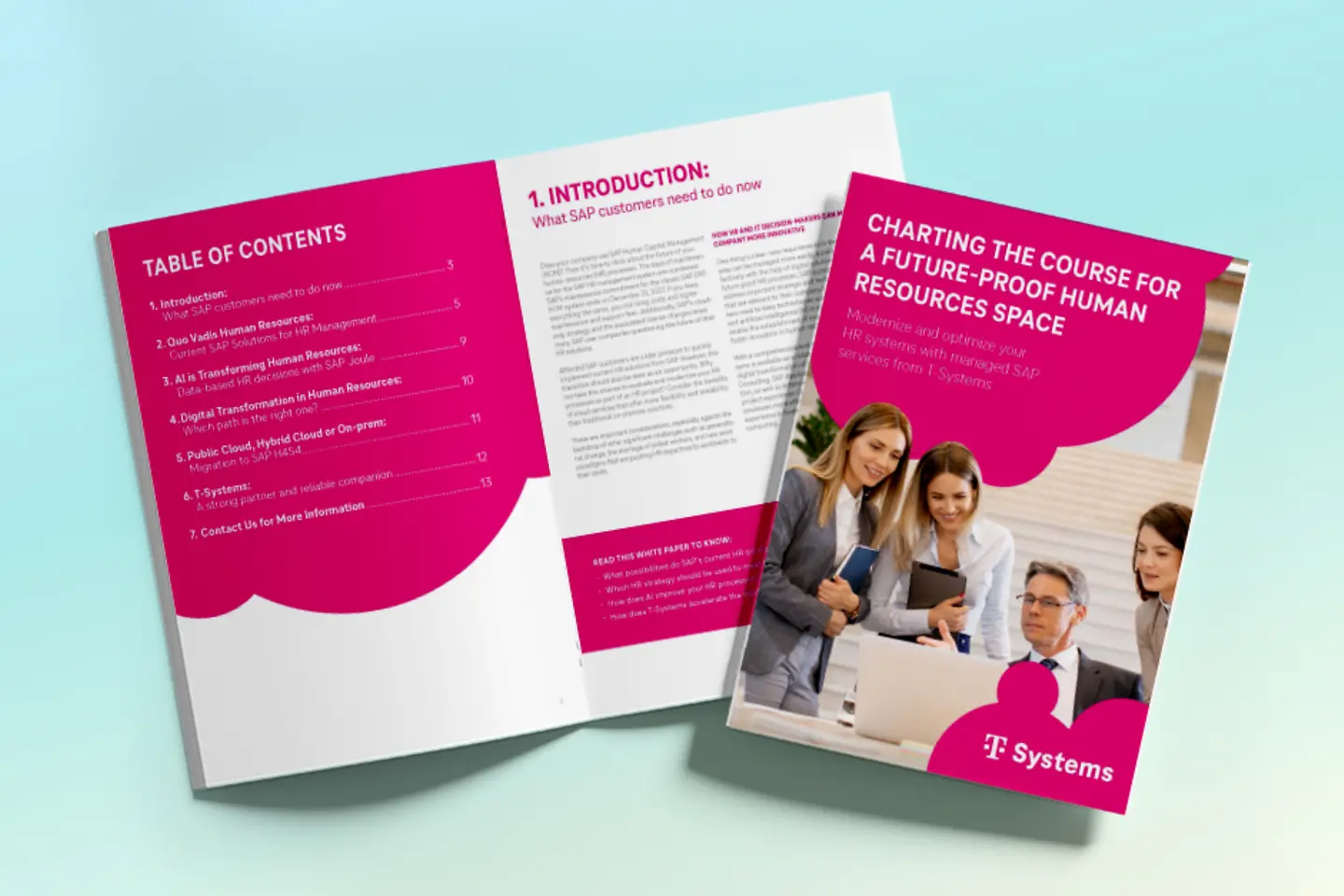
 Image generated with AI
Flexible job models, demographic changes, skills shortages, and the rise of AI are reshaping HR. At the same time, organizations running SAP Human Capital Management (HCM) must prepare for the end of SAP ERP HCM maintenance in 2027. Rather than viewing this only as a migration project, many organizations are using it as an opportunity to modernize HR processes, establish a trusted data foundation, and prepare for AI-driven workforce management.
Our working world is constantly changing, as the example of remote working shows. Although many employees are currently working from home, they are doing so on fewer days than before. One reason: more and more employers are endeavoring to bring their employees back to the office. Hybrid work has become a permanent feature of many organizations. Rather than debating whether employees should work remotely or in the office, HR leaders are now focused on creating flexible working models that improve employee experience while supporting productivity and collaboration. As workforce expectations continue to evolve, HR technology must be able to support distributed teams, digital processes, and consistent employee experiences across locations.
This demand for flexibility extends beyond where people work to how they work and develop within an organization. Employees increasingly expect flexible working arrangements, personalized career development, and digital HR experiences. At the same time, organizations must manage skills shortages, demographic change, and increasing competition for talent. Modern HR platforms help organizations respond faster by automating routine work, improving employee engagement, and providing managers with better workforce insights.
Employees increasingly recognize artificial intelligence (AI) as an opportunity to reduce repetitive administrative work and improve productivity. According to a recent study, 65% of employees surveyed say that AI has improved their productivity and efficiency within organizations that have implemented it.1 This allows HR teams to spend more time on strategic priorities such as talent development, workforce planning, and employee experience. Organizations that modernize today will be better positioned to turn HR data into actionable business insights tomorrow.
 Image generated with AI
Companies currently using SAP HCM for their HR management will have to overcome another challenge. This is because SAP’s maintenance commitment for the classic SAP ERP HCM system ends on 31 December 2027. The previous version of SAP HCM can still be used in SAP S/4HANA environments through a compatibility pack, as the license for this expired at the end of 2025. If companies leave everything as it is, there is a risk of rising costs due to higher maintenance and support fees. In addition, SAP’s cloud-only strategy raises many questions for customers regarding the future viability of their HR solutions.
Affected customers are under pressure to quickly implement the latest HR solutions from SAP. The transition can, however, also be an opportunity. Why not test and modernize processes as part of an HR project? Or consider using cloud services that promise more flexibility and scalability than traditional on-premise solutions? With SuccessFactors (HCM Suite), SAP offers cloud-based HR software with which many HR modules can be used independently.
SAP is also increasingly embedding SAP Business AI across its HR portfolio. Solutions such as SAP SuccessFactors now integrate SAP Joule, SAP's generative AI assistant, while SAP Business Data Cloud and SAP Analytics Cloud provide the trusted workforce data and analytics needed for AI-driven HR decisions. SAP is also advancing AI agents that can autonomously support routine HR tasks and workflows, helping employees and HR teams work more efficiently. Organizations modernizing their HR landscape today are therefore preparing not only for cloud adoption, but also for future AI innovation.
AI is changing the role of HR from an administrative function into a strategic business partner. Instead of spending valuable time producing reports or manually analyzing workforce trends, HR teams can increasingly rely on AI-powered assistants and analytics.
SAP Joule enables users to interact with HR data using natural language processing (NLP), while SAP Analytics Cloud transforms workforce information into forecasts, dashboards, and planning scenarios. Together with SAP Business Data Cloud, organizations can unify HR data across SAP and non-SAP systems, creating the trusted foundation required for secure and reliable AI-driven decision-making. Building on its vision of the autonomous enterprise, SAP’s Joule Agents can autonomously execute routine HR tasks, orchestrate cross-functional workflows, and proactively support employees and managers. This enables HR teams to spend less time on administrative activities and more time on workforce planning, talent development, employee experience, and strategic decision-making.
A good entry-level product into the world of the public cloud is the cloud-based SAP Concur solution for better business travel management. The digital platform helps companies to organize processes relating to the booking of business trips, travel expense accounting, and expense management more efficiently and transparently. Another alternative is the transitional solution, SAP Human Capital Management (HCM) for S/4HANA (H4S4), which has been available since the fourth quarter of 2022. It integrates the HCM module in the SAP S/4HANA core. If you want to safeguard your HCM continuity and investments, this is a good option for the coming years, as SAP provides a maintenance commitment until 2040.
As is so often the case in the digital world, the happy medium has proven its worth—a hybrid core that combines the best of the on-prem and cloud worlds. While cloud solutions are based on rigid standard configurations, specific customer requirements can be mapped in hybrid environments. For example, a company manages its payroll with SAP H4S4 as an on-premise version and connects cloud-based components from SAP SuccessFactors or Concur to HR management, such as the Talent Suite. The SAP HR solutions are either directly linked to each other or connected via the SAP Business Technology Platform (BTP).
A hybrid HR landscape also provides a practical path towards AI adoption. Organizations can retain critical payroll processes within SAP H4S4 while integrating SAP SuccessFactors, SAP BTP, and AI capabilities such as SAP Joule and SAP Analytics Cloud. This approach balances operational continuity with ongoing innovation.
SAP offerings for HR management open up many possibilities for companies—both for public and core hybrid solutions as well as on-premise installations. HR managers are, therefore, faced with the question of which HR solution best suits their company’s requirements. T-Systems helps them answer these questions and devise the right strategy.
We help HR and IT decision-makers develop an HR strategy that balances existing SAP HCM investments with cloud innovation. Beyond migration and modernization, we help organizations establish the data, integration, and cloud foundation required for SAP Business AI, SAP Joule, SAP Analytics Cloud, and future AI-enabled HR processes.
As a certified SAP partner, we offer an end-to-end SAP portfolio. This enables us to map, implement, and operate all SAP and HR processes for our customers. We have extensive SAP expertise and many years of experience with SAP and cloud projects. With our SAP services related to human capital management, we focus on employees and their needs and support them with modern tools. Another plus: we also integrate third-party solutions, such as workflow automation from Pega Software, to make HR processes more efficient.
Our expertise extends beyond migration projects. We help organizations build AI-ready HR environments by integrating SAP SuccessFactors, SAP H4S4, SAP BTP, SAP Business Data Cloud, SAP Analytics Cloud, and SAP Joule into a secure, scalable HR ecosystem that supports long-term innovation.
¹ AI and Workplace Productivity: What Leaders Need to Know in 2026, Gallup, July 2026, www.gallup.com
² 11 HR Trends Every CHRO Must Know in 2026, TMI, December 2025, www.tmi.org
³ Health Report 2024, Techniker Krankenkasse, July 2024, www.tk.de