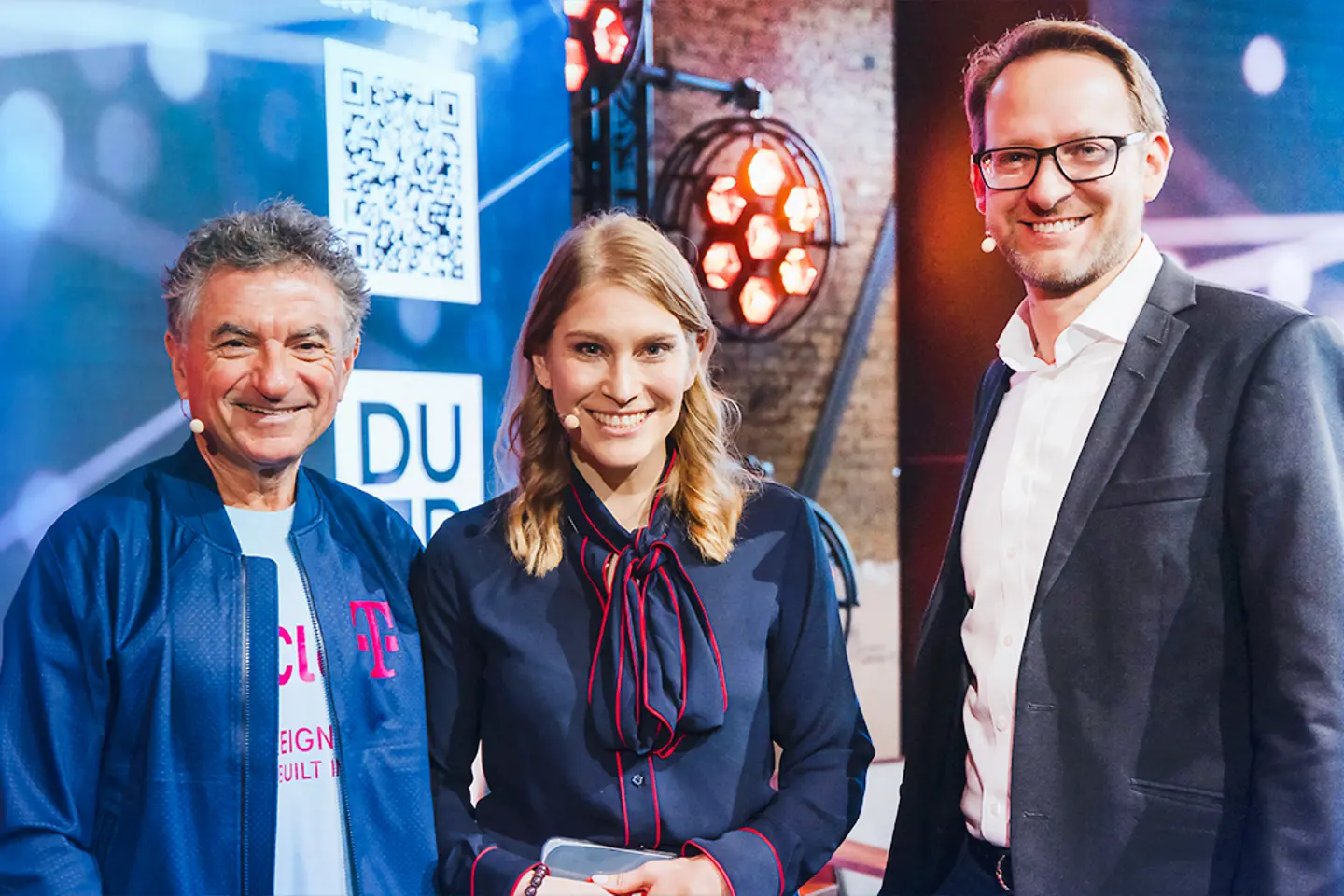
 Image generated with AI
Last week, I was at the BIG BANG AI Festival in Berlin—Europe's largest AI event. Six stages, 350 speakers, and 12,000 decision-makers from business, science, and politics. For two days, all keynotes and conversations revolved around AI. But for me, the decisive question is no longer whether AI will change everything. It already has. The crucial question is: who will create value with AI in the future? And who will ultimately only consume the platforms of others?
In this discussion, we Europeans look very closely at what we lack compared to dominant countries such as America and China: computing power, capital, large platforms, the most well-known AI foundation models. This is right, because one must face the facts. But if we draw the conclusion from this that the game is already lost, we turn a deficit into a self-fulfilling prophecy.
I firmly believe that Europe has its own AI story to tell. It does not consist of copying Silicon Valley one-to-one. Our strength lies in industry, engineering, processes, research, and above all in the data that has been generated there for decades. That is our unique selling point. We must now consistently leverage exactly this combination to play a significant role in shaping the future of AI—on our own terms and according to our own values.
Telekom CEO Tim Höttges made it quite plain in his keynote: The USA accounts for around 75 percent of global GPU computing power, while Europe manages just about five percent. The gap is also enormous when it comes to investments and new AI models. No matter which metric you look at: Europe is not yet scaling in the same league.
Now, one can let this be intimidating. Or one can take a closer look. The US is leveraging its strengths in capital, platforms, and models. China, in turn, is combining digital intelligence with industrial strength and moving AI very quickly from the data center into robotics, logistics, and production. It is precisely this connection between AI and real value creation that I find particularly compelling.
Tim used the image of the highly automated factory to illustrate this. There, we are no longer talking about whether a chatbot can formulate a text slightly faster. AI connects machines, quality control, material flow, logistics, and robotics into an integrated system. Automation becomes intelligent automation. And suddenly we are no longer talking about an IT tool, but about productivity, costs, and global competitiveness.
And that is precisely why AI should be a top management priority in German and European companies. At Telekom, we are already using AI today across the entire value chain—in service, in the network, in software development, and in internal knowledge management. Tim showed how broadly AI is already being used productively within our organization and that it is always about measurable business value. His message is absolutely right: AI is not simply a new tool. Companies must rethink their processes.
That is also exactly what I discussed with SAP board member Thomas Saueressig in a panel talk on the main stage. American tech companies are excellent at telling the story of innovation on a grand scale. A new model appears and a day later the whole world is talking about it. We Europeans are sometimes exactly the opposite: we research, build, optimize—and talk far too little about what we are actually capable of.
We have a great deal to offer: world-class companies, strong research landscapes, and an industrial depth that cannot simply be bought. In our factories, machines, development processes, and supply chains lie decades of data and know-how. This is an enormous treasure for AI—if we learn to make it usable.
That is why I believe: Europe does not need to simply try to copy the next American consumer LLM. Our great opportunity is Industrial AI. If we bring together machine knowledge, industrial data, engineering, and powerful AI, we can increase productivity, shorten development times, and even reclaim value creation that many believed had permanently migrated to Asia. With the help of AI and automation, we can, for example, produce T-shirts at competitive prices in Europe again—rather than in Asia due to lower labor costs.
This is, incidentally, a point that is very important to me. In Germany, we are currently discussing at great length how to distribute the existing pie. AI, on the other hand, gives us the opportunity to make the pie as a whole bigger again. And only if we generate growth and value creation again can we sustainably finance prosperity, social security, and investment.
Our great opportunity is Industrial AI. By bringing together machine knowledge, industrial data, engineering, and powerful AI, we can increase productivity, shorten development times, and even reclaim value creation.
Thomas Saueressig and I were also in strong agreement on a second point: digital sovereignty must not be confused with autarky. No one is demanding that every chip, every database, and every line of software must come from Europe. We naturally work together with American and other international partners. What is crucial is that companies retain control over their data, their critical processes, and their ability to act technologically.
A company must know where its data is stored, who can access it, and under which legal jurisdiction its applications are operated. It must retain the ability to switch technologies and providers when needed. And it must not find itself in a situation where a strategic core process no longer functions simply because business conditions or geopolitical frameworks have changed somewhere in the world.
This requires more than a good AI model. It needs the complete technology stack: connectivity, data centers, compute power, cloud, security, platforms, models, applications, and integration. That is precisely why we at Telekom are investing so heavily in sovereign infrastructure. Not because we are loners, but because digital sovereignty has become an indispensable competitive factor.
And it must not be expensive and complicated. If a sovereign solution costs twice as much and delivers half the performance, it will not scale. Our ambition must therefore be: secure, open, sovereign, and at the same time competitive. Otherwise, sovereignty remains a fine political headline, but never becomes an economic reality.
A good example of our sovereignty efforts is SOOFI. Behind it lies the ambition to make sovereign, open foundation models from Germany available for German and European applications. This is not an exercise against American or Chinese models. It is about ensuring that we ourselves retain the ability to develop, train, and further advance large AI models for our own requirements.
This is precisely where Telekom comes into play. Such models require computing power, secure infrastructure, networks, storage, and professional operations. We provide all of this through our AI factory in Munich. Research and development contribute the model expertise, while we create the industrial foundation on which such models can be developed and later operated.
For me, SOOFI is therefore also an example of a fundamental problem facing Europe. We have good solutions, good researchers, and good technology—but we need to market and promote them much more effectively. American companies are often one step ahead of us when it comes to marketing. This is something we can and must learn, without giving up our European strengths in quality, trust, and data protection.
And this is precisely where the difference lies between a technological demonstrator and genuine sovereignty. A model only becomes relevant when companies can work with it. When it is integrated into processes, when developers use it, when products emerge from it, and when it proves itself in the market. That is the decisive next step we must now take.
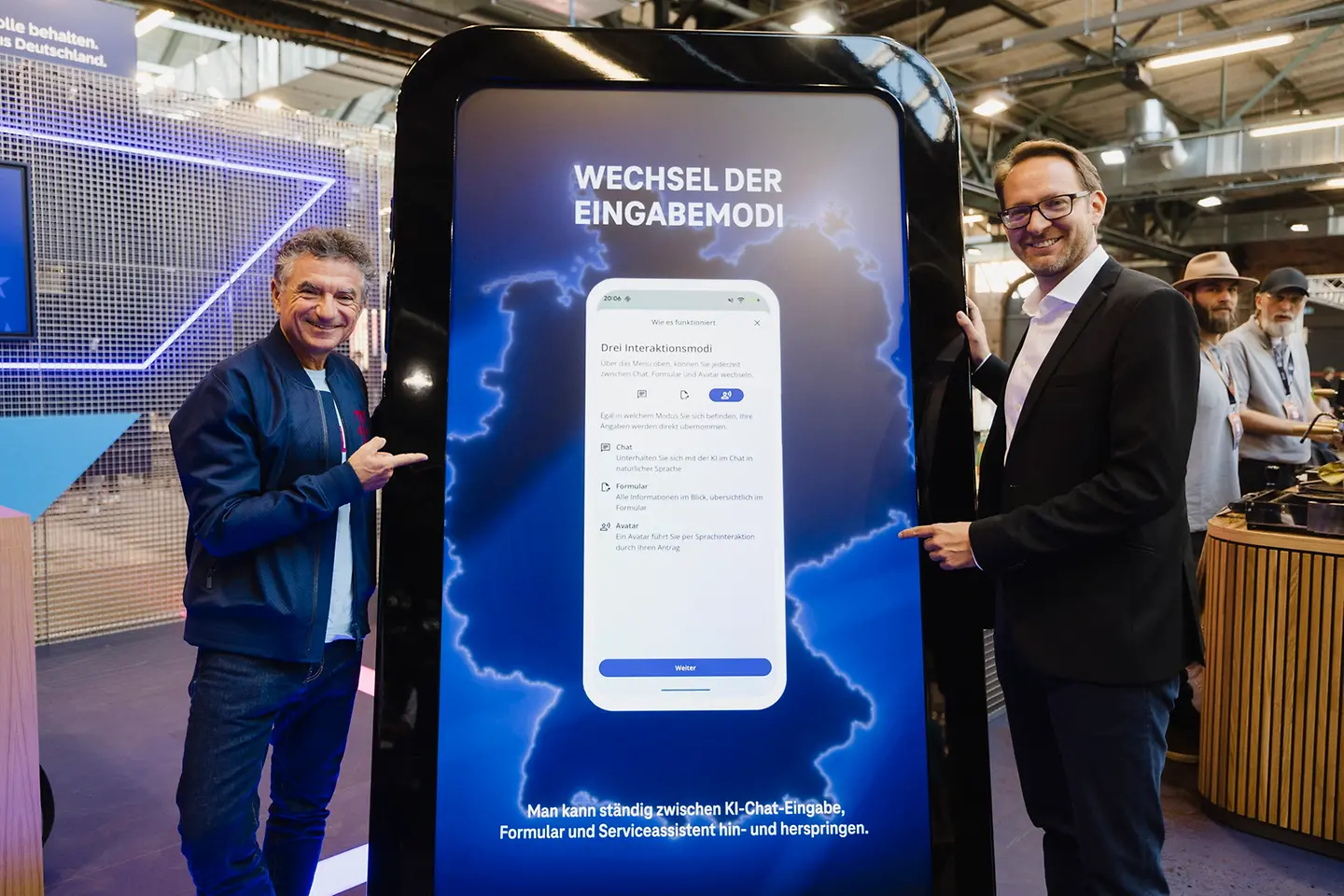
Dr. Ferri Abolhassan, CEO, T-Systems with Thomas Saueressig, Board Member, SAP
At the SAP partner stand, we not only showcased our Industrial AI Cloud—a sovereign foundation for AI solutions made in Europe—but also demonstrated how SAP’s Business Technology Platform and Business AI services complement this foundation. Together, they create an integrated environment in which companies and public administrations can securely develop, operate, and scale AI.
We also presented the prototype of the Germany App, which we developed together with SAP. And this is precisely the decisive point: technology must reach people. It must not remain abstract. It must offer a tangible and measurable added value—for companies, for authorities, or for people's everyday lives.
Today, public administration still works far too often like this for citizens: you search for the responsible authority, fill out forms, enter data multiple times, wait for an appointment, and at some point ask about the processing status. That is not truly digital. That is an analog process that has been given a screen in a few places.
Together with SAP, we want to change exactly that on behalf of the Federal Ministry for Digital and State Modernization. The State must come to the citizen more, rather than the citizen constantly having to go to the State. Administrative services should be easier to find, digitally accessible, and increasingly automated over time. For citizens, this means fewer forms, fewer trips, and less of their lifetime lost to administration.
And for public administration, it means something equally important: when standard processes run digitally and intelligently, employees have more time for the complex cases where people are truly needed. This is also my understanding of AI: the machine should do what a machine can do better. So that people have more time for what people can do better.
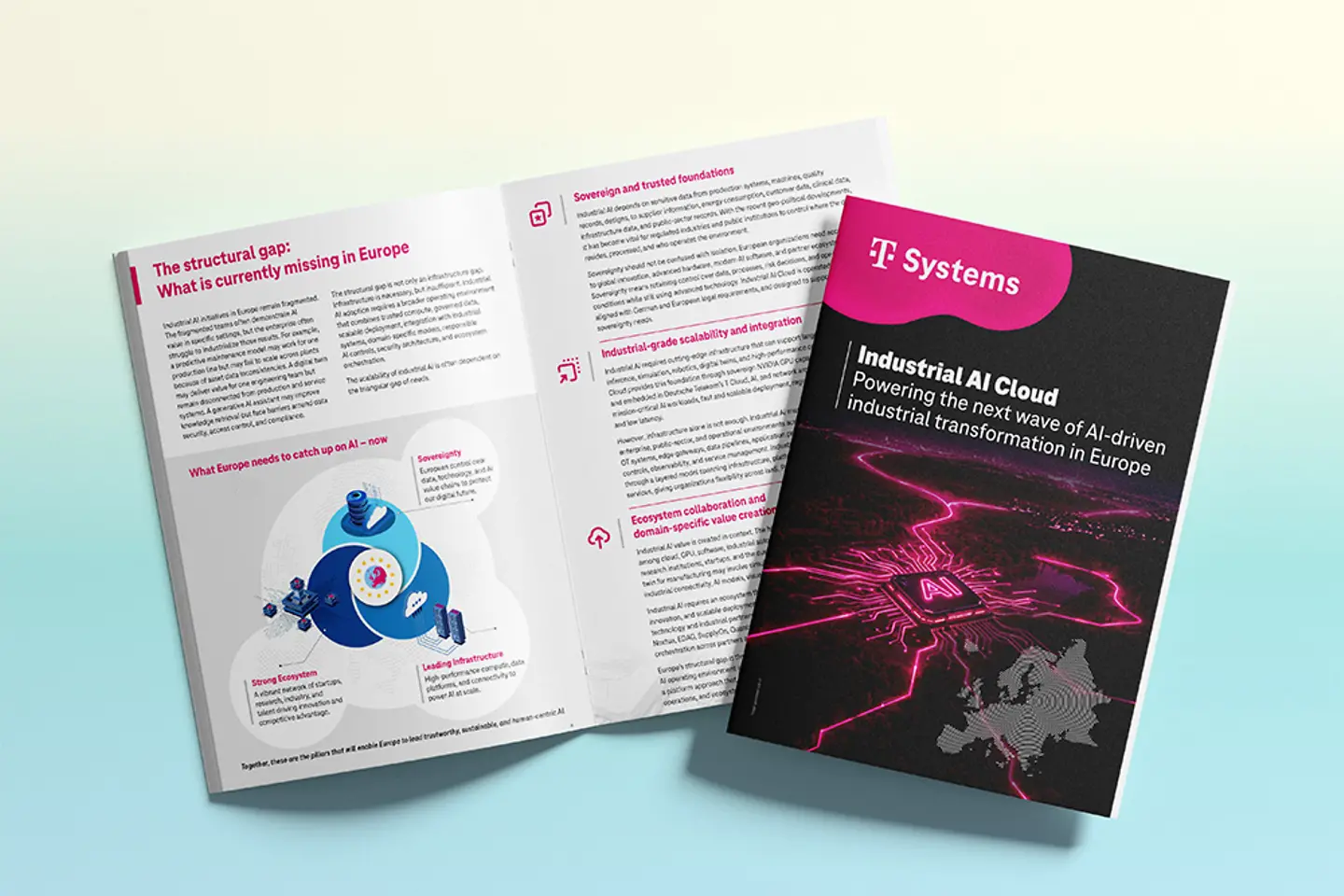
In Munich, we have built our Industrial AI Cloud, a high-performance AI infrastructure, in a very short time. Yes, we have significantly expanded Germany's AI computing capacity in the process. And yes, the demand is so high that we are already planning the next expansion step. But all of this is only relevant if it results in concrete applications and value creation.
A mid-sized company doesn't need GPUs because it's currently trendy to use GPUs. It wants to use AI to detect earlier that one of its machines is about to fail. An automotive manufacturer wants to simulate production processes and shorten development times. A pharmaceutical company wants to conduct research more quickly. And a government agency wants to complete a process that currently takes three weeks in just a few minutes.
That is exactly why we work with partners such as SAP. We bring secure infrastructure, cloud, networks, and operations. SAP brings enterprise processes, platforms, and business data. And together, we can build solutions from this that don't remain in the lab, but work in production, in the office, or in a government agency.
That, for me, is the difference between a data center and an AI factory. A data center provides compute. An AI factory must ultimately create value. For a customer, for a citizen, for an entire economy.
Germany helped invent the computer. We have world-class research in AI and computer science. We have mechanical engineers, automotive companies, chemicals, pharmaceuticals, medical technology, and an SME (small and medium-sized enterprises) sector that is a world market leader in many areas. And we have companies such as SAP, Siemens, Bosch, Telekom, and many others that are technologically highly capable.
Nevertheless, we often tell each other that the global AI race has long been decided. As I emphasized at the outset, I do not believe that. But I also do not believe that we will automatically win simply because we have good engineers. What matters is that we turn research into tangible products, data into applications, and applications into scalable business.
And this is where Physical AI—especially for us Europeans—will be one of the next major waves. China is already demonstrating how quickly AI can be combined with robotics and industrial production. That is precisely why we must not focus solely on large language models. The next major value creation will emerge where digital intelligence meets the real world.
And for this, we have excellent conditions in Europe. What we lack in many areas is speed. We want security, sovereignty, innovation, and one-hundred-percent certainty—ideally all at the same time. But entrepreneurial progress does not work that way. Making decisions under uncertainty is a part of this. That, too, was one of the central ideas in Tim's keynote.
My conclusion from Berlin is therefore clear: Europe has not yet lost when it comes to AI. But we cannot afford to fool ourselves either. We need more computing power, more investment, more courage, and above all more applications that create measurable value. And we must finally bring our own strengths to the market with greater confidence. In the spirit of: do good and talk about it!
A start has been made: with our Industrial AI Cloud, we have created a sovereign infrastructure with a broad partner ecosystem. Together with SAP, we are bringing AI into business processes and, with the Germany App, into citizens' everyday lives. With projects such as SOOFI, we are demonstrating that we too can develop LLMs—ones that comply with our rules and values. Now it is about scaling all of this smartly.
I'm not one for lamenting every morning about how difficult things are in Germany. Bureaucracy gets on my nerves too. Slow processes irritate me too. But the decisive question is: How do we deal with this situation? My credo: talk less about why others are bigger or what they do better. Bring your own strengths to the table more. Be self-confident. And just get on with it.