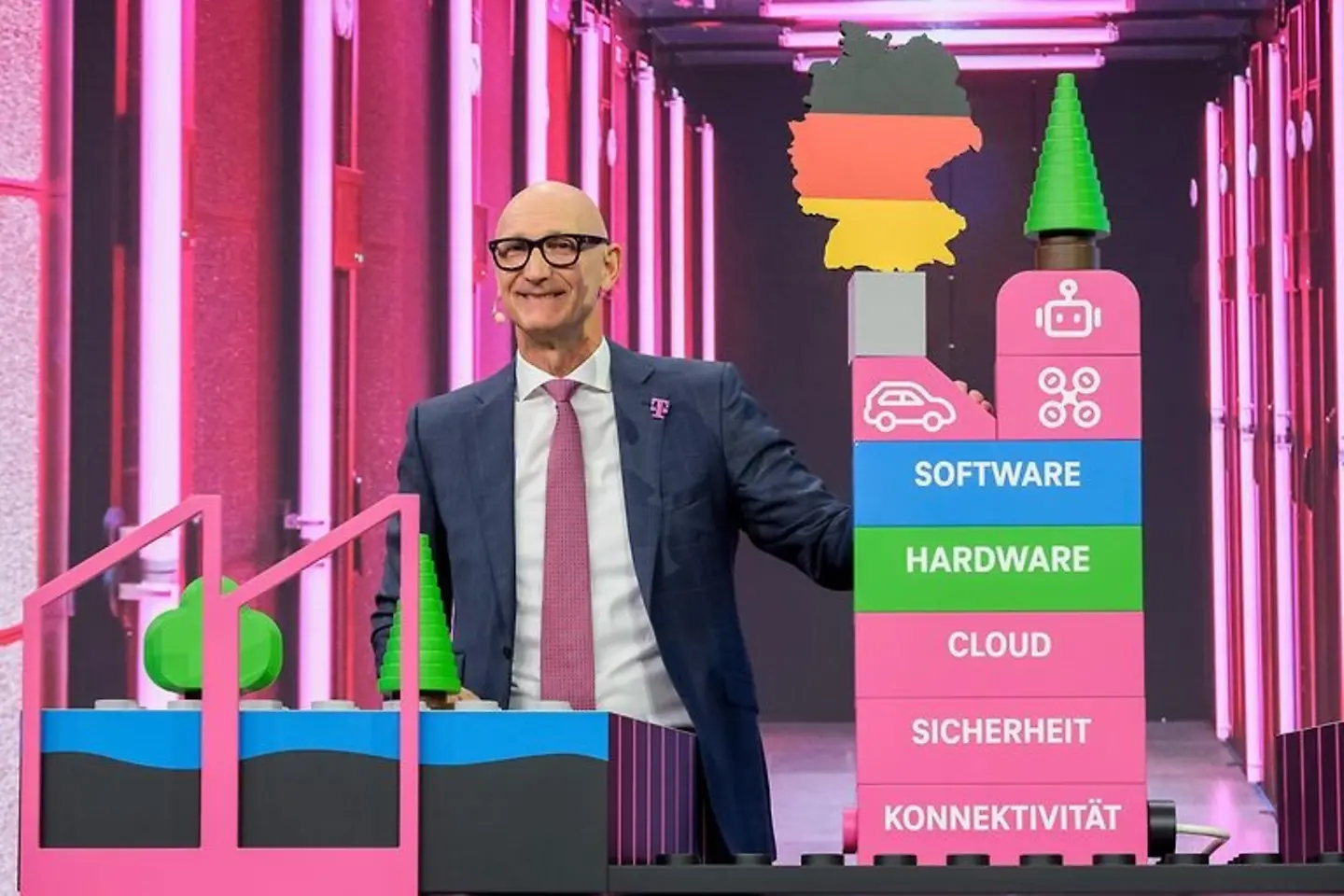
At the opening of Hannover Messe, Tim Höttges (CEO of Deutsche Telekom) reaffirmed the company’s willingness to invest in artificial intelligence in Germany. “The whole world is talking about AI. But without infrastructure, even AI is speechless. That’s why we invest in secure networks, sovereign data centers, and AI computing power.” In his keynote, Höttges also gave an outlook on the upcoming 6G mobile standard, which is expected to unlock new opportunities, particularly for industrial applications.
Germany and Europe have all the prerequisites to take a leading role in physical AI – that is, the application of AI in industrial environments, Höttges said. Companies are now called upon to seize these new opportunities. Many existing challenges can be addressed more effectively with AI. However, this requires not only the right applications but also a redesign of business processes to make them AI-ready. At the same time, Höttges urged industry leaders to remain mindful of AI’s impact on people.
“Progress happens where AI and sovereignty come together,” Höttges continued. “Germany has everything it takes: a strong industrial base, engineering excellence, and the ability to combine production with cutting-edge technologies. If we follow through consistently, Germany will not just keep pace – we will lead.”
Höttges also highlighted the company’s experience in data centers and AI. Deutsche Telekom offers “everything companies need” and benefits from outstanding customer access. When it comes to sovereignty, different levels must be distinguished and applied depending on the use case. In practice, not every application requires the highest level of sovereignty. Depending on the sensitivity of their data and processes, companies should choose the right combination from three levels and flexibly combine them with solutions from various partners.
The first level is data sovereignty. Companies and public authorities retain full control over their data, ensuring it is processed in accordance with European regulations. With offerings such as T Cloud Public, Deutsche Telekom/T-Systems operates data infrastructures in Europe that comply with requirements such as the GDPR. This is a key prerequisite for digitalization, especially in sensitive sectors.
Building on this, Deutsche Telekom/T-Systems ensures operational sovereignty. Its own data centers in Europe, clearly regulated access, and certified processes guarantee that critical systems run reliably and remain under control. This enables core business processes to be operated independently and securely.
The third level is technological sovereignty. The goal here is to reduce dependencies on non-European providers and create alternatives. Deutsche Telekom/T-Systems relies on open standards, its own T Cloud Public, multi-cloud approaches, and European initiatives such as 8ra. This allows companies to combine different providers and use them flexibly.

The whole world is talking about AI. But without infrastructure, even AI is speechless. That’s why we invest in secure networks, sovereign data centers, and AI computing power.
Tim Höttges, CEO of Deutsche Telekom
In early February, Deutsche Telekom/T-Systems opened an AI factory in Munich. Together with partners such as Nvidia, SAP, and Siemens, the company built one of Europe’s most powerful platforms for industrial AI in just six months. The AI infrastructure in Munich (Industrial AI Cloud) is specifically designed for the needs of industry, SMEs, and the public sector, and is operated exclusively according to European standards.
At the AI factory, Deutsche Telekom/T-Systems deliberately uses an AI stack designed to reduce dependencies and integrate into a European ecosystem. An AI stack refers to the entire technological foundation of an AI solution – all the components required to develop, operate, and integrate AI applications into products or processes, including data, models, software, and infrastructure.
Deutsche Telekom invests around € 6 billion annually in Germany alone, primarily in fiber optics, mobile networks, and data centers. At the same time, the company is advancing next-generation technologies. For example, in its 6G Innovation Hub, Deutsche Telekom is researching new 6G technologies in which AI is embedded into the network architecture from the outset, enabling systems to manage network operations largely autonomously.