 Image generated with AI
A Surge in the patient population, shortage of specialists, and growing volumes of data are pushing the healthcare system to its limits. At the same time, the threat of cyberattacks is increasing noticeably. But how can innovation be shaped in a highly regulated environment when data is fragmented, systems are complex, and requirements are high? Is technology enough—or do we need new structures?
The healthcare sector is facing multiple stress tests. A growing number of patients, demographic changes, and an acute shortage of skilled workers are compounded by increasing digital complexity. Hospitals, medical practices, and healthcare facilities have to do more and more—with limited personnel and structural resources.
As a part of critical infrastructure (KRITIS), the healthcare sector is of particular importance: IT failures or security incidents have a direct impact on care.
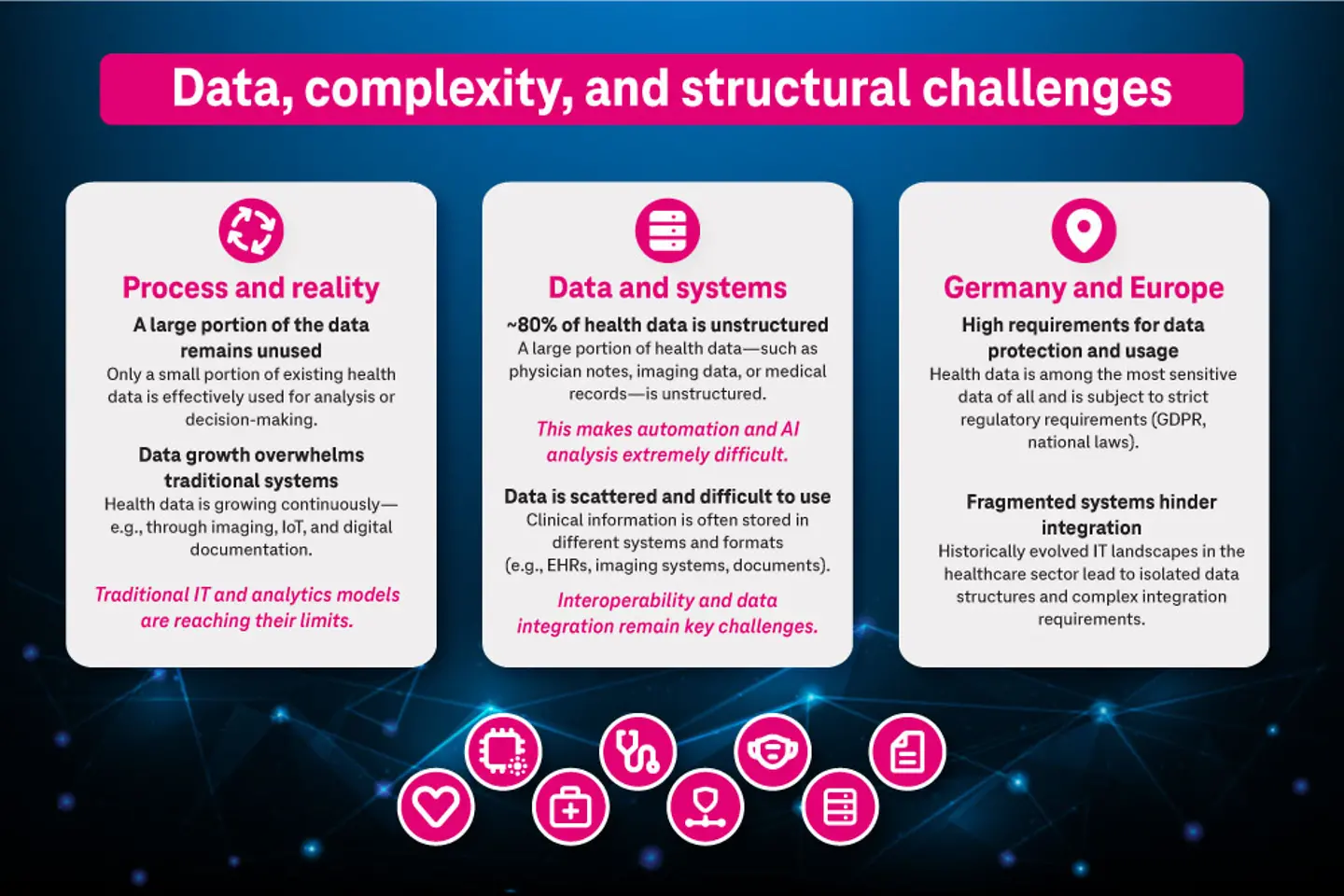
The volume of data is also growing rapidly. Medical imaging, electronic patient records, networked medical devices, and digital documentation are constantly generating new information. This data is valuable—for diagnostics, therapy, and research. However, it is generated in fragmented systems, distributed across different applications, locations, and responsibilities.
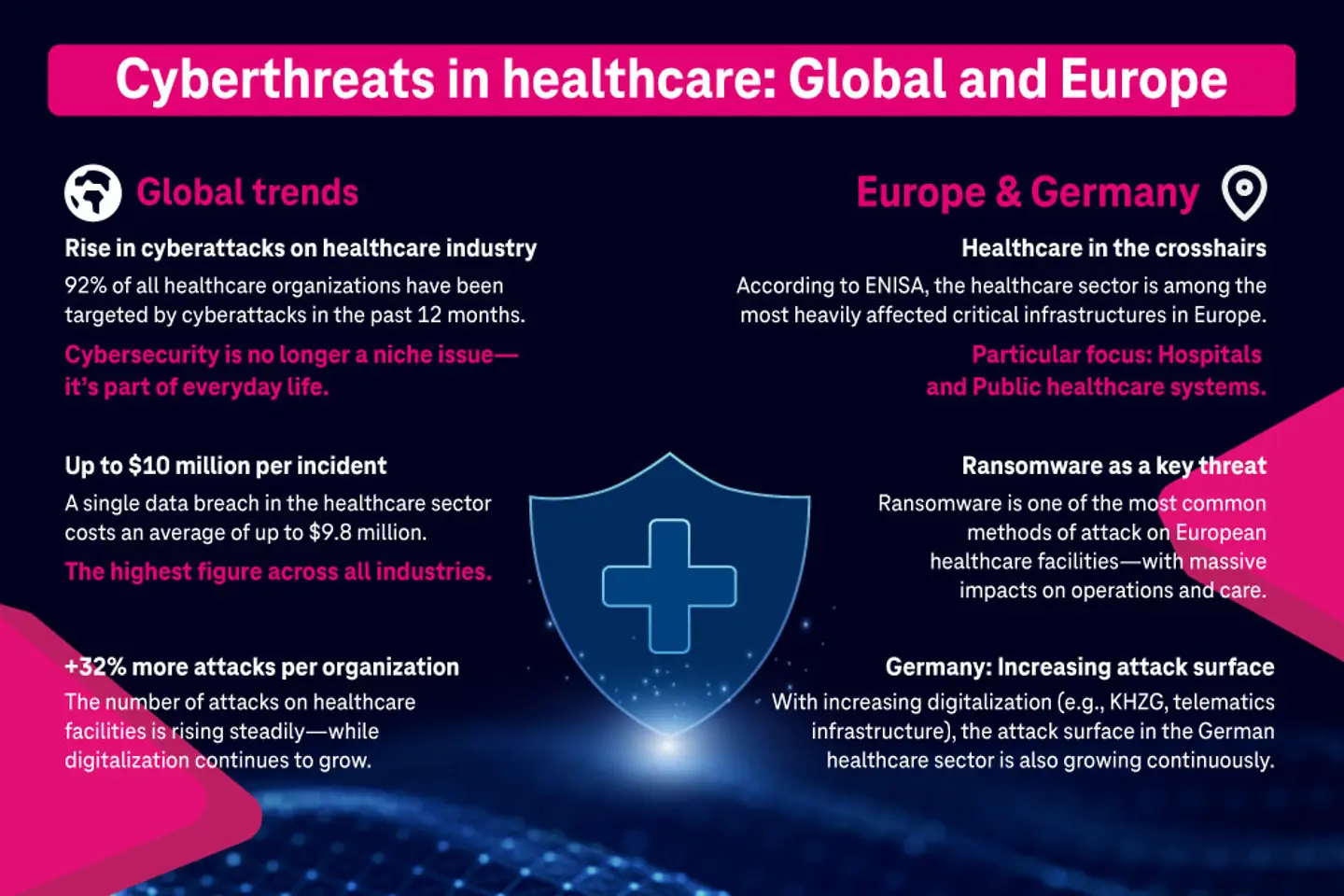
Compounding this situation is the threat landscape. Cyberattacks on hospitals and healthcare facilities are on the rise—impacting care, processes, and trust. Systems are being encrypted, processes disrupted, and treatments delayed. Security is therefore becoming a key factor for stable care.
At the same time, digitalization is advancing. Programs such as the electronic patient file, the telematics infrastructure, or the Hospital Future Act are driving change—but are also increasing the requirements for integration, interoperability, and data protection.
The dependency on digital systems grows with every new application. Complexity increases with every additional interface. And with every disruption, it becomes clear how critical stable, secure, and powerful IT structures have become for the healthcare sector.
The key question is therefore no longer whether the healthcare sector will continue to digitalize—but how this transformation can be stabilized in the face of increasing complexity, growing threats, and limited resources.
Artificial intelligence (AI) is considered a key technology for the future of healthcare. It promises faster diagnoses, more efficient processes, and better use of existing data. But in practice, it is clear that AI can only develop its potential where the structural conditions are right.
AI does not operate in isolation. It needs consistent, available, and high-quality data. However, this is precisely what is often lacking. Data is scattered across different systems, is unstructured, or only accessible to a limited extent. Without integration and clear data structures, AI remains limited to individual use cases.
What's more, many existing IT landscapes are not designed to process large volumes of data in real-time or to integrate AI models efficiently. This results in isolated solutions that create added value at certain points, but do not enable a sustainable improvement in overall processes.
Security and compliance requirements are also becoming increasingly important. AI systems must be operated in a traceable, data protection-compliant, and reliable manner, especially when dealing with sensitive healthcare data. These requirements can hardly be met without an end-to-end security architecture and clear governance.
The key point is therefore that AI is not an isolated tool, but a part of a larger architecture. Only when data is integrated, systems are connected, and processes are structured can AI realize its full potential—as a part of a stable, secure, and sustainable healthcare system.
With increasing digitalization, efficiency is growing—but so is the attack surface. Hospitals, doctors' medical practices, and healthcare facilities are increasingly becoming prone to cyberattacks. Ransomware, data leakage, and system failures can impact patient care, apart from causing financial losses.
The effects are tangible: systems come to a standstill, treatments are delayed, and emergency procedures must be changed. What used to be an IT problem is now becoming a question of continuity of care.
This brings a key challenge into focus: how can AI applications be operated securely in the healthcare sector? After all, the use of AI not only increases efficiency, but also the requirements for control, access security, and data protection.
AI systems access highly sensitive healthcare data, process information from different sources, and increasingly support critical processes. Without clear role and rights models, secure data environments, and transparent governance, new risks arise—both to the security and integrity of the data. The crucial question is therefore not only how attacks can be prevented, but also how AI can be used in a secure, controllable, and sovereign manner.
Cybersecurity and AI cannot be considered separately in the healthcare sector. They are part of the same challenge: operating a highly networked, data-driven system in a stable and trustworthy manner.
A look at the everyday work of many healthcare facilities shows that unusual access to patient data, parallel login attempts from different systems, and atypical data queries initially go unnoticed. On their own, these events seem harmless—but when viewed as a whole, they can indicate a targeted attack.
In highly networked IT landscapes, it is almost impossible for traditional security mechanisms to detect such patterns. This is where integrated security architectures come into play, as implemented by T-Systems in the healthcare sector: AI analyzes large volumes of security-relevant data in real-time, detects deviations, and prioritizes potential threats—before they become a critical incident.
But this also raises a further question: how can AI applications themselves be operated in such a way that they remain secure, controllable, and compliant with data protection regulations? T-Systems provides a concrete answer to this with SmartChat. The AI-supported solution helps employees in the healthcare sector to process and provide information, for example, in hospitals, health insurance companies, or administration.
In contrast to generic AI applications, SmartChat is designed from the outset to handle sensitive data: with clearly defined role and rights models, context-related data processing, and secure data environments. Access is controlled in a targeted manner, information is only provided where necessary, and sensitive content is protected.
In everyday work, this means that employees can retrieve specific information without having to navigate multiple systems, for example, on patient processes, internal guidelines, or administrative procedures. Answers are provided in a context-specific manner, tailored to roles and authorizations.
Especially in time-critical situations, this reduces search effort, speeds up decisions, and significantly reduces the workload of specialist staff. At the same time, it provides transparency into the usage and access to the information. This creates practical interaction: AI not only helps to detect threats at an early stage, but also supports secure and efficient processes in everyday operations. The added value lies not in individual applications, but in the combination of AI, security, and integrated architecture.
Meeting the increasing demands of the healthcare sector requires more than individual technologies. It calls for integrated solutions that combine data, AI, and security while meeting strict data protection and regulatory requirements.
T-Systems pursues a holistic approach that is specifically designed for regulated and security-critical environments such as the healthcare sector. The focus is on sovereign cloud infrastructures developed for handling sensitive healthcare data.
Building on this, T-Systems develops AI solutions—such as SmartChat—for the healthcare sector. These solutions are designed for security, data protection, and controlled use from the outset. Open interfaces, clear governance structures, and integrated security mechanisms ensure that innovation and control complement each other.
As networking in the healthcare sector increases, so do the requirements for security and resilience. Traditional protection mechanisms based on clearly defined system boundaries are increasingly reaching their limits in dynamic, distributed IT landscapes.
Modern security architecture therefore relies on end-to-end concepts such as Zero Trust. Every access is continuously verified, regardless of whether it originates from within the network or from outside. Identities, roles, and authorizations are consistently controlled, data flows are monitored, and potential risks are identified at an early stage.
This approach is complemented by security operations, continuous monitoring, and intelligent analysis. AI helps evaluate large volumes of security-relevant data, recognize patterns, and identify threats more quickly.
The decisive factor is interaction: security is not treated as an isolated measure, but as an integral part of the overall architecture. This is the only way to ensure the stable operation of complex, highly networked systems, and to enable innovation.
Sovereign cloud infrastructures
Secure, scalable cloud solutions for processing sensitive healthcare data—in compliance with European data protection and regulatory requirements.
Integrated cyber security and Zero Trust
Holistic security concepts with continuous access control, monitoring, and threat detection for stable and resilient systems.
AI solutions for healthcare
Practical applications such as SmartChat that support employees and meet the highest requirements for data protection and access security.
Integration and data architecture
Connected systems, structured data availability, and open interfaces as the basis for effective use of AI.
Operation and scaling
End-to-end security operations and continuous development for sustainable and future-proof IT structures in the healthcare sector.