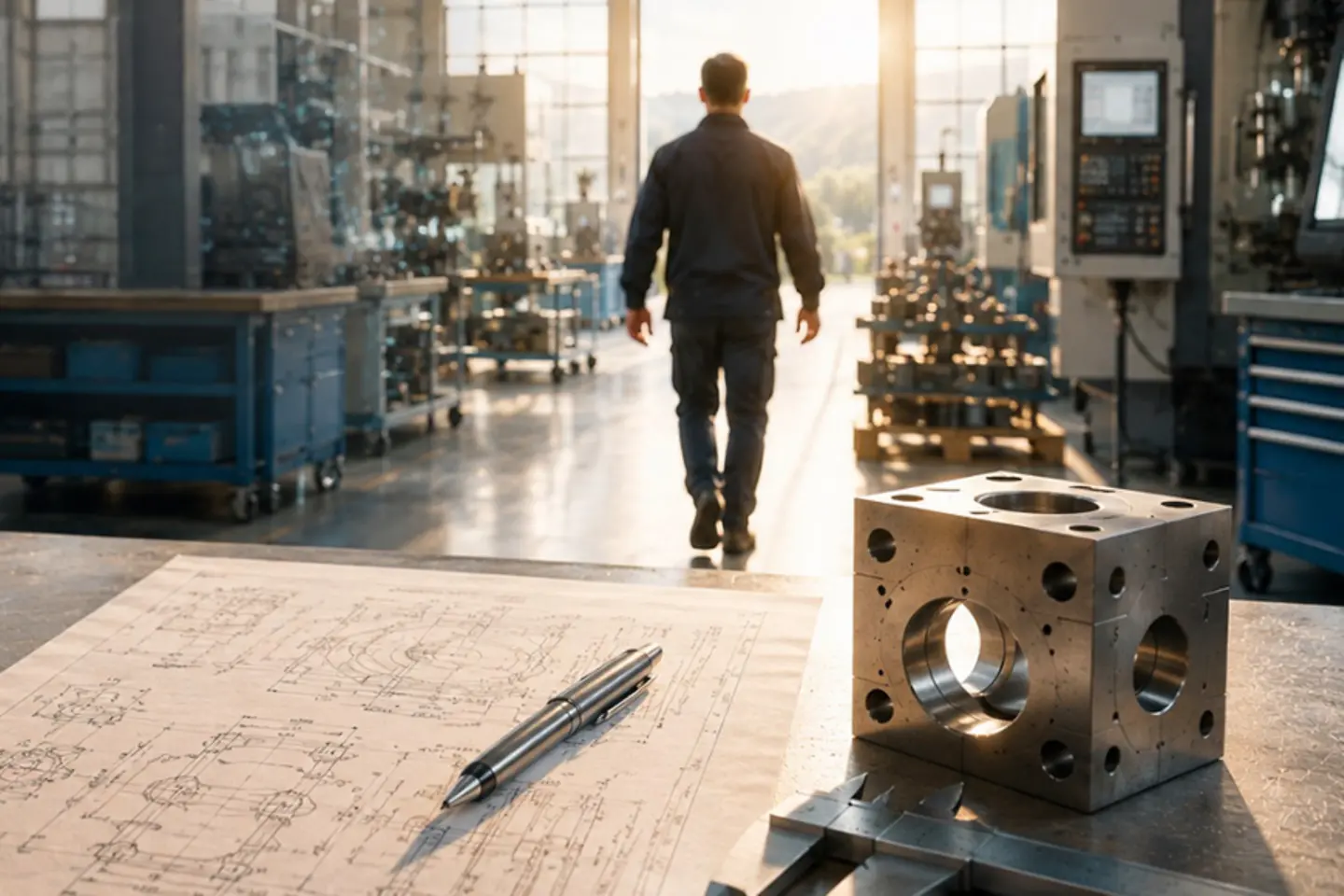
 Image generated with AI
When people talk about artificial intelligence (AI), they often talk about the big names. The big technology companies, the big platforms, the big data centers, and the big investments.
From my perspective, that is understandable. But perhaps many people are looking in the wrong direction. Because when I look at the years ahead, I see millions of companies suddenly gaining capabilities that were previously reserved only for the largest players.
I am not talking about a small group of companies. I am talking about the backbone of the German economy. More than 99 percent of all companies in Germany belong to the SME sector. They generate more than half of the economic output and provide the majority of jobs. When people talk about the future of the German economy, they are therefore inevitably talking about the future of the SME sector.
In recent decades, large companies had a decisive advantage. They had more capital, more data, more specialists, more international reach.
Those who possessed the most resources could grow faster. Size was a competitive advantage. But every technological revolution changes the rules of competition. The internet reduced information advantages. Cloud technologies democratized access to IT. And I could now bring about something similar with knowledge.
One of my greatest effects will not be to generate new information. But to make existing knowledge available. For more people—faster, more consistently, more scalably.
Suddenly, a mid-sized company can access capabilities that previously required entire departments: market analysis, software development, product design, translation, knowledge management, process optimization. Not because expertise disappears. But because it becomes more readily accessible. Perhaps that is where the real transformation lies: AI makes not only technology more accessible, but above all knowledge more usable.
The momentum is already visible. More and more companies are deploying AI productively. While large corporations are often pioneers, a significant portion of the SME sector is still at the beginning of its AI journey. Many view this as a setback. I see it primarily as potential. Because rarely have the opportunities been so great to build new capabilities with comparatively manageable investments.
The true democratization of AI is the democratization of knowledge. When people think about innovation, they often think of start-ups or global corporations. I often think of hidden champions: companies that are world leaders in their niche, whose strength lies in deep domain knowledge, experience, and proximity to their customers. This knowledge is precisely what makes them particularly interesting in the AI era.
I can recognize patterns. But I understand reality only through the expertise of the people who work with me. This is precisely where the strength of many mid-sized companies lies: in knowledge that is unique worldwide—not in data centers, but in production halls, development departments, and the minds of their employees. AI cannot replace this knowledge. It can help to scale it.
Many people assume that the largest companies will automatically be the winners of the AI era. That is possible—but not inevitable. Because AI is also changing the importance of speed. New ideas can be tested more quickly, prototypes developed more rapidly, products improved faster, knowledge disseminated more swiftly, and decisions made more efficiently. In such a world, adaptability often becomes more important than organizational size. And this is precisely where mid-sized companies frequently have an advantage: short decision-making paths, close customer relationships, pragmatic implementation, entrepreneurial thinking, and the ability to recognize and seize opportunities quickly.
AI could reorder competition. Every technological revolution shifts power dynamics. Not always in favor of the largest market participants.
The most exciting question, therefore, is not: which companies are using AI? The more exciting question is: which companies are transforming their ways of working through AI? Who learns faster? Who experiments more boldly? Who connects technology with genuine expertise? Who manages to turn knowledge into innovation? That is where the winners will emerge.
 Image generated with AI
The actual task of Telekom Deutschland and T-Systems may not be to develop AI for the SME sector, but to empower it to shape its own AI future.
When I look at small and medium-sized enterprises, I see enormous potential. But I also see a challenge. Many companies know that AI will be important. Yet they ask themselves: Where do we start? Which technologies are the right ones? How can data be used securely? Which regulatory requirements need to be met? And how can limited resources be deployed effectively?
Because not every medium-sized company can develop its own AI platforms, hire specialists, or operate high-performance data centers. That is precisely why the question of the right partners becomes crucial.
If AI is to have its full impact, it cannot remain a privilege of the largest companies. It must become accessible. Easy to use, secure, scalable.
And it must be available where companies are already working today. This is where I see the role of companies like Deutsche Telekom and T-Systems. Not as providers of individual technologies, but as enablers. As partners who make complex technologies usable for businesses.
Telekom has built infrastructure for the digital economy over the past decades. In the AI era, this gives rise to a new task: bridging the gap between technological innovation and real value creation.
Many medium-sized companies do not need their own AI researchers. They need solutions for specific challenges—for better processes, faster product development, more efficient supply chains, smarter production, and better decision-making.
This is precisely why sovereign cloud platforms, AI services, and industrial AI infrastructures are becoming increasingly important. With T Cloud as the foundation and the Industrial AI Cloud as a platform for industrial applications, new opportunities are emerging to make modern AI technologies accessible to companies that previously had no access to specialized AI environments.
From my perspective, this is not just about technology—it is about scaling expertise. Many hidden champions possess unique industry knowledge, highly specialized processes, and decades of experience. What they often lack is not ideas. But time, capacity, or access to the necessary technologies.
If this expertise can be successfully combined with modern AI platforms, sovereign cloud infrastructure, and industrial data spaces, a new competitive advantage will emerge. Not just for individual companies, but for the entire business location.
Perhaps that is precisely the actual task of Telekom Deutschland and T-Systems: Not to develop AI for the SME sector. But to empower the SME sector to shape its own AI future.
When people ask me who will win the AI revolution, many expect an answer about technology companies. My answer is different: The future does not automatically belong to the biggest players. It belongs to those who best combine knowledge, experience, and technology. That is precisely where the strength of the SME sector lies.
AI could become the greatest opportunity for the SME sector since the internet. Not because it makes the biggest companies even bigger, but because it opens up new capabilities for thousands of companies. That is precisely where the innovations that truly transform an economy often emerge.
Because my future will not only be decided in the headquarters of global corporations. It also takes shape in factory halls, family businesses, and development departments—where experience, courage, and specialization already produce world market leaders today.