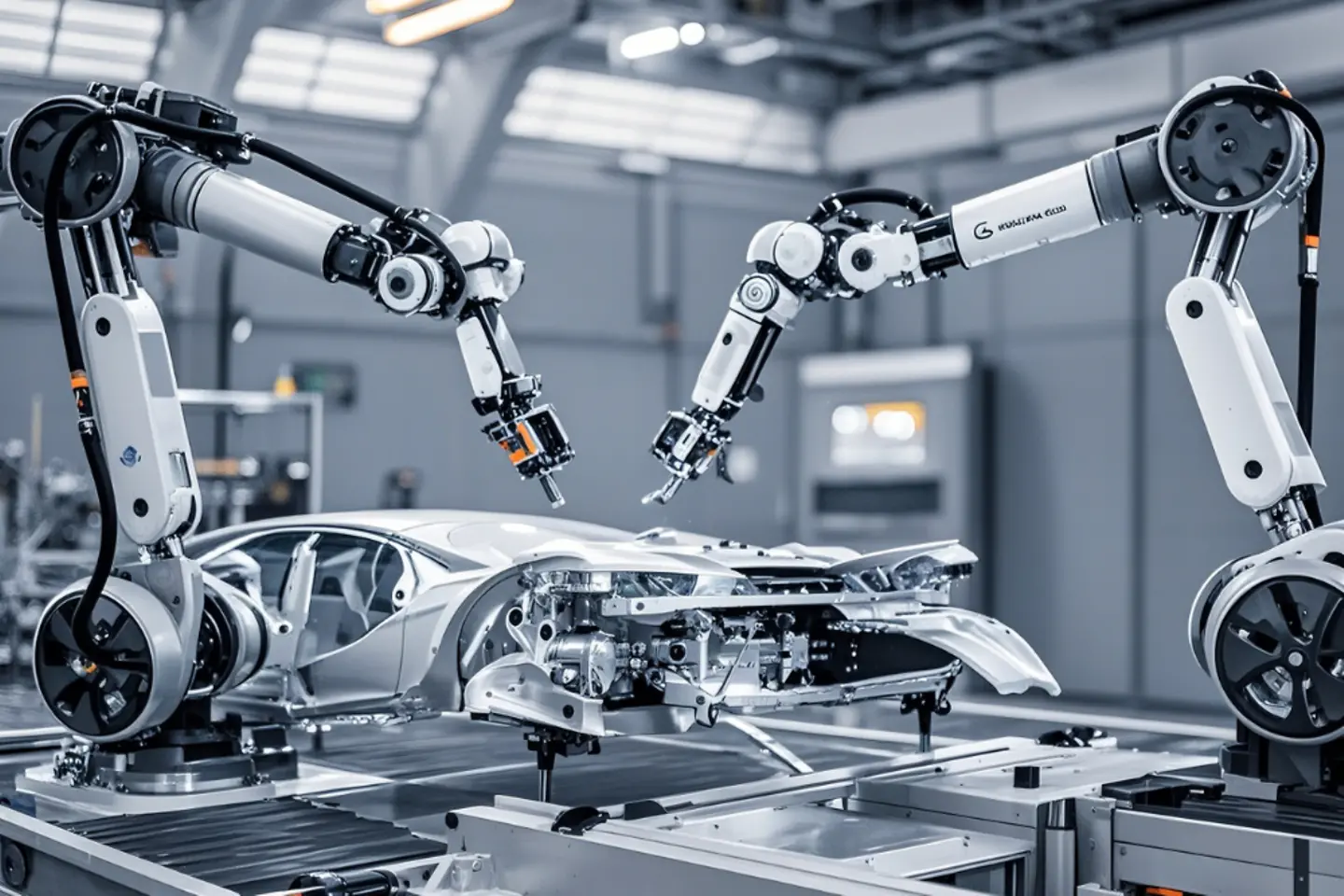
 Image generated with AI
Across the industry, companies are using AI to improve quality inspection, accelerate engineering workflows, optimize robot paths, and simulate production processes before they are deployed. Successful examples can be found in almost every segment of manufacturing, from automotive and electronics to consumer goods and logistics. Yet despite the growing number of proven use cases, relatively few organizations have managed to turn these successes into a repeatable operating model that extends beyond individual projects or sites.
A familiar pattern has emerged. An AI initiative delivers measurable results in a pilot environment, stakeholders gain confidence, and the business case becomes increasingly compelling. Momentum builds quickly until the conversation shifts from a single production line to an entire factory network, or from one successful use case to a broader rollout across regions and business units.
That shift often changes the nature of the challenge. Questions about model performance begin to share the stage with questions about deployment, governance, and operational consistency. Production environments differ from site to site, automation landscapes reflect years of technology decisions, and data structures are rarely as standardized as AI strategies assume. Conditions that can be carefully managed within a pilot environment become far more difficult to coordinate once AI is expected to operate across a large and diverse manufacturing organization.
Many discussions about Industrial AI still focus on the visible part of the stack. New models attract attention. New applications attract investment. New use cases generate headlines. Manufacturers, however, rarely struggle because they lack ideas for where AI could be applied. The more difficult question concerns how successful implementations become operational standards rather than isolated successes. A pilot proves that something can work under specific conditions. Enterprise adoption requires those conditions to be recreated consistently across different plants, teams, systems, and regulatory environments.
Control increasingly sits at the center of that challenge. Industrial companies have spent decades building, refining, and protecting the knowledge embedded in their production systems. Process parameters, engineering data, robot programs, quality information, and operational performance metrics represent far more than technical information. They capture how products are made, how quality is maintained, and how efficiency is achieved. As AI becomes more deeply integrated into manufacturing operations, questions around access, governance, and ownership naturally move into focus.
Many organizations discover that scaling AI raises questions that never surfaced during the pilot phase. Where should operational data be processed? Which AI services should have access to it? How can data remain under enterprise control while still enabling advanced AI capabilities? What happens when workloads need to move between cloud and edge environments? How can global standards be maintained while accommodating local operational requirements? Cloud architecture suddenly becomes part of the production conversation.
That shift reflects a broader change taking place across manufacturing. AI increasingly interacts with physical operations rather than pure digital workflows. Production environments introduce requirements that cannot be treated as secondary considerations. Data sovereignty, cybersecurity, compliance obligations, latency requirements, and operational resilience all influence how AI systems can be deployed and managed. Choices made at the infrastructure level directly affect the speed, flexibility, and scale at which organizations can operationalize AI.
For many manufacturers, the discussion therefore extends well beyond access to AI models. Long-term success depends on creating an environment where AI can be deployed confidently across multiple sites without compromising governance, performance, or control. Sovereign infrastructure, industrial-grade connectivity, and cloud-edge architectures have become strategic considerations because they address challenges that only appear once organizations move beyond experimentation.
The same pattern can be observed inside the production environment itself. Even when infrastructure and governance questions are resolved, scaling often remains difficult because industrial knowledge is still distributed across individual projects, sites, and engineering teams. Improvements achieved in one factory frequently remain local. Proven workflows are recreated elsewhere. Optimization efforts are repeated rather than reused.
The consequences are familiar to anyone responsible for large-scale automation programs. A successful deployment demonstrates what is possible in a specific environment, but each additional rollout still requires substantial engineering effort. Valuable know-how accumulates within teams and projects rather than becoming part of a shared operational capability. AI may accelerate individual activities, yet the organization continues to scale at the speed of its ability to transfer knowledge.
Manufacturers making the greatest progress are approaching the problem from a different angle. Rather than treating every deployment as a separate initiative, they are creating common environments where data, simulation, AI, and automation workflows can be developed, validated, and improved continuously. The objective is not simply to deploy AI more often. The objective is to ensure that every successful deployment makes the next one easier.
That shift reflects a broader transition currently underway across industrial operations. Automation is gradually evolving from a collection of individual projects into a software-defined capability. Knowledge becomes reusable. Improvements become portable. Proven approaches can be adapted and deployed across different environments without repeating the entire engineering process. The result is not only greater efficiency but also a fundamentally different way of scaling operational excellence.

Many manufacturers have already demonstrated that AI can improve industrial operations. The challenge now is creating the conditions that allow those improvements to be repeated across plants, production lines, and regions. That challenge extends beyond individual use cases and touches architecture, governance, infrastructure, and the way automation itself is managed.
Industrial AI has entered a phase where technological capability alone no longer determines success. Organizations that create lasting value are focusing on the foundations that allow successful outcomes to be replicated across sites, business units, and production networks. Infrastructure, governance, software-defined automation, and operational execution increasingly need to work together as part of a coherent strategy rather than as separate initiatives.
Competitive advantage rarely comes from a single successful pilot. Greater value emerges when improvements developed in one part of the organization can be transferred quickly and reliably across the entire operation. Manufacturers that solve that challenge will be better positioned to respond to changing market conditions, improve productivity, and continuously optimize existing assets without constantly starting from zero.
For a deeper look at platform architecture, infrastructure strategy, and data sovereignty requirements for Industrial AI, explore the joint Wandelbots and T-Systems whitepaper, Scaling Physical AI in Industrial Operations.