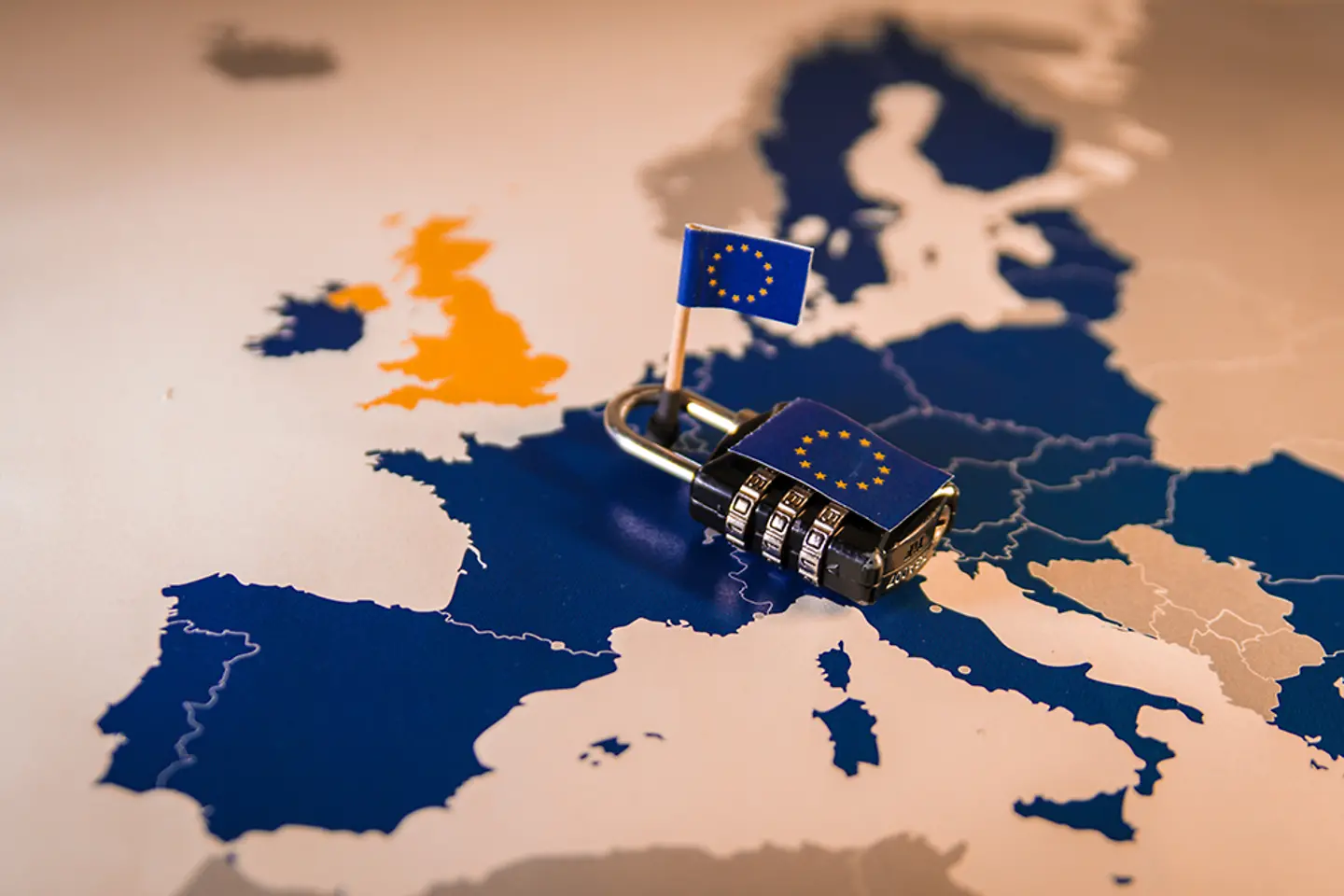
 Image generated with AI
In a cloud-first economy, data sovereignty is no longer only about storage location. It is about maintaining control over data, metadata, encryption keys, access paths, operational processes, infrastructure dependencies and provider relationships. T-Systems frames sovereignty as part of a broader digital foundation: organizations must control their digital technologies, infrastructure and data according to regional laws, values and strategic priorities. For business leaders, this makes data sovereignty a strategic enabler. It helps organizations use cloud, AI, analytics and data ecosystems without losing control over sensitive information, intellectual property, regulated workloads or mission-critical services.
Data sovereignty means your organization can prove where data is stored, who can access it, which laws apply, how it is protected and how it can be moved, deleted or reused. Sovereignty should not slow transformation. It should make transformation safer, more trusted and more resilient.
T-Systems helps enterprises, public-sector organizations and regulated industries combine cloud innovation with sovereignty. The cloud services portfolio spans sovereign cloud models across public, private, hybrid and hyperscaler-integrated environments, with T-Systems positioned as a provider capable of covering a broad sovereignty spectrum within one framework.
Data sovereignty matters because digital transformation now depends on external platforms, global cloud ecosystems and increasingly AI-driven data processing. These technologies create business value, but they also introduce new dependencies.
Organizations can become exposed to foreign legislation, unauthorized data access, provider lock-in, supply-chain disruption and unclear control over critical digital services. T-Systems emphasizes that digital sovereignty is becoming critical in a landscape shaped by cloud, AI and global technology ecosystems because organizations must maintain control over data, infrastructure and digital operations while meeting evolving regulatory requirements.
This is especially important in Europe, where data protection, digital autonomy and trust are deeply connected to public policy and economic strategy. Sovereign cloud adoption is rising because organizations want cloud scalability while keeping data local, supporting EU regulatory compliance and protecting against unwanted foreign access.
For enterprises, data sovereignty supports:
The key point is simple: sovereignty is not isolation. It controls participation in the digital economy.
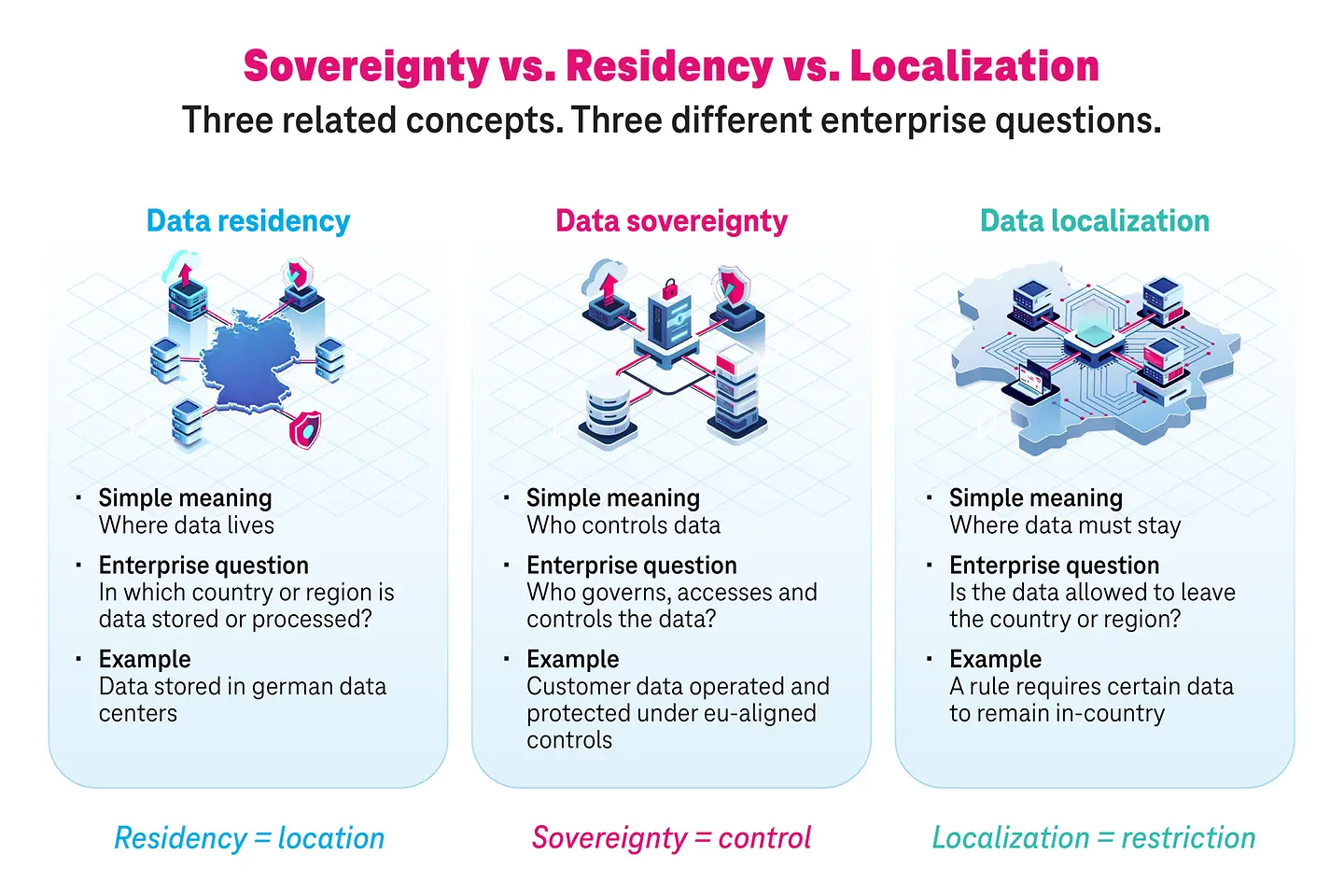
Data sovereignty, data residency and data localization are often used together, but they solve different problems.
| Concept | What it means | Enterprise question | Example |
| Data sovereignty | Legal, technical and operational control over data | Who governs, accesses and controls the data? | Customer data is stored, operated and protected under EU-aligned controls |
| Data residency | Where data is stored or processed | In which country or region does the data live? | Data is stored in German data centers |
| Data localization | A requirement that data must remain in a territory | Is the data allowed to leave the country or region? | A regulation requires certain data to remain in-country |
Data residency is about location.
Data sovereignty is about control.
Data localization is about restriction.
This distinction matters because data residency alone does not guarantee sovereignty. Data may be stored in Germany or the EU, but sovereignty risks can remain if administrative access, metadata, support processes, encryption keys or provider obligations are governed elsewhere.
T-Systems’ sovereign cloud narrative is built around this broader understanding: sovereignty is designed into architecture, operations, legal defensibility and security by design, not treated as a checkbox after deployment.
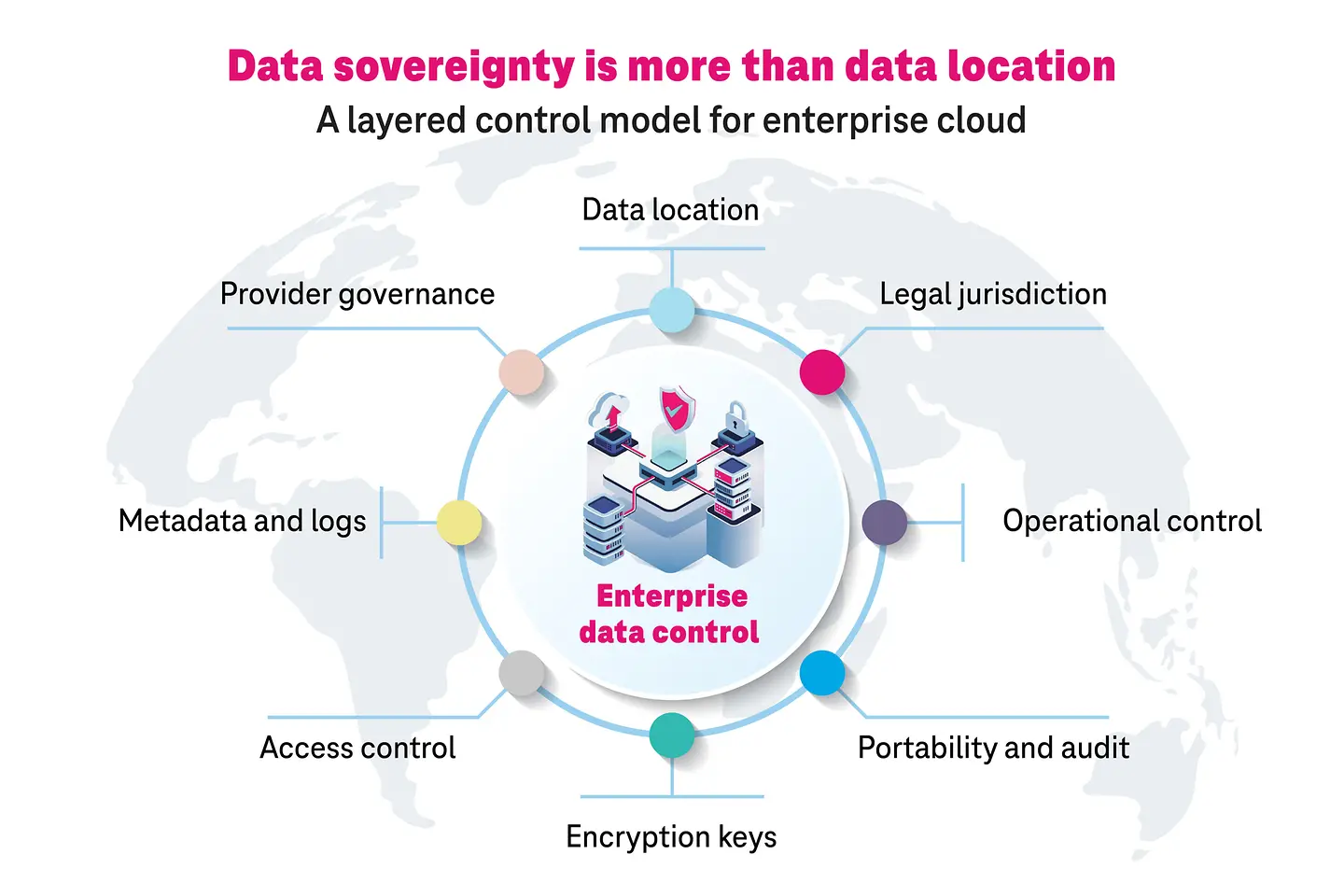
Data sovereignty works through a combination of legal, technical, operational and contractual safeguards.
A practical sovereignty model defines:
In a sovereign cloud environment, these controls are embedded into the cloud model. For example, T-Systems describes sovereign cloud as infrastructure tailored to comply with legal, operational and security requirements of specific national or regional jurisdictions
Data sovereignty starts with control over data itself. Organizations need to know where data lives, who can access it, how it is encrypted, which laws apply and whether third parties can compel access. T-Systems’ broader digital sovereignty messaging identifies data sovereignty as one of the key pillars of Europe’s sovereign digital future: full control over one’s own data.
Operational sovereignty means that critical infrastructure and cloud operations are controlled independently. It covers administration, support, monitoring, security operations, incident response and privileged access.
This matters because even if data is stored locally, operational access can create risk. A sovereign cloud strategy must therefore clarify who operates the infrastructure, where operations staff are located, and how access is approved, logged and audited.
Software or technological sovereignty reduces dependency on proprietary or non-European technology stacks. It supports flexibility, portability, open standards and independence from vendor lock-in.
The public cloud solution of T Cloud Public is built entirely on open-source technology and is positioned to provide full digital sovereignty, independence from non-European providers, geo-redundant data centers in Germany, confidential computing, and adherence to standards such as ISO 27001 and BSI C5.
Legal sovereignty focuses on which legal frameworks govern data and infrastructure. It helps organizations assess risks related to cross-border access, foreign legislation and contractual exposure.
Digital sovereignty is a broader strategic concept. It is the ability of governments, organizations and societies to control digital technologies, infrastructure and data according to regional laws, values and strategic priorities.
For enterprises, digital sovereignty means the ability to innovate with cloud and AI while maintaining resilience, compliance and strategic independence.
Digital sovereignty is the ability to make self-determined decisions in the digital world. It covers data, infrastructure, cloud platforms, software stacks, cybersecurity, AI, identity, operations and ecosystem participation.
T-Systems defines digital sovereignty as maintaining control over how digital technologies are deployed, where data is stored and processed, and who can access critical systems.
For enterprises, digital sovereignty is not about rejecting global technology. It is about using technology on controlled terms.
A digitally sovereign enterprise can:
T-Systems’ position is clear: sovereignty has become a foundation for secure digital transformation and resilient digital ecosystems.
AI changes the data sovereignty discussion. It is no longer enough to know where databases are stored. Organizations must also know where prompts, embeddings, training data, fine-tuning data, inference workloads, logs and model outputs are processed.
Sovereign AI means AI systems are developed, deployed and operated in a way that protects sensitive data, supports regulatory requirements and keeps organizations in control of models, infrastructure and data flows.
A sovereign AI strategy should answer:
T-Systems’ recent sovereignty messaging also connects digital sovereignty with AI infrastructure, noting that digital sovereignty includes data, legal, operational and technological sovereignty, while Deutsche Telekom’s Industrial AI Cloud is described as high-performance AI infrastructure operated in Munich for training and operating large AI models. AI-driven observability, automation, and intelligent operations are enhancing the next generation of managed services.
T-Systems has expanded its AI-enabled managed services portfolio, reinforcing its focus on delivering more resilient, scalable, and intelligent IT operations to customers globally.
For enterprises, the message is clear: AI sovereignty starts with data sovereignty.
Data residency means the location where data is physically or logically stored. In cloud environments, this usually means the selected cloud region, data center, availability zone or backup location. A simple definition is data residency describes where your data lives.
Data residency is important for GDPR, sector regulation, public-sector procurement, customer contracts and internal risk policies. However, residency is only one layer of sovereignty.
A workload can be hosted in Germany but still raise questions about:
This is why T-Systems’ sovereignty approach goes beyond “data center location” and focuses on data, operational, software and digital sovereignty.
Data localization means data must remain within a defined country, region or jurisdiction. It is usually driven by law, regulation, public-sector policy, customer contract or sector requirement. Simply put, data localization defines what data is allowed to do geographically.
Localization requirements may apply to:
Data localization is stricter than data residency. Residency can be a design choice. Localization is a binding requirement.
The difference is control. Data residency tells you where data is stored. Data sovereignty tells you whether the organization can control and prove how that data is governed, accessed, protected and processed.
For example: A German enterprise stores customer data in a Frankfurt cloud region. That supports data residency. The same enterprise restricts operational access to EU-based personnel, controls encryption keys, documents metadata flows, reviews subcontractors, automates audit evidence and defines an exit strategy. That supports data sovereignty. Residency can support sovereignty, but it does not guarantee it.
GDPR
The General Data Protection Regulation is the core EU framework for personal data protection. It applies to the processing of personal data and includes rules for protection of personal data inside and outside the EU. For sovereignty, GDPR is important because organizations must understand lawful processing, data transfers, processor obligations, security controls, accountability and data-subject rights.
Schrems II and international transfers
The Schrems II judgment increased scrutiny of international data transfers where foreign access laws may undermine EU-level protection. For cloud buyers, this makes transfer impact assessments, supplementary measures, encryption and provider transparency more important.
CLOUD Act
The U.S. CLOUD Act is often discussed in European sovereignty assessments because it can raise concerns about extraterritorial access to data held by providers subject to U.S. jurisdiction. Organizations using global providers often assess whether technical, contractual and operational controls can reduce this risk.
EU Data Act1
The EU Data Act applies since September 12, 2025. It complements the Data Governance Act and introduces rules related to data access, sharing, interoperability and data processing services, including cloud-related interoperability and switching requirements. For enterprises, this reinforces the sovereignty principle that data should remain portable and usable, not trapped in one provider ecosystem.
EU AI Act2
The EU AI Act applies progressively, with full roll-out foreseen by August 2, 2027. For sovereign AI, this matters because AI governance depends on controlled data, traceable processing, risk management, transparency and accountability.
BSI C53
The BSI Cloud Computing Compliance Criteria Catalogue specifies minimum requirements for secure cloud computing and is intended for cloud providers, auditors and customers. It helps customers evaluate cloud provider security. For German enterprises and public-sector organizations, BSI C5 is a key reference point in cloud assurance and sovereign cloud procurement.
DORA, NIS2 and sector-specific rules
Financial services, healthcare, public administration, energy, telecommunications and critical infrastructure face additional requirements around resilience, cybersecurity, incident reporting and third-party risk. The Open Sovereign Cloud page explicitly references regulatory requirements such as GDPR, DORA, NIS2 and gematik in common customer scenarios.
In Germany, data sovereignty is closely connected to trust, data privacy, cybersecurity, public-sector accountability, industrial competitiveness and digital independence.
As demand for sovereign cloud solutions continues to grow across Europe, providers such as Deutsche Telekom and T-Systems are expanding their offerings to address varying sovereignty requirements. Through its T Cloud portfolio, T-Systems delivers sovereign cloud services at different levels of sovereignty, enabling organizations to align cloud adoption with their regulatory, operational and strategic needs. Rather than relying on a single, closed ecosystem, T Cloud follows a multi-cloud approach, integrating hyperscaler platforms, Telekom-operated cloud infrastructures and specialized partner services into a unified ecosystem. This allows organizations to balance sovereignty, flexibility and innovation while maintaining greater control over their data and workloads.
German organizations often evaluate sovereignty through:
For German enterprises, data sovereignty is not only a legal issue. It is a strategic business priority that helps protect customer trust, safeguard industrial know-how, strengthen operational resilience and support long-term digital independence.
Healthcare: securing patient data
Healthcare organizations must balance innovation with strict data protection and compliance. Sovereign cloud makes this possible. University Hospital Schleswig-Holstein and Brain+ both use T Cloud Public to securely handle sensitive data while enabling scalability across markets.
Enterprise transformation
TDK migrated over 100 systems to T-Systems’ cloud without disruption, improving security, reliability, and cost efficiency, showing how T Cloud Private supports large-scale modernization. Software companies need scalable cloud solutions while managing risk, compliance, and resilience. Sovereign cloud enables innovation without losing operational control. For example, amber Tech GmbH uses amberSearch, hosted on T Cloud Public, to improve productivity while ensuring data sovereignty for regulated clients.
Automotive: controlled data ecosystems
Automotive firms depend on data across vehicles and systems. The Volkswagen Group Private Cloud, built on T Cloud Private, centralizes applications while keeping data within European regulatory boundaries.
Public sector: trusted digital services
Governments require transparency and legal control. T Cloud Public enables German authorities to access cloud and AI services securely under a standardized framework.
AI and compliance
Solutions like Legalian demonstrate how sovereign cloud supports AI in sensitive areas such as anti-money laundering, ensuring accountability and compliance.
Public transport: advancing digital sovereignty
Public transport systems can strengthen cybersecurity while increasing digital sovereignty—both goals can and should be pursued together. However, achieving this requires a clear, upfront assessment of sovereignty needs before implementation.
Industrial and education use cases
Confusing storage location with control
Many organizations believe that selecting a local cloud region solves sovereignty. It does not. Sovereignty also depends on operations, access, metadata, legal entity, support processes, encryption keys and auditability.
Fragmented regulation
Enterprises operate across countries, industries and data types. GDPR, BSI C5, DORA, NIS2, the EU Data Act, the EU AI Act and sector-specific requirements must be translated into practical architecture.
Provider dependency
Sovereignty is weakened when organizations cannot move workloads, understand provider dependencies or exit contracts without disruption. The EU Data Act’s4 cloud and data-processing service requirements make switching, interoperability and portability more important.
Operational access risk
Data may be stored locally, but support or administration can still create cross-border exposure. Operational sovereignty must therefore be built into provider selection and cloud design.
Metadata and logs
Metadata, telemetry, logs and support data may contain sensitive information. Sovereignty strategies must cover them, not only primary databases.
Lack of evidence
A policy is not enough. Enterprises need auditable proof: logs, control reports, access approvals, encryption status, data maps, contractual safeguards and incident-response documentation.
AI data leakage
AI introduces new data flows. Prompts, embeddings, retrieval systems and model outputs must be governed like other sensitive data assets.
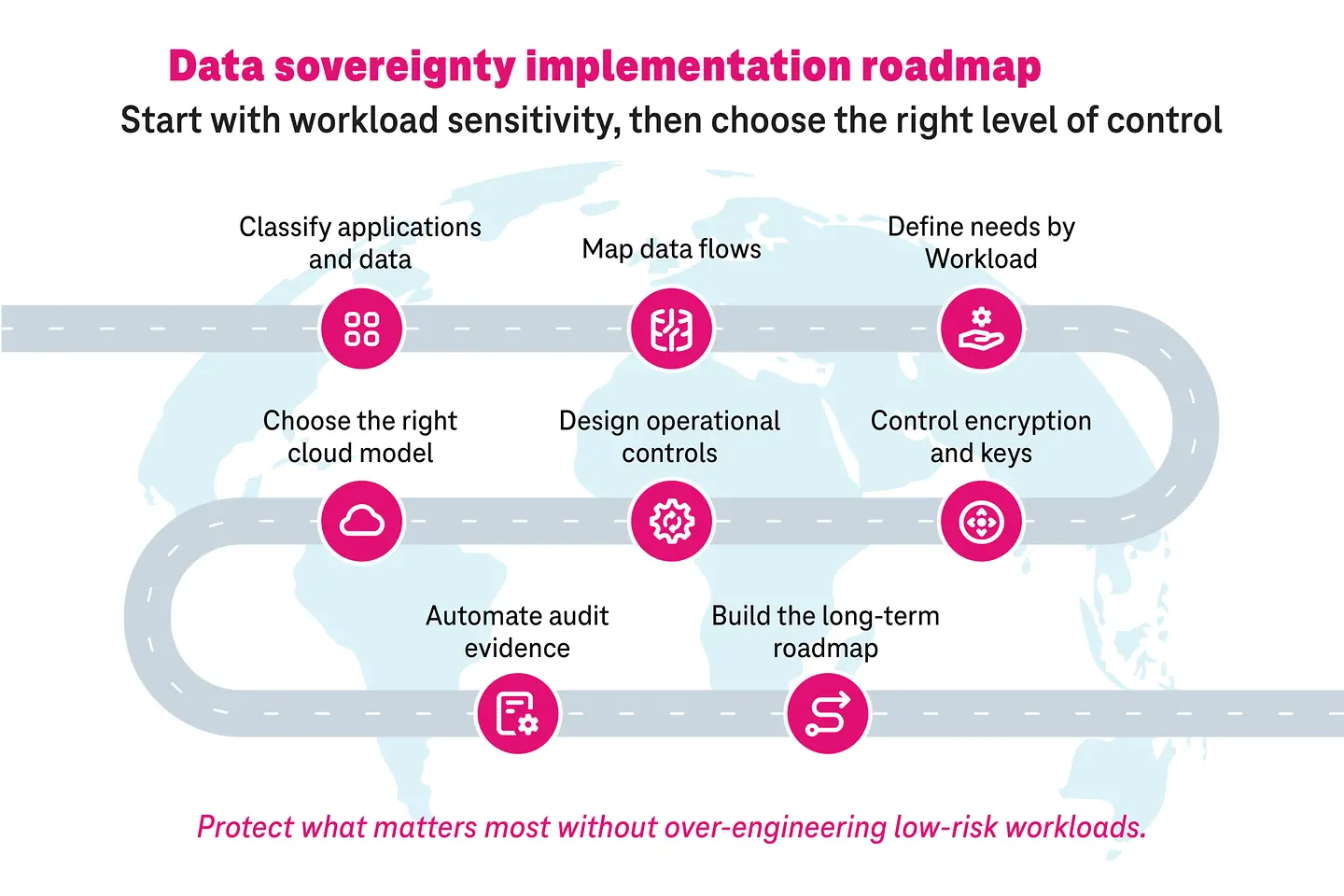
A practical implementation should start with business risk and workload sensitivity, not with a cloud product.
Step 1: Classify applications and data
Identify which applications are truly sensitive. T-Systems and Detecon emphasize that the application determines the level of sovereignty: not every use case needs the same sovereignty depth.
Classify data into:
Step 2: Map data flows
Document where data is collected, stored, processed, backed up, replicated, logged and transferred. Include SaaS platforms, APIs, analytics tools, AI services, data lakes, support systems and integration layers.
Step 3: Define sovereignty requirements by workload
Not all workloads need a fully isolated sovereign environment. Define whether each workload requires:
Step 4: Choose the right cloud model
Match workloads to the right model:
Step 5: Design operational controls
Define who can access systems, from where and under what approval process. Use privileged access management, least privilege, logging, segregation of duties and incident-response playbooks aligned to jurisdictional requirements.
Step 6: Control encryption and keys
Encryption is only sovereign if key control is sovereign. Decide whether keys are provider-managed, customer-managed or held externally. For highly sensitive workloads, evaluate domestic or customer-controlled key management.
Step 7: Automate audit evidence
Sovereignty must be provable. Automate reporting for region configuration, access logs, encryption state, backup location, data transfers, admin access and vendor attestations.
Step 8: Build a long-term roadmap
T-Systems and Detecon recommend embedding sovereign cloud solutions strategically, not as a full replacement, but as an addition where multi-cloud scenarios and different sovereignty levels are considered.
When getting cloud, data or AI infrastructure, enterprises should evaluate sovereignty across legal, operational, technical and commercial dimensions.
Jurisdiction
Data and metadata location
Operations
Security
Compliance
Portability
AI readiness
A strong vendor should help you prove sovereignty, not simply claim it.
You can display all external content on the website at this point.
I agree that personal data may be transmitted to third-party platforms. Read more about this in our privacy policy.
Managing sensitive data in today’s world requires the best sovereign cloud. Scalability, functionality, and sovereignty: choose the levels based on your needs. Explore our video to learn more about leading Sovereign Cloud solutions for Europe.
Use these questions before signing:
T-Systems’ value proposition is especially strong here because it does not position sovereignty as one fixed product. It offers a portfolio across public, private, hybrid and hyperscaler-integrated models, enabling enterprises to choose the right sovereignty level for each workload.
Checklist for choosing a data-sovereign cloud provider
Use this checklist as a practical buying guide:
A T-Systems-style sovereignty strategy starts with the workload. This avoids over-engineering low-risk workloads while protecting the systems that matter most.
| Workload type | Sovereignty need | Suitable model |
| Public websites, low-risk apps | Basic compliance and availability | T Cloud Public |
| Customer-facing business apps | Data residency and GDPR controls | T Cloud Public |
| Regulated business data | Data and operational sovereignty | Industrial AI Cloud |
| Healthcare, public sector, finance | Strong legal and operational control | Sovereign cloud or hosted sovereign cloud |
| Critical infrastructure | High operational independence | T Cloud Private |
| Sensitive AI workloads | Data, operational and technological control | Sovereign AI infrastructure or T Cloud Private |
Data sovereignty is also central to trusted data sharing. Modern enterprises need to share data with suppliers, customers, public institutions, research networks and ecosystem partners. But sharing data should not mean losing control over it. Data spaces support controlled data exchange by defining who can use data, for what purpose and under which rules. This is relevant for automotive, manufacturing, logistics, healthcare, energy and public-sector ecosystems. For T-Systems customers, this connects sovereignty with business value: data can be shared securely across ecosystems while preserving control, traceability and compliance.
Data sovereignty is often treated as a defensive compliance issue. But T-Systems’ point of view is broader: sovereignty strengthens resilience, trust and business continuity. T-Systems argues that digital sovereignty is no longer only a compliance task; it is a business advantage that helps leaders safeguard operations, build resilience and remain competitive in global markets.
A strong data sovereignty strategy helps organizations:
The goal is not to keep data locked away. The goal is to use data confidently, securely and on your own terms.
Data sovereignty means data is governed, accessed, stored and processed under the laws and control requirements that apply to it. It defines who can control the data and how that control is proven.
Data sovereignty means your organization keeps control over where data is stored, who can access it, which laws apply and how it is protected.
Data residency is about where data is stored. Data sovereignty is about who controls the data, who can access it, which laws apply and how the organization proves compliance.
Data sovereignty is the principle of control over data. Data localization is a rule or requirement that certain data must stay within a specific country or region.
No. Data residency can support GDPR compliance, but GDPR also requires lawful processing, security, transparency, accountability, data-subject rights and valid transfer safeguards.
Sovereign cloud is a cloud environment designed to meet national or regional legal, operational and security requirements. It helps organizations use cloud services while maintaining stronger control over data, infrastructure and operations.
Data sovereignty is the goal: control over data. Sovereign cloud is one way to achieve that goal through cloud architecture, local operations, security controls and compliance safeguards.
T-Systems’ sovereignty narrative commonly includes data sovereignty, operational sovereignty and technological or software sovereignty. Together, they support broader digital sovereignty.
Operational sovereignty means independent control over critical infrastructure and processes, including administration, support, monitoring, incident response and privileged access.
Software sovereignty means reducing dependency on closed or non-European software stacks through open standards, portability, open-source technologies and transparent architecture.
AI systems process prompts, training data, embeddings, model outputs and logs. Data sovereignty ensures these data flows are controlled, compliant and auditable.
A healthcare provider stores patient data in Germany, restricts access to authorized EU-based personnel, controls encryption keys, logs privileged access and uses a cloud provider with auditable security controls.
Enterprises can ensure data sovereignty by classifying data, mapping data flows, choosing the right cloud model, controlling access, managing encryption keys, auditing vendors and automating compliance evidence.
No. Data sovereignty is global. However, it is especially important in Europe because of GDPR, national cloud assurance frameworks, sector regulation and It is also about geo-political issues and freedom of choice.
1 Data Act explained, https://digital-strategy.ec.europa.eu/en/factpages/data-act-explained
2 Timeline for the Implementation of the EU AI Act, https://ai-act-service-desk.ec.europa.eu/en/ai-act/timeline/timeline-implementation-eu-ai-act
3 Cloud Computing Compliance Criteria Catalogue, https://www.bsi.bund.de/EN/Themen/Unternehmen-und-Organisationen/Informationen-und-Empfehlungen/Empfehlungen-nach-Angriffszielen/Cloud-Computing/Kriterienkatalog-C5/kriterienkatalog-c5_node.html
4 Data Act explained, https://digital-strategy.ec.europa.eu/en/factpages/data-act-explained