Intermodal Transport Control Systems (ITCS) form the digital backbone of many transport operators. As computer-aided operations control systems in public passenger transport, they connect the control center, vehicle tracking, operations management, and passenger information. New mobility offerings and rising demands for efficiency make one thing clear: the next generation of Intermodal Transport Control Systems must become more open and more interconnected.
Intermodal Transport Control Systems (ITCS) have evolved over the past decades from isolated, infrastructure-based solutions into central control units for public transport. While earlier computer-aided operations management systems relied primarily on analog and digital radio communication as well as simple positioning technologies such as centralized computer-aided location, the focus was on timetable monitoring, operational dispatching, and dynamic rerouting. Modern ITCS additionally connect passenger information, infrastructure, and other mobility services on a shared platform. This creates a seamless view of operations and the ability to coordinate processes across different modes of transport.
Control systems have continuously evolved over the past decades. Today, however, transport operators must deliver significantly more than simple vehicle tracking or timetable monitoring. Multimodal mobility offerings, real-time passenger information, and increasing requirements around data protection, IT security, and KRITIS are placing new demands on existing ITCS landscapes. Many historically grown systems, however, are based on monolithic architectures that can only be extended with considerable effort and frequently impede innovation.
Modern ITCS are increasingly evolving into central platforms for public transport. Data from vehicles, infrastructure, passenger information systems, and other applications are consolidated within a shared system landscape. This creates a continuous real-time view of operations. In addition to timetable, duty, and fleet management, modern platforms also support the dispatching of different modes of transport and transport companies in multi-client systems. Modern ITCS integrate buses, trains, and other mobility services into a shared platform, thereby laying the foundation for efficient operational control. Modern ITCS play a central role in the interplay between bus and rail services. They enable coordinated operational control across different modes of transport and create the basis for better connection assurance and greater punctuality in public transport. A control system thus evolves from a classic operational control system into a central integration, information, and control platform. The focus is no longer exclusively on individual dispatching, but on entire data chains and processes.
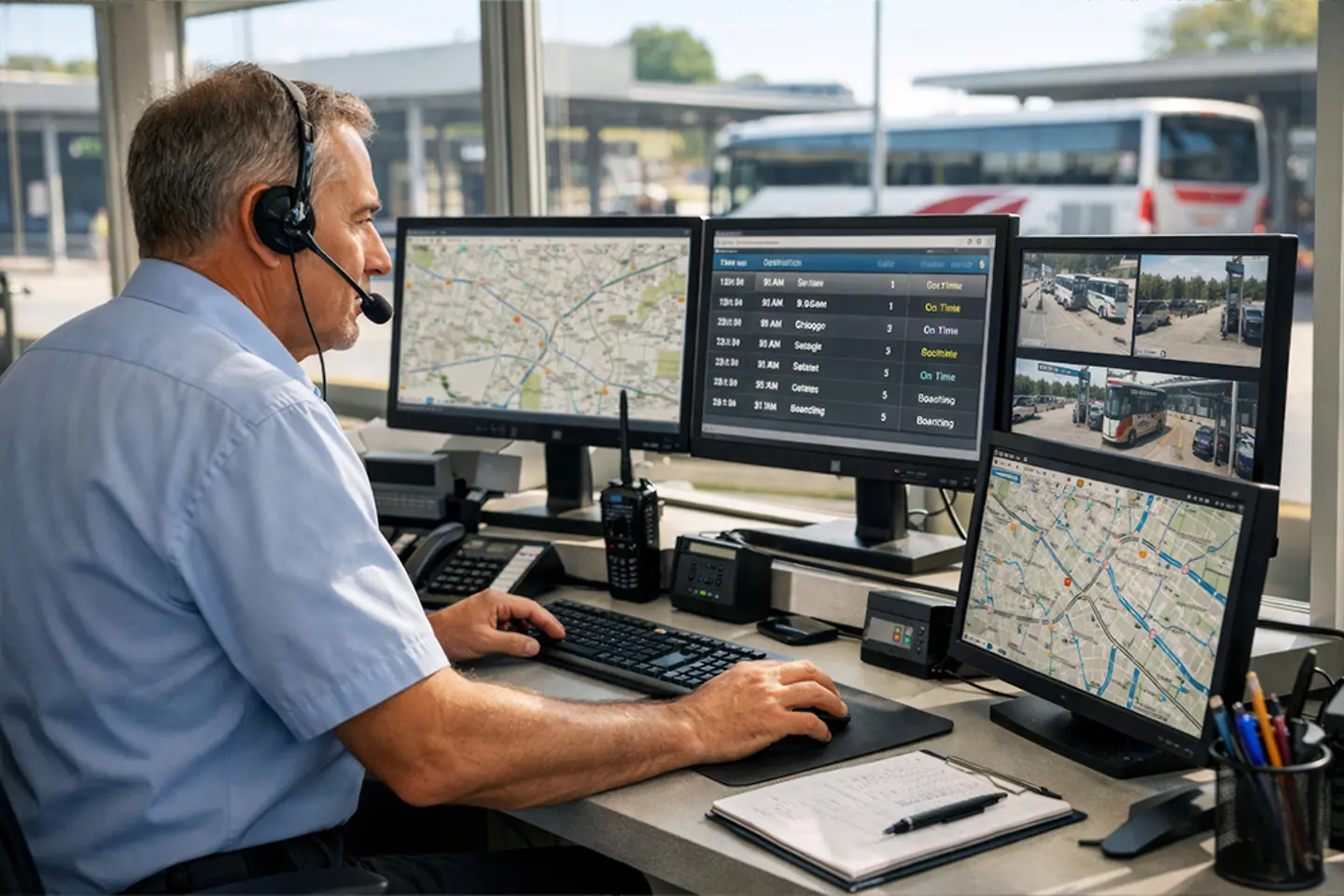
Modern ITCS support transport operators throughout the entire operational process. They capture vehicle positions in real time, assist the control center with dispatching measures, and provide up-to-date information for passengers. At the same time, they enable the coordination of bus and rail services via a shared platform. This makes operational processes more transparent, more efficient, and easier to plan. An important and essential core function of the system is provided by a central forecasting module that calculates overall forecasts based on specialized algorithms and machine learning methods. The forecasting calculation is connected to other modules via the central message broker. In the event of disruptions or delays, the ITCS supports the control center with up-to-date vehicle data and enables dispatching measures in real time. This allows connections to be secured, rotations to be adjusted, and passenger information systems to be automatically updated as data hubs via the existing interfaces.
The ability to process large volumes of data in real time is becoming increasingly important for modern ITCS. Information from vehicles and infrastructure forms the basis for operational decisions and more precise operational control. A so-called message broker plays a central role in this architecture. It acts as a link between the various system components and ensures the reliable, scalable, and decoupled distribution of real-time data. Vehicles, control centers, infrastructure components, and external systems can exchange data in real time via the message broker without being directly coupled to one another. This enables the flexible integration of new modules as well as a robust system architecture.
The information provided via the message broker is processed in various applications and passed on to passengers via standardized interfaces—e.g., VDV interfaces. Passengers receive up-to-date information on arrivals, departures, connections, and disruptions along their entire journey chain.
A decisive success factor for modern control systems is a strong and open partner ecosystem that views the use of open standards as an opportunity. No single provider can comprehensively and optimally address the growing complexity on its own. The collaboration of technology partners, integrators, and innovative start-ups enables a flexible, future-proof, and high-performance overall solution. A particularly central role falls to the operator: they are not merely a user, but an active innovation partner. Through their operational experience, they contribute valuable input for further development, define practice-oriented requirements, and play a key role in driving the introduction of new functions. Open standards and clearly defined interfaces ensure interoperability, foster innovation, and reduce dependencies. The result is a dynamic ecosystem in which expertise is pooled, new technologies are integrated more quickly, and control systems can be continuously developed further.
The future of modern ITCS clearly lies in open and interoperable architectures. Standardized interfaces enable the integration of different manufacturers and applications. At the heart of modern platforms are message broker technologies and APIs that ensure data exchange between vehicles, infrastructure, and backend systems. Open standards such as VDV 435 or ITxPT provide the foundation for long-term investment security and the flexible further development of existing ITCS landscapes.
The introduction of modern ITCS is typically carried out in stages. Transport operators must integrate existing control systems, passenger information systems, and other applications into the new architecture. Open standards such as VDV 435 or ITxPT facilitate this transition and lay the foundation for gradual modernization. This allows existing investments to be protected while simultaneously introducing new functions and digital services. This approach reduces project risks and increases acceptance within the organization.
ITCS are undergoing a transformation: from isolated, monolithic, functional systems to open, data-driven platforms. Operators face the challenge of modernizing existing systems while simultaneously meeting new requirements. The strategic further development of ITCS should therefore be based on interoperability, modularity, and scalability; with the integration of multimodal services and the use of open standard interfaces playing a central role in the transformation.
Modernizing ITCS requires experience in integrating complex system landscapes as well as in operating critical infrastructures. As a long-standing digitalization partner of transportation and infrastructure companies, T-Systems supports transit operators in building open platform architectures, integrating existing specialist applications, and introducing modern cloud and data platforms. This is complemented by DevOps-as-a-Service and AI-based services for optimizing operational and planning processes.
An Intermodal Transport Control System (ITCS) is a computer-based operations control system for local public transport. It connects the control center, vehicles, infrastructure, and passenger information systems on a shared platform. By processing real-time data, an ITCS supports vehicle tracking, operational control, and dispatching, while simultaneously providing up-to-date passenger information across various channels.
Modern Intermodal Transport Control Systems help transport operators make operational processes more efficient and respond more quickly to disruptions or delays. Real-time data enables better operational control, supports dispatching measures in the control center, and improves transparency during ongoing operations. At the same time, passengers benefit from more precise information and a higher quality of service.
An Intermodal Transport Control System provides current operational data in real time, supplying digital displays at stops, information systems in vehicles, and mobile apps. Passengers receive up-to-date information on departure times, connections, and possible disruptions. This dynamic passenger information increases transparency and improves the travel experience in public transport.
Open standards provide the foundation for interoperable and future-proof ITCS landscapes. Standards such as VDV 435 or ITxPT enable the integration of different systems, vehicles, and manufacturers via uniform interfaces. This allows transport operators to modernize existing solutions step by step, connect new applications more easily, and reduce dependencies on individual vendors. At the same time, open standards facilitate the introduction of new mobility offerings and foster innovation in public transport.